
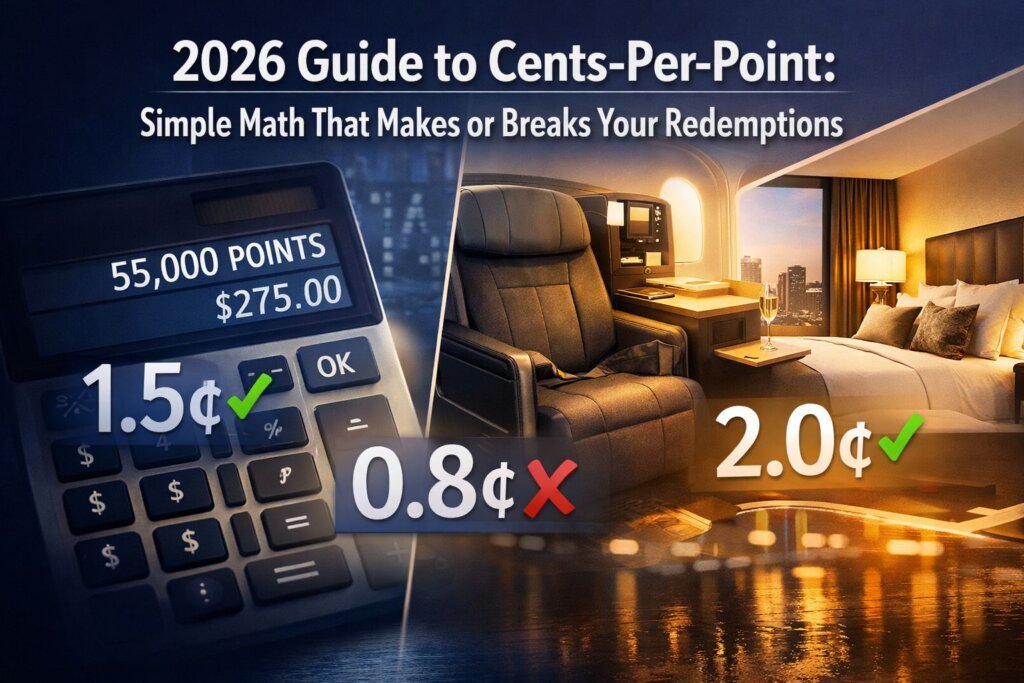
You’ve earned 200,000 Chase Ultimate Rewards points. A roundtrip business class ticket to Paris costs 80,000 points—or $2,400 in cash. Should you transfer and book? The answer depends on a single number: cents per point (CPP). This 2026 guide to cents-per-point will teach you the simple formula that separates smart redemptions from point-wasting mistakes, even as dynamic pricing reshapes award travel.
Most travelers know their balances but freeze when it’s time to redeem. Without a clear valuation method, you’re flying blind—sometimes burning 50,000 points on a flight you could’ve bought for $300 cash, other times passing up genuine sweet spots worth 2+ cents per point. The math itself takes 30 seconds. The confidence it builds lasts for every future booking.
Key Takeaways
- The CPP formula is simple: (Cash price – taxes/fees) ÷ points required = cents per point
- Benchmark targets for 2026: Aim for 1.5¢+ on flexible points, 1.0¢+ on airline miles, 0.5¢+ on hotel points
- Dynamic pricing doesn’t break the math—it just means you calculate CPP before every transfer
- Use Award Travel Hub calculators to compare cash vs. points across multiple programs before committing
- Personal value matters: A 1.4¢ redemption on your preferred routing can beat a 1.8¢ option with two connections
Why Understanding Cents-Per-Point Is Essential in 2026
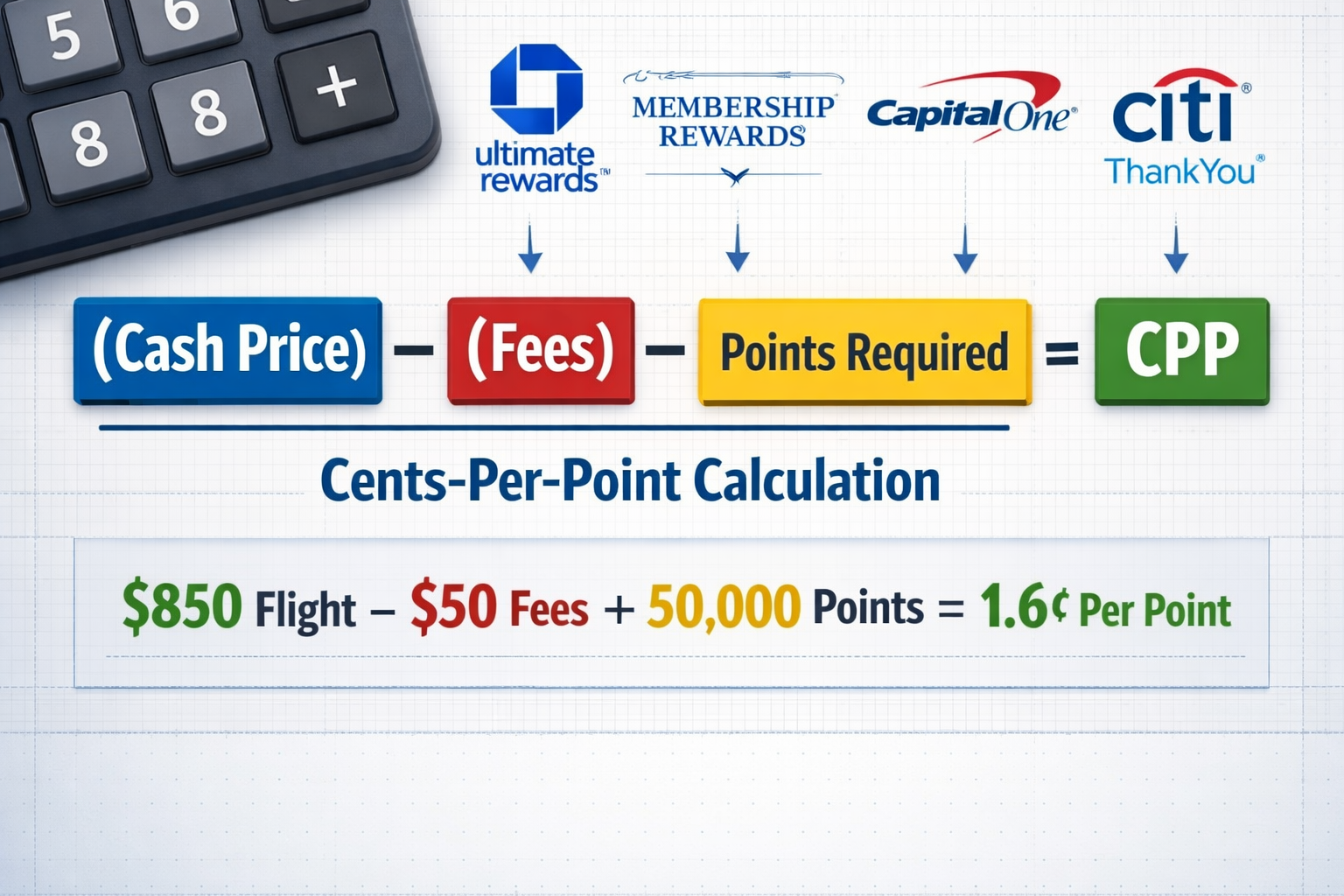
Award travel has changed. Fixed award charts are disappearing. Dynamic pricing now governs most major programs—United MileagePlus, Delta SkyMiles, Marriott Bonvoy, and Hilton Honors all price awards based on cash rates rather than static charts. That shift makes cents-per-point analysis more important, not less.
Here’s why CPP matters now:
- Dynamic pricing creates wild swings. The same route might cost 30,000 points one day and 90,000 the next. CPP tells you instantly whether today’s price is worth it.
- Transfer bonuses complicate decisions. A 30% bonus sounds great—but if the base redemption delivers 0.7¢ per point, you’re still losing value compared to cash.
- Devaluation risk is real. Programs change overnight. Calculating CPP before transferring protects you from locking points into a poor-value currency.
- Opportunity cost adds up. Every point redeemed at 0.8¢ is a point you didn’t save for a 2.0¢ business class redemption.
Without CPP analysis, you’re guessing. With it, you’re making data-driven decisions that maximize points across every redemption.
The Shift from Fixed Charts to Value-Based Thinking
A decade ago, travelers memorized award charts. “United Saver to Europe: 60,000 miles roundtrip.” Those days are fading. In 2026, the question isn’t “What does the chart say?” but “What value am I getting today?”
This 2026 guide to cents-per-point equips you to answer that question in 30 seconds, every single time.
The Simple Formula for Valuing Any Redemption
The cents-per-point formula is straightforward:
(Cash Price – Out-of-Pocket Fees) ÷ Points Required = Cents Per Point (CPP)
That’s it. Three inputs, one output. Let’s break down each component.
Step 1: Find the Cash Price
Search the same flight or hotel room using the airline or hotel’s website in “cash mode.” Note the total price including taxes and fees. This is your baseline.
Important: Use the exact same itinerary—same dates, same cabin, same fare class if possible. Comparing a refundable cash fare to a non-refundable award isn’t apples-to-apples.
Step 2: Subtract Out-of-Pocket Fees
Award tickets aren’t free. You’ll pay taxes, carrier surcharges, and booking fees. Subtract these from the cash price to isolate the value delivered by your points.
Example:
- Cash price: $1,200
- Award ticket out-of-pocket fees: $150
- Value delivered by points: $1,200 – $150 = $1,050
Step 3: Divide by Points Required
Take the value delivered by points and divide by the number of points you’ll redeem.
Example continued:
- Value delivered: $1,050
- Points required: 70,000
- CPP: $1,050 ÷ 70,000 = 1.5 cents per point
Real-World Calculation Walkthrough
Let’s apply this to a realistic scenario:
Booking: Round-trip Business Class, New York (JFK) to Tokyo (NRT) on ANA via Virgin Atlantic Flying Club
- Cash price: $4,800
- Award cost: 90,000 Virgin Atlantic miles (transferred from Chase, Amex, Capital One, Citi, or Bilt)
- Out-of-pocket fees: $180 in taxes and fuel surcharges
CPP calculation:
($4,800 – $180) ÷ 90,000 = $4,620 ÷ 90,000 = 5.13 cents per point
That’s an exceptional redemption—more than 3x the baseline value of flexible points.
Benchmarks for Major Airline, Hotel, and Bank Currencies in 2026
Not all points are created equal. Each currency has different earning rates, transfer partners, and redemption options. Here are the 2026 benchmark targets for common programs.
Flexible Points (Chase, Amex, Capital One, Citi, Bilt)
| Program | Baseline Value | Good Redemption | Excellent Redemption |
|---|---|---|---|
| Chase Ultimate Rewards | 1.25–1.5¢ | 1.5–2.0¢ | 2.0¢+ |
| Amex Membership Rewards | 1.0–1.25¢ | 1.5–2.0¢ | 2.0¢+ |
| Capital One Miles | 1.0¢ | 1.5–2.0¢ | 2.0¢+ |
| Citi ThankYou Points | 1.0–1.25¢ | 1.5–2.0¢ | 2.0¢+ |
| Bilt Rewards | 1.0¢ | 1.5–2.0¢ | 2.0¢+ |
Why the range? These currencies can be transferred to multiple airline and hotel partners. A Chase point transferred to United might deliver 1.2¢; the same point transferred to Hyatt might deliver 2.0¢. Your goal: consistently hit 1.5¢+ per point on transfers.
Airline Miles
| Program | Baseline Value | Good Redemption | Sweet Spots |
|---|---|---|---|
| United MileagePlus | 1.0–1.2¢ | 1.3–1.8¢ | Saver awards, partner business class |
| American AAdvantage | 1.0–1.2¢ | 1.3–2.0¢ | Off-peak awards, partner business |
| Delta SkyMiles | 0.9–1.1¢ | 1.2–1.6¢ | Flash sales, partner redemptions |
| Alaska Mileage Plan | 1.2–1.5¢ | 1.5–2.5¢ | Partner business/first (JAL, Cathay) |
| Avianca LifeMiles | 1.2–1.5¢ | 1.5–2.5¢ | Star Alliance business class |
Rule of thumb: Aim for 1.0¢+ on airline miles. Anything below signals you should consider cash or a different program.
Hotel Points
| Program | Baseline Value | Good Redemption | Peak Value |
|---|---|---|---|
| World of Hyatt | 1.5–2.0¢ | 2.0–3.0¢ | Luxury properties, peak dates |
| Marriott Bonvoy | 0.7–0.9¢ | 0.9–1.2¢ | Category 5+ properties |
| Hilton Honors | 0.4–0.6¢ | 0.6–0.8¢ | Fifth-night-free bookings |
| IHG One Rewards | 0.5–0.7¢ | 0.7–1.0¢ | High-category properties |
Hotel points are trickier. Cash rates fluctuate wildly. A Hyatt property might deliver 2.5¢ per point on New Year’s Eve and 0.9¢ in February. Always calculate CPP for the specific dates you’re booking.
Common Mistakes: Benchmark Traps
❌ Assuming all redemptions should hit 2.0¢+. That’s unrealistic for most domestic economy flights.
❌ Ignoring out-of-pocket fees. Airline fuel surcharges can destroy CPP on British Airways or Lufthansa awards.
❌ Comparing dynamic pricing to old fixed-chart values. The “good old days” are gone. Evaluate today’s redemption on today’s terms.
Real-World Examples: Good vs. Bad Redemptions Side by Side
Theory is helpful. Examples are better. Below are four realistic scenarios—two strong redemptions and two you should avoid.
✅ Example 1: Domestic Economy (Decent Value)
Route: Los Angeles (LAX) to New York (JFK), nonstop, economy
Cash price: $350
Award cost: 21,000 United miles
Out-of-pocket fees: $11.20
CPP: ($350 – $11.20) ÷ 21,000 = 1.61¢ per point
Verdict: Solid. Domestic economy rarely delivers 2.0¢+, but 1.6¢ beats the baseline and frees up cash for other expenses.
❌ Example 2: Domestic Economy (Poor Value)
Route: Chicago (ORD) to Denver (DEN), nonstop, economy
Cash price: $180
Award cost: 25,000 Delta SkyMiles
Out-of-pocket fees: $11.20
CPP: ($180 – $11.20) ÷ 25,000 = 0.68¢ per point
Verdict: Bad. You’re getting less than 0.7¢ per mile. Pay cash or wait for better availability. Delta’s dynamic pricing often inflates award costs on cheap cash fares.
✅ Example 3: International Business Class (Excellent Value)
Route: San Francisco (SFO) to Paris (CDG), business class on Air France
Cash price: $5,200
Award cost: 77,000 Air France-KLM Flying Blue miles (transferred from Chase, Amex, Capital One, or Citi)
Out-of-pocket fees: $220
CPP: ($5,200 – $220) ÷ 77,000 = 6.47¢ per point
Verdict: Outstanding. This is exactly what flexible points are for—premium cabin redemptions that deliver 4–6x baseline value.
❌ Example 4: Hotel Points (Mediocre Value)
Property: Marriott Category 5 hotel, off-peak weeknight
Cash price: $210
Award cost: 35,000 Marriott Bonvoy points
Out-of-pocket fees: $0
CPP: $210 ÷ 35,000 = 0.60¢ per point
Verdict: Below target. Marriott points typically deliver 0.7–0.9¢. At 0.6¢, you’re better off paying cash or transferring Amex/Chase points to Hyatt for a comparable property at a higher CPP.
Key Insight: Context Matters
A 1.4¢ redemption on a nonstop flight with your preferred airline might beat a 1.8¢ option requiring two connections and 14 hours of travel. CPP is a decision tool, not a rigid rule. Use it to compare options, then factor in convenience, routing, and personal preferences.
How Dynamic Pricing Changes—But Doesn’t Break—the Math
Dynamic pricing scared many travelers when it rolled out across United, Delta, and major hotel chains. The fear: “If there’s no award chart, how do I know if I’m getting a good deal?”
Answer: You calculate CPP every single time before booking or transferring.
What Dynamic Pricing Actually Means
Dynamic pricing ties award costs to cash fares. When cash prices rise, award costs rise as well. When cash prices drop, award costs sometimes drop (though not always proportionally).
The upside:
- Award availability often improves (more seats, more dates)
- Occasional “sweet spots” appear when cash prices spike, but award costs lag
The downside:
- Predictability disappears
- Transfer bonuses become less valuable if base redemptions are already inflated
- Devaluation risk increases as programs adjust algorithms
The 2026 CPP Workflow for Dynamic Pricing
- Search for award availability in the loyalty program.
- Note the points required and out-of-pocket fees.
- Search the same itinerary in cash mode.
- Calculate CPP using the formula.
- Compare to your benchmark (1.5¢+ for flexible points, 1.0¢+ for airline miles).
- Decide: Book, wait, or use cash.
This process takes 2–3 minutes. It’s the difference between a smart redemption and a regrettable transfer.
Example: Dynamic Pricing in Action
Scenario: You’re booking a Hilton hotel for a weekend in Miami.
- Friday night: 60,000 Hilton points or $420 cash → CPP = 0.70¢ (good for Hilton)
- Saturday night: 95,000 Hilton points or $480 cash → CPP = 0.51¢ (poor)
Decision framework: Book Friday with points, pay cash for Saturday. You just saved $420 and avoided burning points at 0.5¢ each.
Using Award Travel Hub Calculators to Sanity-Check Your Next Transfer or Booking
Manual CPP calculations work, but they’re tedious when comparing multiple programs. Award Travel Hub’s calculators automate the math and surface the best options instantly.
What the Calculators Do
- Compare CPP across programs: Input your route and see United, Delta, Air France, and partner options side by side.
- Factor in transfer bonuses: Automatically adjust CPP when Chase offers 30% bonus to Virgin Atlantic.
- Include fees and surcharges: Display total out-of-pocket costs upfront.
- Highlight sweet spots: Flag redemptions delivering 2.0¢+ per point.
Step-by-Step: Using ATH Calculators
- Enter your route (origin, destination, dates, cabin class).
- Select your points currency (Chase UR, Amex MR, etc.).
- Review results: The calculator displays cash price, award cost, CPP, and out-of-pocket fees for every transfer partner.
- Filter by CPP: Sort results to see the highest-value options first.
- Transfer confidently: You’ve done the math; now execute.
Pro tip: Bookmark the calculator and check it before transferring points. Transfers are usually instant and irreversible. Once you move 80,000 Chase points to United, you can’t get them back if you find a better Virgin Atlantic option five minutes later.
Real-World Calculator Win
A traveler searched for business class from New York to Tokyo. The calculator showed:
- United MileagePlus: 80,000 miles, $120 fees → 1.52¢ CPP
- ANA via Virgin Atlantic: 90,000 miles, $180 fees → 1.69¢ CPP
- ANA via Avianca LifeMiles: 88,000 miles, $180 fees → 1.74¢ CPP
Without the calculator, they might’ve defaulted to United (it’s familiar). Instead, they transferred to Avianca and gained 15% more value per point.
For more on maximizing your points through strategic transfers, explore transfer partner guides and booking strategy resources.
A Quick Decision Framework for Your Future Redemptions
You’ve learned the formula, reviewed benchmarks, and seen examples. Now, here’s a step-by-step decision framework to apply on your next booking.
The 5-Minute CPP Decision Tree
Step 1: Identify your goal.
Are you booking a specific trip (fixed dates) or exploring options (flexible)?
Step 2: Search award availability.
Use the airline or hotel’s website, or a tool like Award Travel Hub’s search engine.
Step 3: Calculate CPP.
(Cash price – fees) ÷ points = CPP.
Step 4: Compare to benchmarks.
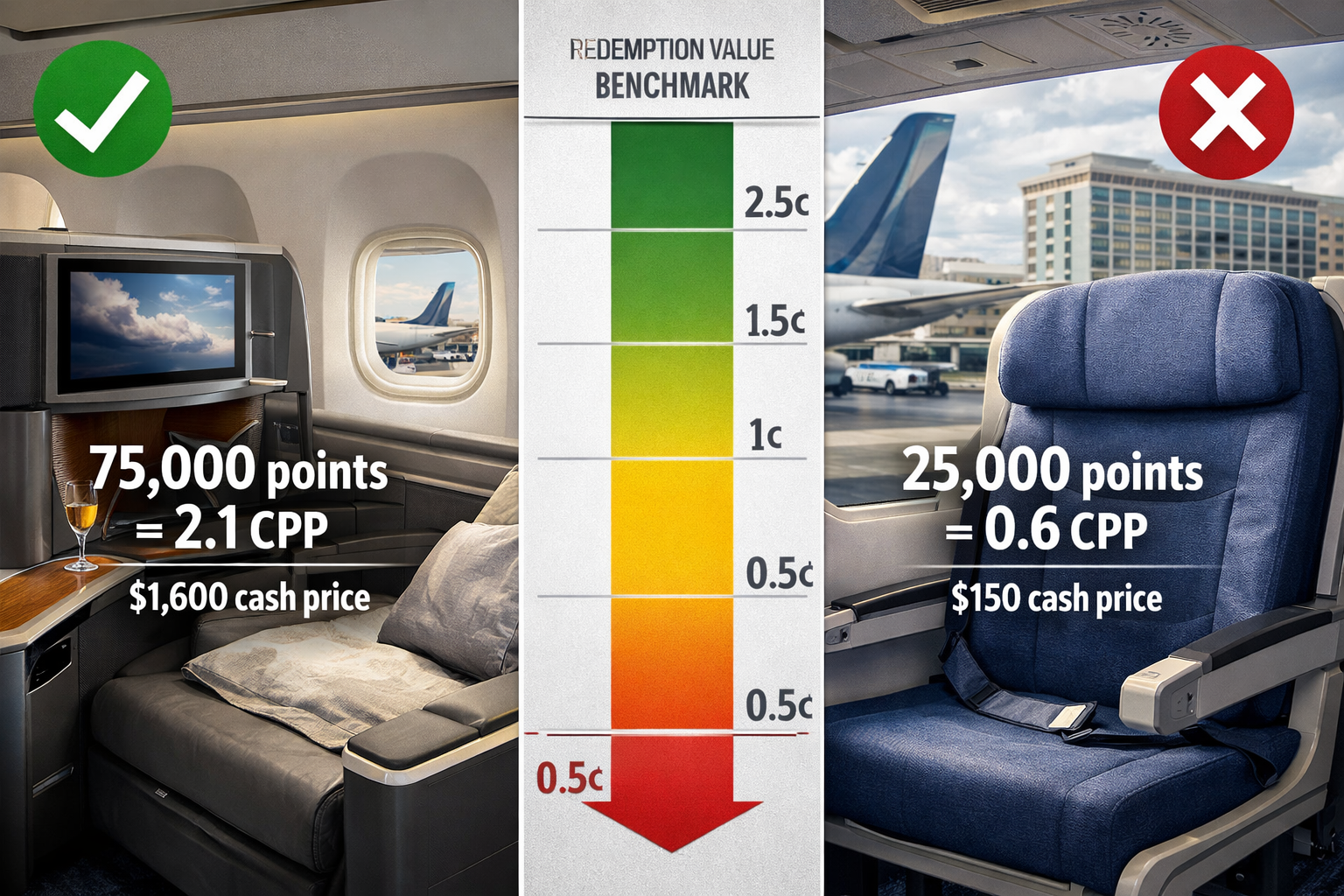
- 2.0¢+: Book immediately. This is excellent.
- 1.5–2.0¢: Strong value. Book unless you have a better option lined up.
- 1.0–1.5¢: Acceptable for airline miles or domestic economy. Marginal for flexible points—consider waiting.
- Below 1.0¢: Avoid. Pay cash or search alternative programs.
Step 5: Factor in personal value.
Does this redemption align with your travel priorities (nonstop routing, preferred airline, lie-flat seat)? A 1.4¢ redemption that saves 10 hours of layovers might beat a 1.7¢ option with three connections.
Step 6: Execute or wait.
If CPP hits your target and the booking fits your needs, transfer and book. If not, set alerts and wait for better availability or a transfer bonus.
When to Override the Math
CPP is a guide, not a gospel. Override the numbers when:
- Award availability is scarce. If this is the last business class seat to your destination during peak season, 1.3¢ might be your best option.
- Cash flow is tight. Redeeming points at 1.2¢ per point frees up $1,500 in cash for other expenses.
- You’re sitting on expiring points. Better to redeem at 1.0¢ than lose the points entirely. (Learn more about preventing points expiry.)
Common Mistakes to Avoid
❌ Transferring before calculating CPP. Always run the math first.
❌ Ignoring transfer bonuses. A 30% bonus can turn a 1.2¢ redemption into 1.56¢.
❌ Forgetting about surcharges. British Airways and Lufthansa awards can carry $400+ in fuel surcharges, tanking your CPP.
❌ Chasing perfection. Waiting for 3.0¢ redemptions means you’ll never redeem. Aim for consistent 1.5–2.0¢ wins.
For additional context on avoiding common award travel mistakes, review beginner-friendly strategy guides.
Advanced Tips: Transfer Bonuses, Stopovers, and Opportunity Cost
Once you’ve mastered basic CPP analysis, these advanced tactics unlock even more value.
Transfer Bonuses: The CPP Multiplier
Transfer bonuses—typically 15–30%—effectively boost your CPP. Here’s how:
Base redemption: 80,000 points → $1,280 value → 1.6¢ CPP
With 30% bonus: 61,538 points → $1,280 value → 2.08¢ CPP
Key insight: Transfer bonuses make marginal redemptions worthwhile. A 1.3¢ base redemption becomes 1.69¢ with a 30% bonus—crossing into “good” territory.
Where to find bonuses:
- Chase, Amex, Capital One, and Citi run rotating promotions (usually 15–30% to select partners).
- Sign up for Award Travel Hub email alerts to catch bonuses the day they launch.
Stopovers and Open-Jaws: Hidden CPP Wins
Some programs let you add a free stopover or open-jaw, effectively booking two trips for one award.
Example: Fly San Francisco → Tokyo (5 days) → Bangkok → San Francisco for the same 80,000 miles as a simple roundtrip. You’ve just doubled your CPP by adding a second destination.
Programs with stopover perks:
- Air Canada Aeroplan: Free stopover on one-way awards
- Alaska Mileage Plan: Free stopover on roundtrip awards
- United MileagePlus: Excursionist Perk (free one-way within a region)
Opportunity Cost: The Hidden CPP Factor
Every point redeemed at 1.0¢ is a point you didn’t save for a 2.5¢ business class redemption. This is an opportunity cost.
Framework:
- Hoard for aspirational trips? Only redeem at 2.0¢+.
- Balance aspirational and practical? Redeem at 1.5¢+ for premium cabins, 1.2¢+ for domestic economy.
- Maximize flexibility? Redeem at 1.0¢+ and earn more points through strategic credit card use.
There’s no single right answer—just the answer that fits your travel goals.
CPP and the Future: What to Watch in 2026 and Beyond
Award travel evolves constantly. Here’s what to monitor as you apply this 2026 guide to cents-per-point throughout the year.
Devaluation Risk
Programs devalue without warning. In 2025, several major airlines increased award costs by 10–20% overnight. CPP analysis protects you: if a program’s redemptions consistently fall below 1.0¢, it’s time to diversify your points portfolio.
Dynamic Pricing Expansion
Expect more programs to adopt dynamic pricing. Fixed award charts are nearly extinct. The good news: CPP analysis works better in a dynamic environment because it forces you to evaluate every redemption individually.
Transfer Partner Changes
Banks regularly add and remove transfer partners. Stay updated on new partnerships—they often launch with transfer bonuses and create short-term sweet spots.
AI and Automation
Tools like AI-powered reward optimization are emerging. These platforms calculate CPP across dozens of programs simultaneously, surfacing the best redemptions in seconds.
Predictions for 2026
- More transfer bonuses as banks compete for engagement
- Increased award availability on off-peak dates (but higher costs on peak dates)
- Greater CPP variance between programs—making your math skills even more valuable
For a deeper dive into award travel predictions for 2026, explore long-term strategy content.
Conclusion: Your Next Steps
This 2026 guide to cents-per-point has equipped you with the single most important skill in award travel: the ability to value any redemption in 30 seconds. The formula is simple. The benchmarks are clear. The decision framework is actionable.
Here’s what to do next:
- Bookmark this guide. Refer back to the benchmark table before every transfer.
- Calculate CPP on your next three redemptions. Practice builds confidence.
- Use Award Travel Hub calculators to compare programs side by side and catch transfer bonuses.
- Set a personal CPP floor. Decide your minimum acceptable value (1.5¢ for flexible points, 1.0¢ for airline miles) and stick to it.
- Track your redemptions. Keep a simple spreadsheet: date, program, points used, cash value, CPP. You’ll spot patterns and improve over time.
Award travel isn’t about perfection. It’s about consistency. Redeem at 1.5–2.0¢ per point across ten bookings, and you’ve unlocked $15,000–$20,000 in travel value from 100,000 points. That’s the power of simple math applied repeatedly.
The next time you’re staring at a redemption option, you won’t wonder if it’s “good.” You’ll know—because you’ll have calculated the number that makes or breaks every redemption: cents per point.
For ongoing guidance on maximizing your points, building effective credit card strategies, and navigating program changes, explore Award Travel Hub’s full library of decision frameworks and step-by-step guides.

