

Last updated: April 5, 2026
Key Takeaways
- Four round-trip economy seats to Europe typically require 200,000–320,000 transferable points at saver rates — not the 120,000–150,000 many families assume.
- Capital One, Chase, and Amex points each transfer to strong European partners; the best choice depends on which airlines serve your home airport.
- Flying Blue (Air France/KLM) and Aeroplan (Air Canada) are the most consistently available programs for finding four seats on the same itinerary.
- Splitting a party of four into two separate two-passenger bookings (two PNRs) dramatically increases award availability and is a standard tactic, not a workaround.
- Summer 2026 award space is tight; shoulder season (late September–October) offers meaningfully better availability and lower mileage costs.
- A 12–18 month card strategy can realistically accumulate 280,000–350,000 points for a family, enough to cover all four economy tickets with points to spare.
- Always check surcharges and fees before transferring — some partners (British Airways, Lufthansa) add $300–$700 per ticket in carrier-imposed fees on transatlantic routes.
- Dynamic pricing is expanding across European carriers in 2026; programs with fixed award charts (Aeroplan, Flying Blue promo fares) offer more predictable costs.
Quick Answer
A family of four to Europe with points in economy class realistically needs 200,000–320,000 transferable points for round-trip tickets, depending on the program, route, and travel dates. Flying Blue, Aeroplan, and United MileagePlus are the three programs most worth prioritizing in 2026 for this specific goal. Capital One, Chase, and Amex all transfer to at least one of these programs, so most families can build a workable strategy around the points they already hold.
How Many Points Does a Family of Four Actually Need for Europe?
The most common mistake families make is underestimating the point requirement — often by 50% or more. Four round-trip economy seats to Europe are not 150,000 points total. Here is a realistic breakdown.
Estimated round-trip economy award costs per person (US to Europe, 2026):
| Program | Partner Airline | Off-Peak (per person RT) | Peak Summer (per person RT) | Fuel Surcharges? |
|---|---|---|---|---|
| Flying Blue | Air France / KLM | ~25,000–30,000 miles | ~35,000–50,000 miles | Moderate ($50–$150) |
| Aeroplan | Air Canada + partners | ~30,000–35,000 miles | ~35,000–45,000 miles | Minimal on partners |
| United MileagePlus | United + Star Alliance | 17,000–30,000 miles (one-way) | 30,000+ miles (one-way) | Low on United metal |
| Avianca LifeMiles | Star Alliance partners | ~30,000 miles (one-way) | ~30,000 miles (one-way) | None on most routes |
Assumptions: East Coast or Midwest departure, one-stop or nonstop routing, economy class. Peak = June–August. Off-peak = September–October or late April–May.
Four-passenger math at off-peak rates:
- Flying Blue at 30,000 per person RT: 120,000 miles total
- Aeroplan at 35,000 per person RT: 140,000 miles total
- United at 34,000 round-trip equivalent: 136,000 miles total
Four-passenger math at peak summer rates:
- Flying Blue at 45,000 per person RT: 180,000 miles total
- Aeroplan at 40,000 per person RT: 160,000 miles total
Add taxes and fees (roughly $50–$200 per person in cash, regardless of program), and a late September 2026 trip for four could cost as few as 120,000–140,000 miles — while peak July travel could run 160,000–200,000 miles or more.
Bottom line: Budget 160,000–250,000 miles for a realistic family booking, and aim for shoulder season if your schedule allows. See ATH’s 2026 Guide to Cents-Per-Point to evaluate whether portal redemptions might outperform transfers in your specific situation.
Which Points Ecosystem Works Best for a Family of Four to Europe?
The right ecosystem depends on three factors: which transferable points you already hold, which airlines fly nonstop or one-stop from your home airport, and how much flexibility you have on travel dates.
Quick decision framework:
- You have 200k+ Capital One miles: Transfer to Avianca LifeMiles or Aeroplan. LifeMiles prices Star Alliance partners (Lufthansa, United, Turkish) without fuel surcharges. Aeroplan offers excellent availability on Air Canada and United metal with low fees.
- You have Chase Ultimate Rewards: Transfer to Flying Blue, Aeroplan, or United MileagePlus. Chase transfers to all three at 1:1. Flying Blue runs periodic 25–30% transfer bonuses that can lower the effective cost per seat.
- You have Amex Membership Rewards: Transfer to Flying Blue or Avianca LifeMiles. Amex does not transfer to Aeroplan or United, which is a meaningful limitation for families targeting those programs.
- You have Citi ThankYou Points: Transfer to Flying Blue or Avianca LifeMiles. Citi also transfers to Turkish Airlines Miles&Smiles, which prices US-to-Europe business class at 45,000 miles — useful if you’re mixing economy and business for adults.
- You have Bilt Rewards: Transfer to Aeroplan or Flying Blue. Bilt’s transfer partner list includes both programs at 1:1.
Best all-around program for families in 2026: Aeroplan
Aeroplan consistently releases four or more saver seats on Air Canada and partner flights, offers reasonable prices across seasons, and charges minimal carrier fees on non-Air Canada metal. It accepts transfers from Chase, Capital One, and Bilt — covering most families’ existing balances.
Runner-up: Flying Blue
Flying Blue’s promo awards (released monthly, discounted 20–50%) occasionally include transatlantic routes. The program accepts transfers from Chase, Amex, Capital One, and Citi, making it accessible regardless of which cards a family holds. Watch for transfer bonuses before moving points.
Caution on Lufthansa/Miles & More: As of March 2026, Lufthansa, SWISS, Austrian Airlines, Discover Airlines, and Air Dolomiti all use dynamic pricing in Miles & More — eliminating the fixed award chart. Costs for the same route now vary widely by date, making it harder to plan a family budget in advance.
For a full side-by-side breakdown, see ATH’s Comparing Transfer Partners 2026: Chase vs Amex vs Citi vs Capital One.
Sample 2026 Itineraries: Family of Four to Europe With Points
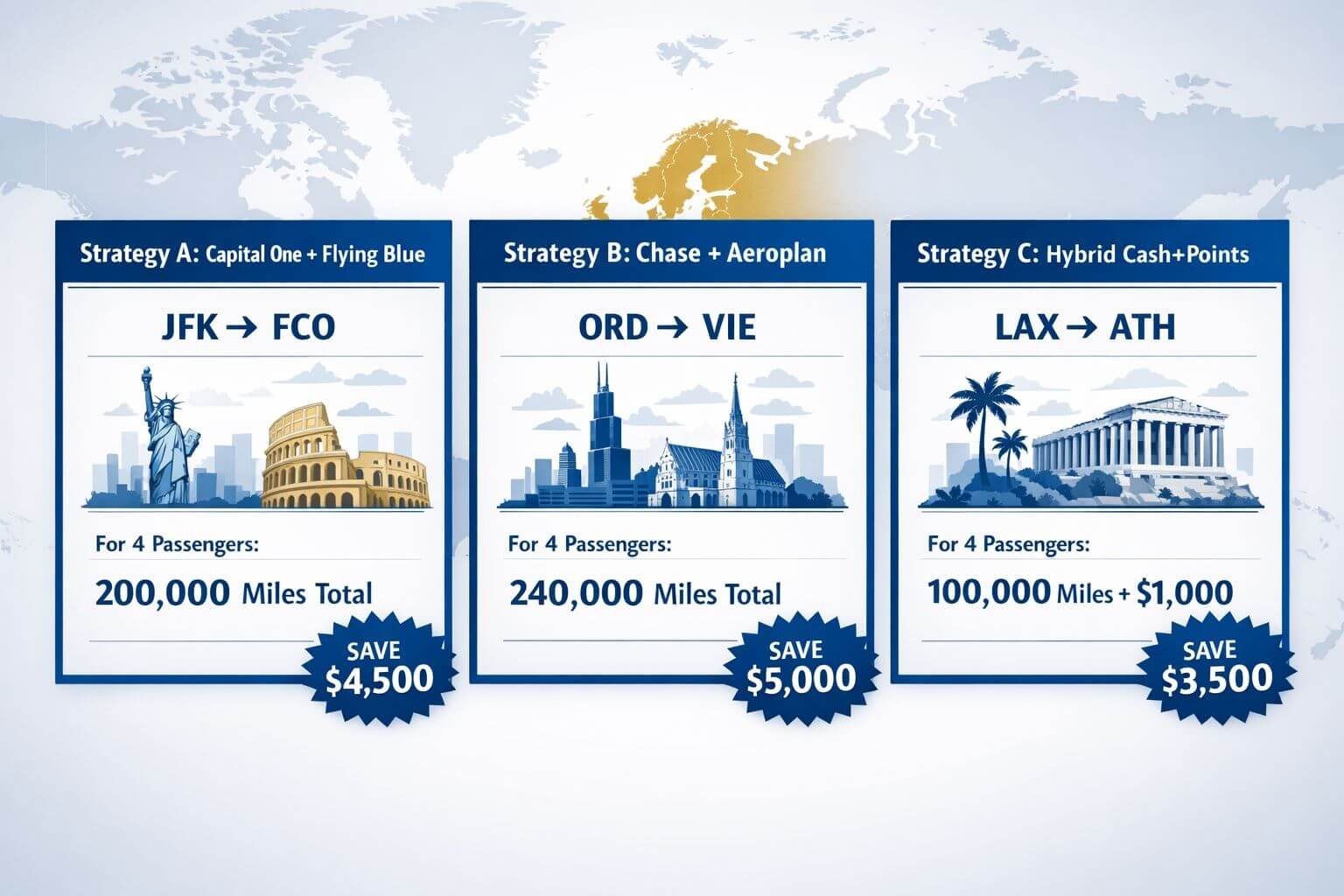
Here are three concrete strategies for a family of four traveling from the East Coast or Midwest to major European destinations in late summer or early fall 2026. Each includes program, estimated mileage, and cash out-of-pocket.
Strategy A: New York to Rome (October 2026) via Flying Blue
Route: JFK → FCO (nonstop on Air France or KLM, or one-stop via Paris/Amsterdam) Program: Flying Blue (transfer from Chase or Capital One) Estimated cost: 30,000 Flying Blue miles per person round-trip (shoulder season promo pricing, if available) or 35,000–40,000 at standard rates Four passengers: 120,000–160,000 miles total Cash fees: Approximately $60–$120 per person in carrier fees and taxes (~$300 total for four) Points source: Chase Ultimate Rewards transferred to Flying Blue at 1:1
Booking note: Flying Blue releases promo awards monthly. October routes from JFK to CDG or AMS with onward connections to FCO are regularly available. Check the Flying Blue website on the first of each month for updated promo destinations.
Strategy B: Chicago to Vienna (September 2026) via Aeroplan
Route: ORD → VIE (one-stop via Toronto or Frankfurt on Air Canada or Lufthansa) Program: Aeroplan (transfer from Chase or Capital One) Estimated cost: 32,500 Aeroplan miles per person round-trip (standard saver, one-stop) Four passengers: 130,000 miles total Cash fees: Approximately $50–$80 per person on partner metal (~$240 total for four) Points source: Capital One miles (200k balance) transferred to Aeroplan at 1:1
Booking note: Aeroplan’s search tool shows availability across all partners. Search two passengers at a time rather than four simultaneously — this is the most reliable way to confirm seat count before transferring points. See the section below on finding four seats.
Strategy C: Hybrid Strategy — East Coast to Budapest (Late September 2026)
Route: BOS or EWR → BUD (one-stop via Frankfurt, Vienna, or Amsterdam) Approach: Book outbound on Aeroplan (two passengers) + two passengers on United MileagePlus; return on Flying Blue for all four. Estimated cost:
- Outbound Aeroplan (2 pax): 65,000 miles + ~$100 fees
- Outbound United (2 pax): 34,000–60,000 miles + ~$60 fees
- Return Flying Blue (4 pax): 120,000–140,000 miles + ~$200 fees
Total miles: Approximately 220,000–265,000 across three programs
Why this works: Budapest (BUD) has limited nonstop options from the US, so one-stop routings dominate. Splitting into separate PNRs by program lets you book two seats at a time and combine the best available space.
This hybrid approach is covered in more depth in ATH’s guide to planning aspirational trips when award space is tighter than ever.
How to Find Four Award Seats on the Same Flights
Finding four economy award seats on the same flight is the hardest part of booking a family of four to Europe with points. Here is a practical framework.
Why four seats are harder than two: Airlines typically release 1–2 saver seats per cabin at a time, occasionally 4 on high-capacity routes. Peak summer dates on popular routes (JFK-FCO, LAX-LHR) may show zero or one saver seat for months at a time.
Step-by-step approach:
Search two passengers at a time. Most booking engines (Aeroplan, Flying Blue, United) show more availability for two seats than four. If you find two seats on two separate flights departing within an hour of each other, that is a workable option.
Split into two PNRs. Book passengers 1+2 on one reservation and passengers 3+4 on a second reservation for the same flight. Airlines allow this; you can request seat assignments together at check-in. This is standard practice, not a workaround.
Use Aeroplan’s mixed-carrier search. Aeroplan searches Air Canada, United, Lufthansa, and other Star Alliance partners simultaneously, giving the widest view of available space on a single search.
Check award release windows. Most airlines release partner award space 330–355 days in advance. For October 2026 travel, that window opened in late 2025. For families still planning now, look for last-minute releases (within 2 weeks of departure) or use alerts.
Consider positioning flights. If your home airport has limited award space, a short paid or points-booked domestic flight to a major hub (JFK, EWR, ORD, BOS) opens significantly more transatlantic options. A $150–$200 positioning flight per person can unlock 30,000–50,000 miles in savings per person on the transatlantic segment.
Use award search tools. Tools like Seats.aero, Point.me, and Awayz aggregate availability across programs. Set alerts for your target route and date range so you are notified when space opens.
Common mistake: Transferring points before confirming award space. Always verify that four seats (or two + two) are bookable before moving points from a bank to an airline program. Transfers are one-way and typically irreversible within 24–48 hours.
For a deeper look at search tools and availability alerts, see ATH’s Best Award Travel Tools and Alerts to Set Up for 2026 Bookings.
12–18 Month Credit Card Plan for a Family Europe Trip
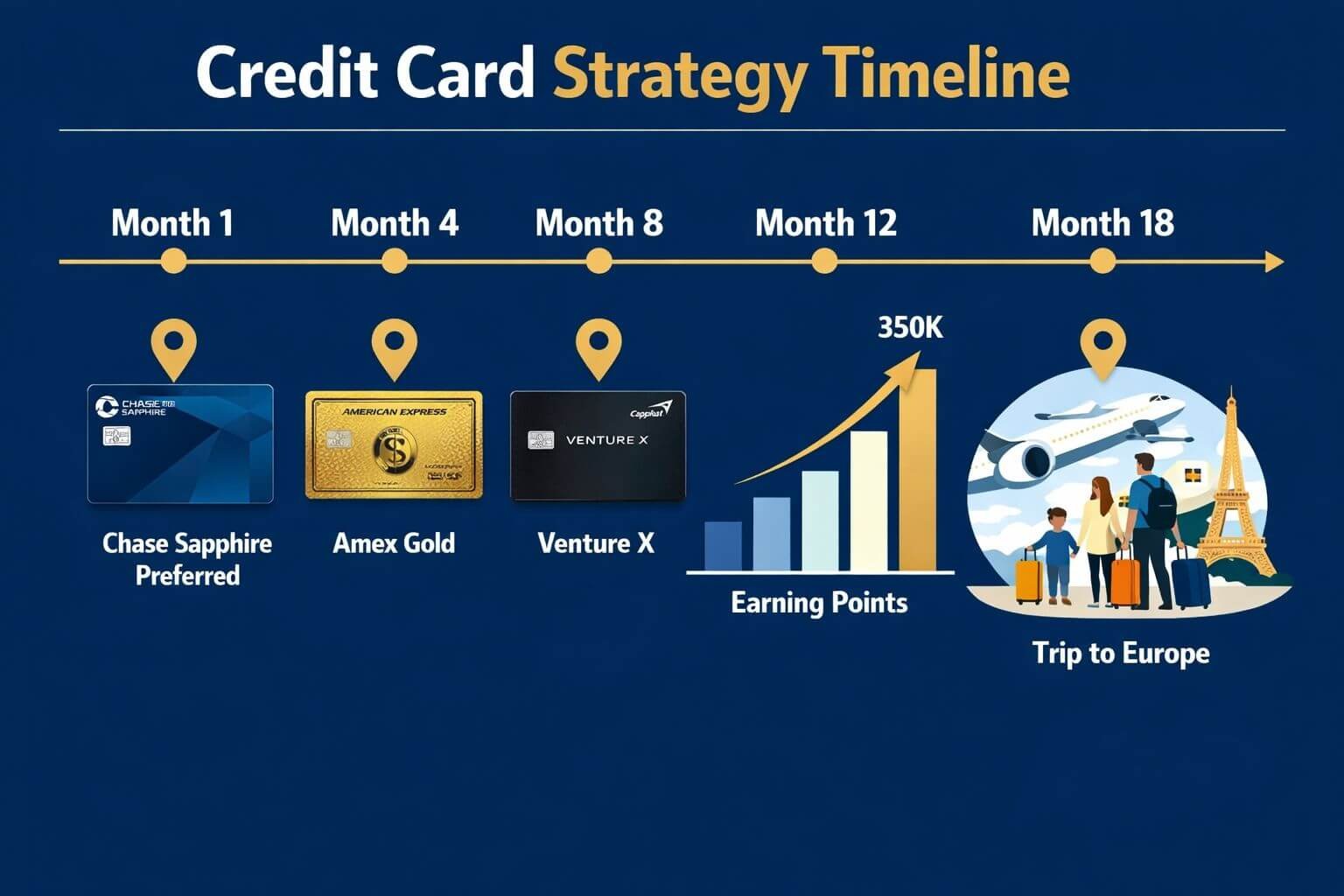
A family that starts planning 12–18 months out can realistically accumulate 280,000–350,000 transferable points through welcome bonuses and organic spending — enough to cover four economy seats with a buffer for fees or upgrades.
Assumptions: Two adults, each eligible for new card welcome bonuses, combined household spending of $6,000–$8,000/month.
Month 1–3: Establish the foundation
- Adult 1: Apply for Chase Sapphire Preferred (60,000–75,000 UR bonus after $4,000 spend in 3 months). If under Chase 5/24, this is the first card to open. See ATH’s Chase Sapphire Preferred vs Reserve 2026 breakdown to decide which version fits your spending.
- Adult 2: Apply for Capital One Venture X (75,000–100,000 miles bonus after $4,000 spend in 3 months) or Amex Gold (60,000–90,000 MR bonus, check current offer).
Month 4–9: Add earning cards
- Adult 1: Add Chase Freedom Unlimited or Ink Business Cash (if self-employed or a side business exists) to stack more Ultimate Rewards on everyday categories.
- Adult 2: Add Amex Blue Business Plus or a second Capital One card if eligible. Avoid opening a second Chase card until the 5/24 status allows.
Month 10–15: Accumulate and monitor
- Continue spending on bonus categories (dining, groceries, travel).
- Watch for Flying Blue or Aeroplan transfer bonuses (25–30% bonuses appear 2–4 times per year) and time transfers accordingly.
- Begin searching for award availability 11–12 months before your target departure.
Month 16–18: Transfer and book
- Confirm award space for two passengers at a time before transferring any points.
- Transfer points in batches: move only what you need for confirmed bookings.
- Book return flights separately if outbound availability is confirmed first.
Realistic point totals after 18 months (two adults):
| Source | Estimated Points |
|---|---|
| Chase Sapphire Preferred welcome bonus | 60,000–75,000 UR |
| Capital One Venture X welcome bonus | 75,000–100,000 miles |
| Amex Gold welcome bonus | 60,000–90,000 MR |
| 18 months of household spending (combined) | 80,000–120,000 points |
| Total | 275,000–385,000 points |
This range comfortably covers 160,000–220,000 miles for four economy seats in shoulder season, with 100,000+ points remaining for hotels, upgrades, or a future trip.
Note on Chase 5/24: Chase’s 5/24 rule limits approval to applicants who have opened fewer than five new credit cards (any issuer) in the past 24 months. Prioritize Chase cards early in the timeline. For a full explanation, see ATH’s guide on how to use Chase 5/24 rules in conjunction with award release strategy.
What Are the Biggest Risks and Tradeoffs to Know Before You Book?
Devaluation risk: Programs can and do change award pricing with little notice. United MileagePlus, Flying Blue, and Avianca LifeMiles have all adjusted rates in the past 18 months. The safest approach is to transfer points only when you have confirmed availability and are ready to book within 24 hours.
Dynamic pricing expansion: As of 2026, Lufthansa Group carriers (including SWISS and Austrian Airlines) have moved to fully dynamic pricing in Miles & More. This means the same JFK-VIE route might cost 35,000 miles on one date and 80,000 miles on another. Families targeting Vienna or Salzburg should use Aeroplan or LifeMiles to book on Lufthansa metal rather than booking directly through Miles & More.
Fuel surcharges: British Airways Avios charges $300–$700 per person in carrier-imposed fees on transatlantic awards — even in economy. Avoid booking transatlantic awards through Avios unless the mileage savings clearly offset the fees. Use ATH’s hidden costs in award travel guide to calculate net value before booking.
Portal redemptions as a backup: If award space is unavailable, Chase Travel and Capital One Travel portals let you redeem points at 1–1.5 cents per point (CPP) toward any cash fare. At 1.25 CPP, 280,000 Chase points cover $3,500 in airfare — roughly the cash cost of four economy tickets to Europe in shoulder season. This is not the highest-value use of points, but it is a reliable fallback when saver space is gone.
Frequently Asked Questions
Q: Is it realistic to book four economy seats to Europe on the same flight with points? Yes, but it requires flexibility. Booking two seats at a time and splitting into two PNRs on the same flight is the most reliable approach. Four seats on a single reservation are available but less common, especially in peak summer.
Q: Can I mix Chase and Capital One points for the same trip? Not directly — the two currencies cannot be combined into one account. But you can use Chase points to book two passengers through Aeroplan and Capital One miles to book the other two through the same or a different program, then coordinate seat assignments at check-in.
Q: What’s the best time of year for a family of four to Europe with points? Late September through October offers the best combination of lower award rates, better availability, and mild weather across Italy, Austria, and Central Europe. Late April through May is the next-best window.
Q: Should I use a bank portal or transfer to an airline program? Transfer to an airline program when the saver rate is 1.5 CPP (cents per point) or lower than the portal price. Use the portal when saver award space is unavailable or when the cash fare is low enough that the CPP difference is minimal.
Q: How far in advance should I search for award space? Start searching 10–12 months before your target departure. Most airlines release partner award space at the 330–355 day mark. Set alerts for your routes using tools like Seats.aero or Point.me.
Q: Do kids under 2 need a separate award ticket? Lap infants (under 2) on international flights require a ticket, but most programs charge 10% of the adult award rate for an infant-in-arms ticket. A child traveling in their own seat requires a full award ticket at the standard rate.
Q: Which program is best for a family flying from the Midwest to Budapest? Aeroplan is the strongest option. It searches Air Canada, Lufthansa, and United partners simultaneously and prices one-stop routings through Frankfurt or Vienna to Budapest at reasonable saver rates with low fees.
Q: What if I only have Capital One miles and no Chase or Amex points? Capital One transfers to Aeroplan, Avianca LifeMiles, Turkish Airlines, and Flying Blue — all strong options for Europe. A 200,000-mile Capital One balance is sufficient to cover four economy seats to Europe in shoulder season through Aeroplan or LifeMiles.
Q: Are there any programs with fixed award charts left for Europe in 2026? Yes. Aeroplan, Flying Blue, Avianca LifeMiles, United MileagePlus, and Turkish Miles&Smiles all maintain structured (though not always static) pricing for most routes. Miles & More (Lufthansa) has moved to fully dynamic pricing, making it less predictable.
Q: What is a “positioning flight” and do I need one? A positioning flight is a short paid or points-booked domestic flight to a major hub airport before your international departure. If your home airport (say, Cincinnati or Raleigh) has limited award space to Europe, flying to JFK, EWR, or ORD first opens many more transatlantic options — often at lower mileage costs than booking from a secondary airport.
Conclusion
A family of four to Europe with points in 2026 is achievable with realistic planning — but it requires more points, more lead time, and more flexibility than most families initially expect. The core playbook: target shoulder season (September–October), use Aeroplan or Flying Blue as your primary programs, split bookings into two PNRs when needed, and start accumulating points at least 12 months before departure.
Your next steps:
- Audit your current balances. Add up all transferable points across Chase, Amex, Capital One, Citi, and Bilt. Compare against the 160,000–220,000-mile target for four economy seats.
- Identify your gap. If you’re short, map out which welcome bonuses close the gap fastest using the 12–18 month card plan above.
- Start searching for award space now. Use Seats.aero or Point.me to check Aeroplan and Flying Blue availability on your target routes. Do not transfer points until you confirm bookable space.
- Calculate CPP before transferring. Use ATH’s Cents-Per-Point guide to confirm the transfer beats the portal price.
- Book return flights separately if needed — mixing programs is not a problem when each booking stands on its own.
For broader context on building a points strategy that supports multi-year travel goals, see ATH’s Award Travel Predictions for 2026 and the Bank Transfer Partners Guide for a full view of which programs accept which currencies.


Content on Award Travel Hub is independently created by Award Travel Hub Editorial Desk and, where noted, reviewed by Award Travel Hub Review Desk. Some pages may contain affiliate links, but compensation does not determine our coverage, opinions, or methodology.