

You’ve spent months earning hotel points through stays, credit card spending, and strategic transfers. Then one morning, you log into your account and discover thousands of points have vanished. The culprit? Inactivity expiration—a silent point killer that catches even experienced travelers off guard.
The short answer to “Do hotel points expire?” is yes; most hotel loyalty programs enforce expiration policies. But the rules vary dramatically by program, and the good news is that keeping points alive requires minimal effort once you understand each program’s specific requirements. This guide provides a program-by-program breakdown of expiration rules, plus practical, low-cost extension methods that take minutes to execute.
Key Takeaways
- Most major hotel programs expire points after 12-24 months of inactivity—not from the date you earned them, but from your last qualifying activity
- IHG has the shortest window at 12 months, while Marriott, Hilton, Hyatt, and Radisson allow 24 months between activities
- Transferring points from credit card partners (Amex, Chase, Capital One, Citi) consistently resets expiration clocks across programs that accept them
- The cheapest extension methods cost $5-25 through shopping portals, dining programs, or discounted award stays—far less than the value of points you’d lose
- Booking and canceling award stays does NOT extend points for most programs (Hyatt, Marriott, Choice)—but works for Radisson
What “Activity” Really Means for Hotel Points Expiration
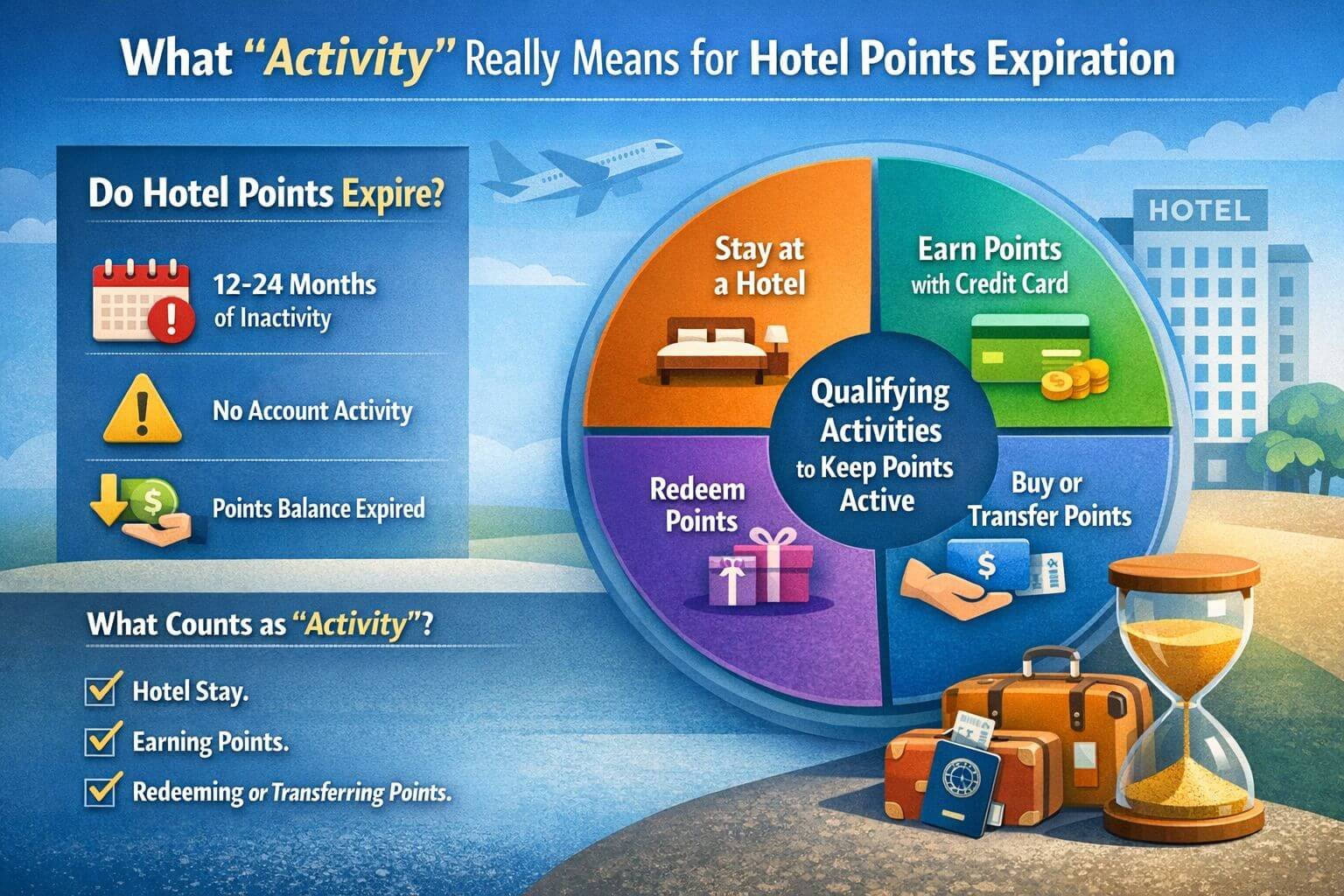
Hotel points don’t expire on a fixed schedule from when you earned them. Instead, they expire after a period of account inactivity—meaning no qualifying transactions that earn, redeem, or move points. This distinction matters because a single qualifying action resets the entire expiration clock for your full balance.
The definition of “qualifying activity” varies by program, but generally includes:
- Completing paid stays at program hotels
- Earning points through co-branded credit cards
- Redeeming points for award nights or other rewards
- Transferring points to or from partners
- Earning through shopping portals, dining programs, or car rentals
- Purchasing or gifting points (program-dependent)
What typically does not count as activity:
- Simply holding a co-branded credit card without transactions
- Booking an award stay without checking out
- Browsing your account or updating profile information
- Receiving promotional bonus points (program-dependent)
Understanding these nuances helps you choose the most efficient extension method for your situation. For beginners just starting with travel hacking and points strategies, establishing a simple annual reminder to trigger activity prevents unexpected losses.
Hotel Points Expiration Rules by Program
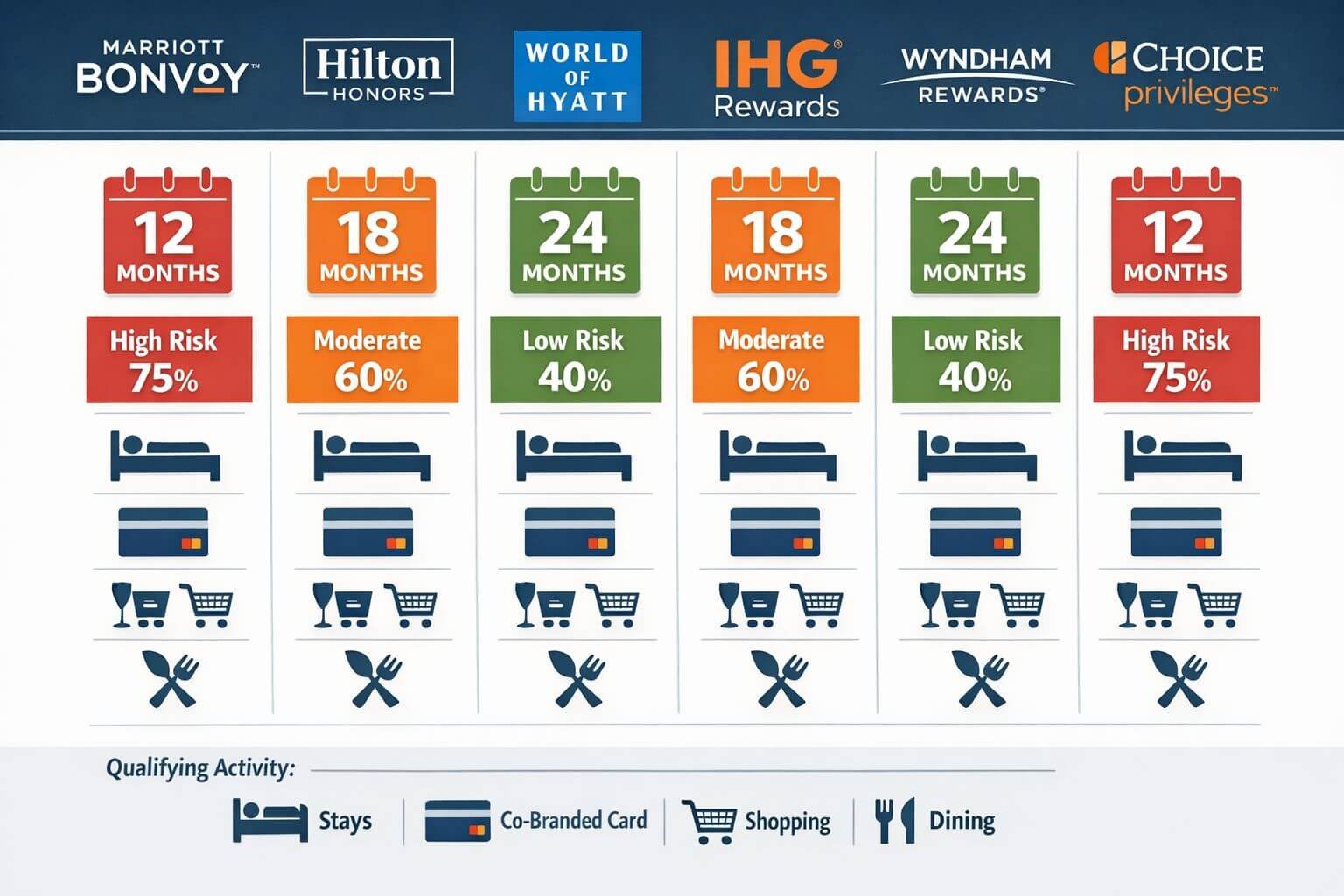
Different hotel programs enforce vastly different expiration policies. This table summarizes the key rules for major loyalty programs in 2026:
| Program | Expiration Window | Qualifying Activity Examples | Elite Status Protection |
|---|---|---|---|
| Marriott Bonvoy | 24 months of inactivity | Stays, credit card earning, transfers from Amex/Chase, point purchases, redemptions | No—elite status does not prevent expiration |
| Hilton Honors | 24 months of inactivity | Stays, credit card earning, shopping/dining portals, partner earning, redemptions | No—elite status does not prevent expiration |
| World of Hyatt | 24 months of inactivity | Stays, credit card earning, 5,000+ point transfers to airlines, 1,000+ point dining/spa redemptions | No—elite status does not prevent expiration |
| IHG Rewards Club | 12 months of inactivity | Stays, credit card earning, partner earning, redemptions | Yes—elite members’ points never expire |
| Wyndham Rewards | 18 months of inactivity OR 4 years from accrual (whichever first) | Stays, redemptions, transfers from Capital One, shopping portals | No—elite status does not prevent expiration |
| Choice Privileges | 18 months of inactivity | Completed stays (not just bookings), cash & points stays, shopping portals | No—elite status does not prevent expiration |
| Accor Live Limitless | 365 days from accrual date | Qualifying stay checkout (must occur 7+ days before expiration), dining programs | No—elite status does not prevent expiration |
| Radisson Americas | 24 months of inactivity | Stays, redemptions, booking and canceling award stays | No—elite status does not prevent expiration |
Program-Specific Nuances
IHG Rewards Club stands out with the shortest standard expiration window (12 months) but offers the best elite status protection: if you maintain club-level elite status, your points never expire. The IHG Premier credit card provides complimentary Platinum Elite status, effectively eliminating expiration concerns for cardholders.
Wyndham Rewards operates under a dual-expiration system: points expire either 18 months after your last activity OR four years after they were earned, whichever comes first. This means even active members must eventually use or extend older points.
Accor Live Limitless requires the most frequent attention, with points expiring just 365 days from their accrual date. The program requires a completed stay checkout at least seven days before expiration—booking alone doesn’t extend validity.
World of Hyatt explicitly states that booking and immediately canceling an award night does not count as a qualifying activity. This closes a loophole that works in some other programs and requires more substantive action to extend points.
For a deeper comparison of hotel loyalty programs and their redemption value, see our guide to top hotel loyalty programs for travelers.
Do Hotel Points Expire? Fastest Ways to Reset Expiration
When you need to quickly reset your expiration clock—whether you’ve just noticed an upcoming deadline or want to secure points before a long period without travel—these methods provide immediate qualifying activity.
1. Transfer Points from Credit Card Partners
Cost: $0 (assuming you already have transferable points)
Time: 1-3 days for transfer to the post
Programs: Marriott (Amex, Chase), Hyatt (Chase), IHG (Chase), Wyndham (Capital One, Citi), Choice (Capital One)
Transferring points from major credit card programs instantly resets expiration clocks and often provides the best value for your transferable points when used strategically. The minimum transfer amounts vary:
- Chase Ultimate Rewards to Hyatt: 1,000 points minimum
- Chase Ultimate Rewards to Marriott: 1,000 points minimum
- Amex Membership Rewards to Marriott: 1,000 points minimum
- Capital One Miles to Wyndham: 1,000 miles minimum (converts to 2,000 Wyndham points)
- Capital One Miles to Choice: 1,000 miles minimum
This method works particularly well when you are already planning to transfer points for an upcoming redemption. Check current transfer partners and bonus opportunities before moving points, as periodic transfer bonuses can increase the value by 25-50%.
Important consideration: Only transfer points when you have a specific redemption in mind or need to prevent imminent expiration. Transferable points held in your credit card account don’t expire as long as your account remains open, providing more flexibility than points already sitting in hotel programs.
2. Complete a Paid Stay (Even One Night)
Cost: Varies ($40-150+ depending on property and location)
Time: Immediate upon checkout
Programs: All major hotel programs
A single paid night at any program property resets your expiration clock and earns new points. This method makes sense when:
- You have legitimate travel needs near your expiration deadline
- You can book a low-cost property (budget brands like Fairfield Inn, Hampton Inn, Tru by Hilton)
- You’re combining the stay with other goals (elite status qualification, mattress runs)
For example, a $60 night at a Fairfield Inn by Marriott resets your Bonvoy expiration while earning 600-750 base points (10-12.5 points per dollar) plus any elite bonuses. If you’re protecting 100,000 Bonvoy points worth approximately $700 in redemption value, the $60 investment provides a substantial return.
Pro tip: Book stays during off-peak periods or use corporate discount codes (AAA, AARP, government rates) to minimize costs. Some programs, like Choice and Wyndham, offer budget brands with frequent rates under $50 per night.
3. Make a Small Award Redemption
Cost: Varies (typically 3,500-7,500 points for lowest-tier redemptions)
Time: Immediate when redemption processes
Programs: All major hotel programs
Redeeming points for any reward—hotel nights, gift cards, merchandise, or experiences—counts as a qualifying activity. The most efficient redemptions for extension purposes:
- Hyatt: Redeem 1,000+ points for dining or spa credits without staying at the property
- Marriott: Book a Category 1 off-peak award night (5,000 points) at a future date, complete the stay
- Hilton: Redeem for Amazon gift cards (starting at 2,500 points for a $10 value)
- IHG: Book a Reward Night at the lowest category (10,000-15,000 points)
This method works best when you were already planning to use points or when the redemption provides reasonable value. Redeeming 5,000 Marriott points (worth approximately $35) to protect 200,000 points (worth approximately $1,400) makes clear economic sense.
Caution: Avoid redeeming points for merchandise or gift cards unless the value proposition makes sense on its own, independent of the extension benefit. Most non-hotel redemptions provide poor value (0.3-0.5 cents per point) compared to hotel stays (0.5-1.0+ cents per point).
4. Earn Through Shopping Portals
Cost: $5-25 in qualifying purchases
Time: 30-90 days for points to post
Programs: Marriott, Hilton, IHG, Choice, Wyndham, Hyatt (limited partners)
Hotel shopping portals award points for online purchases at thousands of retailers. A small purchase resets your expiration clock once the points post to your account.
Example portal earnings:
- Marriott Bonvoy Shopping: 2-10 points per dollar at 900+ retailers
- Hilton Honors Shopping: 2-12 points per dollar at 1,000+ retailers
- IHG Rewards Shopping: 2-10 points per dollar at 1,000+ retailers
A $25 purchase at a 5 points-per-dollar retailer earns 125 points and resets the expiration. The key consideration: points typically take 30-90 days to post, so plan ahead if your expiration deadline is imminent.
Best practice: Make portal purchases you were already planning (holiday gifts, household items, electronics) and select a retailer offering bonus points. Stack with credit card rewards and retailer promotions for maximum value.
5. Earn Through Dining Programs
Cost: $10-30 in restaurant spending
Time: 7-30 days for points to post
Programs: Marriott (Eat Around Town), Hilton (Hilton Honors Dining), IHG (IHG Dining Rewards)
Hotel dining programs award points for meals at participating restaurants after linking your credit card. Typical earning rates range from 3-5 points per dollar spent.
Example: A $30 dinner at a participating restaurant, earning 5 Marriott points per dollar, generates 150 points and resets your expiration clock. The points post within 7-30 days after the transaction.
Setup requirements:
- Enroll your credit card in the dining program (one-time setup)
- Dine at participating restaurants (check program websites for locations)
- Pay with your enrolled card
- Points post automatically within 7-30 days
This method works well for regular restaurant diners who can integrate it into normal spending patterns. Like shopping portals, the posting delay means you should plan ahead of expiration deadlines.
Cheapest Extension Methods: Cost Comparison
When your only goal is preventing expiration—not earning significant new points or completing a stay—these methods provide the lowest cost per extension:
| Extension Method | Typical Cost | Time to Post | Best For | Cost per 50K Points Protected |
|---|---|---|---|---|
| Transfer from credit card | $0 | 1-3 days | Members with transferable points balances | $0 |
| Shopping portal purchase | $5-25 | 30-90 days | Planned online purchases | $0.01-0.05¢ per point |
| Dining program meal | $10-30 | 7-30 days | Regular restaurant diners | $0.02-0.06¢ per point |
| Budget hotel night | $40-80 | Immediate | Legitimate travel needs | $0.08-0.16¢ per point |
| Small award redemption | 3,500-7,500 pts | Immediate | Members with excess points | Varies by redemption value |
| Point purchase | $12.50 per 1,000 | Immediate | Last resort only | $0.25¢ per point (poor value) |
Value calculation example: If you’re protecting 100,000 Marriott Bonvoy points (worth approximately $700-1,000 in premium hotel redemptions), spending $25 on a shopping portal purchase costs 0.025-0.035 cents per point protected—excellent value compared to re-earning those points through stays or credit card spending.
Decision Framework: Which Extension Method to Choose
Use credit card transfers when:
- You have transferable points already (Amex, Chase, Capital One, Citi)
- You’re protecting high-value hotel point balances (50,000+ points)
- Your expiration deadline is within 30 days
- You were already considering a transfer for an upcoming redemption
Use shopping portals when:
- You have 60+ days before expiration (account for posting delays)
- You have planned online purchases anyway
- You want to avoid out-of-pocket costs beyond normal spending
- You’re comfortable with delayed posting (30-90 days)
Use dining programs when:
- You regularly eat at participating restaurants
- You have 30+ days before expiration
- You want a low-cost option integrated into normal spending
- You’ve already enrolled your card (one-time setup)
Use budget hotel stays when:
- Your expiration deadline is immediate (within 7 days)
- You have legitimate travel needs
- You’re also working toward elite status qualification
- You can find properties under $60 per night
Use small award redemptions when:
- You have excess points across multiple programs
- Your expiration deadline is immediate
- You can extract reasonable value from the redemption (0.5+ cents per point)
- You’re consolidating balances across programs
For a comprehensive look at how to evaluate whether extension costs make sense, use our points value calculators to determine the redemption value of your current balance.
When Transferring Points to Extend Hotel Points Makes Sense
Transferring transferable points (Amex Membership Rewards, Chase Ultimate Rewards, Capital One Miles, Citi ThankYou Points) to hotel partners serves dual purposes: it can extend the expiration of hotel points while also positioning points for valuable redemptions.
Transfer-Based Extension Strategy
Best scenarios for transfer-based extensions:
You’re planning a redemption within 12-24 months: Transfer points when you have a specific hotel redemption in mind, even if it’s several months away. This extends your hotel point expiration while positioning points for the booking.
Transfer bonuses are available: Periodic transfer bonuses (typically 20-30% extra points) make transfers more valuable. For example, transferring 40,000 Chase points to Hyatt during a 30% bonus yields 52,000 Hyatt points—extending expiration while maximizing value.
You hold large transferable point balances: Transferable points don’t expire while in your credit card account (as long as the account remains open), but once transferred, they’re subject to hotel program expiration rules. Only transfer when you have a redemption plan or need to prevent hotel points from expiring.
Your hotel balance is already substantial: If you have 200,000 Marriott points at risk of expiration, transferring just 1,000 Chase points (minimum transfer amount) resets the clock on the entire 200,000-point balance.
Programs Accepting Credit Card Transfers
Marriott Bonvoy:
- Accepts transfers from Amex Membership Rewards (1:1 ratio)
- Accepts transfers from Chase Ultimate Rewards (1:1 ratio)
- Minimum transfer: 1,000 points
- Transfer time: 1-3 days
World of Hyatt:
- Accepts transfers from Chase Ultimate Rewards (1:1 ratio)
- Minimum transfer: 1,000 points
- Transfer time: Instant to 24 hours
- Note: Hyatt is a Chase transfer partner only
IHG Rewards Club:
- Accepts transfers from Chase Ultimate Rewards (1:1 ratio)
- Minimum transfer: 1,000 points
- Transfer time: 1-3 days
Wyndham Rewards:
- Accepts transfers from Capital One Miles (1:2 ratio—1,000 Capital One miles = 2,000 Wyndham points)
- Accepts transfers from Citi ThankYou Points (1:2 ratio)
- Minimum transfer: 1,000 miles/points
- Transfer time: 1-5 days
Choice Privileges:
- Accepts transfers from Capital One Miles (1:1 ratio)
- Minimum transfer: 1,000 miles
- Transfer time: 1-5 days
Important limitation: Hilton Honors and Accor Live Limitless do not accept transfers from major credit card programs, so alternative extension methods are required.
For complete details on transfer ratios, timing, and strategic considerations, see our comprehensive credit card transfer partners guide.
Transfer Bonus Timing Strategy
Transfer bonuses typically appear 3-6 times per year for major hotel partners. When a bonus is active:
Calculate the effective value: A 30% transfer bonus to Hyatt means 10,000 Chase points become 13,000 Hyatt points. If Hyatt points are worth 1.5 cents each in your planned redemption, you’re getting 1.95 cents per Chase point—excellent value.
Transfer enough for your planned redemption plus a buffer: If you need 25,000 Hyatt points for a specific stay, transfer 30,000-35,000 during a bonus to build a buffer for future stays while extending expiration.
Monitor bonus announcements: Subscribe to transfer bonus alerts to catch opportunities as they’re announced.
Caution: Never transfer points solely for a bonus without a redemption plan. The bonus value is irrelevant if you eventually lose the points to expiration or redeem them poorly.
Common Mistakes That Trigger Hotel Points Expiration
Even experienced travelers make avoidable errors that lead to unexpected point losses. These common mistakes account for the majority of expiration-related issues:
Mistake #1: Assuming Elite Status Prevents Expiration
Reality: Only IHG Rewards Club protects elite members from expiration. Marriott, Hilton, Hyatt, and other programs expire points after inactivity regardless of elite status.
Many travelers assume their Marriott Platinum or Hilton Diamond status protects points indefinitely. In January 2026, Marriott renewed the status of 2025 elite members through February 2027, but this status extension does not prevent point expiration due to inactivity.
Solution: Set annual reminders to trigger activity in each program, regardless of elite status. The only exception: maintain IHG elite status (easily achieved with the IHG Premier credit card’s complimentary Platinum status) for permanent point protection.
Mistake #2: Booking and Canceling Award Stays as an Extension Strategy
Reality: This strategy only works for Radisson Americas. Hyatt explicitly states that booking and immediately canceling an award night does not count as a qualifying activity. Marriott and Choice also require completed stays.
Solution: Use legitimate extension methods (transfers, shopping portals, dining programs, or actual completed stays) rather than booking-and-canceling tactics.
Mistake #3: Forgetting About Small Balances in Secondary Programs
Reality: Many travelers maintain points across 5-8 hotel programs but focus attention on their primary program (usually Marriott or Hilton). Small balances in secondary programs (IHG, Choice, Wyndham) expire unnoticed.
Example scenario: You earned 15,000 IHG points from a work trip in January 2025. Without any activity, those points expire in January 2026 (12-month window). Meanwhile, you’ve been actively maintaining your 300,000 Marriott points and forgot about the IHG balance.
Solution: Create an annual “points audit” calendar reminder. Check all program balances and expiration dates once per year to trigger activity in any program approaching expiration. Use a spreadsheet or app like AwardWallet to track multiple program expiration dates.
Mistake #4: Waiting Until the Last Minute
Reality: Shopping portal and dining program points take 30-90 days to post. If you wait until your expiration date is 30 days away, these methods won’t work in time.
Solution: Trigger extension activity at least 90 days before expiration to account for posting delays. If your expiration deadline is immediate (within 30 days), use instant methods: credit card transfers, paid stays, or award redemptions.
Mistake #5: Not Understanding “Activity” Definitions
Reality: Simply holding a co-branded credit card or browsing your account doesn’t count as qualifying activity. You must actually earn or redeem points.
Clarification by program:
- Marriott: Annual anniversary free night certificate from the credit card does NOT reset expiration; you must earn points through card spending or other activity
- Hyatt: Transferring 5,000+ points to airline partners counts; transferring fewer than 5,000 does not
- IHG: Maintaining Platinum Elite status (from a credit card) prevents expiration entirely
Solution: Review each program’s specific qualifying activity rules and ensure your extension method actually counts. When in doubt, use multiple methods (e.g., make a small purchase through the shopping portal AND earn points through dining) to ensure at least one triggers the extension.
Mistake #6: Ignoring Dual Expiration Policies
Reality: Wyndham Rewards points expire either 18 months after your last activity OR four years after they were earned, whichever comes first. Active members can still lose older points.
Solution: For programs with dual expiration (Wyndham), prioritize using or extending your oldest points first. Check your point-earning history to identify points approaching the absolute expiration date, regardless of activity.
Best Extension Method by Program: Quick Reference
Different programs have different optimal extension strategies based on their rules, transfer partnerships, and expiration windows. Here’s a program-by-program recommendation:
Marriott Bonvoy (24-month expiration)
Best method: Transfer 1,000 points from Chase Ultimate Rewards or Amex Membership Rewards
Alternative: Make a $10-25 purchase through the Marriott Bonvoy Shopping portal
Avoid: Purchasing points ($12.50 per 1,000) unless you need points immediately for a redemption
Why this works: Marriott accepts transfers from two major credit card programs, making this the fastest and most cost-effective method. The 24-month window provides ample time for planning.
Recent program changes: In January 2026, Marriott renewed elite members who achieved status in 2025 through February 2027, but this does not affect point expiration rules. Additionally, Marriott implemented dynamic pricing changes that affect redemption values but not expiration policies.
Hilton Honors (24-month expiration)
Best method: Make a $10-25 purchase through the Hilton Honors Shopping portal
Alternative: Earn points through the Hilton Honors Dining program with a $20-30 restaurant meal
Avoid: Transferring points from Amex (not available); purchasing points (poor value)
Why this works: Hilton doesn’t accept credit card transfers, making shopping portals the most cost-effective option. The 24-month window allows time for portal points to post (30-90 days).
Recent program changes: As of January 1, 2026, Hilton Honors elite status can no longer be achieved solely through Base Points; it now requires eligible spend at Hilton properties. This doesn’t affect expiration rules but changes status qualification strategies.
World of Hyatt (24-month expiration)
Best method: Transfer 1,000 points from Chase Ultimate Rewards (instant to 24-hour posting)
Alternative: Redeem 1,000+ points for dining or spa credits without staying at a property
Avoid: Booking and canceling award stays (explicitly does not count as activity)
Why this works: Hyatt is a Chase transfer partner with fast posting times, making this the quickest extension method. The dining/spa credit redemption provides a low-cost alternative if you’re near a Hyatt property.
Important note: Hyatt requires 5,000+ points for airline transfers to count as activity—smaller transfers don’t extend expiration. For strategic Hyatt redemptions, see our guide to maximizing Hyatt points for luxury hotels.
IHG Rewards Club (12-month expiration)
Best method: Maintain Platinum Elite status via IHG Premier credit card (points never expire for elite members)
Alternative: Transfer 1,000 points from Chase Ultimate Rewards
Avoid: Letting status lapse if you hold the credit card
Why this works: IHG offers the strongest elite status protection—points never expire for club-level members. The IHG Premier credit card provides complimentary Platinum Elite status, effectively eliminating expiration concerns.
Key consideration: IHG’s 12-month expiration window is the shortest among major programs, requiring more frequent attention if you don’t maintain elite status.
Wyndham Rewards (18-month + 4-year dual expiration)
Best method: Transfer 1,000 Capital One miles (becomes 2,000 Wyndham points)
Alternative: Make a small award redemption (7,500 points for lowest-tier properties)
Avoid: Ignoring the 4-year absolute expiration date
Why this works: Capital One transfers at a 1:2 ratio, providing good value. The dual expiration policy requires monitoring both activity dates and absolute expiration dates.
Important note: Even with regular activity, points expire 4 years after accrual. Check the earning dates of your oldest points and prioritize using or extending them first.
Choice Privileges (18-month expiration)
Best method: Transfer 1,000 Capital One miles (1:1 ratio)
Alternative: Complete a paid stay at any Choice property (Comfort Inn, Quality Inn, etc.)
Avoid: Booking without completing the stay (only completed stays count)
Why this works: Capital One transfers provide zero-cost extensions. Choice operates many budget brands with frequent rates under $60, making paid stays affordable when needed.
Accor Live Limitless (365-day expiration)
Best method: Complete a paid stay at least 7 days before expiration
Alternative: Earn points through Accor dining programs
Avoid: Waiting until the last minute (requires checkout 7+ days before expiration)
Why this works: Accor’s 365-day window requires annual attention. The program doesn’t accept credit card transfers, limiting options to stays and partner earnings.
Key consideration: Accor’s short expiration window and limited extension options make it the most challenging program to maintain points in. Consider consolidating Accor points into other programs if you don’t have regular Accor stays.
Radisson Americas (24-month expiration)
Best method: Book and cancel an award stay (unique among major programs)
Alternative: Complete a paid stay or award redemption
Avoid: Assuming this booking-and-canceling strategy works for other programs
Why this works: Radisson is the only major program where booking and canceling award stays extends expiration, providing a zero-cost extension method.
Free Night Certificates: Different Expiration Rules
Free night certificates from credit cards and elite status have separate expiration policies from regular points. These certificates typically expire faster and cannot be extended through the same methods.
Certificate Expiration by Program
Hyatt Free Night Certificates:
- Credit card anniversary certificates: Valid for one year from issue date
- Brand Explorer certificates: Valid for one year from issue date
- Milestone Rewards certificates (elite status): Valid for 180 days from issue date
- Cannot be extended once issued
Marriott Free Night Certificates:
- Credit card anniversary certificates: Valid for one year from issue date
- Elite status annual choice certificates: Valid for one year from issue date
- Cannot be extended once issued
Hilton Free Night Certificates:
- Credit card anniversary certificates: Valid for one year from issue date
- Elite status weekend night rewards: Valid for one year from issue date
- Cannot be extended once issued
IHG Free Night Certificates:
- Credit card anniversary certificates: Valid for one year from issue date
- Elite status Reward Night certificates: Valid for one year from issue date
- Cannot be extended once issued
Strategy for Expiring Certificates
Unlike regular points, free night certificates cannot be extended through activity. Your only options:
Use the certificate before expiration: Book any qualifying stay, even if it’s not your ideal redemption. A used certificate provides value; an expired certificate provides zero value.
Book a refundable stay: Make a reservation for a date before expiration, then modify the dates later if your plans change. Most programs allow date changes on certificate bookings (though property changes may not be allowed).
Combine certificates with points: If the certificate doesn’t cover your desired property (e.g., Marriott certificates cap at Category 5, but you want a Category 7 property), use the certificate plus points to book higher-category properties.
Stack multiple certificates: If you have multiple certificates expiring around the same time, book a multi-night stay using all certificates before they expire.
Example scenario: Your Hyatt anniversary certificate expires March 31, 2026, but you don’t have travel plans until summer. Book a refundable Category 1-4 property for late March, then call Hyatt to modify the dates to your summer travel once plans solidify. This preserves the certificate’s value while maintaining flexibility.
For strategic certificate usage during peak travel periods, see our guide to the best hotel points redemptions for Christmas week.
Using ATH Calculators to Compare Extension Cost vs. Value
Before spending money to extend hotel points, calculate whether the extension cost makes economic sense compared to the redemption value of your points.
The Extension Cost-Benefit Formula
Step 1: Determine your point balance at risk of expiration
Step 2: Calculate the redemption value of those points (use program-specific valuations)
Step 3: Compare redemption value to extension cost
Step 4: Decide whether the extension makes sense
Example calculation (Marriott Bonvoy):
- Points at risk: 75,000 Bonvoy points
- Average redemption value: 0.7 cents per point (conservative estimate)
- Total value at risk: 75,000 × $0.007 = $525
- Extension cost: $25 shopping portal purchase
- Cost-benefit ratio: $25 / $525 = 4.8% cost to preserve value
- Decision: Extend—spending $25 to preserve $525 in value is worthwhile
Example calculation (Choice Privileges):
- Points at risk: 15,000 Choice points
- Average redemption value: 0.5 cents per point
- Total value at risk: 15,000 × $0.005 = $75
- Extension cost: $60 paid stay at Quality Inn
- Cost-benefit ratio: $60 / $75 = 80% cost to preserve value
- Decision: Don’t extend—spending $60 to preserve $75 in value doesn’t make sense; let points expire or use them immediately
Program-Specific Redemption Values (2026 Estimates)
Use these baseline valuations when calculating extension cost-benefit:
- Marriott Bonvoy: 0.7-0.9 cents per point (higher for Category 6-8 properties)
- Hilton Honors: 0.5-0.6 cents per point (higher for premium properties)
- World of Hyatt: 1.5-1.8 cents per point (highest value among major programs)
- IHG Rewards Club: 0.5-0.7 cents per point
- Wyndham Rewards: 0.8-1.0 cents per point (15,000-point redemptions)
- Choice Privileges: 0.5-0.7 cents per point
- Accor Live Limitless: 0.6-0.8 cents per point (varies significantly by property)
These valuations represent average redemption values. Your actual value may be higher or lower depending on specific properties, dates, and cash rates. Use our points value calculators to determine the specific value of your planned redemptions.
When Extension Doesn’t Make Sense
Let points expire when:
- Extension cost exceeds 50% of redemption value: If you’d spend $40 to preserve $60 in point value, the math doesn’t work
- You have no realistic redemption plans: Points have zero value if you never use them
- You can re-earn the points easily: If you have upcoming stays that would earn back the expiring points, don’t spend money on extension
- The program offers poor redemption value: If you consistently get less than 0.5 cents per point in redemptions, focus on programs with better value
Use points immediately instead of extending when:
- You have small balances (under 10,000 points): Make a low-value redemption rather than spending money to extend
- You’re consolidating into fewer programs: If you’re simplifying your points portfolio, let secondary programs expire
- The program has been devalued: If recent devaluations have reduced redemption value significantly, use or lose the points rather than extending
Advanced Extension Strategies for Multiple Programs
Travelers who maintain points across multiple hotel programs need efficient systems to prevent expiration without constant monitoring.
The Annual Points Audit
Set a single annual reminder (January 1 works well) to review all hotel point balances and expiration dates:
- Log into each program (Marriott, Hilton, Hyatt, IHG, Wyndham, Choice, Accor, Radisson)
- Record the current balance and the last activity date in a spreadsheet
- Calculate the expiration date based on each program’s policy
- Identify programs requiring action within the next 90 days
- Trigger activity in at-risk programs using the most cost-effective method
Spreadsheet template:
| Program | Balance | Last Activity | Expiration Date | Action Needed | Method | Cost |
|---|---|---|---|---|---|---|
| Marriott | 125,000 | 03/15/2025 | 03/15/2027 | No | — | — |
| Hilton | 87,000 | 06/20/2025 | 06/20/2027 | No | — | — |
| Hyatt | 45,000 | 02/10/2025 | 02/10/2027 | No | — | — |
| IHG | 32,000 | Elite member | Never | No | — | — |
| Wyndham | 18,000 | 11/05/2024 | 05/05/2026 | Yes | Transfer 1K Cap One | $0 |
| Choice | 12,000 | 08/15/2024 | 02/15/2026 | Yes | Transfer 1K Cap One | $0 |
Consolidation Strategy
Rather than maintaining active balances in 6-8 programs, consider consolidating into 2-3 primary programs:
Primary programs for most travelers:
- Marriott Bonvoy (largest footprint, 8,500+ properties worldwide)
- World of Hyatt (best redemption value, premium properties)
- Hilton Honors (large footprint, good for U.S. domestic travel)
Secondary programs to maintain:
- IHG Rewards Club if you hold the IHG Premier credit card (points never expire with elite status)
- Program-specific if you have geographic needs (e.g., Accor for Europe, Choice for U.S. road trips)
Programs to let expire:
- Small balances (under 10,000 points) in programs you rarely use
- Programs with poor redemption value in your travel patterns
- Programs requiring frequent attention (Accor’s 365-day window) without corresponding value
Credit Card Strategy for Automatic Extensions
Holding co-branded hotel credit cards that earn points on everyday spending provides automatic activity:
Cards that automatically extend points:
- Marriott Bonvoy credit cards (Chase, Amex): Earn points on every purchase, automatically resetting expiration
- Hilton Honors credit cards (Amex): Earn points on every purchase, automatically resetting expiration
- World of Hyatt Credit Card (Chase): Earn points on every purchase, automatically resetting expiration
- IHG Premier Credit Card (Chase): Provides Platinum Elite status (points never expire)
Important consideration: Only hold cards with annual fees if the benefits justify the cost. A $95 annual fee solely to prevent point expiration rarely makes sense unless you’re also using the card’s other benefits (free night certificates, elite status, bonus categories).
For a comprehensive analysis of hotel credit cards and their benefits, see our guide to the best credit card shortcuts to earn hotel status.
Family Pooling and Point Transfers
Some programs allow point transfers or family pooling, providing additional extension flexibility:
Marriott Bonvoy: Allows point transfers between accounts for $10 per transaction plus $0.01 per point transferred (expensive, not recommended for extension purposes)
World of Hyatt: Does not allow point transfers between member accounts
Hilton Honors: Allows point pooling for family members at the same address (up to 10 accounts); pooled points share the most recent activity date across all accounts
IHG Rewards Club: Allows point transfers between accounts (fees apply)
Strategy: If your household has multiple accounts in the same program, coordinate activities so that one person’s earnings extend everyone’s points (for programs with pooling). This reduces the number of extension actions needed.
Conclusion: Simple Systems Prevent Hotel Points Expiration
Hotel points expiration is preventable with minimal effort once you understand program-specific rules and establish simple maintenance systems. The key takeaways:
Most hotel points expire after 12-24 months of inactivity—not from when you earned them, but from your last qualifying activity. IHG has the shortest window (12 months), while most major programs (Marriott, Hilton, Hyatt, Radisson) allow 24 months between activities.
The cheapest extension methods cost $0-25 through credit card transfers, shopping portals, or dining programs—far less than the redemption value of points you’d lose. A $20 shopping portal purchase protecting 100,000 Marriott points (worth $700-900 in redemptions) provides an exceptional return on investment.
IHG offers unique elite status protection: Points never expire for club-level elite members, making the IHG Premier credit card’s complimentary Platinum Elite status particularly valuable for set-it-and-forget-it point protection.
Booking and canceling award stays doesn’t work for most programs (Hyatt, Marriott, Choice)—only Radisson explicitly allows this extension method. Use legitimate activity instead.
Free night certificates have separate expiration rules (typically one year) and cannot be extended. Use them before expiration or book refundable stays that can be modified later.
Your Next Steps
- Audit your current hotel point balances: Log into each program and record your last activity date and expiration deadline
- Set annual calendar reminders: Create a recurring reminder each January to review all programs and trigger activity where needed
- Choose your primary programs: Consolidate into 2-3 programs you’ll actively maintain; let small balances in unused programs expire
- Implement automatic extensions: Use credit card transfers, shopping portals, or co-branded cards to create ongoing activity without manual intervention
- Calculate extension value: Before spending money on extensions, use our points value calculators to ensure the cost makes economic sense
For travelers building comprehensive points strategies, understanding hotel point expiration fits into broader award travel planning for 2026 and maximizing transferable points across programs.
The bottom line: hotel points expiration is a solvable problem. With program-specific knowledge and simple maintenance habits, you’ll never lose points to inactivity again.

