
Sarah opened her credit card statement in January 2026 and felt confused. She’d been paying her balance in full every month—never carrying debt, never paying interest—yet her credit score had dropped 35 points. After three months of frustration and conflicting advice from online forums, she discovered the culprit: her credit utilization ratio was being reported at 65% even though she paid everything off before the due date. The problem? She was paying after her statement closed, not before.
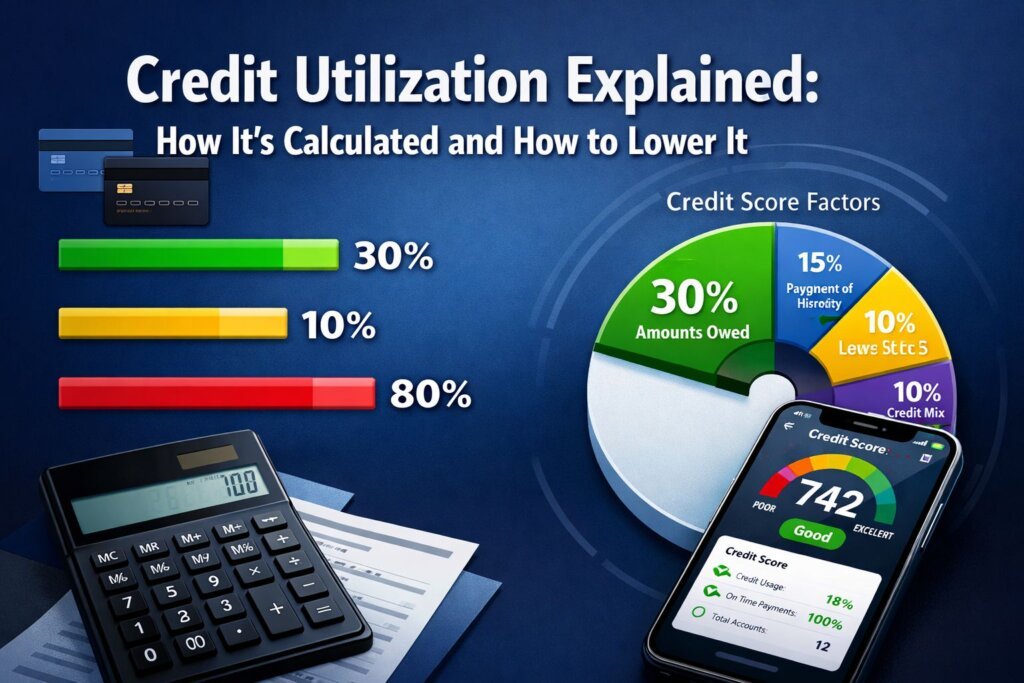
Credit utilization is the second most important factor in your credit score, yet it’s one of the most misunderstood. This metric accounts for 30% of your FICO score calculation—more than the length of your credit history, new credit inquiries, and credit mix combined. For readers building credit to qualify for premium travel cards or maintain excellent scores while earning transferable points through strategic spending, understanding how utilization works and when it’s reported makes the difference between a 720 and an 800+ score.
This guide explains exactly how credit utilization is calculated, when it gets reported to credit bureaus, and the specific strategies to optimize it without paying a cent in interest. Whether you’re preparing to apply for a new Chase, Amex, Capital One, Citi, or Bilt card, or simply want to protect your score while maximizing category bonuses, these frameworks will help you make informed decisions.
Key Takeaways
- Credit utilization represents 30% of your FICO score—only payment history matters more—and is calculated both per card and across all cards combined
- Statement close date, not payment due date, determines what balance gets reported to credit bureaus, making timing critical for score optimization
- Keep utilization below 30% for good scores, below 10% for excellent scores, with individual card ratios mattering as much as overall utilization
- Make payments before your statement closes to lower reported balances without paying interest—you can still use your cards normally afterward
- Newer scoring models like FICO 10 examine utilization patterns over 24 months, making consistent habits more important than one-time fixes
What Is Credit Utilization and Why It Matters for Your Score
The credit utilization ratio measures how much of your available credit you’re currently using. The calculation is straightforward: divide your total credit card balances by your total credit limits, then multiply by 100 to get a percentage.
The formula: (Total Credit Card Balances ÷ Total Credit Limits) × 100 = Utilization Percentage
If you have three credit cards with a combined credit limit of $30,000 and you’re carrying $9,000 in balances across all cards, your overall utilization is 30% ($9,000 ÷ $30,000 = 0.30).
This metric matters because it signals to lenders how you manage available credit. High utilization suggests you may be overextended financially, even if you pay on time. Low utilization indicates you use credit responsibly and aren’t desperate for funds.
Why credit utilization weighs so heavily:
Credit scoring models treat utilization as a real-time indicator of financial stress. Unlike payment history, which looks backward at past behavior, or credit length, which accumulates slowly over years, utilization can change month to month. This makes it both a risk signal for lenders and an opportunity for borrowers to quickly improve scores.
The 30% weight in FICO calculations means utilization has more impact than:
- Length of credit history (15%)
- New credit inquiries (10%)
- Credit mix (10%)
For travelers earning points through credit card spending, this creates a strategic challenge. Putting $5,000 in manufactured spending or prepaying expenses to hit a welcome bonus can temporarily spike utilization and lower your score—unless you understand the reporting timeline and payment strategies covered in the next sections.
How Utilization Affects Different Score Ranges
The impact of utilization isn’t linear. Moving from 50% to 40% utilization doesn’t help your score as much as moving from 20% to 10%.
Utilization thresholds and score impact:
- 0-9% utilization: Optimal range for exceptional scores (800+). Demonstrates that you use credit but aren’t dependent on it.
- 10-29% utilization: Good range for maintaining solid scores (740-799). Acceptable to most lenders.
- 30-49% utilization: Moderate impact zone. Scores typically fall into the 670-739 range. Lenders may view you as a higher risk.
- 50-79% utilization: Significant negative impact. Scores often drop to 580-669. Approval odds decrease for premium cards.
- 80-100% utilization: Severe damage to scores. Maxing out cards can bring scores below 580 and trigger credit limit decreases or account reviews.
These ranges matter when planning credit card applications. Most premium travel cards—like the Chase Sapphire Reserve, Amex Platinum, or Capital One Venture X—have unofficial score requirements around 720-740. If you’re at 35% utilization with a 710 score, dropping to 15% utilization could push you over the approval threshold within one reporting cycle.
How Credit Utilization Is Calculated: Per-Card and Overall Ratios
Credit bureaus and scoring models calculate utilization in two ways simultaneously: per individual card and across all cards combined. Both calculations matter, and high utilization on even one card can hurt your score even if your overall utilization looks acceptable.
Per-Card Utilization (Individual Card Ratio)
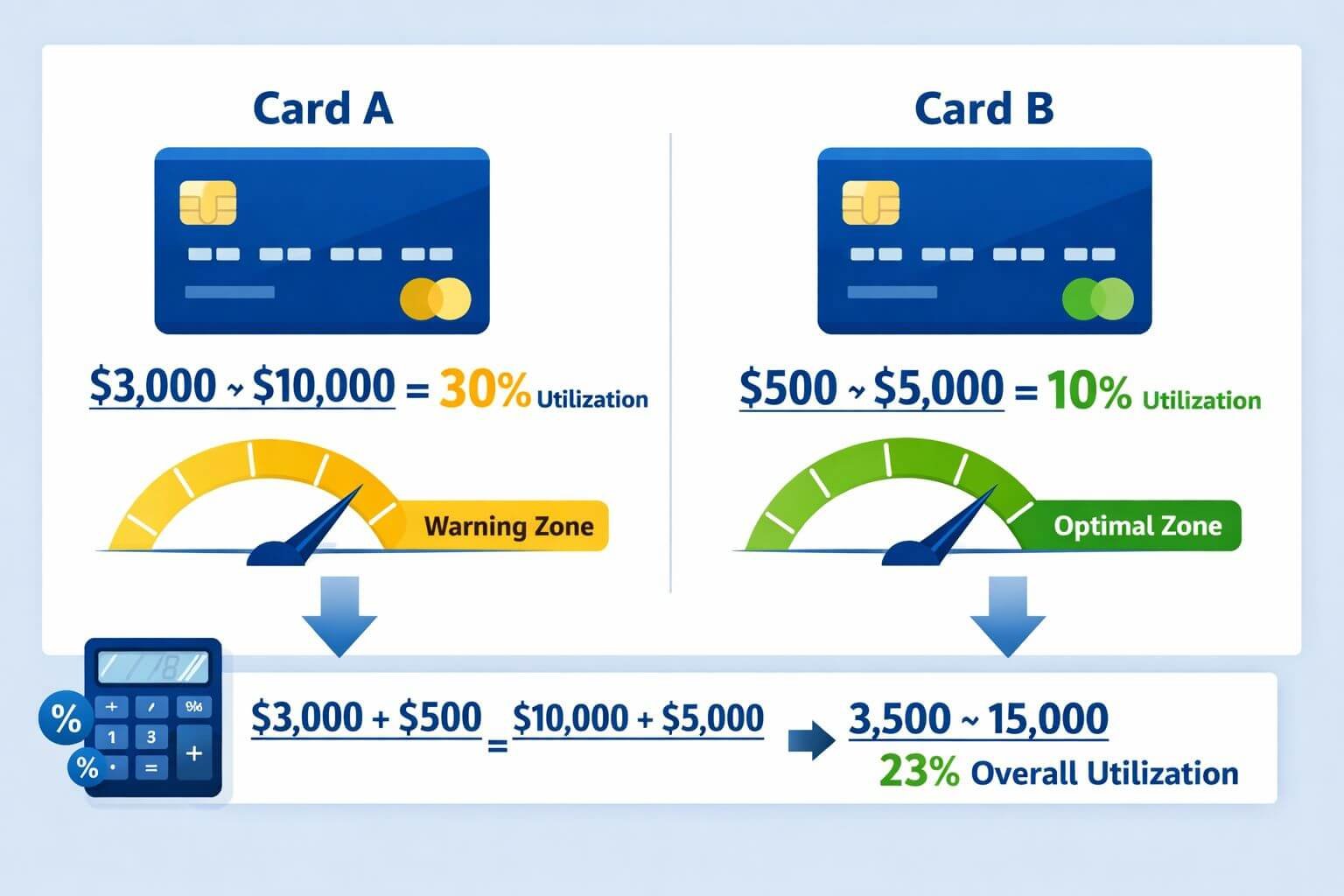
Each credit card’s utilization is calculated independently:
Card A:
- Credit limit: $10,000
- Current balance: $3,000
- Individual utilization: 30%
Card B:
- Credit limit: $5,000
- Current balance: $500
- Individual utilization: 10%
Even though your overall utilization across both cards is 21% ($3,500 ÷ $15,000), Card A’s 30% individual utilization can still negatively impact your score. Scoring models flag individual cards with high utilization as potential risk indicators.
This matters for points earners who concentrate spending on specific cards to maximize category bonuses. If you put all grocery spending on your Amex Gold (which earns 4X points at supermarkets) and that card has a $5,000 limit, spending $2,000 monthly on groceries alone creates 40% utilization on that card—even if your other cards sit unused.
Overall Utilization (Aggregate Ratio)
Overall utilization combines all your credit card balances and limits:
Combined calculation:
- Total balances: $3,500 (Card A + Card B)
- Total limits: $15,000 (Card A + Card B)
- Overall utilization: 23%
Both per-card and overall utilization feed into your credit score. The optimal strategy keeps both metrics low, not just one.
Utilization Calculation Worksheet
Use this framework to calculate your current utilization and identify problem areas:
| Card Name | Credit Limit | Current Balance | Individual Utilization | Action Needed |
|---|---|---|---|---|
| Card 1 | $_______ | $_______ | _____% | ☐ Pay down ☐ OK |
| Card 2 | $_______ | $_______ | _____% | ☐ Pay down ☐ OK |
| Card 3 | $_______ | $_______ | _____% | ☐ Pay down ☐ OK |
| Card 4 | $_______ | $_______ | _____% | ☐ Pay down ☐ OK |
| Totals | $_______ | $_______ | _____% |
Target zones:
- ✅ Individual cards: Below 10% (ideal) or below 30% (acceptable)
- ✅ Overall utilization: Below 10% (ideal) or below 30% (acceptable)
Copy this table and fill in your numbers. Any card showing individual utilization above 30% should be your first priority for payment, even if your overall utilization looks fine.
Why Both Ratios Matter
Credit scoring models penalize high utilization on individual cards because it suggests you may be maxing out available credit sources. If you have five cards with $50,000 in total limits but one card is maxed at $5,000 while the others sit at $0, your overall utilization is only 10%—but that maxed card still hurts your score.
The practical implication: spreading spending across multiple cards with higher limits generally protects your score better than concentrating spending on one card, even if the math produces the same overall utilization percentage.
For a deeper look at how credit fundamentals support your points strategy, see our guide on credit score and financial health.
Statement Date vs. Due Date: What Gets Reported to Credit Bureaus
This distinction causes more confusion than any other aspect of credit utilization. The balance reported to credit bureaus is almost always your statement balance—the amount owed when your billing cycle closes—not your balance on the payment due date.
Most cardholders assume that as long as they pay before the due date, their credit report will show a $0 balance. This is incorrect.
How Credit Card Reporting Works
Credit card issuers typically report account information to the three major credit bureaus (Equifax, Experian, TransUnion) once per month, approximately 30 days after the previous report. For most cards, this reporting happens within a few days of your statement closing date.
The timeline:
- Day 1-28: You make purchases throughout your billing cycle
- Day 28: Statement closes with a balance of $2,000
- Day 30: Issuer reports $2,000 balance to credit bureaus (this appears on your credit report)
- Day 48: Payment due date arrives; you pay $2,000 in full
- Day 49: Your current balance is $0, but your credit report still shows $2,000 until the next statement closes
The $2,000 balance reported on Day 30 determines your utilization for that month, even though you paid it off before interest accrued.
Real-World Example: Statement Timing Impact
Scenario A: Paying after statement close (common mistake)
- Credit limit: $10,000
- Spending during billing cycle: $4,000
- Statement closes: March 28 with $4,000 balance
- Issuer reports: March 30 showing $4,000 balance (40% utilization)
- Payment due: April 21
- You pay: April 20, $4,000 in full
- Result: Credit report shows 40% utilization for the next 30 days, lowering your score
Scenario B: Paying before statement close (optimal strategy)
- Credit limit: $10,000
- Spending during billing cycle: $4,000
- Pre-statement payment: March 25, $3,500
- Statement closes: March 28 with $500 balance
- Issuer reports: March 30 showing $500 balance (5% utilization)
- Payment due: April 21
- You pay: April 20, $500 in full
- Result: Credit report shows 5% utilization, maintaining or improving your score
Both scenarios involve paying in full before the due date and paying zero interest. The only difference is when you make the payment relative to the statement’s close date. Scenario B yields a significantly better credit score.
How to Find Your Statement Close Date
Your statement close date appears on every credit card statement, usually in the top right corner or in the “Account Summary” section. It’s labeled as:
- “Closing Date”
- “Statement Date”
- “Statement Closing Date”
- “Billing Cycle End Date”
This date typically remains consistent each month (e.g., the 28th of every month), though it may shift slightly if it falls on a weekend or holiday.
You can also:
- Check your online account dashboard (most issuers display the next statement close date)
- Call the number on the back of your card and ask
- Review your previous statements to identify the pattern
Important: The statement close date is not the same as your payment due date. The due date is typically 21-25 days after the statement closes, giving you time to pay without interest.
For travelers preparing to apply for new cards or maintain scores while maximizing spending on existing cards, marking statement close dates on your calendar and setting payment reminders 3-5 days before each close date is the single most effective utilization management strategy.
To understand how maintaining good credit supports your ability to qualify for top travel cards, review our beginner guides section.
How to Lower Credit Utilization Without Paying Interest
You can optimize credit utilization and maintain an excellent score without ever paying a cent in interest. The key is understanding the timing of payments and the mechanics of credit reporting.
Strategy 1: Pay Down Balances Before Your Statement Closes
This is the most effective and straightforward method. Instead of waiting until your payment due date, make a payment 3-5 days before your statement’s closing date to reduce the balance reported.
Step-by-step process:
- Identify your statement’s close date (as explained in the previous section)
- Set a calendar reminder for 3-5 days before that date
- Log into your credit card account and check your current balance
- Make a payment to bring your balance below 10% of your credit limit (or as low as possible)
- Let your statement close with the lower balance
- Pay any remaining balance before the due date
Example:
- Credit limit: $8,000
- Current balance on March 23: $3,200 (40% utilization)
- Statement closes: March 28
- Action: March 25, pay $2,600
- Statement closes March 28 with $600 balance (7.5% utilization)
- Issuer reports: $600 balance to bureaus
- Remaining balance: Pay $600 by April 21 due date
- Total interest paid: $0
You can continue using the card after your statement closes. New purchases will appear on the next statement and won’t affect the balance already reported for the current cycle.
Strategy 2: Make Multiple Payments During the Billing Cycle
If you have consistent spending throughout the month—common for those maximizing category bonuses or working toward welcome bonus thresholds—making multiple payments during the billing cycle keeps your balance low when the statement closes.
How it works:
Instead of making one large payment before the statement closes, make smaller payments weekly or bi-weekly as you spend. This approach works particularly well if you’re putting significant expenses on one card.
Example:
- Credit limit: $6,000
- Target utilization: Below 10% ($600)
- Monthly spending: $2,400
Payment schedule:
- Week 1: Spend $600, pay $600 → Balance: $0
- Week 2: Spend $600, pay $600 → Balance: $0
- Week 3: Spend $600, pay $600 → Balance: $0
- Week 4: Spend $600, let it post to statement → Balance: $600 (10% utilization)
- Statement closes with $600 balance
- Pay $600 before due date
This strategy requires more frequent attention but ensures you never approach high utilization, even with heavy spending. It’s particularly useful when:
- Working toward a large welcome bonus (e.g., “Spend $4,000 in 3 months”)
- Maximizing category bonuses on a card with a moderate credit limit
- Prepaying large expenses like property taxes or estimated tax payments for points
Strategy 3: Request a Credit Limit Increase
Increasing your credit limit while maintaining the same spending automatically lowers your utilization percentage. If your $5,000 limit increases to $10,000 and you typically carry a $1,500 balance when your statement closes, your utilization drops from 30% to 15% without changing your payment behavior.
How to request an increase:
Most issuers allow you to request a credit limit increase through:
- Your online account dashboard (usually under “Account Services” or “Credit Limit Increase”)
- Calling the number on the back of your card
- Mobile app (many issuers offer instant decisions through their apps)
Factors that improve approval odds:
- Account in good standing for at least 6 months
- Regular card usage (not dormant)
- On-time payments with no recent late payments
- Income increase since you opened the card or last requested an increase
- Low utilization on the specific card and across all cards
Some issuers grant automatic increases periodically without requiring a request, particularly if you use the card regularly and pay on time.
Important consideration: Some issuers perform a hard credit inquiry when you request a limit increase, which can temporarily lower your score by a few points. Others use soft inquiries that don’t affect your score. Before requesting, check the issuer’s policy or ask the representative whether a hard pull is required. For most major issuers (Chase, Amex, Capital One, Citi), online requests typically use soft pulls, while phone requests may trigger hard pulls.
Strategy 4: Open a New Credit Card Strategically
Adding a new credit card increases your total available credit, which lowers your overall utilization ratio if your spending remains constant. However, this strategy requires careful timing and consideration of tradeoffs.
The math:
- Current situation: $10,000 total limits, $3,000 balance = 30% utilization
- After opening a new card: $20,000 total limits, $3,000 balance = 15% utilization
When this strategy makes sense:
- You’re planning to apply for a new card anyway, for the welcome bonus or benefits
- Your credit score is already strong enough to absorb the temporary impact of a hard inquiry
- You can manage multiple cards without overspending
- You’re spacing out applications appropriately (see our guide on navigating credit card application rules)
Tradeoffs to consider:
- New hard inquiry (typically -5 to -10 points temporarily)
- Lower average age of accounts (minor impact)
- Potential for approval denial if your utilization is already high when you apply
- Risk of overspending with more available credit
For points earners, opening a new card often serves dual purposes: lowering utilization and earning a valuable welcome bonus. Cards like the Chase Sapphire Preferred (60,000 points after $4,000 spend), Amex Gold (60,000 points after $4,000 spend), or Capital One Venture X (75,000 miles after $4,000 spend) provide immediate value that can offset the temporary score impact from the hard inquiry.
If you’re considering new cards, review our analysis of top credit cards for international travel to identify cards that align with your earning strategy.
Strategy 5: Keep Unused Cards Open
Closing a credit card reduces your total available credit, which increases your utilization ratio if you maintain the same spending. Unless a card has an annual fee you can’t justify, keeping it open preserves your credit limit and helps your utilization.
Example:
- Current: Card A ($10,000 limit), Card B ($5,000 limit), $3,000 total balance = 20% utilization
- After closing Card B: Card A ($10,000 limit), $3,000 balance = 30% utilization
Your utilization jumped 10 percentage points without any change in spending.
When to keep cards open:
- No annual fee (no cost to keep)
- Long account history (helps average age of accounts)
- High credit limit (contributes significantly to total available credit)
- Issuer doesn’t close inactive accounts aggressively
When closing might make sense:
- High annual fee you can’t justify with benefits
- Temptation to overspend with more available credit
- Issuer offers a no-fee downgrade option (preserves the credit line and account history)
For premium cards with annual fees, consider downgrading instead of canceling to maintain the credit line while eliminating the fee.
Strategy 6: Use a Personal Loan or Balance Transfer for High Balances
If you’re carrying high balances across multiple cards and paying interest, consolidating into a personal loan or a 0% APR balance transfer card can immediately lower your reported credit card utilization and save on interest.
How this affects utilization:
Credit scoring models typically don’t include personal loan balances in credit card utilization calculations. If you transfer $8,000 in credit card debt to a personal loan, your credit card utilization drops to 0% (assuming you don’t add new charges), even though you still owe the $8,000.
Important: This strategy is primarily for people carrying balances and paying interest. If you’re already paying in full each month, the previous strategies are more appropriate and don’t involve taking on installment debt.
Common Credit Utilization Myths That Hurt Your Score
Misinformation about utilization leads many people to make decisions that inadvertently damage their credit scores. Here are the most common myths and the reality behind them.
Myth 1: Carrying a Small Balance Helps Your Credit Score
Reality: Paying your balance in full every month is always better for your credit score than carrying a balance, regardless of size. This myth likely originated from confusion about utilization—you do want your statement to show some balance (ideally 1-10%), but you should pay that balance in full before the due date to avoid interest.
The optimal approach: Let a small balance post to your statement (showing lenders you use the card), then pay it in full before the due date (avoiding interest). You get the credit benefit without the interest cost.
Myth 2: Only Your Overall Utilization Matters
Reality: Both per-card utilization and overall utilization affect your score. Maxing out one card while keeping others at $0 will hurt your score even if your overall utilization looks acceptable.
Credit scoring models flag individual cards with high utilization as warning signs, regardless of your overall ratio. If you have five cards, one at 90% utilization and the others at 5%, your score will suffer despite a low overall utilization percentage.
Myth 3: Your Payment Due Date Determines What Gets Reported
Reality: Your statement closing date, not your payment due date, determines the balance reported to credit bureaus. This is the most consequential misunderstanding about utilization.
Paying on the due date is fine for avoiding interest, but if you want to optimize your credit score, you need to pay before the statement closes. The two dates serve different purposes:
- Statement close date: Determines reported balance (affects credit score)
- Payment due date: Deadline to avoid interest and late fees (affects payment history)
Myth 4: Zero Utilization Is Best for Your Score
Reality: While very low utilization (1-10%) is ideal, 0% utilization across all cards can actually be less favorable than showing minimal usage. Credit scoring models want to see that you use credit responsibly, not that you avoid it entirely.
The optimal strategy: Let at least one card report a small balance (1-10% of the limit) each month to demonstrate active credit use, while keeping other cards at or near $0.
Myth 5: Closing Cards Improves Your Utilization Ratio
Reality: Closing a credit card reduces your total available credit, which increases your utilization ratio if you maintain the same spending. Closing cards typically hurts utilization, not helps it.
The only scenario where closing a card might improve utilization is if you’re carrying a balance on that specific card and pay it off as part of closing it—but in that case, you could achieve the same benefit by paying down the balance and keeping the card open.
Myth 6: Utilization Has Long-Term Memory
Reality: For traditional FICO models, utilization has no memory—it’s recalculated each month based on your current reported balances. If your utilization is 80% this month and 5% next month, your score will improve next month with no lasting penalty from the previous high utilization.
Important update: Newer models, such as FICO 10, examine utilization patterns over the past 24 months, not just a single snapshot. This means consistent habits are becoming more important than one-time optimizations. If you regularly spike to 60% utilization and then pay down to 10%, the pattern may affect your score differently than maintaining steady 10% utilization.
The practical takeaway: While you can still improve your score quickly by lowering utilization, developing sustainable habits matters more in 2026 than it did in previous years.
2026 Credit Scoring Changes That Affect Utilization Strategy
The credit scoring landscape is evolving, with new models and reporting practices changing how utilization affects your score. Understanding these shifts helps you adapt your strategy for long-term score optimization.
FICO 10 and Trended Data
FICO 10, which lenders are increasingly adopting, examines your credit utilization patterns over the past 24 months rather than taking a single snapshot of your current balance. This “trended data” approach means:
What changed:
- Previous models: One-month snapshot of utilization
- FICO 10: 24-month pattern analysis
What this means for your strategy:
Consistently maintaining low utilization matters more than temporarily optimizing before a major credit application. If you regularly spike to 50% utilization and then pay down to 10%, FICO 10 may score you lower than someone who maintains steady 15% utilization throughout the 24-month period.
Practical implications:
- One-time high utilization events (like a large purchase paid off immediately) have less impact than patterns
- Regularly maxing out cards, even if you pay them off, may hurt your score more under FICO 10
- Sustainable habits (keeping utilization consistently low) provide better long-term score outcomes
VantageScore 4.0 Expansion
VantageScore 4.0 is gaining adoption, particularly in mortgage lending through Fannie Mae and Freddie Mac. This model includes some differences in how utilization is weighted and what accounts are considered.
Key differences:
- Includes rental payments, utilities, and telecom payments in the credit assessment
- May weigh utilization slightly differently than FICO models
- Provides credit scores for consumers with limited traditional credit history
For most consumers with established credit card history, FICO models remain more relevant, but VantageScore’s expansion means more lenders are using it as a secondary or primary scoring tool.
Buy Now, Pay Later (BNPL) Reporting
BNPL services like Affirm, Klarna, and Afterpay are beginning to report to credit bureaus. Currently, most BNPL plans don’t affect credit card utilization because they’re structured as installment loans rather than revolving credit. However:
What to watch:
- On-time BNPL payments may help build credit history
- Missed BNPL payments will hurt your score
- BNPL balances don’t currently count toward credit card utilization, but may affect debt-to-income calculations for mortgage and auto loan applications
For points earners, this means BNPL services offer less value than credit cards for building credit and earning rewards. Stick with credit cards for purchases when possible to maximize points and maintain control over utilization reporting.
Medical Debt Reporting Changes
Paid medical collections and medical debts under $500 are being removed from credit reports, reducing the risk of unexpected score damage for many consumers. This change doesn’t directly affect utilization but improves overall credit health for those with medical debt.
Credit Card Debt Trends in 2026
Credit card balances are projected to reach $1.18 trillion by the end of 2026, up from $1.16 trillion in 2025. This trend indicates sustained consumer reliance on revolving credit, which may influence lender behavior and credit scoring model adjustments.
What this means for you:
As more consumers carry higher balances, maintaining low utilization becomes a stronger differentiator. Lenders may tighten approval standards or increase focus on utilization as a risk indicator, making the strategies in this guide even more valuable for securing approvals for premium travel cards.
Utilization Strategy for Travel Card Applicants
If you’re building credit to qualify for premium travel cards or maintaining your score while maximizing spending on existing cards, these specific considerations apply.
Pre-Application Utilization Optimization
Most premium travel cards have unofficial score requirements around 720-740 (Chase Sapphire Reserve, Amex Platinum) or 670-700 (Capital One Venture X, Citi Premier). If your score is borderline, lowering utilization 30-60 days before applying can push you over the approval threshold.
90-day pre-application timeline:
Day 1-30: Identify target cards and review approval odds based on current score. Day 30-60: Implement utilization reduction strategies (pay down balances, request limit increases). Day 60: Check credit score to confirm improvement. Day 60-90: Maintain low utilization while preparing the application. Day 90: Apply for the target card with an optimized score
This timeline allows enough time for lower utilization to be reported (typically one statement cycle) and for your score to update before you apply.
Managing Utilization While Meeting Welcome Bonus Requirements
Welcome bonuses often require significant spending in a short period (e.g., “Spend $4,000 in 3 months”). If you have moderate credit limits, this spending can spike your utilization and hurt your score—unless you manage the timing strategically.
Framework for high-spend periods:
- Calculate your target utilization: Determine what balance keeps you below 30% (or 10%) on each card
- Schedule mid-cycle payments: Make payments every 1-2 weeks to keep balances low
- Time large purchases: Make large purchases immediately after your statement closes, giving you the full billing cycle to pay them down before the next statement
- Use multiple cards: Spread spending across cards with higher limits rather than concentrating on one card
Example:
- Welcome bonus requirement: Spend $4,000 in 3 months on the new Chase Sapphire Preferred
- Card limit: $8,000
- Strategy: Spend $1,333 per month, make mid-cycle payment of $1,000 each month, let $333 post to statement
- Result: Statement balance never exceeds $333 (4% utilization), you meet the spending requirement in 3 months, score remains high
For more on maximizing welcome bonuses without damaging your credit, see our guide on how to maximize credit card sign-up bonus rewards.
Utilization Considerations for Multiple Travel Cards
Many points earners maintain 5-10 travel cards to maximize category bonuses across different spending types:
- Amex Gold: 4X at restaurants and supermarkets
- Chase Sapphire Reserve: 3X on travel and dining
- Capital One Venture X: 2X on everything
- Citi Premier: 3X on gas, groceries, and travel
- Bilt Mastercard: 1X on rent (no fees)
Managing utilization across multiple cards:
- Track per-card ratios: Use the worksheet from earlier in this guide to monitor each card’s utilization
- Concentrate spending on high-limit cards: If possible, put large expenses on cards with $15,000+ limits rather than cards with $5,000 limits
- Rotate cards strategically: Use different cards for different months to avoid consistently high utilization on any single card
- Set up alerts: Most issuers allow you to set balance alerts (e.g., “Notify me when balance exceeds $2,000”) to catch high utilization before statements close
When to Prioritize Points Over Utilization
In some cases, maximizing points may temporarily increase utilization—and that’s an acceptable tradeoff if you understand the impact and have a plan to recover.
Scenarios where higher utilization may be worth it:
- Limited-time transfer bonuses: Amex occasionally offers 15-30% transfer bonuses to partners like Avianca LifeMiles. Maximizing spending during the bonus period to accumulate transferable points may justify temporarily higher utilization if you’re not applying for new credit soon. Learn more in our guide on how to use transfer bonuses to maximize your travel rewards.
- Category bonus opportunities: Q4 often brings 5X or 10X category bonuses on specific spending. If you’re not applying for credit in the next 60 days, temporarily higher utilization to maximize these bonuses is reasonable.
- Welcome bonus deadlines: If you’re close to a welcome bonus deadline and need to hit the spending requirement, prioritize meeting the threshold even if it means higher utilization for one cycle—the bonus value typically exceeds the temporary score impact.
Recovery plan:
After a high-utilization period, implement these steps to restore your score:
- Pay down balances immediately after meeting the spending requirement
- Make pre-statement payments for the next 2-3 cycles to show low utilization
- Avoid new applications for 60-90 days to allow your score to recover
- Monitor your score monthly to confirm improvement
For a broader look at maximizing rewards while maintaining financial health, see our guide on credit score and financial health.
Action Plan: Your 30-Day Utilization Optimization Checklist
Use this step-by-step framework to lower your credit utilization and improve your credit score within one billing cycle.
Week 1: Assessment and Planning
☐ Day 1-2: Calculate your current utilization
- Log into each credit card account
- Record credit limit and current balance for each card
- Calculate per-card and overall utilization using the worksheet earlier in this guide
- Identify any cards above 30% utilization (priority targets)
☐ Day 3-4: Identify statement close dates
- Review recent statements to find the statement closing date for each card
- Add these dates to your calendar with reminders 5 days before each close date
- Note which cards have close dates coming up in the next 30 days
☐ Day 5-7: Review your budget and available funds
- Determine how much you can allocate to paying down balances
- Prioritize cards with the highest utilization percentages
- Calculate target balances to achieve below 10% utilization on each card
Week 2-3: Implementation
☐ Day 8-14: Make strategic payments
- Pay down high-utilization cards first (those above 30%)
- Make payments 3-5 days before statement close dates
- If possible, bring all cards below 10% utilization
- Keep at least one card with a small balance (1-10%) to show active credit use
☐ Day 15-21: Request credit limit increases
- Submit online requests for limit increases on cards with a good payment history
- Focus on cards you’ve had for 6+ months
- Confirm whether the request will trigger a hard inquiry before submitting
- Update your utilization calculations with any approved increases
Week 4: Monitoring and Maintenance
☐ Day 22-25: Verify statement balances
- Check that your statements closed with low balances as planned
- Confirm the reported balances are below your target thresholds
- Pay any remaining statement balances before due dates to avoid interest
☐ Day 26-28: Set up ongoing systems
- Schedule recurring calendar reminders for future statement close dates
- Set up balance alerts on each card (e.g., “Alert me at 20% of credit limit”)
- Create a simple spreadsheet or use a tracking app to monitor utilization monthly
☐ Day 29-30: Check your credit score
- Wait 30-45 days after your statements close with lower balances
- Check your credit score through your credit card issuer’s free score tool or a service like Credit Karma
- Confirm your score improved as expected
- Repeat this process monthly to maintain optimal utilization
Ongoing Maintenance (Monthly)
☐ First week of each month:
- Review balances on all cards
- Calculate current utilization
- Identify any cards approaching 30%
☐ Week before each statement close date:
- Make a payment to bring the balance below 10% target
- Verify payment processed before statement closes
☐ After statement closes:
- Confirm the reported balance meets your target
- Pay the remaining balance before the due date
- Resume normal card usage
This systematic approach ensures you maintain consistently low utilization, which is increasingly important under newer scoring models like FICO 10 that examine patterns over time.
Conclusion
Credit utilization represents 30% of your credit score—more than credit history length, new credit inquiries, and credit mix combined. For travelers building credit to qualify for premium cards or maintaining excellent scores while maximizing category bonuses, understanding how utilization is calculated and when it’s reported makes the difference between approval and denial, between a 720 and an 800+ score.
The key insights:
Statement close date, not payment due date, determines your reported balance. Making payments before your statement closes—rather than waiting until the due date—allows you to maintain low utilization while paying zero interest. This single timing shift can improve your score by 50+ points within one billing cycle.
Both per-card and overall utilization matter. Maxing out one card while keeping others at $0 hurts your score even if your overall utilization looks acceptable. Spread spending across cards with higher limits and monitor individual card ratios, not just your aggregate percentage.
Newer scoring models examine patterns, not snapshots. FICO 10’s adoption means your utilization behavior over 24 months matters more than a single month’s optimization. Develop sustainable habits: keep utilization consistently below 30% (ideally below 10%), make mid-cycle payments during high-spend periods, and avoid regularly maxing out cards even if you pay them off.
Utilization is the fastest credit score lever you control. Unlike payment history (which requires months of on-time payments to repair) or credit age (which grows slowly over years), you can lower utilization and improve your score within one billing cycle by implementing the strategies in this guide.
Next Steps
- Calculate your current utilization using the worksheet in this guide and identify any cards above 30%
- Mark your statement close dates on your calendar and set reminders for 5 days before each date
- Make a pre-statement payment on your highest-utilization card within the next week
- Request credit limit increases on cards you’ve held for 6+ months with good payment history
- Monitor your score 30-45 days after implementing these changes to confirm improvement
- For readers preparing to apply for new travel cards, review our beginner guides for foundational credit strategies and explore our analysis of top credit cards for international travel to identify cards that align with your earning goals.
Understanding credit utilization is a foundational skill for maximizing transferable points while maintaining the credit health needed to qualify for premium cards and the best redemption opportunities. The strategies in this guide work whether you’re earning Amex points, Chase points, Capital One miles, Citi points, or Bilt points—low utilization supports your ability to open new cards, maximize welcome bonuses, and maintain the excellent credit required for long-term points optimization.

