

Last updated: March 21, 2026
Key Takeaways
- Being flexible on destination and dates is the single most powerful thing a beginner can do to unlock award availability in Europe.
- Tools like Seats.aero, Roame, AwardFares, and point.me let you search across all of Europe at once — no fixed city required.
- Programs like Flying Blue, ANA Mileage Club, and Air Canada Aeroplan offer strong value for transatlantic awards, with Business Class starting around 60,000–100,000 miles round-trip.
- Award space to Europe is genuinely scarce in summer; shoulder seasons (May, September, October, November) are far easier and cheaper.
- “Flexible hub” thinking — fly to wherever has open seats, then use trains or low-cost carriers to reach your real destination — stretches your miles further than most people realize.
Quick Answer
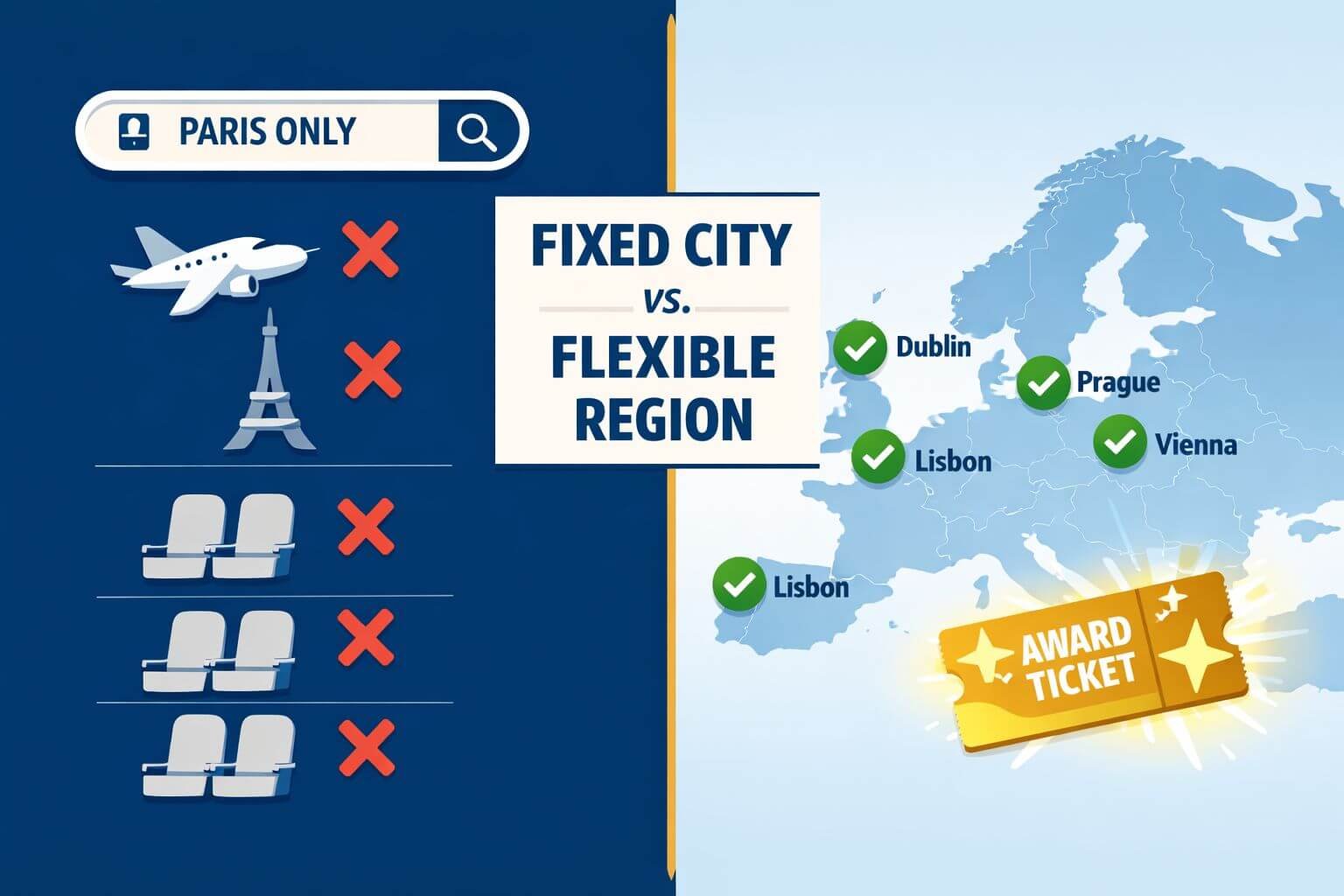
Learning how to book an award flight anywhere in Europe with miles starts with one mindset shift: stop searching for one city and start searching for a region. Use tools like Seats.aero or AwardFares to scan all European destinations at once, identify which routes have open award seats, then check which loyalty program offers the lowest mileage cost for that route. For most beginners with 60,000–120,000 transferable points, Flying Blue, ANA Mileage Club, or Air Canada Aeroplan will cover a round-trip in economy or business class — as long as you stay flexible on where you land.
Why “Anywhere in Europe” Is Easier (and Cheaper) Than One Specific City
Searching for award space to a single European city is one of the most frustrating experiences in travel rewards. Searching for any European city with open award seats is a completely different game — and beginners who make this shift almost always find better options faster.
Here’s why flexibility works so well for Europe specifically:
Europe has dozens of major gateway airports. London Heathrow, Paris CDG, Amsterdam Schiphol, Lisbon, Madrid, Frankfurt, Zurich, Vienna, Dublin, Copenhagen — all of these receive direct transatlantic flights from U.S. cities. Award space doesn’t concentrate in one place; it’s spread across all of them. On any given week, one city might have a wide-open business class while another has nothing for months.
Mileage costs vary by program, not just by city. Flying into Lisbon instead of Paris might cost you the same miles on Flying Blue (since both are in the same pricing zone), but save you 15,000–20,000 miles on a different program. Knowing which programs price Europe as a single zone versus by distance or carrier is one of the most useful early lessons in award travel.
Low-cost carriers and trains make “anywhere” practical. Once you land in Europe, getting from Lisbon to Barcelona costs $30–60 on Ryanair or Vueling. A train from Paris to Amsterdam runs for about 2.5 hours. So landing in a “wrong” city isn’t really wrong — it’s just a short hop away from where you want to be.
The mental shift: Instead of “I need to fly to Rome,” think “I need to get to Europe, and then I’ll get to Rome.” That one change opens up three times as many award options.
For a deeper look at how flexible thinking applies across programs, the Secrets to Booking Award Flights with Flexible Points guide covers the broader strategy well.
The Best Free and Paid Tools for Flexible Europe Award Searches
The right tools make a flexible Europe award search fast and clear. Here are the ones that actually work for beginners searching across the whole region.
Google Flights (Free — Start Here)
Google Flights isn’t an award search tool, but it’s the best starting point for any European trip. Use it to:
- Identify which U.S. cities have direct routes to Europe (this tells you which airline partnerships to look for in award programs)
- Find the cheapest travel dates using the calendar view
- Understand the cash price of your trip, which helps you calculate whether your miles are giving good value
How to use it for flexible searches: Enter your departure city, set the destination to “Europe,” and switch to the map view. You’ll see cash prices for dozens of European cities at once. This tells you where airlines are flying and which routes are competitive.
Seats.aero (Paid — Best for Award Space Scanning)
Seats.aero is the most powerful tool for beginners who want to search award space across all of Europe simultaneously. It aggregates availability from multiple loyalty programs and lets you filter by:
- Departure region (e.g., Northeast U.S.)
- Destination region (e.g., all of Europe)
- Cabin class (economy, business, first)
- Date range
The paid tier (around $99/year as of early 2026) unlocks full search history and alerts. The free tier still shows recent availability, which is useful for getting started. For a full breakdown of how to set up award alerts alongside Seats.aero, check out Best Award Travel Tools and Alerts to Set Up for 2026 Bookings.
AwardFares (Paid — Great for Star Alliance and SkyTeam)
AwardFares specializes in real-time award seat scanning and is particularly strong for Star Alliance and SkyTeam partners. Its timeline view shows you availability across multiple dates at once — extremely useful when your dates are flexible. It also lets you search by alliance rather than specific airline, which is exactly what flexible Europe searchers need.
Roame (Free Tier Available)
Roame is a newer tool that’s gained traction for its clean interface and multi-program search. It’s especially useful for beginners because it shows you which program to book through, along with availability, removing one step of guesswork.
point.me (Paid)
point.me is built for people who already know their points balance and want to see what they can actually book. Enter your points, currencies, and balances, and it shows you real award options ranked by value. For someone sitting on 120,000 Chase Ultimate Rewards or Amex Membership Rewards points, this is a fast way to see Europe options without memorizing every transfer partner.
Airline Engines Worth Knowing
Some airline websites still offer useful, flexible search features:
| Tool | Best For | Cost |
|---|---|---|
| United.com (not logged in) | Searching ANA and Star Alliance partner space | Free |
| AirFrance.us | Flying Blue award search | Free (account required) |
| BritishAirways.com | Avios searches on BA and partners | Free |
| Aeroplan.com | Air Canada partner space | Free |
Common mistake: Logging into United.com when searching for ANA partner awards. Logging in can filter out availability that’s visible to non-members. Search without an account for the most complete picture.
Step-by-Step Workflow: How to Book an Award Flight Anywhere in Europe with Miles
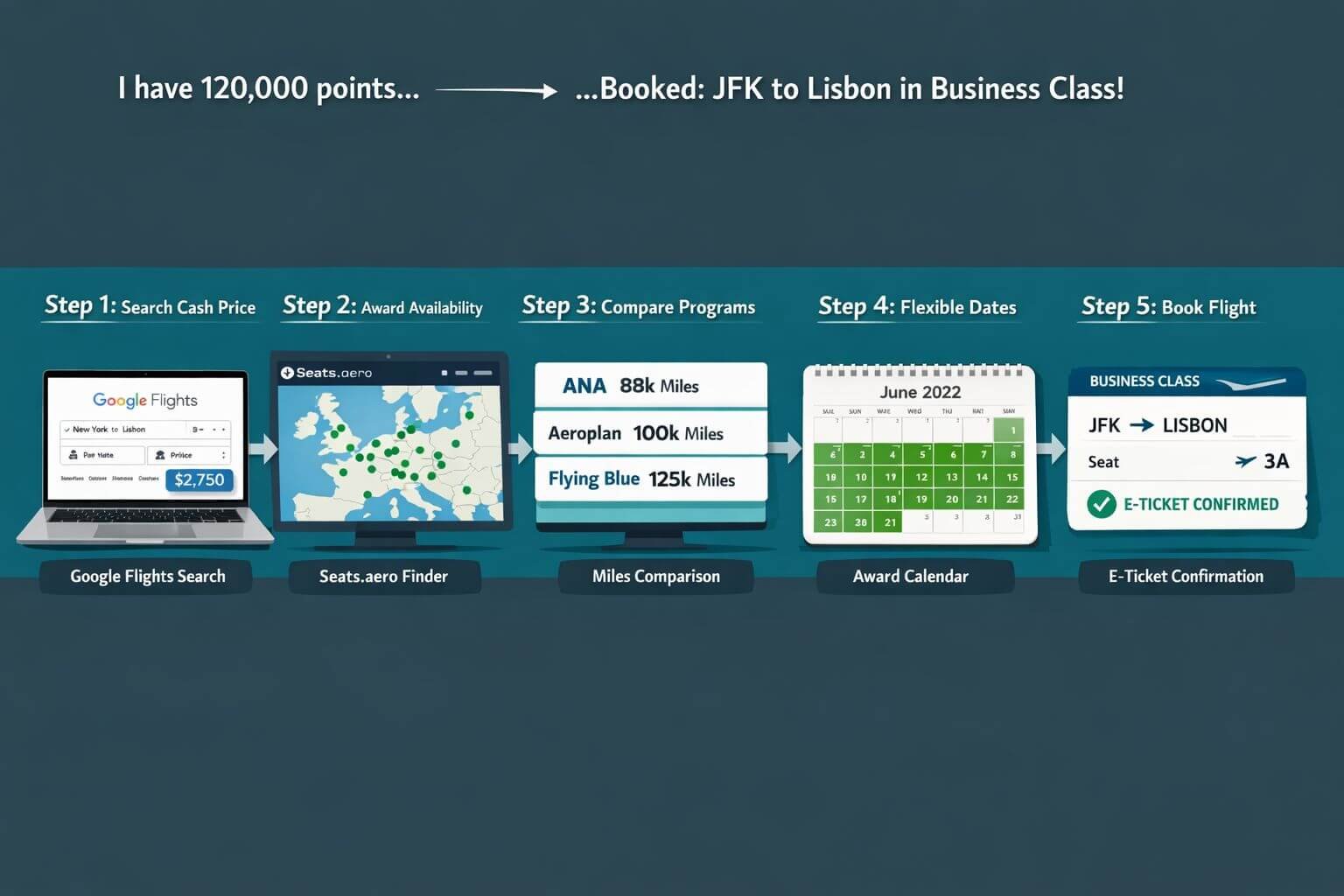
This is the practical workflow for a beginner with a flexible mindset. The example scenario: you’re based in the Northeast U.S. (JFK, BOS, or PHL), you have roughly 120,000 transferable points (Chase Ultimate Rewards, Amex Membership Rewards, or Citi ThankYou), and you want to go to Europe in May 2026 — destination open.
Step 1: Check Google Flights for Route Intelligence
Go to Google Flights. Set departure to “New York area” (it’ll include JFK, EWR, LGA). Set the destination to “Europe.” Switch to map view. Look at which cities have direct flights and which dates are cheapest in cash terms. This tells you which routes airlines are actively flying — and award space generally follows cash routes.
In May 2026, you’d likely see strong options to London, Dublin, Lisbon, Amsterdam, Paris, and Frankfurt from the New York area. Note these cities down.
Step 2: Search Award Space on Seats.aero or AwardFares
Open Seats.aero. Set:
- Origin: New York area airports (JFK, EWR, LGA, BOS, PHL — add all of them)
- Destination: Europe (select the region, not a specific city)
- Cabin: Business (or Economy if that’s your goal)
- Dates: May 1–31, 2026
You’ll get a list of routes with open award space, the program that holds the space, and the approximate mileage cost. This is your menu of options.
Step 3: Cross-Reference Program Pricing
Once you see which routes have space, check what each program charges. Here’s how the math works for a sample JFK-to-Europe business class trip:
| Program | Miles (One-Way Business) | Fuel Surcharges? | Notes |
|---|---|---|---|
| Flying Blue | 60,000 | Sometimes | Accepts Chase, Amex, Citi, Capital One transfers |
| Air Canada Aeroplan | 90,000 (East Coast) | Low | Strong partner network, no fuel surcharges on many partners |
| ANA Mileage Club | 50,000 (one-way, post-June 2025) | Yes on some carriers | Excellent value; search via United.com without logging in |
| Avianca LifeMiles | 69,000–80,000 | No | No fuel surcharges; transfers from Amex, Citi, Capital One |
| United MileagePlus | 70,000–88,000 | Varies | Dynamic pricing; check carefully |
For this 120,000-point budget, ANA Mileage Club stands out: a one-way business class seat to Europe at 50,000 miles leaves you 70,000 miles for the return — or a second trip. Flying Blue at 60,000 miles each way uses your full budget for a round-trip, but it is the easiest to transfer to from most credit card programs.
The savings math: Choosing ANA over a program charging 88,000 miles one-way saves you 38,000 miles on a single ticket — enough for a free economy round-trip to the Caribbean on many programs. That’s the real value of comparing programs before you book.
Step 4: Identify Your Transfer Partners
Check which of your credit card points transfer to your chosen program:
- Chase Ultimate Rewards transfers to: Flying Blue, Aeroplan, United, British Airways Avios, Singapore KrisFlyer, and others
- Amex Membership Rewards transfers to: Flying Blue, ANA, Avianca LifeMiles, British Airways Avios, and others
- Citi ThankYou transfers to: Flying Blue, Avianca LifeMiles, Turkish Miles&Smiles, and others
For the Flying Blue program, transfers come in from all four major bank programs, which makes it the most accessible starting point for most beginners. For ANA Mileage Club, Amex is your primary transfer path.
Step 5: Confirm Space and Book
Once you’ve identified a route with open space and a program that prices it well:
- Go directly to the airline’s website (AirFrance.us for Flying Blue, United.com without login for ANA partner space, Aeroplan.com for Air Canada)
- Confirm the award space is still available
- Transfer your points (only after confirming — transfers are usually one-way and final)
- Book the award
Important: Award space can disappear within minutes on popular routes. Don’t transfer points until you’ve confirmed the seat is bookable on the airline’s own site.
Example Routes and Programs That Work for Europe Business Class
Here are three concrete scenarios showing how the “anywhere in Europe” approach plays out with 120,000 transferable points.
Scenario A: JFK to Lisbon — Flying Blue
Lisbon has become one of the most award-friendly European gateways. TAP Air Portugal is a Star Alliance member, and Air France/KLM operate the route directly. Flying Blue prices this at 60,000 miles one-way in business class.
With 120,000 Amex or Chase points transferred to Flying Blue, you get a round-trip business class ticket to Lisbon. Flying Blue also runs Promo Rewards sales two to three times per year, where select routes drop to 10,000–15,000 miles one-way in economy, making Lisbon potentially reachable for under 30,000 miles round-trip during a promo.
From Lisbon, trains and budget flights reach Madrid (3 hours by train), Seville, Porto, and beyond.
For tips on making the most of Flying Blue’s stopover rules, see Maximize Your Europe Trip with Flying Blue Stopovers.
Scenario B: JFK to Vienna — ANA Mileage Club via Lufthansa
Vienna doesn’t always show up on beginner radar, but it’s a fantastic base for Central Europe (Prague is 4 hours by train, Budapest is 2.5 hours). Lufthansa flies JFK-Vienna, and ANA Mileage Club can price that Lufthansa seat at approximately 50,000 miles one-way in business class post-June 2025.
With 120,000 Amex points transferred to ANA, you cover the round-trip with miles to spare. The catch: Lufthansa business class carries fuel surcharges, so budget an extra $200–400 in fees. Still, the seat itself (Lufthansa’s short-haul business or Allegris on newer routes) is worth it for many travelers.
Search this on United.com without logging in, then book through ANA’s website.
Scenario C: BOS to Dublin — Aeroplan via Aer Lingus
Aer Lingus is an Aeroplan partner, and Dublin is one of the easiest transatlantic gateways for East Coast travelers — plus it has U.S. Customs pre-clearance, so you arrive in Europe already cleared. Air Canada Aeroplan prices this route at approximately 90,000 points one-way from the East Coast in Business Class.
That’s over your 120,000-point budget for a round-trip, but here’s the workaround: book the business class outbound with Aeroplan (90,000 points), then use a separate 25,000-mile economy award on Flying Blue for the return. Total: 115,000 points across two programs, and you’ve flown business class one-way.
For more on maximizing Aeroplan awards, including current transfer bonuses from Chase, that guide covers the details.
When to Book: Award Space Timing for Europe
Award space to Europe is genuinely scarce, especially in business class. Setting the right expectations here saves a lot of frustration.
Summer (June–August): Book 11–12 Months Out or Forget It
Summer Europe Business Class awards are among the hardest to find in all of award travel. Airlines know demand is high and release very little partner award space. If you want summer travel, start searching the day the booking window opens — typically 330–365 days before departure, depending on the airline.
If you find nothing at 11 months out, the next window is last-minute (within 2 weeks of departure), when airlines sometimes release unsold seats. This is a gamble, not a strategy.
Shoulder Season (May, September, October): The Sweet Spot
May and September are the best months for beginners searching for “anywhere in Europe” awards. Award space is meaningfully more available, mileage costs are the same (most programs don’t charge more for shoulder season), and Europe itself is less crowded and less expensive on the ground.
Miles & More, for example, ran a Mileage Bargains promotion through February 28, 2026, offering round-trip business class at 61,000 miles for travel between May 15 and June 30, 2026 — routes included JFK to Brussels and IAD to Brussels on Brussels Airlines. These promotions reward travelers who stay alert and flexible.
November–March (Off-Peak): Easiest Award Space, Fewer Crowds
If your dates are truly flexible, November through March (excluding holiday weeks) offers the most consistent award availability. Business Class seats that are impossible to find in July appear regularly in January. The tradeoff is weather and shorter daylight hours, but for cities like Lisbon, Seville, or the Canary Islands, winter is genuinely pleasant.
For strategies on booking off-peak travel with points, see Best Ways to Book Winter Travel Deals with Points After Holiday Crowds.
Pro Tips for Positioning Flights, Low-Cost Carriers, and Trains in Europe
Once you’ve landed in Europe, the “flexible hub” strategy really pays off. Here’s how to think about it.
Choose a Hub Airport, Then Radiate Out
The most award-friendly European gateway airports — Lisbon, Dublin, Amsterdam, Frankfurt, Vienna — are all excellent bases for further travel. From any of them, you can reach most of Western and Central Europe within 2–4 hours by train or a short budget flight.
Best hubs for onward travel:
- Lisbon (LIS): Easy access to Spain, Morocco, and Porto
- Dublin (DUB): Good for U.K. and quick hops to mainland Europe; U.S. pre-clearance is a bonus
- Amsterdam (AMS): Central location; trains reach Paris, Brussels, Cologne in under 3 hours
- Vienna (VIE): Gateway to Central/Eastern Europe; Prague, Budapest, Bratislava, all within 3 hours
- Frankfurt (FRA): Massive Lufthansa hub; trains reach most of Germany and neighboring countries
Low-Cost Carriers: Your Secret Weapon
Ryanair, Vueling, Wizz Air, and EasyJet operate hundreds of intra-Europe routes for $20–80. Once you’re in Europe on your award ticket, these carriers let you visit 2–3 countries for the cost of a nice dinner.
Common mistake: Booking a tight connection between an international award flight and a low-cost carrier. If your transatlantic flight is delayed, the LCC won’t rebook you. Always book these as separate tickets with at least one night between them.
For a deeper look at using points for European ground travel, Maximizing Points for Train Travel in Europe is worth reading before you go.
The “Positioning Flight” Move
If your home airport doesn’t have great award options, consider flying to a U.S. hub first. For example:
- Flying from Charlotte (CLT) to JFK on a cheap domestic ticket ($50–80), then taking a transatlantic award from JFK
- Flying from Denver (DEN) to Chicago (ORD), then onward to Europe on a United or Lufthansa award
This is called a positioning flight, and it dramatically expands your departure options. Many award programs also allow you to add a domestic connection to your international award for free or very few extra miles.
Alliance Thinking Makes “Anywhere” Work
Understanding airline alliances helps you predict which award programs can book which flights. Star Alliance (United, Lufthansa, ANA, Air Canada, TAP, Swiss, Austrian, LOT) covers the most European destinations. Oneworld (British Airways, Iberia, Finnair, Aer Lingus) is strong in the U.K. and Scandinavia. SkyTeam (Air France, KLM, Alitalia successor ITA Airways) covers France, the Netherlands, and Italy well.
For a solid primer on how alliances work and why they matter for award searches, the Beginner’s Guide to Airline Alliances explains it clearly without getting into the weeds.
For Star Alliance specifically — which covers the most European routes — the Star Alliance Award Booking Guide 2026 walks through partner booking step by step.
Common Mistakes Beginners Make When Searching Europe Awards
Transferring points before confirming availability. Points transfers are almost always one-way and instant. If you transfer 60,000 Chase points to Flying Blue and then the seat disappears, you’re stuck with Flying Blue miles. Always confirm the award seat is bookable on the airline’s website before transferring.
Searching for only one program. The same seat on Lufthansa from JFK to Frankfurt might be bookable through ANA, United, Avianca LifeMiles, or Air Canada Aeroplan — at very different mileage costs. Always compare at least two programs before booking.
Ignoring fuel surcharges. Some programs (British Airways Avios, Lufthansa’s own program) pass through substantial fuel surcharges that can add $300–700 per ticket. Programs like Avianca LifeMiles and Air Canada Aeroplan are known for low or no fuel surcharges on partner awards.
Booking too late for summer. If you want to travel to Europe in June or July in Business Class, you need to start searching 10–12 months out. Starting in April for a July trip will almost always result in disappointment.
Fixating on Paris and London only. These are the two most popular European destinations and consistently have the worst award availability. Lisbon, Vienna, Prague (via Vienna), Dublin, and Amsterdam regularly have better availability at the same mileage cost.
FAQ: How to Book an Award Flight Anywhere in Europe with Miles
Q: How many miles does it take to fly to Europe? Economy class to Europe starts at around 20,000–25,000 miles one-way on programs like Virgin Atlantic Flying Club (for U.S. to U.K.) or Flying Blue. Business class runs 50,000–90,000 miles one-way, depending on the program.
Q: What’s the easiest loyalty program for a beginner booking Europe awards? Flying Blue (Air France/KLM) is the most beginner-friendly because it accepts transfers from Chase, Amex, Citi, and Capital One, and its award search tool is straightforward. Economy starts at 25,000 miles one-way; business class at 60,000.
Q: Can I really search for “anywhere in Europe” as a destination? Yes. Tools like Seats.aero, AwardFares, and Roame let you set the destination to a region rather than a specific city. Google Flights also has a map view that shows cash prices across Europe at once, helping identify which routes are active.
Q: Is business class to Europe worth the miles? For most people, yes — especially on long overnight flights. Business class seats on carriers like Lufthansa, Air France, and Swiss include lie-flat beds, which makes a meaningful difference on a 7–9 hour flight. The mileage cost is roughly 2–3x economy, but the experience is significantly better.
Q: What’s the best time of year to find Europe award space? Shoulder season (May, September, October) and off-peak (November–March, excluding holidays) offer the most consistent award availability. Summer (June–August) is the hardest by far.
Q: Do fuel surcharges make some programs not worth it? It depends on the program and carrier. British Airways Avios and Lufthansa Miles & More can carry high surcharges. Avianca LifeMiles and Air Canada Aeroplan are better for avoiding them. Always check the total out-of-pocket cost, not just the miles required.
Q: What if my home airport doesn’t have direct Europe flights? Use a positioning flight — a cheap domestic ticket to a major hub (JFK, ORD, IAD, BOS) — and then take your transatlantic award from there. Many programs also let you add a domestic connection to your international award at no extra cost.
Q: How far in advance should I book Europe awards? For summer travel: 10–12 months out. For shoulder season, 4–8 months is usually sufficient. For off-peak: 2–4 months often works, and last-minute (within 2 weeks) occasionally opens up.
Q: Can I use one set of points to book multiple European cities? Some programs allow stopovers (Air Canada Aeroplan and ANA are known for this). A stopover lets you spend time in one city en route to another — for example, flying JFK-Frankfurt-Vienna with a few days in Frankfurt — all on one award ticket. See Award Flight Stopovers: Insider Tricks on Air Canada, ANA, and Alaska for how this works.
Q: What if I can’t find award space anywhere? Set alerts on Seats.aero or AwardFares for your preferred routes and cabin. Award space releases in waves — airlines sometimes release seats 24–48 hours before departure, or in batches at the 330-day mark. Patience and alerts together solve most availability problems.
Q: Are there programs with no fuel surcharges for Europe business class? Yes. Avianca LifeMiles is well-known for its lack of fuel surcharges on Star Alliance partners, including Lufthansa and Swiss. Air Canada Aeroplan also has low or no surcharges on many partner bookings.
Q: What’s a “saver” award versus a “dynamic” award? A saver award has a fixed mileage price set by the program’s award chart (e.g., 60,000 miles for business class to Europe). A dynamic award price fluctuates based on cash ticket prices — it might be 45,000 miles one day and 120,000 the next. Beginners generally get better value from programs with fixed award charts. United MileagePlus and Delta SkyMiles use dynamic pricing; Flying Blue and Aeroplan use a mix.
Conclusion: Your Next Steps for Booking “Anywhere in Europe” with Miles
The beginner’s path to Europe on miles is simpler than most guides make it look — once you drop the requirement of a specific city.
Here’s a clear action plan to get started:
- Audit your points. Log into your credit card accounts and note which transferable currencies you have (Chase, Amex, Citi, Capital One). Check balances.
- Pick your travel window. Shoulder season (May or September) gives you the best odds of finding space without fighting summer crowds.
- Open Seats.aero or AwardFares. Search Northeast U.S. to Europe (or your region to Europe) in your target month. See what’s available before you decide on a destination.
- Compare two programs. For any routes showing availability, check the mileage cost in at least Flying Blue and one other program (ANA, Aeroplan, or LifeMiles).
- Confirm on the airline’s own site. Before transferring any points, verify the seat is bookable directly.
- Transfer and book. Move only the points you need, then book immediately.
If you’re ready to go deeper on business class specifically, the How to Book Star Alliance Business Class Awards: 2026 Complete Guide covers the full partner booking process in detail. And if you’re still building your points base, Travel Hacking 101: Beginner’s Guide to Earning and Using Travel Points is the right place to start.
Europe is absolutely reachable by miles — even for beginners, even without a fixed city in mind. The flexibility is the strategy.
Key Takeaways
- Flexible destination searches (all of Europe, not one city) consistently surface more award options than fixed-city searches.
- Seats.aero, AwardFares, and Roame are the best tools for region-wide award space scanning; Google Flights helps with route intelligence.
- Flying Blue is the most transfer-partner-friendly program for Europe awards; ANA Mileage Club and Avianca LifeMiles offer strong mileage value with different tradeoffs.
- Business class to Europe starts around 50,000–60,000 miles one-way on the best programs; 120,000 transferable points can cover a round-trip on several programs.
- Shoulder season (May, September, October) offers the best balance of award availability, weather, and value.
- Always confirm award space on the airline’s website before transferring points — transfers are almost always final.
- “Flexible hub” thinking (land anywhere with open seats, then use trains or budget carriers) makes the “anywhere in Europe” approach genuinely practical on the ground.
- Fuel surcharges can add $200–700 to an award ticket; programs like Avianca LifeMiles and Air Canada Aeroplan are better for avoiding them.
- Set award alerts on Seats.aero or AwardFares for your preferred routes — space opens in waves and alerts catch it automatically.
- Positioning flights (cheap domestic tickets to a major U.S. hub) dramatically expand your departure airport options for transatlantic awards.

