

Reaching 100,000 points feels like crossing a threshold. It’s not just another balance update—it’s the moment when aspirational travel shifts from “someday” to “this year.” But here’s where many points earners stall: they’ve built the balance but lack a clear framework for extracting maximum value. Should those 100,000 Chase points go toward United business class to Europe, or transfer to Hyatt for five nights in Tokyo? What about Amex points—are they better with ANA or Air France?
The best use of 100,000 points isn’t a single answer. It’s a decision framework based on your travel goals, route flexibility, and how you calculate value. This guide compares real redemption options across Chase Ultimate Rewards, Amex Membership Rewards, Capital One, and Citi transfer partners. You’ll see specific flight examples, hotel night calculations, and cents-per-point (CPP) values for each scenario—so you can rank options and book with confidence.
Key Takeaways
- Business Class flights to Europe or Asia consistently deliver 1.5–2.5 cents per point when booked through optimal transfer partners like ANA, Air France, or Singapore Airlines
- Luxury hotel stays through Hyatt or Hilton can yield 1.8–2.8 CPP for aspirational properties, often exceeding flight redemption value
- 100,000 points opens access to round-trip premium cabin awards on most major routes when you understand partner sweet spots and award availability patterns
- Transfer bonuses can boost effective value by 15–30%, turning 100K into 115K–130K points with strategic timing
- Pure CPP calculations miss context—surcharges, availability, and booking flexibility matter as much as raw point value
Understanding Transfer Partner Value: The Foundation
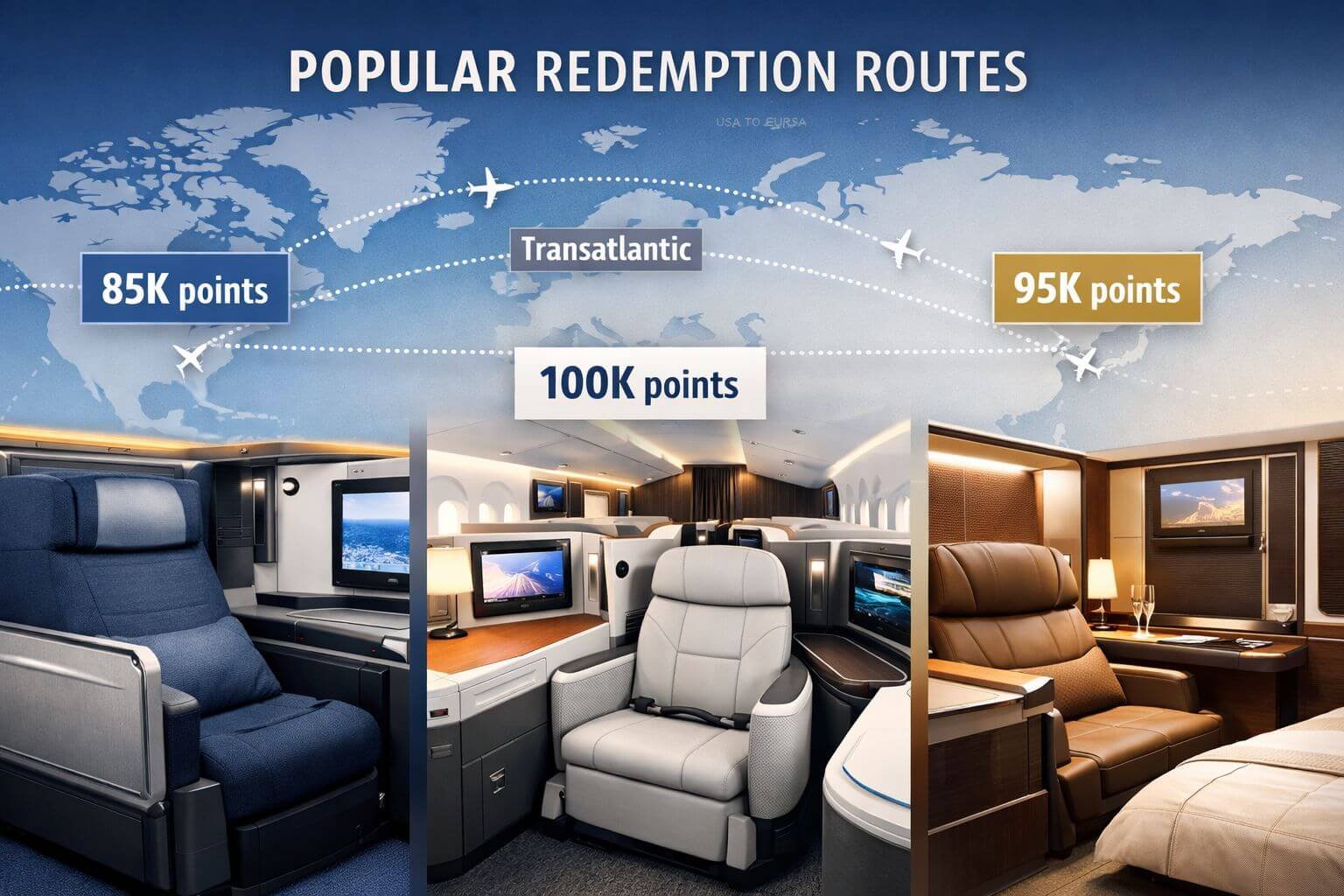
Before comparing specific redemptions, establish how transfer partners work and why they matter for the best use of 100,000 points.
Transferable points programs—Chase Ultimate Rewards, Amex Membership Rewards, Capital One Miles, Citi ThankYou—let you move points to airline and hotel partners at fixed ratios (usually 1:1). Once transferred, points follow the partner’s award chart and availability rules.
Why this matters: Transferring 100,000 Chase points to United gets you a different redemption than transferring the same balance to Hyatt. United uses dynamic pricing for most awards; Hyatt maintains fixed award charts. The partner you choose determines your value outcome.
Cents Per Point (CPP): The Value Benchmark
CPP measures redemption value by comparing the cash price of a ticket or stay to the points required:
Formula: (Cash price ÷ Points used) × 100 = CPP
Example: A $1,200 business class ticket costs 60,000 points. That’s ($1,200 ÷ 60,000) × 100 = 2.0 CPP.
Decision framework:
- Below 1.0 CPP: Poor value; consider cash or portal booking
- 1.0–1.5 CPP: Acceptable for economy or standard hotel stays
- 1.5–2.5 CPP: Strong value for premium cabins or luxury hotels
- Above 2.5 CPP: Exceptional; typically aspirational redemptions
Use the Award Travel Hub calculator to run your own scenarios with current cash prices and award costs.
Common Mistakes to Avoid
❌ Transferring before confirming availability: Points transfers are usually one-way. Always search award space first, then transfer.
❌ Ignoring surcharges: Some partners (British Airways, Lufthansa) add $400+ in fuel surcharges to award tickets. Your CPP calculation must include these fees.
❌ Chasing CPP without considering your goals: A 3.0 CPP redemption to a destination you don’t want to visit delivers zero real value.
Round-Trip Business Class Flights: Best Transfer Partner Routes
Business class redemptions typically offer the strongest value for 100,000 points. Here’s what that balance can book across major transfer partners in 2026.
United MileagePlus (Chase Transfer Partner)
Route: New York (EWR) to London (LHR) round-trip
Points Required: 100,000 miles (Saver award)
Typical Cash Price: $2,500–$3,500
CPP Value: 2.5–3.5 CPP
Surcharges: ~$150 in taxes/fees
Why this works: United operates direct flights and releases consistent Saver award space 337 days out. The 100K price point is fixed for transatlantic business class, regardless of season (though availability tightens in summer).
Best for: Travelers with flexibility to book 11 months in advance and those based near United hubs (Newark, Chicago, San Francisco).
Not for: Last-minute bookings or peak summer travel when Saver space disappears.
Air France/KLM Flying Blue (Chase, Amex, Capital One, Citi Partner)
Route: Los Angeles (LAX) to Paris (CDG) round-trip
Points Required: 100,000–110,000 miles (off-peak)
Typical Cash Price: $3,000–$4,000
CPP Value: 2.7–4.0 CPP
Surcharges: ~$200–$300
Why this works: Flying Blue uses dynamic pricing, but off-peak awards (November–March, excluding holidays) often price at 50,000–55,000 miles one-way. The program runs frequent transfer bonuses that can reduce effective cost by 25%.
Sweet spot: Promo awards during transfer bonus periods. A 30% bonus turns 77,000 transferred points into 100,000 Flying Blue miles.
Watch out: Peak pricing can spike to 150,000+ miles round-trip. Always check the calendar before transferring.
ANA Mileage Club (Amex Transfer Partner)
Route: San Francisco (SFO) to Tokyo (NRT) round-trip
Points Required: 85,000–95,000 miles (depending on season)
Typical Cash Price: $3,500–$5,000
CPP Value: 3.7–5.9 CPP
Surcharges: ~$100–$150
Why this works: ANA maintains one of the last true award charts with fixed pricing. Business class to Japan prices at 85,000 miles round-trip in low season, 95,000 in high season. The program allows one stopover on round-trips, effectively giving you two destinations for one award.
Best for: Travelers booking ANA-operated flights or Star Alliance partners like United. Award space on ANA metal is generous 355 days out.
Limitation: ANA requires phone booking for partner awards, and the website can be clunky for English speakers. Budget extra time for the booking process.
Singapore Airlines KrisFlyer (Chase, Amex, Capital One, Citi Partner)
Route: New York (JFK) to Frankfurt (FRA) round-trip on Lufthansa
Points Required: 90,000–100,000 miles
Typical Cash Price: $3,000–$4,500
CPP Value: 3.0–5.0 CPP
Surcharges: ~$400–$600 (Lufthansa adds high fuel surcharges)
Why this works: KrisFlyer offers access to Star Alliance partners with better availability than United sometimes releases to its own members. The program doesn’t pass on all partner surcharges, though Lufthansa remains expensive.
Strategic note: Consider routing through a partner with lower surcharges (Swiss, Austrian) to reduce out-of-pocket costs while maintaining strong CPP.
Best for: Flexible travelers who can adjust routing to minimize fees and maximize value.
Virgin Atlantic Flying Club (Amex, Capital One, Citi Partner)
Route: Boston (BOS) to London (LHR) round-trip on Delta
Points Required: 100,000 miles
Typical Cash Price: $2,800–$3,800
CPP Value: 2.8–3.8 CPP
Surcharges: ~$400–$500 (Virgin adds carrier surcharges on own metal; Delta flights have lower fees)
Why this works: Virgin offers competitive pricing on Delta-operated flights, and Delta’s business class product (Delta One) is strong on transatlantic routes. Virgin runs frequent transfer bonuses (often 15–30%) that effectively reduce the cost.
Sweet spot: Book Delta flights to avoid Virgin’s own surcharges. A 30% transfer bonus turns 77,000 Amex points into 100,000 Virgin miles.
Watch out: Award space on Delta can be limited. Search early and be flexible with dates.
For more context on maximizing premium cabin bookings, see our guide on best cards for international travel.
Luxury Hotel Stays: Points-to-Nights Comparison
Hotel redemptions often surprise points earners with their value potential. While business class flights grab headlines, luxury hotel stays can deliver equal or better CPP—especially at aspirational properties where cash rates exceed $500/night.
World of Hyatt (Chase Transfer Partner)
Property Example: Park Hyatt Tokyo
Points Per Night: 30,000 (Category 6)
Nights with 100K: 3 nights (90,000 points)
Typical Cash Rate: $650/night
Total Cash Value: $1,950
CPP Value: 2.17 CPP
Additional Perks: Free breakfast for Globalist members; upgrades subject to availability
Why this works: Hyatt maintains fixed award charts, so 30,000 points always books a Category 6 property regardless of cash rate fluctuations. The Park Hyatt Tokyo consistently ranks among the world’s top luxury hotels, and 100,000 points delivers three nights in the heart of Shinjuku.
Strategic consideration: Hyatt’s fifth-night-free benefit (on awards) means 120,000 points books five nights—effectively 24,000 points per night. If you can top up 20,000 points, your CPP jumps to 2.71.
Best for: Travelers prioritizing hotel experience over flight class, especially in expensive markets (Tokyo, Paris, New York, Maldives).
Hilton Honors (Amex Transfer Partner)
Property Example: Conrad Maldives Rangali Island
Points Per Night: 95,000 (standard room)
Nights with 100K: 1 night (95,000 points, plus 5K leftover)
Typical Cash Rate: $1,200–$1,800/night
CPP Value: 1.26–1.89 CPP
Additional Perks: Fifth night free on award stays; resort credit for Diamond members
Why this works: Hilton’s fifth-night-free benefit is the real value unlock. While 100,000 points only books one night at the Conrad Maldives, 475,000 points books five nights—effectively 95,000 per night at a property that often costs $1,500+ in cash.
Transfer consideration: Amex transfers to Hilton at 1:2 (1,000 Amex points = 2,000 Hilton points). To book five nights, you’d transfer 237,500 Amex points to get 475,000 Hilton points. That’s still 47,500 points per night for a $1,500 property—3.16 CPP.
Best for: Travelers planning longer stays (5+ nights) at aspirational properties where the fifth-night-free benefit compounds value.
Not for: Short stays or standard properties where cash rates are reasonable. Hilton points lose value quickly at mid-tier brands.
Marriott Bonvoy (Chase, Amex Transfer Partner)
Property Example: St. Regis Maldives Vommuli Resort
Points Per Night: 100,000 (Category 8)
Nights with 100K: 1 night
Typical Cash Rate: $1,500–$2,200/night
CPP Value: 1.5–2.2 CPP
Additional Perks: Fifth night free on award stays; suite upgrades for Platinum+ members
Why this works: Marriott’s Category 8 properties represent the portfolio’s peak—often overwater villas, remote resorts, and urban flagships. While 100,000 points only books one night, the fifth-night-free benefit means 400,000 points books five nights (80,000 per night).
Transfer consideration: Both Chase and Amex transfer to Marriott at 1:1, but Marriott points generally deliver lower CPP than Hyatt. The value case works at ultra-luxury properties where cash rates are astronomical.
Strategic note: Marriott runs periodic “Nights for Less” promotions offering 20–30% discounts on award stays. Booking during these windows can stretch 100,000 points to 1.25 nights or reduce the five-night cost to 350,000 points.
Best for: Travelers with large point balances targeting bucket-list properties where cash rates exceed $1,000/night.
IHG One Rewards (Chase Transfer Partner)
Property Example: InterContinental Bora Bora Resort & Thalasso Spa
Points Per Night: 70,000
Nights with 100K: 1 night (70,000 points, plus 30K leftover)
Typical Cash Rate: $900–$1,400/night
CPP Value: 1.29–2.0 CPP
Additional Perks: Fourth night free on award stays; upgrades for Diamond members
Why this works: IHG’s fourth-night-free benefit (not fifth) means 210,000 points books four nights—52,500 per night. At $1,000+ cash rates, that’s 1.9+ CPP. The Bora Bora property is one of IHG’s few true luxury offerings.
Transfer consideration: Chase transfers to IHG at 1:1, but IHG runs frequent transfer bonuses (often 30–50%). A 50% bonus turns 70,000 Chase points into 105,000 IHG points—enough for one night with points to spare.
Best for: Travelers targeting specific IHG luxury properties (Bora Bora, Maldives, select InterContinentals) where the brand punches above its typical tier.
Not for: Most IHG properties, where cash rates are reasonable and CPP drops below 0.8.
For more strategies on hotel redemptions, explore our best hotel loyalty free nights guide.
Chase Ultimate Rewards: Top 100K Point Redemptions
Chase Ultimate Rewards transfers to 14 airline and hotel partners, offering broad flexibility for the best use of 100,000 points. Here’s how to maximize that balance across Chase’s strongest partners in 2026.
Option 1: United MileagePlus (Business Class to Europe)
Redemption: New York to London round-trip
Points: 100,000 miles
Cash Value: $2,500–$3,500
CPP: 2.5–3.5
Why United: Direct access to Star Alliance award space, fixed Saver pricing, and consistent availability 337 days out. United’s Polaris business class product is solid on transatlantic routes.
Booking tip: Search award space on United.com before transferring. Saver space appears as “Saver” tags on the calendar. Transfer only after confirming availability on your preferred dates.
Option 2: World of Hyatt (Luxury Hotel Stays)
Redemption: 3 nights at Park Hyatt Paris-Vendôme
Points: 90,000 (30,000/night, Category 6)
Cash Value: $1,950 (at $650/night)
CPP: 2.17
Why Hyatt: Fixed award charts, exceptional luxury properties, and the fifth-night-free benefit for longer stays. Hyatt consistently delivers 1.8–2.5 CPP at Category 5–7 properties.
Strategic note: If you have 120,000 Chase points, transfer all and book four nights (120,000 points). Hyatt’s fifth-night-free benefit applies at 150,000 points for five nights—24,000 per night effective cost.
Option 3: Southwest Rapid Rewards (Companion Pass Strategy)
Redemption: Multiple domestic flights with Companion Pass
Points: 100,000 points = ~$1,400 in flights (at 1.4 cpp baseline)
Effective Value with Companion: $2,800 (doubling value)
CPP: 2.8 (with companion)
Why Southwest: If you hold a Companion Pass (earned by flying 100 qualifying one-way flights or earning 135,000 qualifying points in a calendar year), every redemption effectively doubles in value. Your companion flies free on award tickets.
Best for: Domestic travelers with Companion Pass status who fly frequently with a consistent travel partner.
Not for: International travelers or those without Companion Pass (baseline value drops to 1.2–1.4 CPP).
Option 4: Air France/KLM Flying Blue (Transatlantic Sweet Spots)
Redemption: Los Angeles to Paris round-trip (off-peak)
Points: 100,000 miles
Cash Value: $3,000–$4,000
CPP: 3.0–4.0
Why Flying Blue: Off-peak pricing and frequent transfer bonuses create value opportunities. The program’s dynamic pricing works in your favor during low-demand periods.
Booking tip: Monitor Flying Blue Promo Rewards—monthly discounted awards that can drop business class to 37,500 miles one-way. Combined with a transfer bonus, you could book this route for 60,000 Chase points transferred (78,000 Flying Blue miles after bonus).
Option 5: Singapore KrisFlyer (Asia-Pacific Premium Cabins)
Redemption: San Francisco to Singapore round-trip
Points: 92,000 miles (Advantage pricing)
Cash Value: $4,000–$6,000
CPP: 4.3–6.5
Why KrisFlyer: Access to Singapore’s own award space (some of the best business and first class products globally) plus Star Alliance partners. Advantage pricing offers discounts on Singapore-operated flights.
Strategic note: Singapore releases excellent award space to its own program 355 days out. Book early for best availability on A350 and A380 routes.
For broader context on maximizing Chase cards, see our best credit card combos for free travel.
Amex Membership Rewards: Premium Award Sweet Spots
American Express Membership Rewards transfers to 21 airline and hotel partners, including several premium options unavailable through Chase. Here’s where 100,000 Amex points delivers maximum value in 2026.
Option 1: ANA Mileage Club (Japan Business Class)
Redemption: West Coast to Tokyo round-trip
Points: 85,000–95,000 miles (season dependent)
Cash Value: $3,500–$5,000
CPP: 3.7–5.9
Why ANA: Fixed award charts, generous award space on ANA-operated flights, and the ability to add a stopover. This is consistently one of the highest-value uses of Amex points.
Booking strategy: ANA releases space 355 days out. Search on United.com (shows most ANA space), then call ANA to book. Be prepared for a phone booking process that can take 30–60 minutes.
Sweet spot: Add a stopover in Tokyo on a route to Southeast Asia. You can fly San Francisco → Tokyo (5 days) → Bangkok → Tokyo (3 days) → San Francisco for the same 95,000 miles.
Option 2: Virgin Atlantic Flying Club (Delta One to Europe)
Redemption: East Coast to London round-trip on Delta
Points: 100,000 miles
Cash Value: $2,800–$3,800
CPP: 2.8–3.8
Why Virgin: Competitive pricing on Delta-operated flights and frequent transfer bonuses. Virgin often runs 30% bonuses, turning 77,000 Amex points into 100,000 Virgin miles.
Booking tip: Search Delta award space on Delta.com, then transfer to Virgin and book. Virgin’s website shows Delta space reliably. Avoid Virgin-operated flights due to high surcharges (~$400+).
Strategic timing: Wait for a transfer bonus before moving points. Amex runs Virgin bonuses 2–3 times per year.
Option 3: Air Canada Aeroplan (North America to Europe)
Redemption: US to Europe round-trip with stopover
Points: 100,000–120,000 miles (depending on routing)
Cash Value: $2,500–$4,000
CPP: 2.1–4.0
Why Aeroplan: Flexible routing rules, stopover options, and access to Star Alliance partners. Aeroplan’s stopover benefit lets you add a second European city for just 5,000 extra points.
Example routing: New York → London (4 days) → Paris → New York for 105,000 points. You visit two cities for marginally more points than a direct round-trip.
Best for: Travelers who want to maximize destinations per redemption and don’t mind slightly higher point costs for flexibility.
Option 4: Hilton Honors (Extended Luxury Stays)
Redemption: 5 nights at Conrad Maldives
Points: 237,500 Amex points → 475,000 Hilton points
Cash Value: $7,500 (at $1,500/night)
CPP: 3.16
Why Hilton: The fifth-night-free benefit and 1:2 transfer ratio create value at ultra-luxury properties. While the point cost seems high, the CPP at aspirational resorts is strong.
Strategic consideration: This only makes sense at properties where cash rates exceed $1,000/night. At standard Hilton properties, CPP drops below 0.5.
Best for: Travelers planning bucket-list stays at Conrad, Waldorf Astoria, or LXR properties in expensive markets (Maldives, Bora Bora, Dubai).
Option 5: British Airways Avios (Short-Haul Sweet Spots)
Redemption: Multiple short-haul flights (West Coast to Hawaii, East Coast to Caribbean)
Points: 100,000 Avios = 4 round-trips at 25,000 Avios each
Cash Value: $1,600–$2,400 (at $400–$600 per round-trip)
CPP: 1.6–2.4
Why British Airways: Distance-based pricing makes short flights cheap. Los Angeles to Hawaii prices at 12,500 Avios one-way in economy, 25,000 in business/first.
Watch out: British Airways adds high fuel surcharges on own-operated flights. Stick to partner airlines (American, Alaska) to avoid fees.
Best for: Travelers making multiple short-haul trips where cash fares are expensive but distance is short.
For more on leveraging Amex benefits, check our American Express Platinum Card value guide.
Capital One and Citi: High-Value 100K Transfer Options
Capital One Miles and Citi ThankYou Points offer unique transfer partners and competitive value propositions for the best use of 100,000 points. While their partner networks are smaller than Chase or Amex, strategic sweet spots exist.
Capital One Transfer Partners: Best Options
Capital One transfers to 19 airline partners, including several overlapping with Chase and Amex plus a few exclusives.
Turkish Airlines Miles&Smiles
Redemption: US to Europe business class round-trip
Points: 90,000 miles
Cash Value: $3,000–$4,500
CPP: 3.3–5.0
Why Turkish: One of the cheapest business class redemptions to Europe via Star Alliance partners. Turkish prices United flights at 45,000 miles one-way—lower than United’s own 60,000 Saver pricing.
Booking process: Search United.com for Saver space, then call Turkish to book. Phone-only booking for partner awards.
Sweet spot: Book United Polaris flights for fewer points than transferring to United directly.
Air France/KLM Flying Blue
Redemption: US to Europe business class (off-peak)
Points: 100,000 miles
Cash Value: $3,000–$4,000
CPP: 3.0–4.0
Why Flying Blue: Same sweet spot as Chase/Amex transfers, but Capital One runs its own transfer bonuses (often 15–30%) that can stack with Flying Blue promotions.
Strategic timing: Wait for a Capital One transfer bonus to Flying Blue. A 30% bonus turns 77,000 Capital One miles into 100,000 Flying Blue miles.
Wyndham Rewards
Redemption: 13 nights at mid-tier Wyndham properties
Points: 97,500 (7,500 per night at most properties)
Cash Value: $1,300–$1,950 (at $100–$150/night)
CPP: 1.3–2.0
Why Wyndham: Flat-rate pricing at 7,500–15,000 points per night across most properties. While not luxury, this delivers strong value for extended road trips or positioning stays.
Best for: Domestic travelers needing multiple nights at budget-friendly properties where cash rates add up.
Not for: Luxury seekers or international travelers.
Citi ThankYou Transfer Partners: Best Options
Citi transfers to 18 airline partners with several unique sweet spots unavailable elsewhere.
Turkish Airlines Miles&Smiles
Redemption: US to Asia business class round-trip
Points: 90,000 miles
Cash Value: $4,000–$6,000
CPP: 4.4–6.7
Why Turkish: Exceptional value on long-haul Star Alliance business class. Turkish prices US-Asia routes at 45,000 miles one-way—significantly cheaper than most programs.
Example: San Francisco to Tokyo on ANA for 90,000 Turkish miles vs. 95,000 ANA miles. Same flight, fewer points.
Strategic note: Turkish doesn’t pass on fuel surcharges from most partners, keeping out-of-pocket costs low.
Singapore KrisFlyer
Redemption: US to Asia business class round-trip
Points: 92,000 miles (Advantage pricing)
Cash Value: $4,000–$6,000
CPP: 4.3–6.5
Why KrisFlyer: Access to Singapore’s own premium products (often considered the world’s best business and first class) plus Star Alliance partners.
Sweet spot: Book Singapore-operated A380 or A350 flights for the full premium experience. Award space is generous 355 days out.
Virgin Atlantic Flying Club
Redemption: US to Europe business class on Delta
Points: 100,000 miles
Cash Value: $2,800–$3,800
CPP: 2.8–3.8
Why Virgin: Same redemption as Amex, but Citi occasionally runs transfer bonuses to Virgin. The partnership gives Citi cardholders access to Delta award space without transferring to Delta directly (where dynamic pricing often inflates costs).
Booking tip: Book Delta flights to avoid Virgin’s own surcharges. Search on Delta.com, then transfer and book through Virgin.
For more on strategic credit card use, see our guide on avoiding common travel credit card mistakes.
Value Rankings: Which Redemptions Deliver Most Per Point
Here’s a ranked comparison of 100,000-point redemptions across all programs, sorted by typical CPP value. This framework helps identify the best use of 100,000 points based purely on value extraction.
Tier 1: Exceptional Value (3.5+ CPP)
- ANA Mileage Club: US West Coast to Tokyo business class (85K–95K points) = 3.7–5.9 CPP
- Singapore KrisFlyer: US to Asia business class on Singapore metal (92K points) = 4.3–6.5 CPP
- Turkish Miles&Smiles: US to Asia business class via Star Alliance (90K points) = 4.4–6.7 CPP
- Air France Flying Blue: US to Europe business class during off-peak with transfer bonus (77K transferred, 100K after bonus) = 3.9–5.2 CPP
Best for: Travelers prioritizing maximum point value and willing to be flexible with booking processes (phone bookings, advance planning).
Tier 2: Strong Value (2.5–3.5 CPP)
- United MileagePlus: US to Europe business class (100K points) = 2.5–3.5 CPP
- Virgin Atlantic Flying Club: US to Europe business class on Delta (100K points) = 2.8–3.8 CPP
- Hilton Honors: 5 nights at ultra-luxury properties with fifth night free (237.5K Amex → 475K Hilton) = 3.16 CPP
- Southwest Rapid Rewards: Domestic flights with Companion Pass (100K points) = 2.8 CPP effective
Best for: Travelers seeking solid value with more straightforward booking processes and broader availability.
Tier 3: Good Value (1.8–2.5 CPP)
- World of Hyatt: 3 nights at Category 6 luxury hotels (90K points) = 2.0–2.5 CPP
- Air Canada Aeroplan: US to Europe with stopover (105K points) = 2.1–4.0 CPP (varies by routing)
- Marriott Bonvoy: 1 night at Category 8 ultra-luxury (100K points) = 1.5–2.2 CPP
- British Airways Avios: Multiple short-haul flights (100K points = 4 round-trips) = 1.6–2.4 CPP
Best for: Travelers balancing value with convenience, availability, and specific property/route preferences.
Tier 4: Acceptable Value (1.2–1.8 CPP)
- IHG One Rewards: 1–2 nights at luxury properties (70K–100K points) = 1.3–2.0 CPP
- Wyndham Rewards: 13 nights at mid-tier properties (97.5K points) = 1.3–2.0 CPP
- Chase/Capital One Travel Portal: Direct booking at 1.25–1.5× redemption rate = 1.25–1.5 CPP
Best for: Travelers prioritizing flexibility, last-minute bookings, or specific properties/routes not available through transfer partners.
Value Ranking Table
| Redemption | Points | Cash Value | CPP | Complexity |
|---|---|---|---|---|
| ANA to Tokyo (Business) | 85K–95K | $3,500–$5,000 | 3.7–5.9 | High |
| Singapore to Asia (Business) | 92K | $4,000–$6,000 | 4.3–6.5 | Medium |
| Turkish to Asia (Business) | 90K | $4,000–$6,000 | 4.4–6.7 | High |
| United to Europe (Business) | 100K | $2,500–$3,500 | 2.5–3.5 | Low |
| Hyatt Luxury Hotels (3 nights) | 90K | $1,800–$2,250 | 2.0–2.5 | Low |
| Virgin/Delta to Europe (Business) | 100K | $2,800–$3,800 | 2.8–3.8 | Medium |
| Hilton Ultra-Luxury (5 nights) | 237.5K Amex | $7,500 | 3.16 | Low |
| Southwest w/ Companion Pass | 100K | $2,800 | 2.8 | Low |
Complexity ratings:
- Low: Online booking, immediate confirmation, straightforward process
- Medium: May require phone booking or partner coordination
- High: Phone-only booking, language barriers, or complex routing rules
Strategic Considerations Beyond Pure Point Value
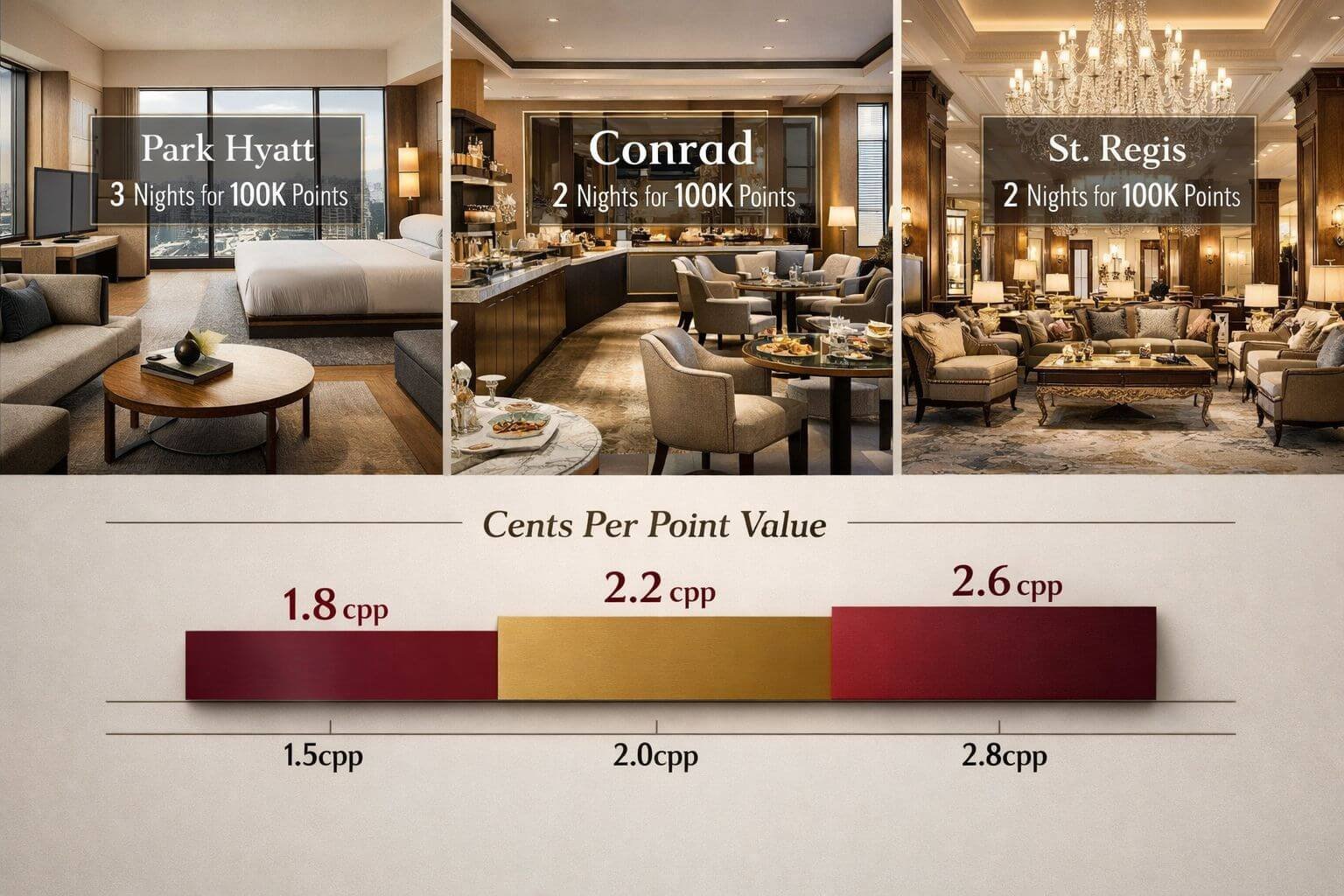
CPP calculations provide a useful benchmark, but the best use of 100,000 points requires evaluating factors beyond raw value. Here’s what else matters.
Award Availability: The Value Limiter
A 6.0 CPP redemption you can’t book delivers zero value. Award availability varies dramatically by:
- Route popularity: Transatlantic summer flights fill 11 months out; off-peak winter routes often have space weeks before departure
- Partner relationships: Some airlines release more space to certain partners (e.g., ANA releases generous space to its own program, less to United)
- Booking windows: Most programs release space 330–365 days out; some (Qantas, Emirates) release closer to departure
Decision framework:
- Search award space before deciding on a transfer partner
- Have 2–3 backup options if your first choice isn’t available
- Consider slightly lower CPP redemptions with better availability over theoretical “best” options you can’t book
Tools for searching: Use tools like award search platforms to check availability across multiple programs simultaneously.
Surcharges and Fees: The Hidden Cost
Some airlines add substantial “carrier-imposed surcharges” (fuel surcharges) to award tickets. These fees can reach $400–$700 on business class awards, dramatically reducing effective value.
High-surcharge partners to watch:
- British Airways: $400–$600 on own-operated long-haul flights
- Lufthansa: $400–$700 on business class awards
- Virgin Atlantic: $400–$500 on own-operated flights (but not on Delta partners)
- Air France: $200–$400 on business class awards
Low-surcharge alternatives:
- ANA: $100–$150 on most routes
- United: $150–$200 on most routes
- Singapore: $200–$300 on most routes
- Turkish: Minimal surcharges on partner awards
Strategic approach: Factor surcharges into your CPP calculation. A 4.0 CPP redemption with $500 in fees may deliver less real value than a 3.0 CPP redemption with $150 in fees.
For more on this topic, see our guide on avoiding airline fuel surcharges.
Transfer Bonuses: The Value Multiplier
Transfer bonuses can boost your effective balance by 15–50%, turning 100,000 points into 115,000–150,000 at the partner program. This compounds value significantly.
Common bonus patterns:
- Air France/KLM Flying Blue: 25–30% bonuses, 2–3 times per year across multiple programs
- Virgin Atlantic: 30% bonuses, 2–3 times per year (Amex, Capital One, Citi)
- Avianca LifeMiles: 15–20% bonuses occasionally
- Marriott Bonvoy: 30–50% bonuses during promotions
Strategic timing:
- Don’t transfer speculatively: Bonuses are worthless if you don’t have a specific redemption in mind
- Confirm availability first: Search award space, verify pricing, then wait for a bonus if timing allows
- Calculate effective CPP: A 30% bonus on a 3.0 CPP redemption yields 3.9 CPP effective value
Example: You find Air France business class space to Paris for 50,000 miles one-way ($3,000 cash price = 6.0 CPP). A 30% transfer bonus means you only transfer 38,500 Chase points to get 50,000 Flying Blue miles. Your effective CPP jumps to 7.8.
Devaluation Risk: The Long-Term Consideration
Award charts and pricing change over time, usually in the airline’s favor. Holding points indefinitely exposes you to devaluation risk.
Recent devaluation examples:
- Delta SkyMiles: Eliminated award charts entirely in 2015, moved to dynamic pricing
- Flying Blue: Increased business class pricing to popular destinations by 20–30% in 2022
- Avianca LifeMiles: Eliminated stopover benefits and increased pricing on certain routes in 2023
Risk mitigation strategies:
- Use points within 12–18 months of earning: Don’t hoard indefinitely
- Book aspirational trips first: If you’re saving for a specific goal, book it before programs devalue
- Diversify across programs: Don’t put all points in one partner; maintain balances across multiple programs
- Monitor program changes: Subscribe to blogs and newsletters tracking program updates
When to hold points: If you don’t have a specific trip planned, keeping points in flexible currencies (Chase, Amex, Capital One, Citi) is safer than transferring speculatively. Transferable points rarely devalue, while airline miles frequently do.
Flexibility vs. Value: The Tradeoff
The highest CPP redemptions often require:
- Booking 11 months in advance
- Phone bookings (30–60 minutes)
- Inflexible dates
- Complex routing
- Language barriers (for some programs)
Lower CPP options may offer:
- Last-minute availability
- Online booking
- Flexible cancellation
- Simpler routing
- English-language support
Decision framework: Determine your personal “flexibility premium.” If a 2.5 CPP redemption you can book online in 5 minutes saves you an hour of phone time compared to a 3.5 CPP redemption requiring a 60-minute call, what’s your time worth?
For many travelers, the convenience of United or Hyatt (straightforward booking, flexible cancellation) justifies slightly lower CPP compared to maximum-value but complex alternatives.
Your Travel Goals: The Ultimate Filter
Pure value optimization can lead to booking trips you don’t actually want to take. The best use of 100,000 points aligns with your actual travel goals.
Questions to ask:
- Where do you want to go? A 6.0 CPP redemption to a destination you’re not interested in visiting delivers zero real value
- When can you travel? Peak-season availability constraints may force you toward off-peak options or different destinations
- Who’s traveling? Companion Pass value only applies if you consistently travel with the same person; family travel may prioritize economy over business class
- What’s your comfort threshold? Some travelers prioritize direct flights over connections, even if connections offer better CPP
Example scenario: You could book ANA business class to Tokyo (5.0 CPP) or United business class to London (3.0 CPP). If you’ve always wanted to visit London and have limited vacation time, the London redemption delivers more real value despite lower CPP.
For more on aligning strategy with goals, see our award travel predictions for 2026.
Step-by-Step: Booking Your 100K Point Redemption
Here’s a practical framework for executing the best use of 100,000 points from research to confirmation.
Step 1: Define Your Travel Goals
Before searching awards, clarify:
- Destination(s): Where do you want to go?
- Dates: Specific dates or flexible windows?
- Cabin class: Economy, premium economy, business, or first?
- Travelers: Solo, couple, family?
- Trip type: Quick getaway or extended vacation?
Example: “Business class to Europe, flexible on specific city, prefer June but can do May or September, traveling with partner.”
Step 2: Research Award Pricing Across Partners
Check how different programs price your desired route:
- Use award search tools to compare pricing across programs
- Check program award charts (for those that still publish them)
- Note surcharges for each option
- Calculate CPP for realistic cash price comparisons
Example research:
- United: 100K round-trip, $150 fees
- Air France: 100K round-trip, $250 fees
- Virgin/Delta: 100K round-trip, $200 fees
- ANA: 95K round-trip, $120 fees
Step 3: Search Award Availability
Search for actual available award space on your preferred dates:
- Start with airline websites: United.com, AirFrance.com, etc.
- Check partner websites: Sometimes partners see space the airline doesn’t release to its own program
- Use award search tools: Aggregate searches across multiple programs
- Be flexible: Check dates ±3 days from your target
Availability tip: If you find space on one partner, it’s often available through multiple programs. Example: United Saver space usually appears in ANA, Singapore, and Aeroplan searches.
Step 4: Confirm Pricing and Fees
Before transferring points:
- Verify exact point cost (dynamic pricing can change)
- Calculate total out-of-pocket fees (taxes, surcharges, booking fees)
- Check cancellation policy (some programs charge fees; others allow free cancellation)
- Confirm routing (connections, layover times, aircraft type)
Pro tip: For phone-only bookings (ANA, Turkish), call to confirm pricing and availability before transferring points. Tell the agent you’re planning to transfer and want to verify everything before moving points.
Step 5: Transfer Points
Once you’ve confirmed availability and pricing:
- Log into your transferable points account (Chase, Amex, Capital One, Citi)
- Initiate transfer to the airline/hotel partner
- Note transfer time: Most transfers are instant, but some take 24–72 hours
- Don’t close the browser until you receive confirmation
Transfer times by program:
- Instant: Most Chase, Amex, and Capital One partners
- 24 hours: Some Citi partners
- 48–72 hours: Avianca LifeMiles, Aeromexico
Step 6: Book the Award
After points appear in your partner account:
- Book online if the program allows
- Call to book for phone-only partners (have flight numbers and dates ready)
- Request confirmation number and verify details
- Screenshot or save confirmation for your records
Phone booking tips:
- Call during business hours in the program’s home country
- Have flight numbers, dates, and passenger details ready
- Be patient—some calls take 30–60 minutes
- Request email confirmation before hanging up
Step 7: Monitor and Manage
After booking:
- Add flights to your calendar with confirmation numbers
- Set reminders for online check-in (24 hours before departure)
- Monitor for schedule changes (airlines will email you)
- Consider travel insurance for expensive redemptions
Award ticket flexibility: Most programs allow free cancellation/changes within 24 hours of booking. Some (United, Air Canada) allow free changes anytime before departure, redepositing points for a fee.
For more on booking strategy, explore our guide on award booking calendar patterns.
Real-World Examples: 100K Point Redemptions in Action
Here are three detailed scenarios showing how different travelers used 100,000 points to book real trips in 2026.
Example 1: The Business Class Traveler
Profile: Sarah, solo traveler, flexible dates, prioritizes comfort on long-haul flights
Goal: Business class to Asia for two weeks
Research process:
- Searched ANA Mileage Club for US West Coast to Tokyo availability
- Found round-trip space on ANA-operated flights (San Francisco to Tokyo) for 95,000 miles
- Cash price: $4,200
- Fees: $120
- CPP: 4.3
Execution:
- Transferred 95,000 Amex points to ANA
- Called ANA to book (45-minute call)
- Added 5-day stopover in Tokyo on return from Bangkok (same 95K miles)
- Total out-of-pocket: $120
Result: Two-week trip to Bangkok with 5-day Tokyo stopover in ANA business class for 95,000 points + $120. Effective value: $4,200 (4.3 CPP).
What worked: Booking 11 months out ensured availability. The stopover benefit let Sarah visit two destinations for one award.
Tradeoff: Phone booking took 45 minutes, and Sarah had to be flexible on exact dates to find availability.
Example 2: The Hotel Maximizer
Profile: James and Maria, couple, planning honeymoon, prioritize luxury hotel experience
Goal: One week at aspirational property
Research process:
- Searched Hyatt award availability in Maldives
- Found 7 nights available at Park Hyatt Maldives Hadahaa
- Points required: 30,000/night × 7 = 210,000 points
- Cash rate: $1,200/night × 7 = $8,400
- CPP: 4.0
Challenge: James had 120,000 Chase points; Maria had 90,000 Chase points (210,000 total).
Execution:
- Transferred 210,000 Chase points to Hyatt (combined from both accounts)
- Booked 7 nights online (5-minute process)
- Received confirmation immediately
- Total out-of-pocket: $0 (no resort fees on award stays)
Result: Seven nights at Park Hyatt Maldives for 210,000 points. Effective value: $8,400 (4.0 CPP).
What worked: Hyatt’s fixed award chart and online booking made the process straightforward. Combining points from two Chase accounts gave them enough for the full week.
Bonus: As Hyatt Globalist members (from credit card status), they received complimentary breakfast ($100/day value) and a room upgrade to an overwater villa.
Example 3: The Value Optimizer
Profile: David, frequent traveler, makes 4–5 domestic trips per year, holds Southwest Companion Pass
Goal: Maximize number of trips with 100,000 points
Research process:
- Checked Southwest award pricing for typical routes (Los Angeles to San Francisco, Los Angeles to Las Vegas, Los Angeles to Seattle)
- Average cost: 12,000–15,000 points round-trip per person
- With Companion Pass: Effective cost 6,000–7,500 points per person
- 100,000 points = ~7 round-trips for two people
Execution:
- Kept points in Chase Ultimate Rewards
- Transferred points to Southwest as needed for each trip
- Booked 6 domestic round-trips over 12 months
- Added companion on each booking (free)
- Total travel value: ~$3,600 (6 trips × $300 average per person × 2 people)
Result: Six domestic round-trips for two people using 100,000 points. Effective value: $3,600 (3.6 CPP with Companion Pass).
What worked: Companion Pass doubled the value of every redemption. Keeping points in Chase until needed provided flexibility to book last-minute trips.
Tradeoff: Lower per-trip glamour compared to international business class, but higher total value for David’s travel patterns.
Common Mistakes: What to Avoid
Even experienced points users make errors that reduce value. Here’s what to avoid when determining the best use of 100,000 points.
Mistake 1: Transferring Before Confirming Availability
The error: Transferring points to a partner, then discovering no award space exists on your dates.
Why it happens: Excitement about a redemption idea without doing the research first.
The fix: Always search award availability before transferring. Most transfers are one-way—once points move, you can’t transfer them back.
Exception: Programs with instant transfers (most Chase and Amex partners) allow you to search, transfer, and book within minutes. But still search first to avoid tying up points in a program you might not use.
Mistake 2: Ignoring Surcharges in Value Calculations
The error: Calculating 4.0 CPP on a redemption, then paying $600 in surcharges that drop effective value to 2.5 CPP.
Why it happens: Focusing on point cost without checking total out-of-pocket fees.
The fix: Calculate CPP using (Cash price – Surcharges) ÷ Points used. A $3,000 ticket with $600 surcharges is really $2,400 of value.
Example: British Airways business class to London: 100,000 Avios + $600 fees. Cash price: $3,000. Real CPP: ($3,000 – $600) ÷ 100,000 = 2.4 CPP, not 3.0.
Mistake 3: Chasing CPP Without Considering Goals
The error: Booking a 6.0 CPP redemption to a destination you’re not excited about visiting.
Why it happens: Optimizing for value metrics instead of actual travel desires.
The fix: Start with where you want to go, then optimize value within that constraint. A 3.0 CPP redemption to your dream destination delivers more real value than a 6.0 CPP redemption somewhere you’re indifferent about.
Mistake 4: Booking Too Close to Departure
The error: Waiting until 2–3 months before travel to search for awards, finding no availability.
Why it happens: Not understanding that most programs release space 11 months out, and popular routes fill quickly.
The fix: Book aspirational redemptions (business class, luxury hotels) 10–11 months in advance. Set calendar reminders for when booking windows open.
Exception: Some programs release last-minute space 2–4 weeks before departure. But this is unreliable for planning.
Mistake 5: Not Monitoring Transfer Bonuses
The error: Transferring 100,000 points at 1:1, then seeing a 30% bonus announced the next week.
Why it happens: Not tracking transfer bonus patterns and timing.
The fix: If your travel is 2+ months out, wait to see if a transfer bonus appears. Programs like Flying Blue, Virgin Atlantic, and Avianca run bonuses 2–3 times per year. Subscribe to points blogs to get alerts.
When to ignore this: If you find perfect availability and your travel is imminent, book it. Don’t risk losing the space waiting for a bonus that might not come.
Mistake 6: Overlooking Hotel Value
The error: Assuming flights always deliver better value than hotels.
Why it happens: Business class redemptions get more attention in points blogs and forums.
The fix: Calculate CPP for both flights and hotels. At luxury properties in expensive markets, hotels often deliver 2.0–3.0+ CPP—competitive with business class flights.
Example: Park Hyatt Paris at $650/night = 30,000 points = 2.17 CPP. That’s comparable to many business class redemptions with less complexity.
For more on avoiding these errors, see our guide on common travel rewards mistakes.
Conclusion: Your Next Steps
Reaching 100,000 points opens access to premium travel experiences that would cost thousands in cash. The best use of 100,000 points depends on your travel goals, flexibility, and how you value different redemption factors beyond pure CPP.
Key decision framework:
- Define your goal: Where do you want to go, when, and in what cabin class?
- Research options: Compare pricing across 3–4 transfer partners
- Search availability: Confirm award space exists before transferring
- Calculate total cost: Include surcharges and fees in your CPP calculation
- Consider timing: Wait for transfer bonuses if your travel is 2+ months out
- Book strategically: Transfer points only after confirming availability
- Monitor and adjust: Set up award alerts if you don’t find immediate space
Highest-value options for most travelers:
- Business class to Europe/Asia: ANA (3.7–5.9 CPP), Singapore (4.3–6.5 CPP), Turkish (4.4–6.7 CPP)
- Luxury hotel stays: Hyatt Category 5–7 properties (2.0–2.5 CPP), Hilton ultra-luxury with fifth night free (3.0+ CPP)
- Domestic travel with Companion Pass: Southwest (2.8 CPP effective)
Best balance of value and simplicity:
- United business class to Europe: 100K points, 2.5–3.5 CPP, straightforward online booking
- Hyatt luxury hotels: 90K–120K points for 3–4 nights, 2.0–2.5 CPP, instant online booking
- Virgin/Delta business class: 100K points, 2.8–3.8 CPP, online booking with transfer bonus timing
Your action plan:
- Use the calculator: Visit Award Travel Hub’s calculator to model your specific redemption scenarios with current pricing
- Search availability: Spend 30 minutes searching award space on your target routes before committing to a strategy
- Set up alerts: If you don’t find immediate availability, set up award alerts to notify you when space opens
- Join the community: Subscribe to award travel newsletters to stay current on transfer bonuses, program changes, and sweet spots
- Book your trip: Once you’ve found the right redemption, execute the booking and start planning your travel
The difference between 1.5 CPP and 4.0 CPP on 100,000 points is $2,500 in effective value—the cost of another trip. Taking time to research, compare, and book strategically turns your points balance into real travel experiences that would otherwise remain out of reach.
Start with one aspirational redemption. Book it, take the trip, and use that experience to refine your strategy for the next 100,000 points you earn.

