

Choosing the wrong travel credit card can cost you thousands in missed rewards, wasted annual fees, and limited redemption options. With annual fees climbing to $895 on premium cards in 2026 and lounge access policies tightening across major issuers, selecting the best travel credit cards requires a clear understanding of your spending patterns, travel goals, and how to maximize transferable points.
This guide provides a practical framework for comparing the best travel credit cards in 2026, organized by traveler profile rather than arbitrary rankings. Whether you’re booking your first award flight or optimizing a portfolio of premium cards, you’ll find concrete break-even analysis, current welcome bonuses, and decision criteria to match cards to your specific situation.
Key Takeaways
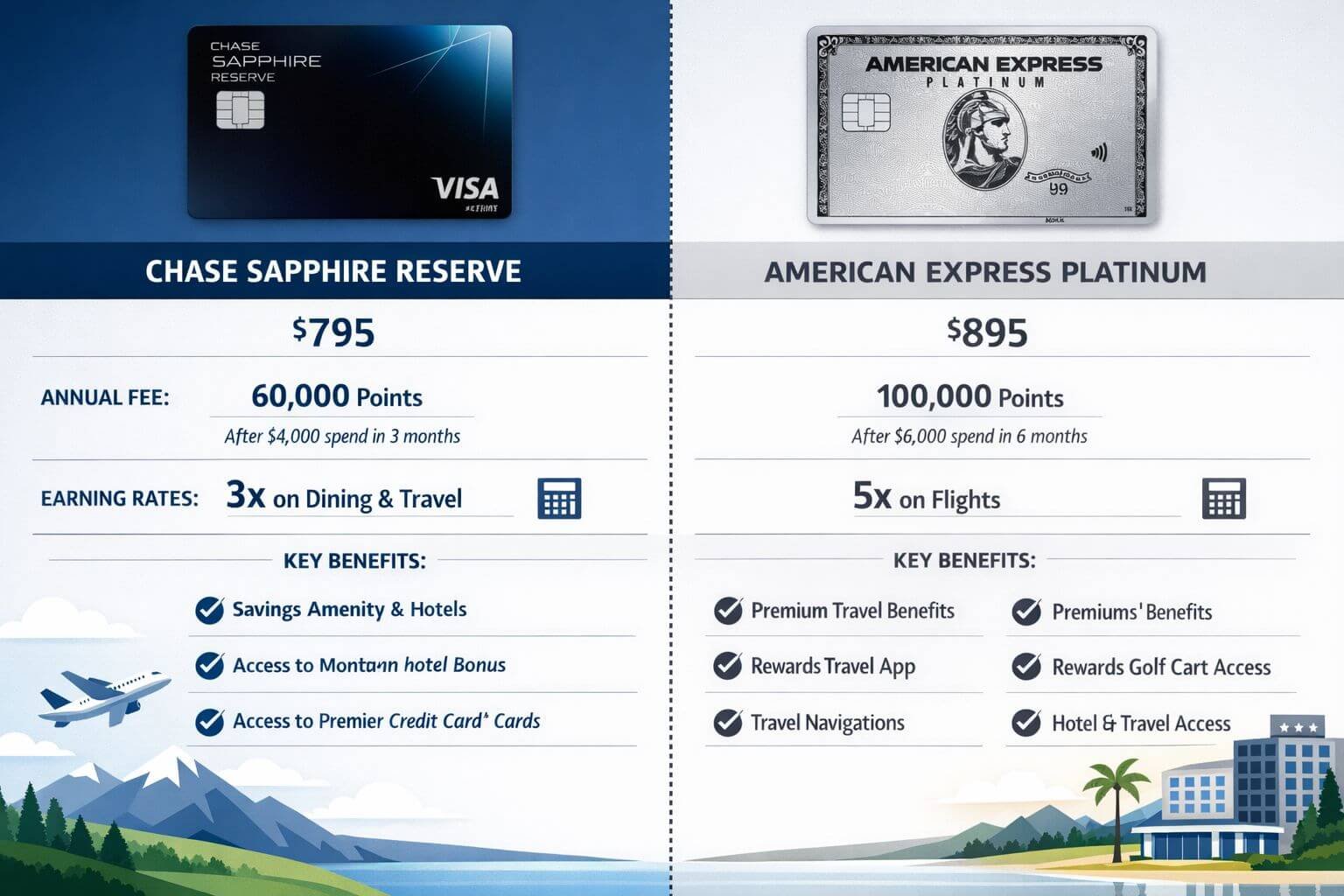
- Premium cards justify their fees through specific credits: Chase Sapphire Reserve ($795) and Amex Platinum ($895) require strategic use of travel credits, lounge access, and transfer partners to break even
- Transferable points provide the most flexibility: Cards earning Chase Ultimate Rewards, Amex Membership Rewards, Capital One miles, Citi ThankYou Points, and Bilt Rewards offer the best redemption value through airline and hotel transfer partners
- Match your card to your travel patterns: Frequent flyers benefit from airline-specific cards for elite status and free checked bags, while flexible travelers maximize value with general travel cards
- Annual fee math matters more than welcome bonuses: Calculate the actual value of credits, benefits, and earning rates against your annual spend to determine if a card pays for itself
- 2026 brought significant changes: Capital One Venture X lounge policies tightened in February, making alternative lounge strategies essential for maximizing access benefits
How to Choose the Best Travel Credit Card for Your Goals
Selecting from the best travel credit cards starts with understanding the fundamental difference between transferable points currencies and fixed-value redemption programs. This distinction determines your flexibility, redemption value, and long-term strategy.
Transferable Points vs. Fixed-Value Programs
Transferable points cards (Chase, Amex, Capital One, Citi, Bilt) allow you to move points to airline and hotel partners at varying ratios, typically 1:1. This flexibility enables premium cabin redemptions that can deliver 2-5 cents per point (CPP) value when booking business or first class awards through partner airlines.
Fixed-value programs redeem at a set rate, usually 1-1.25 cents per point through the issuer’s travel portal. While simpler, they cap your maximum value and limit strategic redemptions.
For most travelers focused on maximizing value, transferable points programs provide superior long-term returns despite requiring more knowledge about transfer partners and award availability.
Decision Framework: Four Questions to Ask
1. What’s your annual travel spend?
- Under $10,000: Consider no annual fee or low-fee cards ($95-$250)
- $10,000-$30,000: Mid-tier cards ($250-$550) offer strong value
- Over $30,000: Premium cards ($695-$895) can justify their fees through earning rates and benefits
2. Do you prioritize flexibility or simplicity?
- Flexibility seekers: Choose transferable points for maximum redemption options
- Simplicity seekers: Fixed-value programs require less research but limit upside
3. What type of travel do you book most?
- Specific airline loyalty: Airline co-branded cards provide elite status, free bags, and companion passes
- Hotel chains: Hotel cards offer free night certificates and automatic elite status
- Varied travel: General travel cards with broad transfer partners maximize options
4. Will you actually use the benefits?
Premium cards include credits for specific merchants (Uber, dining, streaming). If you don’t naturally spend in these categories, the credits provide no real value despite appearing in break-even calculations.
Common Mistakes to Avoid
❌ Focusing only on welcome bonuses: A 100,000-point bonus on a card with poor earning rates and limited transfer partners provides less long-term value than a 75,000-point bonus on a flexible currency
❌ Ignoring credit restrictions: Many travel credits require purchases through specific portals or merchants, reducing their practical value
❌ Overlooking transfer partner devaluation risk: Award charts change regularly; diversifying across multiple transferable currencies reduces risk
❌ Paying annual fees without annual reviews: Set calendar reminders to evaluate whether each card’s benefits justified its fee over the past year
Best Overall Travel Credit Cards: Premium Options for Frequent Travelers
Premium travel cards command annual fees of $550-$895 in 2026, but deliver comprehensive benefits including Priority Pass lounge access, airline credits, hotel elite status, and high earning rates on travel spending. These cards make sense for travelers spending $20,000+ annually on travel and dining who will actively use lounge access and statement credits.
Chase Sapphire Reserve: The Flexible Powerhouse
Annual Fee: $795 (increased from $550 in 2024)
Welcome Bonus: 75,000 Ultimate Rewards points after $4,000 spend in 3 months
Key Earning Rates:
- 10x on hotels and car rentals through Chase Travel℠
- 10x on Lyft rides (through March 2027)
- 5x on flights booked through Chase Travel℠
- 3x on dining and other travel
- 1x on all other purchases
Top 3 Benefits:
$300 Annual Travel Credit: Automatically applied to travel purchases (airlines, hotels, parking, tolls, transit). Unlike Amex Platinum’s airline-specific credit, this applies broadly to any travel category.
Priority Pass Select + Chase Lounges: Unlimited visits to 1,300+ Priority Pass lounges worldwide, plus exclusive Chase Sapphire Lounges (currently Hong Kong, Boston Logan opening 2027). Guests are included at Priority Pass locations.
1.5x Points Boost Through Chase Travel: Redeem Ultimate Rewards at 1.5 cents per point through the Chase portal, providing a guaranteed minimum value without transferring to partners.
Break-Even Analysis:
- Annual fee: $795
- Less $300 travel credit: $495 net cost
- Break-even at 16,500 points earned annually (at 1.5 CPP redemption value)
- With 3x dining/travel: requires $5,500 annual spend in bonus categories
- Additional value from lounge access, travel protections, and transfer flexibility
Best For: Travelers who value flexible Ultimate Rewards transfers to partners like Hyatt (1:1), United (1:1), and Southwest (1:1), plus those who frequently dine out and want comprehensive travel protections.
Not For: Travelers who won’t use lounge access or can’t justify the $495 net annual fee through earning rates and benefits.
American Express Platinum: The Premium Travel Lifestyle Card
Annual Fee: $895 (increased from $695 in 2024)
Welcome Bonus: 80,000 Membership Rewards points after $8,000 spend in 6 months
Key Earning Rates:
- 5x on flights booked directly with airlines or through Amex Travel
- 5x on prepaid hotels booked through Amex Travel
- 1x on all other purchases
Top 3 Benefits:
Centurion Lounge Access + Multiple Lounge Networks: Access to Amex Centurion Lounges (premium domestic lounges with full meals and premium drinks), plus Priority Pass, Delta Sky Club when flying Delta, and Escape Lounges. Note: Guest policies tightened in 2023; only two complimentary guests permitted.
$200 Annual Airline Fee Credit: Choose one airline and receive up to $200 in statement credits for incidental fees (seat selection, baggage fees, in-flight purchases). Does not cover airfare.
$200 Hotel Credit: $200 annual credit for prepaid Fine Hotels + Resorts or The Hotel Collection bookings through Amex Travel, plus room upgrades and late checkout when available.
Additional Credits (require specific spending):
- $189 CLEAR Plus credit
- $240 Digital Entertainment credit ($20/month for streaming services)
- $155 Walmart+ credit
- $100 Saks Fifth Avenue credit ($50 semi-annually)
- $84 Equinox credit ($7/month)
Break-Even Analysis:
- Annual fee: $895
- Realistic credits for most travelers: $400-$600 (airline + hotel credits, selective use of entertainment/CLEAR)
- Net cost: $295-$495, depending on credit utilization
- Requires strategic spending in bonus categories and active credit management
Best For: Frequent flyers who value Centurion Lounge access, already use qualifying streaming services, and book hotels through Amex Fine Hotels + Resorts for the $200 credit and upgrade benefits. Strong option for travelers focused on international Premium Cabin flights through Amex transfer partners like ANA, Air Canada Aeroplan, and Virgin Atlantic.
Not For: Travelers who don’t naturally spend in credit categories or rarely access Centurion Lounges (limited locations outside major hubs).
Capital One Venture X: The Value-Focused Premium Card
Annual Fee: $395
Welcome Bonus: 75,000 miles after $4,000 spend in 3 months
Key Earning Rates:
- 10x on hotels and rental cars booked through Capital One Travel
- 5x on flights booked through Capital One Travel
- 2x on all other purchases
Top 3 Benefits:
- $300 Annual Travel Credit: Automatically applied to Capital One Travel bookings (no portal restrictions like some competitors). Effectively reduces the
annual fee to $95.
10,000-Mile Anniversary Bonus: Receive 10,000 miles each account anniversary (worth $100 at 1 cent per mile baseline), further offsetting the annual fee.
Priority Pass + Capital One Lounge Access: Unlimited Priority Pass visits plus access to Capital One Lounges (Dallas DFW, Denver, Washington Dulles). Important 2026 Update: Starting February 2026, Capital One restricted lounge access for Venture X cardholders during peak hours at select locations, requiring alternative strategies for consistent access.
Break-Even Analysis:
- Annual fee: $395
- Less $300 travel credit: $95
- Less 10,000-mile anniversary bonus ($100 value): $5 net cost or slight profit
- 2x earnings on all purchases provides a strong baseline return
- Transfer partners include Turkish Airlines (1.5x bonus promotions common) and Avianca LifeMiles
Best For: Travelers seeking premium benefits at the lowest net annual fee, those who value 2x earning on all spending, and anyone building a Capital One miles balance for transfer partners.
Not For: Travelers who need extensive lounge networks beyond Priority Pass and Capital One locations, or those seeking higher category bonuses on dining/travel.
Best Travel Credit Cards for Beginners: Low Fees and Easy Rewards
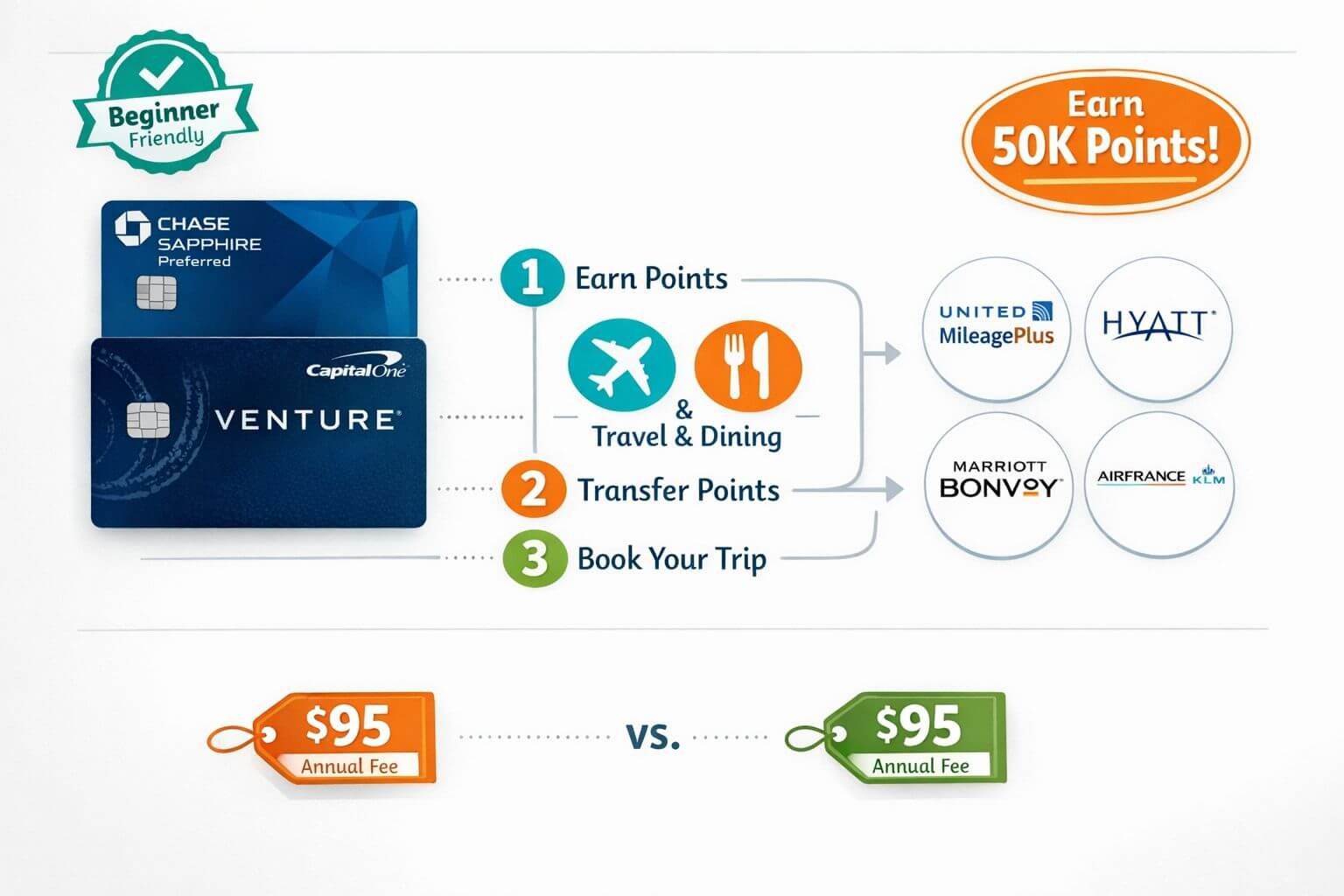
Starting with the best travel credit cards doesn’t require jumping straight to premium annual fees. These cards provide strong earning rates, transferable points, and manageable fees while building credit history and learning award travel fundamentals.
Chase Sapphire Preferred: The Gateway to Ultimate Rewards
Annual Fee: $95
Welcome Bonus: 60,000 Ultimate Rewards points after $4,000 spend in 3 months
Key Earning Rates:
- 5x on Chase Travel℠ purchases
- 3x on dining, select streaming services, and online grocery
- 2x on all other travel
- 1x on all other purchases
Top 3 Benefits:
Access to Chase Transfer Partners: Full access to the same transfer partners as Sapphire Reserve (Hyatt, United, Southwest, Air Canada, British Airways, etc.) at 1:1 ratios. This is the lowest annual fee entry point to Chase’s transfer ecosystem.
1.25x Points Boost Through Chase Travel: Redeem points at 1.25 cents each through the Chase portal, providing a guaranteed baseline value without needing to understand transfer partners.
No Foreign Transaction Fees: Use internationally without 3% surcharges, plus primary rental car insurance coverage.
Break-Even Analysis:
- Annual fee: $95
- Break-even at 7,600 points earned annually (at 1.25 CPP portal value)
- With 3x dining: requires $2,533 annual dining spend
- With 2x travel: requires $4,750 annual travel spend
- Most travelers easily justify the fee through a welcome bonus and moderate spending
est For: Beginners building their first points balance, travelers who want transferable points without premium fees, and anyone planning to eventually upgrade to Sapphire Reserve (product change preserves points and account history).
Not For: Travelers who already hold Sapphire Reserve (can’t hold both personal Sapphire cards simultaneously under Chase rules).
Capital One Venture: Simple Fixed-Value Redemptions
Annual Fee: $95
Welcome Bonus: 75,000 miles after $4,000 spend in 3 months
Key Earning Rates:
- 5x on hotels and rental cars booked through Capital One Travel
- 2x on all other purchases
Top 3 Benefits:
Straightforward Redemption: Redeem miles at 1 cent each to erase travel purchases (flights, hotels, rental cars, parking, tolls). No award charts or transfer partner research required.
2x Earning on Everything: Flat 2x rate on all spending simplifies earning strategy and ensures strong returns across all categories.
Transfer Partner Option: While designed for simple redemptions, Venture miles can transfer to Capital One partners (same as Venture X), providing flexibility as you learn award travel.
Break-Even Analysis:
- Annual fee: $95
- Break-even at 9,500 miles earned (at 1 cent per mile)
- With 2x earning: requires $4,750 annual spend
- Welcome bonus alone provides $750 in travel value
Best For: Travelers who want simplicity over optimization, those uncomfortable with researching transfer partners, and anyone seeking a flat 2x earning rate across all spending.
Not For: Advanced travelers who will extract higher value from transfer partners and prefer category bonuses over flat earnings.
Wells Fargo Autograph: Best No Annual Fee Option
Annual Fee: $0
Welcome Bonus: 20,000 points after $1,000 spend in 3 months
Key Earning Rates:
- 3x on restaurants, travel, gas stations, transit, popular streaming services, and phone plans
- 1x on all other purchases
Top 3 Benefits:
No Annual Fee: Keep the card indefinitely without ongoing costs, making it ideal for long-term portfolio building.
Broad 3x Categories: Earning 3x on six different categories (including gas and phone bills) provides strong returns without category activation or spending caps.
Flexible Redemption: Redeem points for travel statement credits, cash back, or gift cards at 1 cent per point baseline value.
Break-Even Analysis:
- No annual fee = automatic positive value
- 20,000-point welcome bonus worth $200
- 3x categories provide 50% better returns than flat 2% cash back cards
Best For: Travelers building credit history, those wanting a no-fee card to keep long-term for the average age of accounts, and anyone uncomfortable with annual fee commitments.
Not For: Travelers seeking transferable points to airline/hotel partners (Wells Fargo points don’t transfer) or those wanting premium travel benefits.
Best Airline-Specific Credit Cards for Elite Status and Free Bags
Airline co-branded cards provide benefits that general travel cards can’t match: free checked bags, priority boarding, companion certificates, and accelerated paths to elite status. These cards make sense when you consistently fly one airline or alliance and value loyalty perks over transfer flexibility.
Delta SkyMiles Reserve (American Express)
Annual Fee: $650
Welcome Bonus: 80,000 SkyMiles after $5,000 spend in 6 months
Key Earning Rates:
- 3x on Delta purchases
- 3x on hotels booked through Amex Travel
- 1x on all other purchases
Top 3 Benefits:
Delta Sky Club Access: Unlimited access when flying Delta (same-day boarding pass required), plus up to two guests for $39 each. Sky Clubs offer full bars, hot food, showers at select locations, and premium workspaces.
Domestic First Class Companion Certificate: Annual certificate for a companion to fly domestic first class when you purchase a first class ticket. Companion pays taxes/fees only (typically $50-$100). Restrictions apply; blackout dates on peak travel.
15,000 Medallion Qualification Dollars (MQDs): Receive $15,000 toward Delta Medallion status after $30,000 annual spend, significantly accelerating status qualification. Additional $15,000 MQDs after $60,000 spend and $15,000 after $90,000 spend.
Break-Even Analysis:
- Annual fee: $650
- Sky Club day passes: $39 each (17 visits = $663 value)
- Companion certificate value: $200-$800, depending on route
- Free checked bags: $60-$120 per roundtrip for two bags
- Requires frequent Delta travel to justify the fee
Best For: Frequent Delta flyers (10+ flights annually) who value Sky Club access and are pursuing Medallion elite status. Strong option for travelers in Delta hubs (Atlanta, Detroit, Minneapolis, Salt Lake City, Seattle).
Not For: Occasional Delta flyers or those who prefer transfer partner flexibility over airline-specific benefits.
United Quest℠ Card (Chase)
Annual Fee: $250
Welcome Bonus: 70,000 United MileagePlus miles after $4,000 spend in 3 months
Key Earning Rates:
- 3x on United purchases
- 2x on dining and select streaming services
- 2x on all other travel
- 1x on all other purchases
Top 3 Benefits:
Two Free Checked Bags: Primary cardmember and one companion on the same reservation receive two free checked bags each (up to $360 value per roundtrip for a couple). This benefit alone justifies the annual fee for families taking 2-3 United trips annually.
$125 Annual United Purchase Credit: Automatically applied to United purchases (tickets, seat selections, baggage fees, in-flight purchases). Effectively reduces the annual fee to $125.
Priority Boarding and 25% Back on In-Flight Purchases: Board in Group 2 (before general boarding) and receive 25% statement credit on United in-flight food, beverage, and Wi-Fi purchases.
Break-Even Analysis:
- Annual fee: $250
- Less $125 United credit: $125 net cost
- Free checked bags for two people, two bags each, one roundtrip: $240 value
- Card pays for itself with one family trip requiring checked bags
Best For: United flyers who check bags, families traveling together on United, and travelers building MileagePlus balances for Star Alliance award redemptions.
Not For: Travelers who only fly carry-on or prefer transfer partner flexibility through Chase Sapphire cards.
Airline Card Strategy Note
Airline cards work best as complementary cards in a portfolio anchored by transferable points cards. Use airline cards for:
- Free checked bags and priority boarding on your primary airline
- Accelerated elite status qualification
- Airline-specific purchase protections and credits
arn the bulk of your points through transferable currencies (Chase, Amex, Capital One), then transfer strategically to airline partners based on award availability and redemption value. This approach provides both loyalty benefits and redemption flexibility. For more on this strategy, see our guide on avoiding common travel rewards mistakes.
Best Hotel Credit Cards for Free Nights and Room Upgrades
Hotel co-branded cards provide automatic elite status, free night certificates, and property credits that can deliver outsized value for travelers loyal to specific chains. Unlike airline cards, hotel cards often justify their annual fees solely through the anniversary free night certificate.
World of Hyatt Credit Card (Chase)
Annual Fee: $95
Welcome Bonus: 30,000 Hyatt points after $3,000 spend in 3 months
Key Earning Rates:
- 4x at Hyatt hotels
- 2x on dining, fitness club/gym memberships, and airline tickets purchased directly from the airline
- 1x on all other purchases
Top 3 Benefits:
Annual Free Night Certificate: Receive a free night certificate (valid at properties up to 15,000 points per night) each account anniversary. This certificate alone can provide $200-$400+ value at Category 1-4 Hyatt properties worldwide.
Automatic Discoverist Elite Status: Receive Hyatt’s entry-level elite status, providing late checkout, bonus points on stays, and occasional room upgrades. Earn Explorist status (mid-tier) after $50,000 annual card spend.
5 Qualifying Night Credits: Receive 5 elite qualifying night credits toward status each year, plus 2 additional night credits for every $5,000 spent. Accelerates path to Explorist (30 nights) and Globalist (60 nights) status.
Break-Even Analysis:
- Annual fee: $95
- Free night certificate (15,000-point property): $200-$400 value
- Card pays for itself with the anniversary certificate alone
- Additional value from elite status and earning rates
Best For: Travelers who stay at Hyatt properties 2-4 times annually, those pursuing Hyatt elite status, and anyone who values the free night certificate at aspirational properties (Park Hyatt, Andaz, Grand Hyatt).
Not For: Travelers who don’t stay at Hyatt properties or prefer Marriott/Hilton ecosystems.
Marriott Bonvoy Brilliant™ American Express® Card
Annual Fee: $650
Welcome Bonus: 95,000 Marriott Bonvoy points after $6,000 spend in 6 months
Key Earning Rates:
- 6x at participating Marriott Bonvoy hotels
- 3x on dining and flights booked directly with airlines
- 2x on all other purchases
Top 3 Benefits:
Annual Free Night Certificate: Certificate valid at properties up to 85,000 points per night (Category 1-6 properties). Provides $300-$600+ value at premium Marriott properties (Ritz-Carlton, St. Regis, Luxury Collection, W Hotels).
Automatic Marriott Bonvoy Gold Elite Status: Receive Gold status (mid-tier), providing room upgrades when available, late checkout, and 25% bonus points on stays. Earn Platinum status (top tier) after $75,000 annual card spend.
$300 Annual Marriott Bonvoy Statement Credit: Receive up to $300 in statement credits for eligible purchases at participating Marriott properties. Effectively reduces the annual fee to $350.
Break-Even Analysis:
- Annual fee: $650
- Less $300 Marriott credit: $350
- Free night certificate (85,000-point property): $400-$700 value
- Requires 2-3 Marriott stays annually to maximize value
Best For: Frequent Marriott guests (5+ stays annually) who will use the $300 property credit and value Gold elite status benefits. Strong option for travelers pursuing Platinum status through card spend.
Not For: Occasional hotel guests or travelers who prefer independent properties over chain hotels.
Hotel Card Portfolio Strategy
The optimal hotel card strategy depends on your stay patterns:
Concentrated Loyalty (10+ nights at one chain annually):
- Choose your primary chain’s premium card
- Maximize elite status benefits and free night certificates
- Use earning rates to accelerate status qualification
Diversified Stay Patterns (mix of chains):
- Hold 2-3 hotel cards with strong free night certificates (Hyatt, Marriott, IHG)
- Use each card’s free night at aspirational properties in that chain
- Earn bulk points through general travel cards, and transfer to hotel partners when needed
Minimal Hotel Stays (under 5 nights annually):
- Skip hotel cards entirely
- Earn points through transferable currencies
- Transfer to hotel partners for specific redemptions (Hyatt via Chase, Marriott via Amex)
Best No Annual Fee Travel Cards That Still Deliver Value
No annual fee travel cards provide long-term value without ongoing costs, making them ideal for building credit history, maintaining the average age of accounts, and earning rewards on spending categories not covered by premium cards.
Capital One VentureOne Rewards
Annual Fee: $0
Welcome Bonus: 20,000 miles after $500 spend in 3 months
Key Earning Rates:
- 5x on hotels and rental cars booked through Capital One Travel
- 1.25x on all other purchases
Top 3 Benefits:
No Annual Fee with Transfer Partners: Only a no-fee card offering access to Capital One’s transfer partners (Turkish Airlines, Avianca LifeMiles, Air France-KLM, etc.). Provides award travel flexibility without annual costs.
1.25x Earning on Everything: Slightly better than 1x earning on non-bonus spending, adding up over time on everyday purchases.
No Foreign Transaction Fees: Use internationally without surcharges, making it a solid backup card for travel.
Best For: Travelers wanting access to transfer partners without annual fees, those building long-term credit history, and anyone seeking a simple backup travel card.
Not For: Travelers seeking high category bonuses or premium benefits (upgrade to Venture or Venture X for better earning rates).
Bank of America® Travel Rewards
Annual Fee: $0
Welcome Bonus: 25,000 points after $1,000 spend in 90 days
Key Earning Rates:
- 1.5x on all purchases
Top 3 Benefits:
Flat 1.5x Earning: Simple earning structure with no categories to track or activate. Competitive with 2% cash back cards when redeemed for travel.
Preferred Rewards Bonus: Bank of America Preferred Rewards members earn 25-75% bonus points based on combined Bank of America and Merrill investment balances. At Platinum Honors tier ($100,000+ combined balances), earn 2.625x on all purchases.
No Foreign Transaction Fees: Use internationally without additional costs.
Best For: Bank of America customers with Preferred Rewards status, travelers seeking simple flat-rate earnings, and those wanting a no-fee card for everyday spending.
Not For: Travelers without Bank of America relationships (limited value compared to cards with transfer partners) or those seeking category bonuses.
Chase Freedom Unlimited®
Annual Fee: $0
Welcome Bonus: $200 cash back after $500 spend in 3 months
Key Earning Rates:
- 5% on travel purchased through Chase Travel℠
- 3% on dining and drugstore purchases
- 1.5% on all other purchases
Top 3 Benefits:
Ultimate Rewards Earning Without Annual Fee: When paired with Chase Sapphire Preferred or Reserve, Freedom Unlimited points become Ultimate Rewards points with full transfer partner access. Use Freedom Unlimited for everyday spending, transfer points to Sapphire card, then move to airline/hotel partners.
Strong Category Bonuses: 3% on dining and drugstores provides solid returns on common spending categories.
Intro APR Offer: 0% intro APR on purchases for 15 months (then variable APR), useful for large purchases you want to pay down over time.
Best For: Chase ecosystem members who hold Sapphire Preferred or Reserve, travelers wanting to maximize Ultimate Rewards earning across all spending categories, and anyone building a no-fee card portfolio.
Not For: Travelers without a Chase Sapphire card (points redeem at a lower value without transfer access).
Annual Fee Math: Which Premium Cards Actually Pay for Themselves
Premium travel cards require an honest accounting of which benefits you’ll actually use versus theoretical value in marketing materials. This section provides realistic break-even calculations for the most popular premium cards in 2026.
The Credit Value Trap
Card issuers market total annual benefits that often exceed $1,000, but many cards require spending you wouldn’t otherwise make or restrict redemptions to specific merchants. Only count credits toward break-even if you would spend that money anyway.
Example: American Express Platinum
Marketed annual benefits:
- $200 airline fee credit ✓ (usable if you select one airline)
- $200 hotel credit ✓ (requires Amex Travel booking)
- $189 CLEAR credit ⚠️ (only valuable if you already use CLEAR)
- $240 entertainment credit ⚠️ (requires specific streaming services)
- $155 Walmart+ credit ❌ (not valuable if you don’t shop at Walmart)
- $100 Saks credit ⚠️ (requires shopping at Saks Fifth Avenue)
- $84 Equinox credit ❌ (not valuable if you don’t use Equinox gyms)
Total marketed credits: $1,168
Realistic value for a typical traveler: $400-$600
Premium Card Break-Even Calculations
Chase Sapphire Reserve ($795 Annual Fee)
Guaranteed Credits:
- $300 travel credit (applies automatically to any travel purchase): $300
- Net annual fee: $495
Required Earning to Break Even (assuming 1.5 CPP redemption through Chase Travel):
- Need 33,000 points earned annually
- At 3x dining/travel: $11,000 annual spend in bonus categories
- At 10x Chase Travel hotels: $3,300 annual spend on hotels through the Chase portal
Additional Value Factors:
- Priority Pass lounge access (value varies by usage: 10 visits = $390 at $39/visit retail)
- Primary rental car insurance (saves $15-$30 per rental day)
- Trip delay, cancellation, and baggage insurance
- Access to Chase transfer partners at 1:1 ratios
Verdict: Breaks even for travelers spending $10,000+ annually on dining/travel who use lounge access 5+ times per year.
American Express Platinum ($895 Annual Fee)
Realistic Credits (conservative estimate):
- $200 airline fee credit: $200
- $200 hotel credit (requires Amex Travel booking): $200
- $189 CLEAR credit (if you use CLEAR): $189
- Total realistic credits: $400-$589
- Net annual fee: $306-$495
Required Earning to Break Even (assuming 2 CPP transfer value):
- Need 15,300-24,750 points earned annually
- At 5x flights: $3,060-$4,950 annual airfare spend
- At 1x, everything else: $15,300-$24,750 annual spend
Additional Value Factors:
- Centurion Lounge access (premium experience, limited locations)
- Multiple lounge networks (Priority Pass, Delta Sky Club when flying Delta)
- Fine Hotels + Resorts benefits (room upgrades, $100 property credits)
- Amex Offers (targeted deals can provide $200-$500 annual value)
Verdict: Breaks even for frequent flyers spending $15,000+ on airfare annually who actively use Centurion Lounges and redeem hotel credits through Amex Travel. Requires more active credit management than the Sapphire Reserve.
Capital One Venture X ($395 Annual Fee)
Guaranteed Credits:
- $300 travel credit (applies to Capital One Travel bookings): $300
- 10,000-mile anniversary bonus ($100 value): $100
- Total credits: $400
- Net annual fee: -$5 (slight profit)
Required Earning to Break Even:
- Card pays for itself through credits alone
- All earning is profit: 2x on everything, 10x on hotels through Capital One Travel
Additional Value Factors:
- Priority Pass + Capital One Lounge access (note 2026 restrictions during peak hours)
- Transfer partners with frequent bonuses (Turkish Airlines, Avianca LifeMiles)
- No foreign transaction fees
Verdict: Easiest premium card to justify. Breaks even through credits alone, making it profitable for any spending level. Best value proposition among premium cards in 2026.
Multi-Card Strategy: Maximizing Across Portfolios
Advanced travelers often hold 2-4 cards to maximize earning across all spending categories while minimizing redundant annual fees:
Example Portfolio 1: Chase + Amex Ecosystem
- Chase Sapphire Reserve ($795): 3x dining/travel, Chase transfer partners, $300 travel credit
- Chase Freedom Unlimited ($0): 1.5x on everything else, pool points with Reserve
- Amex Gold ($250): 4x dining/groceries, Amex transfer partners
- Total annual fees: $1,045
- Total credits: $300 (Reserve travel credit) + $120 (Amex Gold Uber credit) = $420
- Net cost: $625
- Coverage: Maximized earning on dining (4x Amex Gold), travel (3x Reserve), groceries (4x Gold), everything else (1.5x Freedom Unlimited)
Example Portfolio 2: Capital One + Hotel Card
- Capital One Venture X ($395): 2x everything, transfer partners, $300 + $100 credits
- World of Hyatt ($95): 4x Hyatt, free night certificate, elite status
- Total annual fees: $490
- Total credits: $400 (Venture X)
- Net cost: $90
- Coverage: Simple 2x earning on all spending, 4x at Hyatt, transfer flexibility, hotel benefits
Calculate your optimal portfolio using the Award Travel Hub calculator to model earning rates across your actual spending patterns.
When to Cancel or Downgrade
Set annual calendar reminders to review each card’s value:
Cancel if:
- You didn’t use credits worth at least 70% of the annual fee
- Lounge access went unused (5+ visits required to justify most premium fees)
- Your travel patterns changed (stopped flying one airline, changed hotel chains)
- Transfer partners devalued significantly
Downgrade if:
- You want to keep the account age and credit limit
- A no-fee version exists in the same family (Sapphire Reserve → Freedom Unlimited, Venture X → VentureOne)
- You’re over 5/24 with Chase and want to preserve the relationship
Keep if:
- Credits exceeded 80% of the annual fee
- You actively used premium benefits (lounges, elite status, insurance)
- Transfer partners provided redemptions worth 2+ cents per point
- Welcome bonus recency rules prevent you from getting the bonus again soon
Comparison Table: Best Travel Credit Cards 2026
| Card | Annual Fee | Welcome Bonus | Best Earning Rate | Transfer Partners | Key Benefit | Best For |
|---|---|---|---|---|---|---|
| Chase Sapphire Reserve | $795 | 75,000 UR | 10x Chase Travel hotels | Yes (Chase) | $300 travel credit + Priority Pass | Frequent travelers wanting flexible transfers |
| Amex Platinum | $895 | 80,000 MR | 5x flights | Yes (Amex) | Centurion Lounges + multiple credits | Frequent flyers who use Centurion Lounges |
| Capital One Venture X | $395 | 75,000 miles | 10x Capital One Travel hotels | Yes (Capital One) | $300 credit + 10K anniversary bonus | Best value premium card |
| Chase Sapphire Preferred | $95 | 60,000 UR | 5x Chase Travel | Yes (Chase) | Low-fee transfer partner access | Beginners wanting transferable points |
| Capital One Venture | $95 | 75,000 miles | 5x Capital One Travel hotels | Yes (Capital One) | 2x on everything | Simple earning + transfer option |
| Wells Fargo Autograph | $0 | 20,000 pts | 3x on 6 categories | No | No annual fee | No-fee card with strong categories |
| Delta Reserve (Amex) | $650 | 80,000 miles | 3x Delta | No | Sky Club access + companion cert | Frequent Delta flyers |
| United Quest | $250 | 70,000 miles | 3x United | No | Free checked bags + $125 credit | United flyers who check bags |
| World of Hyatt | $95 | 30,000 pts | 4x Hyatt | No | Free night cert + elite status | Hyatt loyalists |
| Marriott Brilliant | $650 | 95,000 pts | 6x Marriott | No | Free night cert + $300 credit | Frequent Marriott guests |
Final Recommendations: Matching Cards to Your Travel Profile
If You’re Just Starting (Under 100,000 Points Total)
Recommended First Card: Chase Sapphire Preferred ($95)
- Low annual fee reduces commitment risk
- Access to Chase transfer partners at 1:1 ratios
- 60,000-point welcome bonus provides the first award redemption
- Can upgrade to Reserve later once you understand transfer value
Second Card (6-12 months later): Capital One Venture or Amex Gold
- Diversifies transfer partner options
- Builds points in the second currency for flexibility
- Provides category bonuses Chase doesn’t cover (Amex Gold: 4x groceries)
If You Travel Frequently (10+ Flights Annually)
Recommended Setup: Chase Sapphire Reserve + Airline Card
- Reserve for flexible transfers and broad travel coverage
- Airline card for free bags, priority boarding, elite status acceleration
- Example: Reserve + United Quest = comprehensive United travel benefits + transfer flexibility
Alternative: Amex Platinum + Delta Reserve
- Premium lounge access (Centurion + Sky Club)
- Strong for Delta hub travelers (Atlanta, Detroit, Minneapolis, Salt Lake, Seattle)
- Amex transfer partners for non-Delta redemptions
If You Prioritize Hotels Over Flights
Recommended Setup: Capital One Venture X + World of Hyatt
- Venture X for general spending (2x everything) and transfer flexibility
- Hyatt card for a free night certificate and elite status
- Use Venture X credits for flights, Hyatt card for hotel stays
- Transfer Venture X miles to Wyndham or Choice if needed for budget properties
Alternative: Amex Platinum + Marriott Brilliant
- Platinum for flights and Amex transfer partners
- Brilliant for Marriott stays, free night certificate, and Gold status
- Combined annual fees are high ($1,545), requires heavy travel to justify
If You Want Maximum Simplicity
Recommended Card: Capital One Venture X
- Breaks even through credits alone ($300 + 10K miles)
- Simple 2x earning on everything (no category tracking)
- Transfer partners available when you’re ready to learn
- Priority Pass lounge access without complexity
Alternative: Chase Sapphire Preferred
- Lower annual fee ($95) for less commitment
- Still provides transfer partner access
- 1.25x portal redemption option for simple bookings
If You’re Optimizing for Premium Cabin Awards
Recommended Setup: Chase Sapphire Reserve + Amex Platinum + Capital One Venture X
- Access to all major transfer partner ecosystems
- Maximum flexibility for award availability
- Combined earnings across all spending categories
- Total net annual fees: ~$990 after credits
- Justified only if you book 2+ international premium cabin awards annually (value: $4,000-$10,000)
Transfer Strategy:
- Build balances in all three currencies
- Search award availability across all transfer partners
- Transfer only when ready to book (avoid speculative transfers)
- Use transfer bonuses strategically (common on Turkish Airlines, Avianca, Air France)
For detailed guidance on maximizing transfer partner value, see our comprehensive transfer partner guide.
Common Pitfalls and How to Avoid Them
Mistake 1: Chasing Welcome Bonuses Without a Long-Term Strategy
The Problem: Opening cards solely for welcome bonuses without considering ongoing earning rates, annual fees, or transfer partner value.
The Fix: Evaluate each card’s 3-year value:
- Year 1: Welcome bonus + annual fee
- Year 2-3: Earning rates + annual fee + benefits
- If the card doesn’t justify its fee in years 2-3, plan to cancel or downgrade after year 1
Mistake 2: Paying Annual Fees on Cards You Don’t Use
The Problem: Keeping premium cards “just in case” without actively using benefits or earning rates.
The Fix: Conduct quarterly card reviews:
- Track credit utilization (set phone reminders for Amex dining credits, airline credits, etc.)
- Count lounge visits (if under 5 annually, premium cards may not justify fees)
- Calculate actual earning (if you earned fewer points than the annual fee ÷ 1 cent, consider downgrading)
Mistake 3: Ignoring Transfer Partner Devaluations
The Problem: Building large balances in one currency without monitoring partner program changes.
The Fix: Diversify across multiple transferable currencies:
- Maintain balances in Chase, Amex, and Capital One
- Don’t transfer speculatively (transfer only when ready to book)
- Monitor program announcements (set Google Alerts for “devaluation” + program name)
- Book valuable redemptions when you find them rather than waiting for “perfect” timing
For more on managing devaluation risk, see our guide on fuel surcharges and program changes.
Mistake 4: Overlooking Travel Insurance and Protections
The Problem: Not understanding which cards provide primary rental car coverage, trip delay protection, or baggage insurance.
The Fix: Know your coverage before you travel:
- Primary rental car insurance: Chase Sapphire Reserve, Amex Platinum (decline rental company insurance)
- Trip delay protection: Most premium cards cover delays 6+ hours (meals, hotels)
- Baggage delay: Typically covers delays 6+ hours (purchase essentials, submit receipts)
- Trip cancellation: Covers non-refundable trips cancelled for covered reasons
Always pay for travel with the card providing the best protection for that purchase type.
Mistake 5: Not Maximizing Category Bonuses
The Problem: Using the wrong card for purchases, leaving bonus points on the table.
The Fix: Create a simple reference guide:
- Dining: Amex Gold (4x) > Sapphire Reserve (3x) > Sapphire Preferred (3x)
- Groceries: Amex Gold (4x) > everything else
- Gas: Wells Fargo Autograph (3x) > most other cards
- Travel booked directly: Amex Platinum (5x flights) > Sapphire Reserve (3x)
- Everything else: Venture X (2x) > Freedom Unlimited (1.5x)
Use digital wallet category tags or a simple spreadsheet to track optimal cards for each merchant.
Next Steps: Building Your Travel Card Strategy
Month 1: Research and Application
- Calculate your annual spending by category (dining, travel, groceries, gas, everything else)
- Determine your travel goals (domestic economy, international premium cabins, hotel stays)
- Choose your primary card based on the recommendations above
- Apply for one card (avoid multiple applications within 30 days)
- Set up automatic payments to avoid interest charges and late fees
Month 2-3: Meeting Welcome Bonus Requirements
- Track minimum spend toward welcome bonus (use spreadsheet or app)
- Make normal purchases only (don’t manufacture spend unless experienced)
- Pay statement balance in full each month
- Activate any quarterly categories (Chase Freedom cards require activation)
- Set up credit monitoring (Amex, Capital One, Chase offer free monitoring)
Month 4-6: Learning Transfer Partners and Award Searches
- Research transfer partners for your card’s currency (start here)
- Create accounts with 3-5 airline and hotel partners
- Practice award searches using tools like United.com, Aeroplan, British Airways
- Join our community for award availability alerts and booking help
- Plan your first redemption (start with simple domestic awards)
Month 7-12: Optimizing and Expanding
- Evaluate your first card’s performance (did you use benefits? earn enough points?)
- Consider a second card to fill category gaps or access new transfer partners
- Book your first award using transferred points
- Set annual fee review reminders for each card anniversary
- Adjust strategy based on actual spending and travel patterns
Ongoing: Portfolio Management
- Review cards quarterly to ensure you’re maximizing benefits
- Monitor transfer partner changes through blogs and newsletters
- Adjust applications based on 5/24 status and issuer rules
- Calculate actual cents per point on redemptions to refine strategy
- Stay informed on program devaluations and new card launches
For personalized guidance on building your points strategy, explore our beginner’s guide to travel rewards and join our community for real-time award availability alerts.
Conclusion
Choosing the best travel credit cards in 2026 requires matching cards to your specific spending patterns, travel goals, and willingness to manage annual fees and credits. The landscape has evolved significantly, with premium card fees reaching $895 (Amex Platinum), lounge access policies tightening, and transfer partner options expanding across all major issuers.
Key principles to remember:
✅ Transferable points provide maximum flexibility: Chase, Amex, Capital One, Citi, and Bilt offer superior long-term value through airline and hotel transfer partners
✅ Annual fees must be justified through actual use: Only count credits and benefits you’ll genuinely use in your break-even calculations
✅ Diversification reduces devaluation risk: Maintain balances across multiple currencies rather than concentrating in one program
✅ Airline and hotel cards complement general travel cards: Use co-branded cards for loyalty benefits (free bags, elite status) while earning bulk points through transferable currencies
✅ Simple strategies often outperform complex ones: Capital One Venture X’s $395 fee with $400 in credits provides better value than managing $1,168 in Amex Platinum credits you won’t fully use
The best travel credit card for you depends on whether you prioritize flexibility (transferable points cards), simplicity (fixed-value cards), or loyalty benefits (airline/hotel cards). Most travelers benefit from starting with Chase Sapphire Preferred or Capital One Venture, learning transfer partners over 6-12 months, then expanding to premium cards once they understand redemption values.
Your next action: Choose one card from this guide based on your current travel profile, apply, meet the welcome bonus spend requirement, and start building your first points balance. Set a calendar reminder for 90 days from now to research transfer partners and plan your first award redemption.
For ongoing strategy updates, award availability alerts, and booking walkthroughs, bookmark Award Travel Hub and join our community of travelers maximizing transferable points for premium cabin flights and hotel stays.

