

Last updated: March 20, 2026
Key Takeaways
- A carefully chosen 2–3 card no-annual-fee setup can realistically earn $600–$900 in travel value per year on $24,000 in annual spending, based on typical bonus category rates and welcome offer estimates.
- The best no-annual-fee travel credit cards 2026 include the Wells Fargo Autograph, Chase Freedom Flex, Chase Freedom Unlimited, Discover it Miles, Citi Custom Cash, and Amex Blue Cash Everyday.
- No-fee cards let beginners learn the rewards system, build credit history, and accumulate points before committing to the $550–$895 annual fee of a premium card.
- Most top no-fee cards charge $0 in foreign transaction fees or can be paired with one that does, making them viable for international travel.
- The smartest long-term play: start with no-fee cards, earn welcome bonuses, then add one premium anchor card only when the math clearly justifies it.
Quick Answer
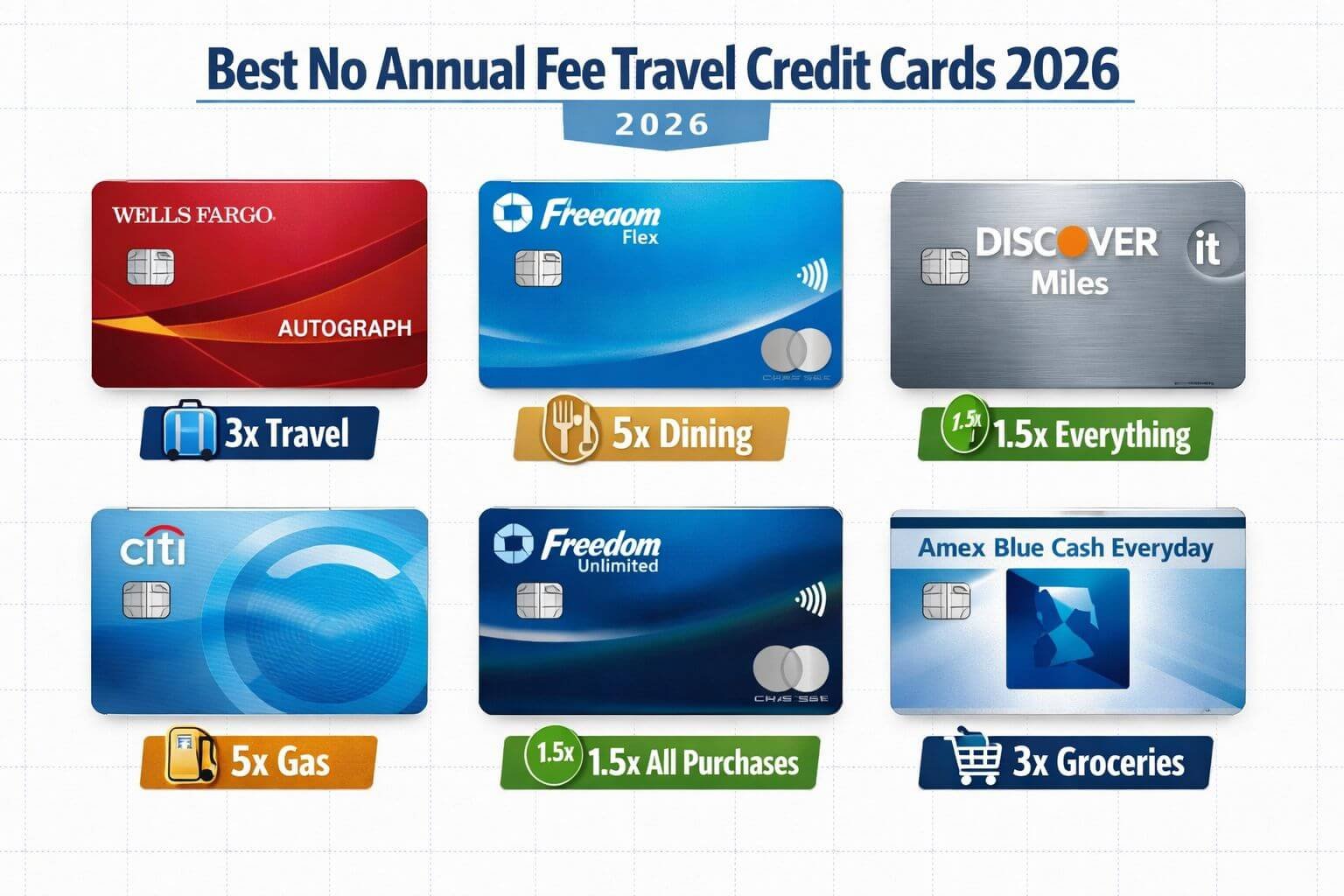
The best no-annual-fee travel credit cards for 2026 are the Wells Fargo Autograph (3x on travel, dining, gas, transit, and streaming), Chase Freedom Flex (5x on rotating categories), Chase Freedom Unlimited (1.5x on everything), Discover it Miles (1.5x miles, first-year match), Citi Custom Cash (5x on top spend category), and Amex Blue Cash Everyday (3x groceries and gas). These cards earn real rewards across everyday spending categories, charge no annual fee, and most charge no foreign transaction fees. Used together in a simple 2–3 card setup, they can generate meaningful travel value while you learn the points game at zero cost.
Why No-Annual-Fee Travel Cards Are Perfect for Beginners in 2026
No-annual-fee travel cards are the lowest-risk way to start earning travel rewards because there’s no fee to justify, no break-even pressure, and no downside to keeping the card open long-term. For beginners, simplicity matters.
Think about someone who just graduated, started a new job, or simply wants to stop paying for flights out of pocket. Jumping straight into a $695 premium card feels risky when you’re not sure how often you’ll actually use the lounge access or travel credits. A no-fee card removes that pressure entirely. You earn rewards on spending you’re already doing, and if you don’t use the card for three months, nothing bad happens to your wallet.
The travel rewards credit card market is projected to grow from $196.59 billion in 2025 to $214.11 billion in 2026, indicating that issuers are competing more aggressively for cardholders. That competition has actually benefited the no-fee segment: welcome bonuses have gotten better, bonus categories have expanded, and more no-fee cards now waive foreign transaction fees.
There’s also a strategic reason to start here. Industry observers note that the market is splitting between high-fee premium products and entry-level options, with mid-tier cards getting squeezed out. That means the no-fee tier is getting more attention from issuers who want to capture beginners early and grow them into premium customers later. For you, that translates to better no-fee card offers right now.
Who this strategy works best for:
- People who’ve never had a travel card and want to test the waters
- Anyone hesitant to pay $500+ in annual fees before knowing if they’ll use the perks
- Travelers who take 1–3 trips per year and want to offset costs without complexity
- People building or rebuilding credit who need cards they can keep open long-term
The Top No-Annual-Fee Cards That Still Work for Travel Rewards
The best no-annual-fee travel credit cards 2026 fall into two groups: cards that earn transferable points or miles directly usable for travel, and cards that earn cash back you can redirect toward travel spending. Both approaches work; the right choice depends on how much complexity you want.
Wells Fargo Autograph — Best All-Around No-Fee Travel Card
The Wells Fargo Autograph earns 3x points on travel, dining, gas stations, transit, streaming services, and phone plans, plus 1x on everything else. There’s no annual fee and no foreign transaction fee, which makes it genuinely useful abroad.
Points earned on the Autograph can be redeemed for travel through Wells Fargo’s portal at 1 cent per point or transferred to select airline partners. The card also comes with a welcome bonus (check the current offer directly with Wells Fargo, as bonus amounts change periodically).
Best for: Beginners who want broad bonus categories without tracking rotating quarterly categories.
Upgrade path: The Wells Fargo Autograph Journey ($95/year) earns 5x on hotels and 4x on airlines, and it unlocks transfer partners including Air France/KLM Flying Blue, Avianca LifeMiles, and others. Points earned on the no-fee Autograph can be transferred to the Journey card once you have both, making this one of the cleanest upgrade paths available.
Chase Freedom Flex — Best for Rotating 5x Categories
The Chase Freedom Flex earns 5x on rotating quarterly categories (activated each quarter), 5x on Chase Travel purchases, 3x on dining and drugstores, and 1x on everything else. No annual fee.
The rotating categories historically include groceries, gas, Amazon, PayPal, and other high-spend areas. If you remember to activate and use the card in those windows, the 5x rate on up to $1,500 in quarterly purchases is hard to beat. That’s up to $75 in rewards per quarter, or $300 annually, just from the bonus category alone.
Here’s the key upgrade mechanic: points earned on the Freedom Flex are technically Chase Ultimate Rewards points. On their own, they can only be redeemed for cash back or Chase Travel at 1 cent per point. But once you add a premium Chase card (like the Sapphire Preferred or Sapphire Reserve), those points become transferable to airline and hotel partners, potentially at 1.5–2+ cents per point in value.
Best for: People who don’t mind a small amount of management (quarterly activation) in exchange for a higher earnings rate.
For a deeper look at how to maximize the quarterly bonus windows, see Maximize Your Chase 5% Bonus Categories in Q1 2026.
Chase Freedom Unlimited — Best for Everyday Spend
The Chase Freedom Unlimited earns 1.5x on all purchases, 5x on Chase Travel, and 3x on dining and drugstores. No annual fee, and it pairs perfectly with the Freedom Flex.
This card fills the gaps. When you’re not in a bonus category on the Freedom Flex, the Freedom Unlimited ensures you’re never earning just 1x. For a beginner, a two-card Chase setup (Freedom Flex + Freedom Unlimited) covers most spending categories well and builds a pool of Ultimate Rewards points that become much more valuable the moment you add a Sapphire card later.
Discover it Miles — Best First Travel Card for Credit Builders
The Discover it Miles earns 1.5x miles on every purchase, and Discover matches all miles earned in the first year at the end of your cardmember anniversary. That means if you earn 18,000 miles in year one, Discover gives you another 18,000 — effectively making it a 3x card for year one.
Miles redeem at 1 cent each toward travel purchases or as a statement credit against travel charges. There are no transfer partners, which keeps things simple. No annual fee, no foreign transaction fee.
Best for: People with limited credit history who want a simple, flat-rate card with a strong first-year value proposition.
Common mistake: Forgetting that the match only happens once, at the end of year one. The card’s value drops to 1.5x in year two, which is still solid but less exceptional. Plan accordingly.
Citi Custom Cash — Best for Maximizing One Spend Category
The Citi Custom Cash earns 5x on your top eligible spend category each billing cycle (up to $500 in purchases, then 1x). Eligible categories include restaurants, gas stations, grocery stores, select travel, and several others.
This card works best as a specialist. If you spend heavily on groceries one month and restaurants the next, the card automatically adjusts. It earns ThankYou Points, which can be redeemed for travel or cash back. Like Chase, the real value is unlocked when you later add a premium Citi card (like the Strata Premier) that enables full transfer partner access.
Amex Blue Cash Everyday — Best for Grocery and Gas Rewards
The Amex Blue Cash Everyday earns 3% cash back at U.S. supermarkets (up to $6,000/year, then 1%), 3% at U.S. gas stations (up to $6,000/year), and 3% on U.S. online retail purchases. No annual fee.
This card earns cash back, not Membership Rewards points, so it’s more of a travel-adjacent option: the cash back offsets everyday expenses, freeing up more of your budget for travel. It’s a strong supporting card in a multi-card setup.
No foreign transaction fee? The Blue Cash Everyday does charge a 2.9% foreign transaction fee, so leave it at home when traveling internationally. For international travel card options, see Top Credit Cards for International Travel: Maximize Rewards & Avoid Fees.
Quick Comparison Table
| Card | Annual Fee | Best Earn Rate | Foreign Transaction Fee | Upgrade Path |
|---|---|---|---|---|
| Wells Fargo Autograph | $0 | 3x travel, dining, gas, transit | None | Autograph Journey ($95) |
| Chase Freedom Flex | $0 | 5x rotating + 3x dining | None | Sapphire Preferred/Reserve |
| Chase Freedom Unlimited | $0 | 1.5x everything + 3x dining | None | Sapphire Preferred/Reserve |
| Discover it Miles | $0 | 1.5x (3x yr 1 with match) | None | Standalone |
| Citi Custom Cash | $0 | 5x top category | None | Strata Premier |
| Amex Blue Cash Everyday | $0 | 3x groceries, gas, online | 2.9% | Blue Cash Preferred |
Build a 2–3 Card Starter Setup for Flights and Hotels
Two or three no-fee cards, chosen intentionally, outperform a single card in almost every spend scenario. Here are three concrete starter setups based on different goals.
Setup 1: The Chase Ecosystem Starter (Best for Future Point Transfers)
Cards: Chase Freedom Flex + Chase Freedom Unlimited
How it works: Use the Freedom Flex for rotating 5x categories and dining (3x). Use the Freedom Unlimited for everything else (at least 1.5x). Both cards pool their points into one Chase Ultimate Rewards account.
Why it’s powerful: When you’re ready to upgrade, adding a Chase Sapphire Preferred ($95/year) turns all those accumulated points into transferable currency. You can move them to United, Southwest, Hyatt, British Airways, and more. The no-fee cards do the heavy lifting; the Sapphire unlocks the value.
For a full breakdown of how points and cash back compare once you reach the upgrade stage, see Points vs Cash Back: Which Credit Card Strategy Wins 2026?.
Setup 2: The Wells Fargo All-Rounder (Best for Simplicity)
Cards: Wells Fargo Autograph (solo, or paired with a flat-rate card for non-bonus spend)
How it works: The Autograph’s 3x categories cover travel, dining, gas, transit, streaming, and phone plans, which account for a large share of most people’s monthly spending. Use it as your primary card.
Why it’s powerful: One card, broad coverage, no fee, no foreign transaction fee. When you’re ready to go deeper, the Autograph Journey upgrade adds airline and hotel transfer partners and higher earn rates in those categories.
Setup 3: The Citi + Discover Combo (Best for Credit Builders)
Cards: Discover it Miles + Citi Custom Cash
How it works: Use Discover it Miles as your everyday card (1.5x, 3x in year one with the match). Use Citi Custom Cash for your single highest-spend category each month (5x up to $500).
Why it’s powerful: Both cards are accessible to people with limited credit history. The Discover match in year one creates an outsized first-year return. The Citi 5x rate on your top category adds a meaningful boost. Neither card charges a foreign transaction fee.
How Much Travel Can You Actually Earn? (Sample Spend Scenarios)
Here’s a realistic model based on $2,000/month in total spending ($24,000/year), split across common categories. All reward values use a conservative 1-cent-per-point baseline unless noted otherwise.
Assumed monthly spend split:
- Travel (flights, hotels, rideshare): $200/month
- Dining: $300/month
- Gas and transit: $150/month
- Groceries: $400/month
- Everything else: $950/month
Chase Freedom Flex + Freedom Unlimited (Setup 1)
| Category | Monthly Spend | Earn Rate | Monthly Points |
|---|---|---|---|
| Dining (Freedom Flex) | $300 | 3x | 900 |
| Rotating 5x (avg, Freedom Flex) | $300 | 5x | 1,500 |
| Everything else (Freedom Unlimited) | $1,400 | 1.5x | 2,100 |
| Monthly total | $2,000 | — | 4,500 pts |
Annual points: ~54,000 points Value at 1 cent/point (cash back): ~$540/year Value at 1.5 cents/point (after adding Sapphire Preferred, transferred to partners): ~$810/year
Add a welcome bonus (historically 20,000–30,000 points on each Freedom card, though offers vary — check current terms), and first-year value can easily reach $800–$1,100 in travel.
Wells Fargo Autograph Solo (Setup 2)
| Category | Monthly Spend | Earn Rate | Monthly Points |
|---|---|---|---|
| Travel | $200 | 3x | 600 |
| Dining | $300 | 3x | 900 |
| Gas/Transit | $150 | 3x | 450 |
| Streaming/Phone | $100 | 3x | 300 |
| Everything else | $1,250 | 1x | 1,250 |
| Monthly total | $2,000 | — | 3,500 pts |
Annual points: ~42,000 points Value at 1 cent/point: ~$420/year With welcome bonus (check current offer): First-year value can reach $600–$800 depending on the current promotion.
The Autograph earns slightly fewer points on non-bonus spend, but the breadth of its 3x categories means most people’s real-world spending skews toward the bonus side more than the model shows.
Key insight: A well-structured 2-card no-fee setup can realistically generate $600–$900 in annual travel value on $24,000 in spending, without paying a single dollar in annual fees. That’s a meaningful amount of travel — a domestic round-trip, a couple of hotel nights, or a significant offset on a bigger trip.
No-Annual-Fee Cards vs. Premium Cards: The Honest Comparison
Premium travel cards are not bad — they’re just a different tool for a different stage. The honest comparison shows that no-fee cards win on simplicity and low risk, while premium cards win on perks and point transfer value, but only if you use those perks consistently.
The premium card math problem for beginners:
A card with a $695 annual fee needs to deliver at least $695 in value just to break even. If that card offers a $300 travel credit, a $120 dining credit, and lounge access, you need to actually use all of those benefits every year. Many beginners don’t — and they end up paying $695 for a card that effectively costs them $400 after unused credits.
Industry trends show that issuers are adding more statement credits and more complex benefit structures to justify higher annual fees, which means the premium card value proposition is increasingly dependent on whether you can navigate and use all those credits. For a beginner, that’s a lot to manage.
The Credit Card Annual Fee ROI Calculator is a useful tool for running the numbers to see whether a specific premium card makes sense for your actual spending habits before you commit.
What no-fee cards can’t do:
- Transfer points to airline and hotel partners (on most no-fee cards, or only at limited rates)
- Provide lounge access
- Offer trip delay insurance or baggage insurance at the same level as premium cards (though some no-fee cards do include basic travel protections — see Credit Card Travel Insurance: What You Should Know)
- Earn at the highest rates on airline and hotel purchases specifically
What no-fee cards do better:
- Zero break-even pressure
- Safe to keep open long-term (good for credit history length)
- Lower stakes while you learn the system
- Can be product-changed or upgraded later without losing points
When It Finally Makes Sense to Add a Premium Travel Card
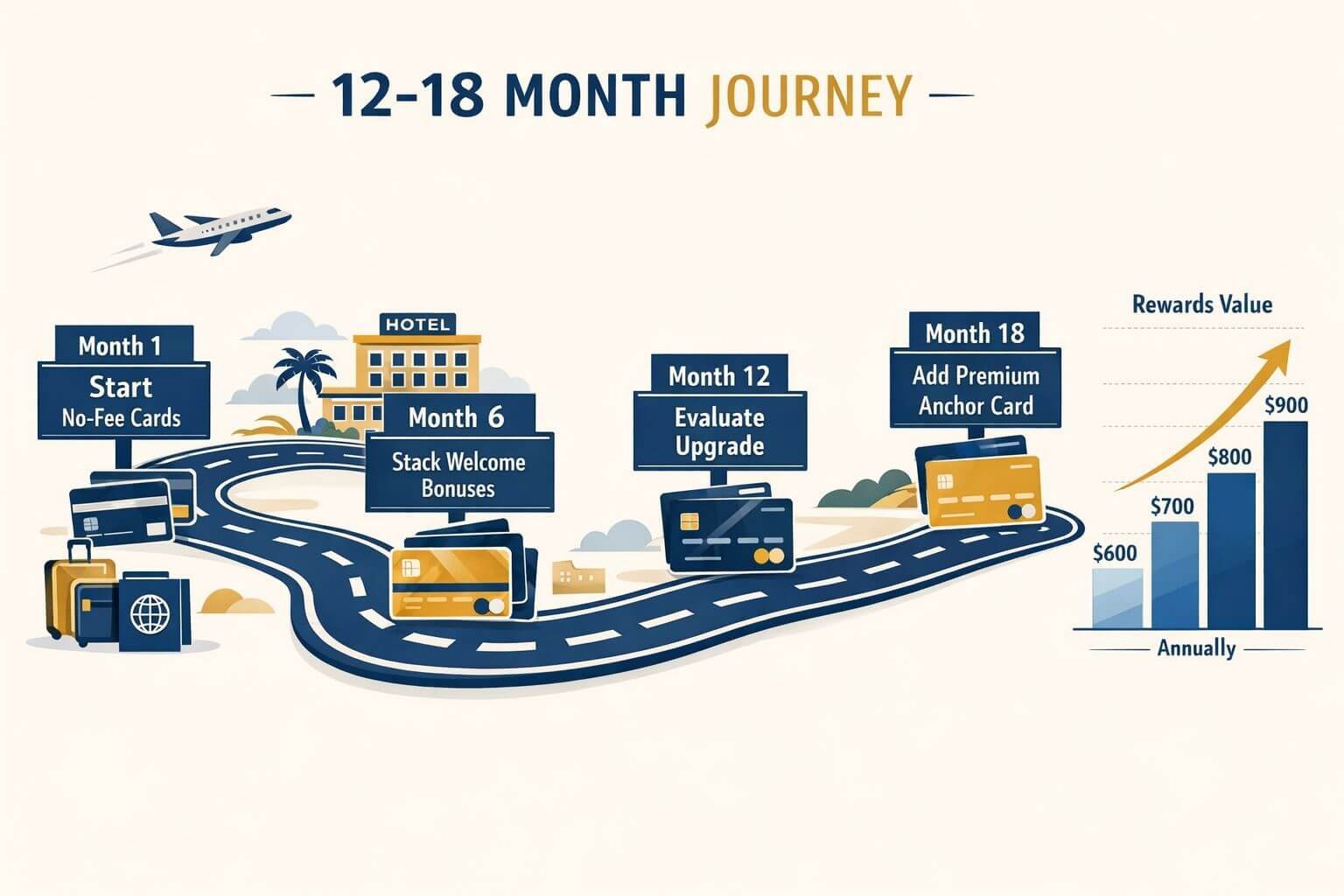
Adding a premium card makes sense when you can clearly identify at least $200–$300 in net value above the annual fee, based on benefits you’ll actually use. That’s the honest threshold.
For most beginners, that moment comes 12–18 months after opening their first no-fee card. By then, you’ll have a better sense of how often you travel, which categories you spend most in, and whether lounge access or travel credits would genuinely change your experience.
Signs you’re ready to upgrade:
- You’re taking 4+ trips per year and spending $500+ on flights annually
- You’ve maxed out the value of your no-fee cards and want to transfer partner access
- You can clearly use at least one major credit on the premium card (travel, dining, hotel)
- Your credit score has improved enough to qualify for the best offers
- You’ve accumulated a solid base of points on your no-fee cards that will transfer up
The upgrade path, step by step:
- Open a no-fee card (or two) from the same issuer ecosystem you want to eventually join (Chase, Wells Fargo, Citi, or Amex).
- Earn the welcome bonus and spend normally for 12–18 months.
- Use the Annual Fee ROI Calculator to model whether the premium card pays off for your specific spend.
- Apply for the premium card (or product-change your no-fee card if eligible).
- Transfer points from your no-fee cards to the premium card to unlock access to transfer partners.
For guidance on whether to upgrade, downgrade, or cancel when evaluating a card, see Credit Card Downgrade Versus Cancel Decision Guide.
What not to do: Don’t cancel your no-fee cards when you add a premium card. Keep them open. They cost nothing, they protect your credit history, and they continue earning points in bonus categories that the premium card may not cover as well.
The 12–18 month roadmap in brief: Month 1–3: Open 1–2 no-fee cards, earn welcome bonuses. Month 3–12: Use cards normally, track your rewards, learn what categories matter most. Month 12–18: Evaluate whether a premium card’s benefits justify the fee based on your actual travel patterns. Only then commit.
For a broader look at where award travel is heading and how to position your strategy, see Award Travel Predictions for 2026: What Matters Most for Points Strategy Now.
Common Mistakes Beginners Make with No-Fee Travel Cards
1. Ignoring foreign transaction fees. Not all no-fee cards waive foreign transaction fees. The Amex Blue Cash Everyday charges 2.9% abroad. Always check before traveling internationally.
2. Forgetting to activate rotating categories. The Chase Freedom Flex requires quarterly activation. If you forget, you earn 1x instead of 5x. Set a calendar reminder for the first week of January, April, July, and October.
3. Redeeming points for cash back too early. If you’re in the Chase ecosystem, cashing out points at 1 cent each before adding a Sapphire card means leaving 50%+ of potential value on the table. Hold the points until you’re ready to transfer.
4. Opening too many cards too fast. Chase’s informal 5/24 rule means they’re unlikely to approve you for a Sapphire card if you’ve opened 5+ cards in the past 24 months. Be strategic about which cards you open and in what order. See Navigating Credit Card Application Rules for a full breakdown.
5. Canceling no-fee cards after getting a premium card. Canceling old cards shortens your average credit history and can lower your credit score. Since no-fee cards cost nothing to keep, there’s almost never a reason to cancel them.
6. Chasing welcome bonuses without a plan. Welcome bonuses are valuable, but opening cards without a clear ecosystem strategy can leave you with points scattered across programs that don’t combine well. Stick to one or two issuer ecosystems when starting out.
FAQ: Best No-Annual-Fee Travel Cards 2026
Q: Can you actually travel hack with no-annual-fee cards? Yes. A 2–3 card no-fee setup earning 3x–5x on key categories, combined with welcome bonuses, can generate enough points for domestic flights or hotel nights within 12 months of normal spending. The limitation is that most no-fee cards don’t offer direct transfer partners, so redemption values are typically capped at 1 cent per point unless you later add a premium card.
Q: What is the single best no-annual-fee travel card for a complete beginner? The Wells Fargo Autograph is the strongest single-card option for most beginners. Its 3x categories cover travel, dining, gas, transit, streaming, and phone plans — which accounts for a large share of typical monthly spending — and it charges no foreign transaction fee. One card, broad coverage, no fee.
Q: Do no-annual-fee cards have foreign transaction fees? Most top no-fee travel cards do not charge foreign transaction fees. The Wells Fargo Autograph, Chase Freedom Flex, Chase Freedom Unlimited, Discover it Miles, and Citi Custom Cash all waive foreign transaction fees. The Amex Blue Cash Everyday is a notable exception, charging 2.9% abroad.
Q: How do Chase Freedom points become transferable? Points earned on the Chase Freedom Flex and Freedom Unlimited are Ultimate Rewards points. On their own, they redeem at 1 cent per point for cash or travel. Once you add a premium Chase card (Sapphire Preferred or Sapphire Reserve), you can combine all your points into one account and transfer them to airline and hotel partners, where they can be worth 1.5–2+ cents each.
Q: Is the Discover it Miles card good for international travel? Yes, with one caveat. The Discover it Miles card charges no foreign transaction fee and earns 1.5x miles on all purchases. However, Discover card acceptance is lower in some international destinations compared to Visa or Mastercard. It’s worth carrying a Visa or Mastercard backup when traveling abroad.
Q: When should I NOT start with no-annual-fee cards? If you already travel frequently (6+ trips per year), spend heavily on flights and hotels ($5,000+/year on travel), and can clearly use the credits on a premium card, starting directly with a premium card may make more financial sense. The no-fee starter path is designed for people new to travel rewards or unsure about their travel frequency.
Q: Can I product-change a no-fee card to a premium card later? Yes, in most cases. Chase allows product changes within card families (e.g., Freedom Flex to Sapphire Preferred). Wells Fargo allows upgrades from the Autograph to the Autograph Journey. Product changes preserve your account history and existing points. You generally need to have had the card for at least 12 months before requesting a product change.
Q: How long does it take to earn a free flight with no-annual-fee cards? It depends on your spending and the cost of the flight. On $2,000/month in spending with a two-card Chase setup, you might earn 50,000–60,000 points in year one (including a welcome bonus). That’s enough for a domestic round-trip on United or Southwest, or a short international flight on a partner airline, depending on availability and routing.
Q: Are no-annual-fee cards worth keeping after I get a premium card? Almost always yes. No-fee cards cost nothing to keep open, they protect your credit history for a longer period, and they often earn better rates in specific categories than the premium card. The Chase Freedom cards, for example, earn 5x on rotating categories and 3x on dining — rates that the Sapphire Reserve doesn’t always beat in those specific windows.
Q: What’s the biggest risk of starting with no-annual-fee cards? The main risk is accumulating points in a program that doesn’t align with your eventual travel goals. For example, if you spend a year earning Discover miles but later realize you want to fly business class internationally, those miles won’t transfer to the partners you need. Research which issuer ecosystem aligns with your travel goals before you start, even if you’re beginning with no-fee cards.
Key Takeaways
- The best no-annual-fee travel credit cards 2026 include the Wells Fargo Autograph, Chase Freedom Flex, Chase Freedom Unlimited, Discover it Miles, Citi Custom Cash, and Amex Blue Cash Everyday.
- A 2–3 card no-fee setup can realistically generate $600–$900 in annual travel value on $24,000 in spending, based on typical bonus category earn rates and conservative point valuations.
- No-fee cards are the lowest-risk way to learn the rewards system, build credit history, and accumulate points before committing to a premium card’s annual fee.
- The Chase Freedom Flex + Freedom Unlimited combination is the strongest two-card no-fee setup for future point transfer value, because those points unlock full transfer partner access when you later add a Sapphire card.
- The Wells Fargo Autograph is the best single no-fee card for simplicity, with 3x on six broad categories and no foreign transaction fee.
- Most no-fee cards charge no foreign transaction fees, but always verify before traveling internationally (the Amex Blue Cash Everyday is an exception).
- Don’t cancel no-fee cards after upgrading to a premium card — they cost nothing to keep and protect your credit history.
- The optimal upgrade timeline is 12–18 months: use no-fee cards to learn your spending patterns, then add one premium anchor card only when the math clearly justifies the fee.
- Welcome bonuses on no-fee cards can significantly boost first-year value — often adding the equivalent of a domestic round-trip on top of regular spending rewards.
- Avoid opening cards across multiple issuer ecosystems too early; pick one or two and go deep before branching out.
Conclusion: Start Simple, Upgrade Strategically
The travel rewards world can feel intimidating from the outside, especially when every headline seems to be about $695 cards with 10 different credits to track. But the best no-annual-fee travel credit cards 2026 prove that you don’t need to pay a cent in annual fees to start earning real travel rewards.
The path forward is straightforward. Pick one or two no-fee cards from an issuer ecosystem that matches your eventual travel goals — Chase for flexible transfers, Wells Fargo for simplicity, Citi for category maximization. Use them for 12–18 months. Earn the welcome bonuses. Learn which categories you actually spend in. Then, and only then, decide whether a premium card’s benefits justify its fee based on your real spending data, not hypothetical scenarios.
That approach is lower risk, lower cost, and honestly more educational than jumping straight into a premium card and hoping the credits work out. And when you do eventually add that premium anchor card, you’ll have a solid base of points ready to transfer, a clear understanding of the ecosystem, and the confidence that comes from having done this before.
Your next steps:
- Choose one starter setup from this guide that matches your spending patterns.
- Apply for the first card (check current welcome offers directly with the issuer).
- Set calendar reminders for quarterly activation if you choose the Chase Freedom Flex.
- Track your rewards monthly for the first six months to see which categories are performing.
- At month 12, use the Annual Fee ROI Calculator to evaluate whether a premium card upgrade makes sense.
For a broader context on where the Points and Miles world is heading, Award Travel Trends 2026 is a good next read.

