

Last updated: May 11, 2026
Quick Answer: For most U.S.-based travelers who fly 2–4 times per year, the best airline loyalty program for infrequent flyers in 2026 is either Alaska Atmos Rewards or American AAdvantage, depending on your home airport and whether you hold a co-branded credit card. Both programs offer non-expiring miles, strong partner networks, and meaningful earnings outside of flying. If neither airline serves your home airport well, United MileagePlus is a solid backup given its global reach and non-expiring miles policy.
Key Takeaways
- Miles in Delta SkyMiles, United MileagePlus, Southwest Rapid Rewards, and JetBlue TrueBlue do not expire — a critical factor if you go 12+ months between flights.
- Alaska Atmos Rewards and AAdvantage offer the strongest partner award sweet spots for infrequent flyers who want to stretch miles on international trips.
- Southwest’s move to assigned seating and fully dynamic award pricing in January 2026 makes Rapid Rewards less predictable for casual travelers than it used to be.
- Delta and United have both shifted to fully dynamic pricing — meaning award costs fluctuate with demand and there are no fixed award charts to plan around.
- A co-branded airline credit card is often the fastest way for infrequent flyers to earn enough miles for a meaningful redemption without flying frequently.
- Transferable points (Amex, Chase, Capital One, Citi, Bilt) give you flexibility to wait and transfer to whichever program has the best award availability when you’re ready to book.
- Choosing one primary program and one primary transferable points card is almost always better than splitting miles across multiple programs.
Why Infrequent Flyers Still Need a Simple Airline Strategy
Flying 2–4 times per year doesn’t mean loyalty programs are irrelevant — it means the wrong choice wastes more time than it’s worth.
Without a strategy, miles scatter across multiple programs, none of which ever reach a useful balance. A traveler who takes one domestic trip and one international trip per year could realistically accumulate 15,000–25,000 miles annually through a combination of flights and a co-branded card. That’s enough for a domestic round-trip or a meaningful contribution toward an international redemption — but only if those miles land in one place.
The good news: in 2026, several major programs have eliminated miles expiration entirely, which removes the biggest risk for low-frequency travelers. The challenge is picking the right program before you start accumulating.
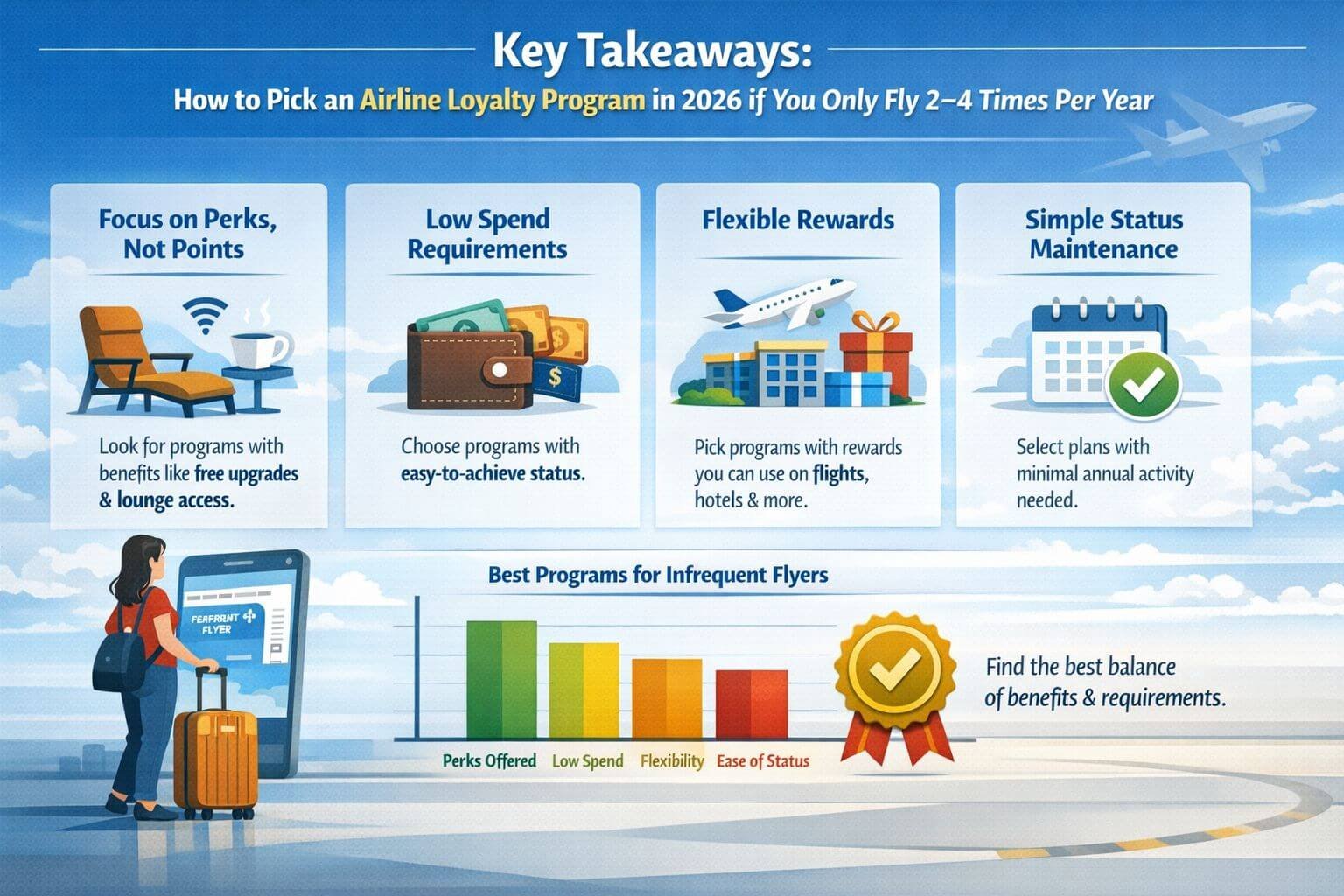
Key Factors That Matter More Than Elite Status for Infrequent Flyers
Elite status is largely out of reach for someone flying 2–4 times per year — and that’s fine. The factors that actually matter are different.
Prioritize these four criteria:
- Miles expiration policy — Can your miles survive a 12–18 month gap between trips? Non-expiring miles are essential for infrequent flyers.
- Ease of earning via credit cards — Co-branded cards and transferable points programs let you build a balance without flying. This is the primary earning lever for low-frequency travelers.
- Partner coverage and award availability — Does the program let you book flights on other airlines? Are award seats actually available when you need them?
- Award pricing structure — Fixed award charts (where they still exist) let you plan and budget. Fully dynamic pricing makes it harder to know what a redemption will cost until you search.
What to deprioritize:
- Elite status tiers (Gold, Platinum, etc.) — the flying requirements are too high for 2–4 trips per year
- Upgrade priority — without status, complimentary upgrades are rare regardless of program
- Earning rate on paid tickets — card spending will drive most of your balance anyway
Understanding how airline miles expire and how to extend them is the single most important piece of program homework for anyone who doesn’t fly often.
Program Snapshots: AA, United, Delta, Southwest, and Alaska
Here’s a direct comparison of the five programs most relevant to U.S.-based infrequent flyers in 2026.
| Program | Miles Expire? | Award Pricing | Key Earning Lever | Best For |
|---|---|---|---|---|
| Alaska Atmos | No | Partner: fixed; Alaska: dynamic | Distance-based earning; co-branded card | West Coast flyers; partner award seekers |
| AAdvantage | No | Partner: fixed; AA: dynamic | Co-branded card (1 LP per $1); free Wi-Fi | East Coast/hub flyers; partner sweet spots |
| United MileagePlus | No | Fully dynamic | Chase cards; Star Alliance partners | Hub cities; Star Alliance itineraries |
| Delta SkyMiles | No | Fully dynamic | Amex cards; Delta partners | Atlanta/NYC/LA hubs; Amex cardholders |
| Southwest Rapid Rewards | No | Fully dynamic (as of Jan 2026) | Rapid Rewards card; companion pass | Domestic-only travelers; families |
You may be interested



Alaska Atmos Rewards launched a “Choose How You Earn” feature in 2026, allowing members to select whether they earn based on distance, spend, or segments. For infrequent flyers who take longer trips, distance-based earning is a strong option. Partner awards on Alaska miles remain some of the most competitive available — for example, Aer Lingus business class from the U.S. to Ireland prices at around 45,000 Alaska miles, which is lower than most comparable programs. The Alaska Atmos Rewards guide for 2026 covers the full earning and redemption structure.
American AAdvantage added free Wi-Fi for all members on mainline narrow-body aircraft in early 2026 — no status required, just an AAdvantage login. The program also introduced new Loyalty Point Rewards at 15,000 LPs (in-flight credits and subscriptions), making it easier for cardholders to see value without reaching elite thresholds. The key advantage for infrequent flyers: partner award charts on Oneworld carriers remain fixed, so you can plan redemptions with predictable costs. Note that if you book American Airlines basic economy fares, those tickets no longer earn miles or Loyalty Points — an important caveat.
United MileagePlus updated its partner earning rules in April 2026, which affects how miles accumulate on Star Alliance flights. The program’s miles don’t expire, and the Chase Ultimate Rewards ecosystem makes it easy to top up a MileagePlus balance by transferring points. The full breakdown of 2026 MileagePlus changes is worth reviewing if United is your primary carrier.
Delta SkyMiles is the most Amex-integrated program in the U.S. — nearly all transferable Amex points can move to SkyMiles at a 1:1 ratio. The tradeoff: Delta uses fully dynamic award pricing with no published chart, so redemption costs vary widely. SkyMiles are best suited for travelers who already hold Amex cards and regularly fly Delta routes. For infrequent flyers without an Amex card, Delta offers less structural advantage. The Delta SkyMiles transfer partners guide explains what’s available through Amex.
Southwest Rapid Rewards switched to assigned seating and fully dynamic award pricing in January 2026. This is a meaningful shift for casual travelers — the old model (fixed points per dollar of ticket price) made it easy to estimate redemption value. Now, award costs fluctuate with demand, similar to Delta and United. Southwest still has non-expiring points and no award fees, but the predictability advantage it once held has largely disappeared. See the Southwest assigned seating and Rapid Rewards update for current details.
Example Profiles: Which Program Fits Your Real Travel Pattern?
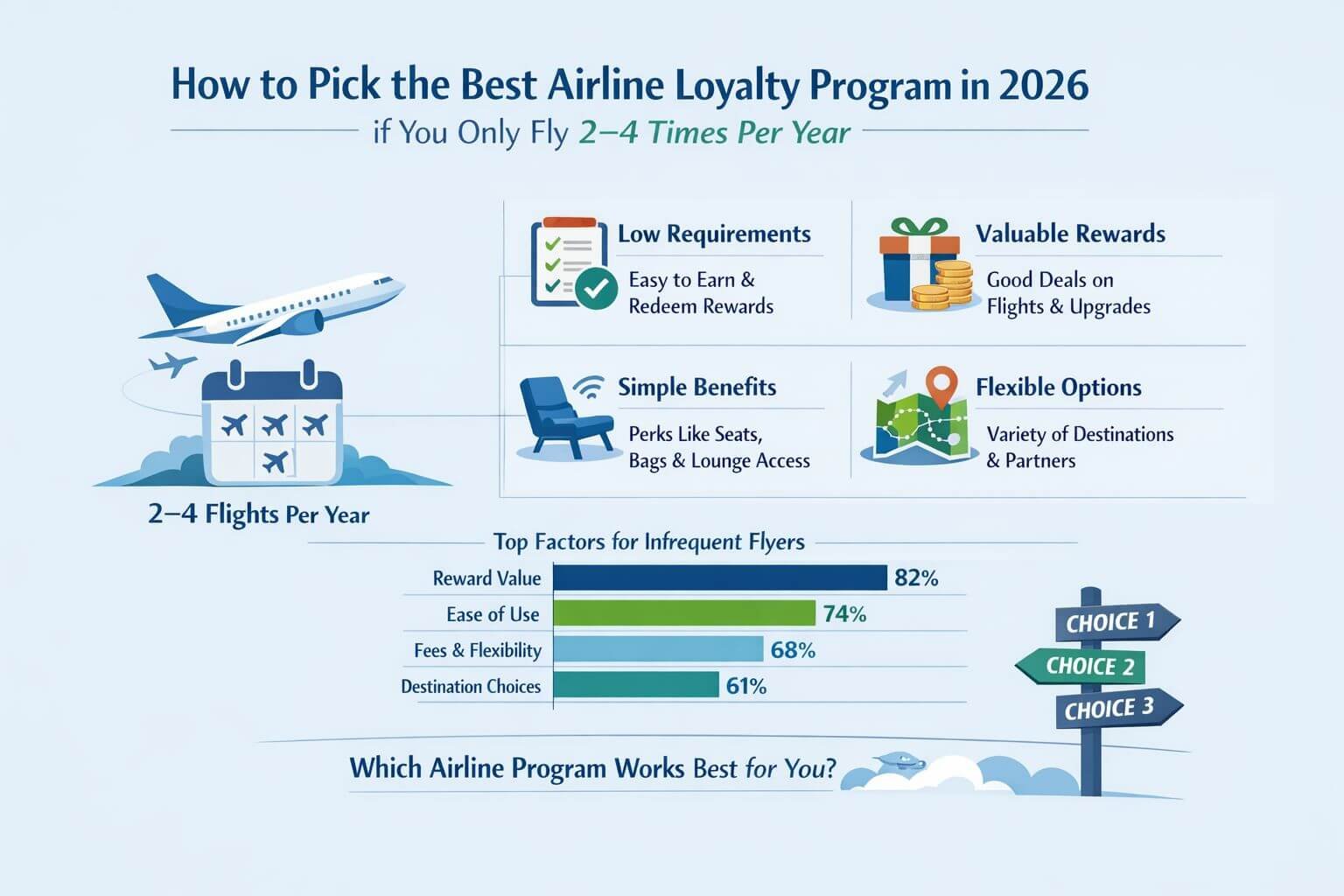
The best airline loyalty program for infrequent flyers depends heavily on where you live and where you’re going.
Profile A: East Coast Family, One Big Trip Per Year
Setup: Family of four based in the New York/New Jersey area. They fly once per year — typically a domestic beach trip or an occasional Europe vacation. They hold one Chase Sapphire Preferred card and occasionally book through the Chase travel portal.
Best fit: American AAdvantage
- JFK, LGA, and EWR all have strong American service, and AA is a major Oneworld hub for transatlantic routes.
- Chase Ultimate Rewards transfers to British Airways Avios (a Oneworld partner), which can book American Airlines flights at fixed partner rates — a useful workaround when AA’s own award prices are high.
- The co-branded AAdvantage card earns Loyalty Points toward the 15,000-LP reward tier, providing small perks even without status.
- Free Wi-Fi on mainline flights adds everyday value without requiring any status.
Assumption: The family earns roughly 15,000–20,000 Chase points per year through card spending, which can transfer to Avios or AAdvantage when a redemption opportunity arises.
Watch out for: Booking basic economy fares on American — those tickets earn zero miles or Loyalty Points.
Profile B: West Coast Tech Worker, 2–3 Domestic + Occasional Asia/Europe Trip
Setup: Solo traveler based in Seattle or San Francisco. Flies 2–3 times domestically per year, plus one international trip every 18–24 months. Holds an Amex Gold card and occasionally a Capital One Venture X.
Best fit: Alaska Atmos Rewards
- Seattle-Tacoma (SEA) is Alaska’s primary hub; San Francisco (SFO) has strong Alaska service.
- Distance-based earning rewards longer domestic and international flights disproportionately.
- Partner award sweet spots (Cathay Pacific, Japan Airlines, Finnair, Aer Lingus) make international premium cabin redemptions accessible at lower mile costs than most U.S. programs.
- Capital One miles transfer to Turkish Airlines Miles&Smiles and Air France/KLM Flying Blue, both of which can book Star Alliance and SkyTeam partners — useful when Alaska partner space is limited.
Assumption: The traveler earns 20,000–30,000 miles per year across flights and card spending, building toward a Business Class redemption every 2–3 years.
Watch out for: Alaska’s international partner award availability can be inconsistent. Always search availability before transferring points. The best ways to find partner award space guide covers search tools that help.
How Credit Cards and Transferable Points Fill the Gaps
For infrequent flyers, credit card spending — not flights — will generate the majority of miles. This is the most important structural reality of building a useful balance on 2–4 trips per year.
Two earning approaches:
Option 1: Co-branded airline card earns miles directly in one program. Simpler, but locks you into that program’s award availability and pricing. Best if you’ve already chosen a primary airline and want to consolidate.
Option 2: Transferable points card (Amex, Chase, Capital One, Citi, or Bilt). Earns flexible currency that transfers to multiple airline programs. More complex, but it gives you the ability to move points to whichever program has the best award space when you’re ready to book. This is the preferred approach for travelers who want optionality.
For example, Chase Ultimate Rewards transfers to United MileagePlus, British Airways Avios, Air France/KLM Flying Blue, and Singapore KrisFlyer — all at a 1:1 ratio. Amex Membership Rewards transfers to Delta SkyMiles, Air Canada Aeroplan, and ANA Mileage Club, among others. Capital One miles transfer to Turkish Airlines, Air Canada, and others. See the full Capital One transfer partners guide for current ratios and partners.
Common mistake: Holding transferable points for too long without a redemption target. Points sitting in an Amex or Chase account don’t expire, but airline programs can devalue at any time. Transfer only when you have a confirmed booking target and available award space.
For a deeper look at how to evaluate whether a transfer is worth it, the cents-per-point math guide walks through the calculation step by step.
A 3-Step Plan for Picking and Sticking to One Main Program
Choosing the best airline loyalty program for infrequent flyers doesn’t require complex analysis — it requires answering three specific questions in order.
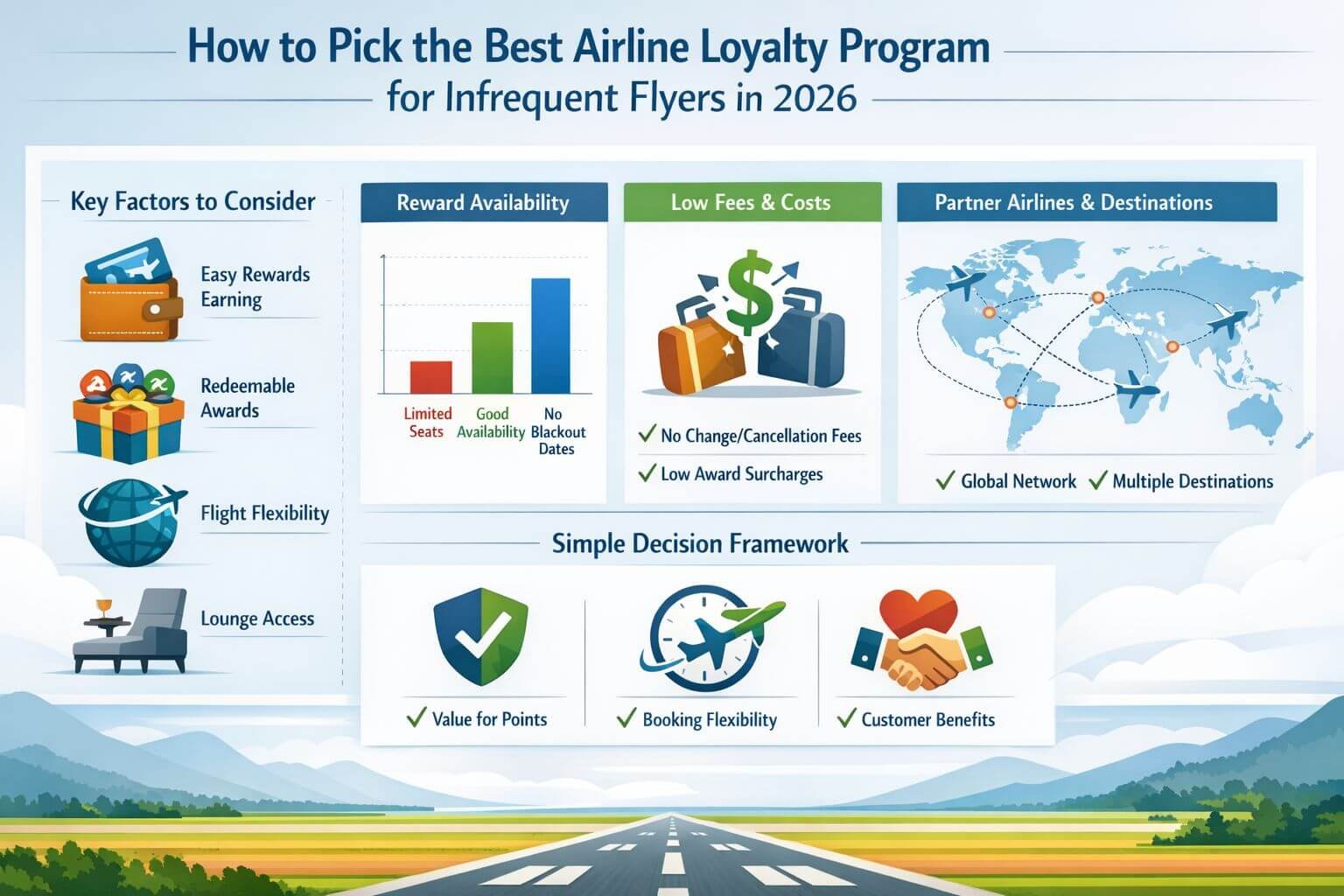
Step 1: Identify your home airport and dominant carrier
Which airline has the most nonstop flights from your home airport? That airline’s program is your default starting point. Nonstop access matters more than program perks — positioning flights to reach a hub adds cost and complexity that rarely pay off for 2–4 annual trips.
- Seattle, Portland, Anchorage → Alaska Atmos
- Dallas, Miami, Charlotte, Philadelphia → AAdvantage
- Chicago O’Hare, Houston, Denver, Newark → United MileagePlus
- Atlanta, Minneapolis, Detroit, Salt Lake City → Delta SkyMiles
- Dallas Love Field, Chicago Midway, Baltimore → Southwest Rapid Rewards
Step 2: Check your current credit card(s)
Which transferable points currencies do you already earn? If you hold a Chase Sapphire card, United and British Airways Avios (for AA flights) are natural transfer targets. If you hold an Amex Gold or Platinum, Delta and Aeroplan are accessible. Match your card ecosystem to your program choice where possible.
If you don’t yet hold a travel card, the comparison of points vs. cash back strategies is a useful starting point before committing.
Step 3: Confirm the miles expiration policy and set a calendar reminder
Even with non-expiring programs, confirm the current policy for your chosen program — policies can change. For programs that still have activity-based expiration windows, set a calendar reminder every 18 months to make a qualifying transaction. Our airline miles expiration rules guide tracks current policies by program.
Once you’ve completed these three steps, credit all future flights to that one program. Open the co-branded card or confirm your transferable points card transfers to that program. Stop splitting miles across multiple accounts.
FAQs: Infrequent Flyers on Miles and Programs
Q: Do airline miles expire if I only fly once or twice a year?
A: Delta SkyMiles, United MileagePlus, Southwest Rapid Rewards, and JetBlue TrueBlue miles do not expire under current 2026 policies. American AAdvantage and Alaska Atmos miles also do not expire. Always verify the current policy for your program, as rules can change.
Q: Is it worth joining an airline loyalty program if I only fly 2–3 times a year?
A: Yes — even at low frequency, a loyalty program account lets you earn miles on every flight, access free Wi-Fi (on American), and build toward a redemption over time. The key is consolidating into a single program rather than spreading miles across several programs.
Q: Which airline program is easiest to earn miles in without flying?
A: American AAdvantage and Alaska Atmos both allow meaningful earning through co-branded credit cards. AAdvantage awards 1 Loyalty Point per $1 spent on the co-branded card, which counts toward reward tiers. Alaska Atmos miles can also be earned through the Bank of America co-branded card and shopping portals.
Q: Should I pick Delta or United if I live in a hub city for both?
A: Both use fully dynamic award pricing, so neither has a structural advantage in award costs. The deciding factor is usually your credit card: if you hold Amex cards, Delta is the natural fit; if you hold Chase cards, United is the better match.
Q: Is Southwest still a good option for infrequent flyers after the 2026 changes?
A: Southwest remains a reasonable option for domestic-only travelers who value no award fees and no miles expiration. However, the shift to fully dynamic award pricing in January 2026 removed the predictability that made Rapid Rewards particularly beginner-friendly. Budget for variability in award costs.
Q: Can I use transferable points for airline awards without picking one program?
A: Yes — transferable points (Amex, Chase, Capital One, Citi, Bilt) can sit in your bank account and transfer to whichever airline program has the best availability when you’re ready to book. This is the most flexible approach for infrequent flyers, though it requires searching for award space before transferring.
Q: What’s the minimum number of miles needed for a useful domestic redemption?
A: This varies by program and dynamic pricing, but a realistic range for a domestic round-trip is 15,000–25,000 miles on most U.S. programs in 2026. Fixed-chart partner awards (Alaska, AAdvantage on Oneworld partners) can sometimes be priced lower.
Q: Is basic economy worth booking if I’m trying to earn miles?
A: Not on American Airlines — basic economy fares on AA earn zero miles and zero Loyalty Points as of 2026. On United, basic economy earns miles at a reduced rate. Always check the fare class earning rate before booking the cheapest available option.
Q: How do I avoid devaluation risk as an infrequent flyer?
A: Don’t accumulate miles for years without a redemption target. Build toward a specific trip, transfer points only when you have confirmed award availability, and don’t let a large balance sit idle in a single program for more than 12–18 months without a plan.
Q: What if I travel internationally — does that change which program is best?
A: Yes, significantly. Alaska Atmos and AAdvantage both offer fixed-rate partner awards on international itineraries through their alliance partners, making planning more predictable than with fully dynamic programs. For business class redemptions specifically, the guide to booking business class with points covers the best program options in detail.
Conclusion: Keep It Simple, Pick One, and Start Now
The best airline loyalty program for infrequent flyers in 2026 is the one that matches your home airport, your credit card ecosystem, and your travel goals — not the one with the most marketing buzz.
For most U.S. travelers flying 2–4 times per year, the decision comes down to two programs: Alaska Atmos Rewards if you’re on the West Coast or want strong partner award value, and American AAdvantage if you’re on the East Coast or in an AA hub city. United MileagePlus is the right call if your home airport is a United hub and you hold Chase cards.
Avoid spreading miles across three or four programs. Avoid booking basic economy on American if you want to earn. And don’t wait to pick a program — every untracked flight is miles left behind.
Your next steps:
- Identify your home airport’s dominant carrier using the Step 1 framework above.
- Check whether your current credit card is accepted by that program.
- Open or confirm your account and credit your next flight.
- Set a calendar reminder to review your balance and expiration status every 12 months using the end-of-year points and miles checklist.
For a more advanced comparison of Alaska Atmos, United MileagePlus, and AAdvantage — including sweet spot redemptions and partner award availability — see the full airline loyalty program value comparison guide.


Content on Award Travel Hub is independently created by Award Travel Hub Editorial Desk and, where noted, reviewed by Award Travel Hub Review Desk. Some pages may contain affiliate links, but compensation does not determine our coverage, opinions, or methodology.