

Last updated: February 25, 2026
The American Express Gold Card now costs $325 annually—up from $250 just two years ago. That’s a significant jump for a mid-tier rewards card, and if you’re evaluating whether to keep the Amex Gold card worth it in 2026 or apply for the first time, you need a clear-eyed look at the math. The short answer: it depends entirely on whether you’ll use the statement credits and how much you spend on dining and groceries. This guide breaks down every dollar of value, shows you exactly when the card pays for itself, and compares it against the newest alternatives most reviews ignore.
Key Takeaways
- The Amex Gold Card offers $424 in annual statement credits ($120 Uber, $120 dining, $84 Dunkin’, $100 Resy) that can offset the $325 fee if fully utilized
- You earn 4x Membership Rewards points on U.S. restaurant and grocery spending (up to $50,000 and $25,000 annually), which translates to strong returns for moderate spenders
- Breakeven point: With just $6,000 in combined dining and grocery spending annually, plus partial credit usage, the card generates a positive ROI
- The card makes sense if you value flexible transfer points over cash back and will actively use at least three of the four statement credits
- Consider the Citi Strata Premier ($95 fee) or Capital One Savor (no fee) if you want simpler rewards without credit restrictions
What the Amex Gold Card Costs vs. What You Get Back
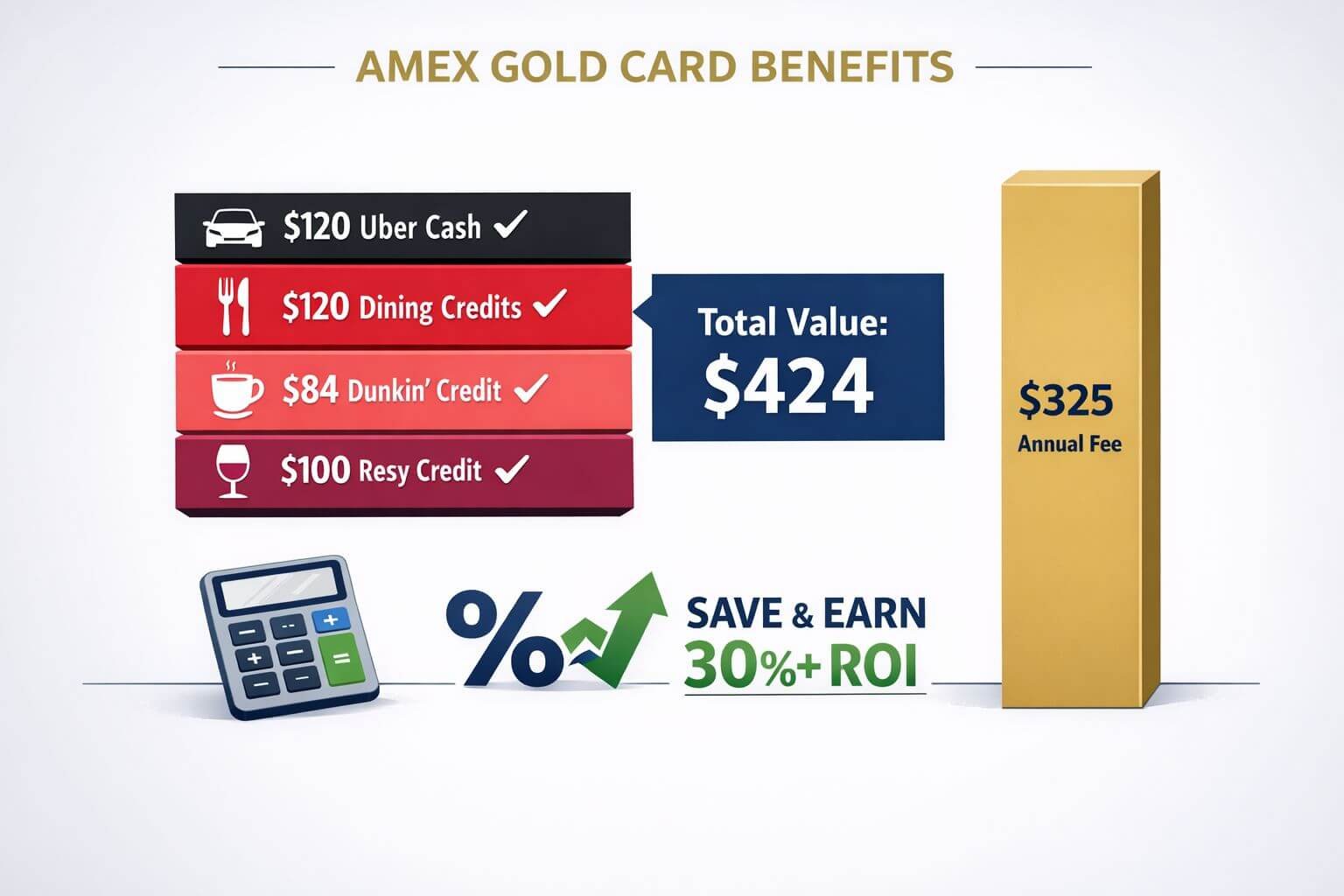
The Amex Gold Card charges a $325 annual fee in 2026, but American Express bundles four separate statement credits that can return up to $424 in value annually. The card earns 4x Membership Rewards points on restaurant spending worldwide (up to $50,000 per year), 4x on U.S. supermarket purchases (up to $25,000 annually), 3x on flights booked directly with airlines or on AmexTravel.com, and 1x on everything else.
Here’s the value equation: if you use all four credits fully, you’re ahead by $99 before earning a single point. Add in the 4x multipliers on categories where you already spend money, and the card can generate substantial returns. But that’s a big “if”—the credits come with restrictions that make them harder to maximize than a simple cash-back percentage.
The real question isn’t whether the card can deliver value. It’s whether it will deliver value based on your actual spending habits and willingness to adjust your behavior to capture the credits.
Understanding the Fee Increase
American Express raised the annual fee from $250 to $325 in October 2024, a 30% increase that coincided with the addition of the $100 Resy credit and the $84 Dunkin’ credit. Existing cardholders saw the change at their next renewal, while new applicants paid the higher fee immediately.
The fee increase reflects a broader trend across premium cards: issuers are adding targeted credits to justify higher fees while maintaining the same core earning structure. For the Amex Gold, this strategy works if you already patronize the eligible merchants. If you don’t, you’re essentially paying $325 for a card that used to cost $250 with fewer hoops to jump through.
Breaking Down Every Amex Gold Statement Credit for 2026
Each of the four statement credits has specific eligibility rules, monthly caps, and merchant restrictions. Here’s exactly what you get and how to maximize each one.
$120 Uber Cash ($10 Monthly)
You receive $10 in Uber Cash each month that can be used for Uber rides or Uber Eats orders in the United States. The credit posts automatically when you add your Amex Gold Card to your Uber account and select it as your payment method.
Key restrictions:
- Credits expire at the month-end and don’t roll over
- Must use the Uber app (not available for web bookings)
- Applies to rides, Uber Eats food delivery, and Uber Eats grocery delivery
- Works on the ride/order total before tips
Maximization strategy: Set a monthly reminder for the last week of each month. If you haven’t used your $10 credit, order a small Uber Eats meal or take a short ride. Even a $7 Uber Eats order captures $7 of value that would otherwise disappear.
$120 Dining Credit ($10 Monthly)
This credit provides $10 per month (up to $120 annually) when you use your card at select merchants: Grubhub, The Cheesecake Factory, Goldbelly, Wine.com, and Five Guys. You must enroll in the benefit through your Amex account before the credit activates.
Key restrictions:
- Must enroll each calendar year
- Credits don’t roll over month-to-month
- Limited to five specific merchants
- Minimum purchase requirements vary by merchant
Maximization strategy: Wine.com and Goldbelly offer shelf-stable products you can stockpile. Order a $10+ bottle of wine or specialty food item monthly to capture the credit, even if you don’t need immediate delivery. The Cheesecake Factory and Five Guys are good options for in-person dining if you visit these chains regularly.
Common mistake: Forgetting to re-enroll each January. The benefit doesn’t auto-renew, and you’ll miss credits until you manually activate it.
$84 Dunkin’ Credit ($7 Monthly)
You get $7 per month (up to $84 annually) for purchases at Dunkin’ locations or through the Dunkin’ app. Like the dining credit, you must enroll through your Amex account.
Key restrictions:
- Must enroll annually
- Credits expire monthly
- Only valid at Dunkin’ (not other coffee chains)
- Must use an enrolled Amex Gold Card for payment
Maximization strategy: If you don’t regularly visit Dunkin’, this credit is the hardest to justify. A $7 monthly coffee run captures the value, but it requires intentionally choosing Dunkin’ over competitors. For non-Dunkin’ customers, this credit often goes unused.
$100 Resy Credit ($50 Biannual)
Added in July 2024, this credit provides $50 twice per year (January-June and July-December) when you book and pay for dining reservations through Resy using your Amex Gold Card. The credit posts within 5-7 business days after your meal.
Key restrictions:
- Must book through the Resy app or website
- Must use an enrolled Amex Gold Card for payment at the restaurant
- Credit periods don’t roll over (use it or lose it every six months)
- Only applies to participating Resy restaurants
Maximization strategy: Resy operates in major metro areas with strong restaurant coverage, including New York, San Francisco, Los Angeles, Chicago, and Miami. If you live in or visit these markets, the credit is well-suited for special-occasion dining. For suburban or rural cardholders, Resy’s limited footprint makes this credit nearly worthless.
Total Credit Value: $424 (Theoretical Maximum)
If you capture every dollar of every credit, you receive $424 in annual value against the $325 fee—a $99 net gain before earning any points. But the “if” matters enormously here. The credits require:
- Monthly attention (Uber, dining, Dunkin’)
- Behavioral changes (choosing specific merchants)
- Geographic proximity (Resy)
- Active enrollment (dining, Dunkin’)
Realistic value for most cardholders: $250-$350 annually, depending on location and spending flexibility.
How Much You Actually Earn at 4x on Dining and Groceries
The statement credits get the headlines, but the 4x earning multipliers on dining and groceries drive the card’s long-term value. Here’s how the math works for different spending profiles.
Membership Rewards Point Valuations
Membership Rewards points are transferable to 21 airline and hotel partners, including Delta SkyMiles, Air France-Flying Blue, Hilton Honors, and Marriott Bonvoy. The value per point varies dramatically based on how you redeem:
- Cash back or statement credit: 0.6 cents per point (terrible value)
- Amex Travel portal: 1.0 cent per point (acceptable for domestic economy)
- Transfer to partners: 1.5-2.0 cents per point (typical for business class awards)
- Premium cabin sweet spots: 2.0-4.0+ cents per point (expert-level redemptions)
For this analysis, we’ll use a conservative 1.6 cents per point valuation—achievable by anyone who transfers points to partners for economy or business class international flights. If you’re already comfortable with transfer partner strategies, you can push valuations higher.
Spending Scenario 1: Moderate Spender
Profile: $500 monthly dining, $400 monthly groceries
- Annual dining: $6,000 × 4x = 24,000 points
- Annual groceries: $4,800 × 4x = 19,200 points
- Total points earned: 43,200 points
Point value: 43,200 × $0.016 = $691
Credit value (realistic): $300 (assuming 75% credit utilization)
Total value: $991 Net value after $325 fee: +$666
This profile represents a single person or couple with average dining and grocery spending. Even with conservative point valuations and partial credit usage, the card delivers strong positive returns.
Spending Scenario 2: High Spender
Profile: $1,000 monthly dining, $800 monthly groceries
- Annual dining: $12,000 × 4x = 48,000 points
- Annual groceries: $9,600 × 4x = 38,400 points
- Total points earned: 86,400 points
Point value: 86,400 × $0.016 = $1,382
Credit value (realistic): $375 (assuming 90% credit utilization)
Total value: $1,757 Net value after $325 fee: +$1,432
High spenders see exceptional returns. At this level, the card generates more value than most premium cards with higher annual fees.
Spending Scenario 3: Light Spender
Profile: $300 monthly dining, $250 monthly groceries
- Annual dining: $3,600 × 4x = 14,400 points
- Annual groceries: $3,000 × 4x = 12,000 points
- Total points earned: 26,400 points
Point value: 26,400 × $0.016 = $422
Credit value (realistic): $200 (assuming 50% credit utilization)
Total value: $622 Net value after $325 fee: +$297
Even light spenders can break even or slightly ahead, but the margin is thin. If you struggle to use the credits or value points below 1.5 cents each, you’re better off with a no-annual-fee card.
The Breakeven Calculation
To break even on the $325 annual fee with zero credit usage, you need to earn 20,313 Membership Rewards points (valued at 1.6 cents per point). At 4x earnings:
Breakeven spending: $5,078 annually in combined dining and grocery purchases
That’s roughly $423 per month—achievable for most households. Add in partial credit usage, and the breakeven threshold drops to $3,000-$4,000 in annual spending.
Comparing Point Value: Amex vs. Cash Back
A flat 2% cash-back card returns $120 on $6,000 in spending. The Amex Gold returns 24,000 points worth $384 (at 1.6 cents per point) on the same $6,000 in dining alone—a 3.2x advantage.
But that advantage only matters if you’re willing to transfer points and book award travel. If you prefer simplicity and immediate cash, a 2% card beats the complexity of managing credits and transfer partners. For more on this trade-off, see our points vs. cash-back comparison.
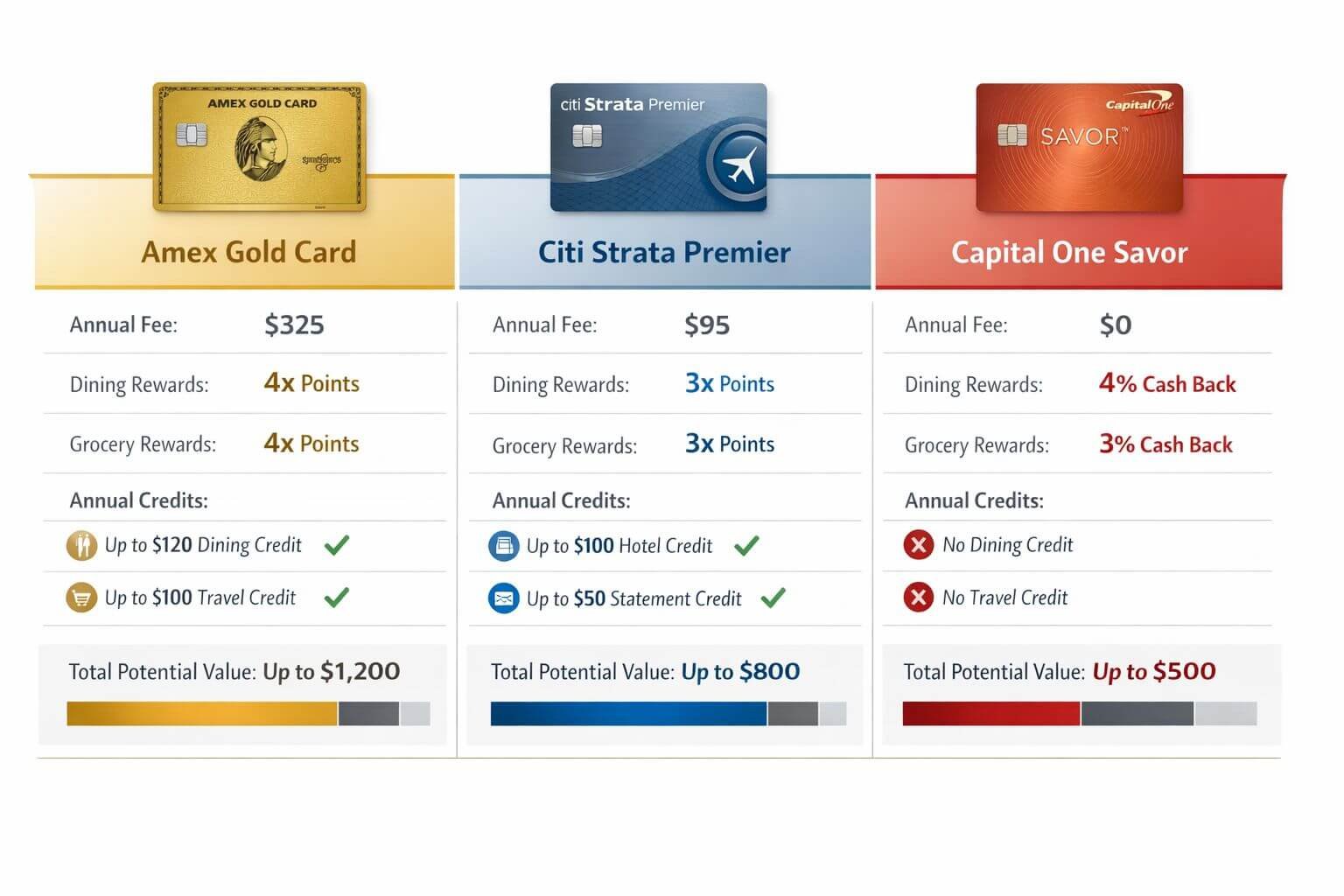
Amex Gold vs. Citi Strata Premier vs. Capital One Savor
The Amex Gold faces stiffer competition in 2026 than ever before. Two cards deserve serious consideration as alternatives: the Citi Strata Premier and Capital One Savor.
Citi Strata Premier: The Low-Fee Alternative
Annual fee: $95 Earning rates:
- 3x on dining, gas stations, supermarkets, air travel, hotels
- 1x on everything else
Key benefits:
- $100 annual hotel credit
- 10% points back on the first 100,000 points redeemed annually
- Transfer to 19 airline and hotel partners
- No foreign transaction fees
Value comparison: The Strata Premier offers broader 3x categories (including gas and hotels) with a $230 lower annual fee. You earn fewer points per dollar on dining and groceries (3x vs. 4x), but you also don’t need to chase monthly credits to justify the fee.
Choose the Strata Premier if:
- You want lower annual costs
- You spend significantly on gas and hotels
- You prefer simpler benefits without monthly credit management
- You value the 10% points-back bonus on redemptions
Choose the Amex Gold if:
- You spend heavily on dining and groceries specifically
- You’ll actively use the statement credits
- You prefer Amex’s transfer partners (particularly Delta and Hilton)
Capital One Savor: The No-Fee Option
Annual fee: $0 Earning rates:
- 4% cash back on dining and entertainment
- 3% on groceries
- 1% on everything else
Key benefits:
- No annual fee
- Straightforward cash back (no points to manage)
- No foreign transaction fees
Value comparison: The Savor delivers 4% cash back on dining (equivalent to 4x points at 1.0 cent per point) and 3% on groceries with zero annual fee. You give up the flexibility of transferable points and the statement credits, but you also eliminate the $325 fee and credit management burden.
Choose the Savor if:
- You prefer cash back over travel points
- You don’t want to pay annual fees
- You value simplicity over optimization
- You rarely book award travel
Choose the Amex Gold if:
- You actively use transfer partners for travel
- You can maximize the statement credits
- You value points at 1.5+ cents each through transfers
Side-by-Side Comparison Table
| Feature | Amex Gold | Citi Strata Premier | Capital One Savor |
|---|---|---|---|
| Annual Fee | $325 | $95 | $0 |
| Dining Earning | 4x points | 3x points | 4% cash |
| Grocery Earning | 4x points (cap $25k) | 3x points | 3% cash |
| Annual Credits | $424 (max) | $100 hotel | None |
| Transfer Partners | 21 partners | 19 partners | None |
| Best For | Heavy dining/grocery + credit users | Balanced spenders | Cash-back simplicity |
When You Should Keep the Amex Gold Card (and When to Cancel)
The decision to keep or cancel the Amex Gold in 2026 comes down to three factors: spending patterns, credit utilization, and point redemption behavior.
Keep the Card If You:
✅ Spend $6,000+ annually on dining and groceries combined. At this threshold, you earn enough points to justify the fee even with minimal credit usage. Higher spending dramatically improves the value proposition.
✅ Will use at least three of the four statement credits. If you can capture $300+ in credits annually, the effective annual fee drops to $25 or less. At that price, the 4x multipliers make the card a no-brainer.
✅ Transfer points to airline and hotel partner.s Membership Rewards points shine when transferred. If you’re booking business class flights or redeeming for high-value hotel stays, your points are worth 1.5-2.0+ cents each. That multiplier effect makes the 4x earning rates extremely valuable. Learn more about maximizing Amex transfer partners.
✅ Live in a major metro area with Resy coverage. The $100 Resy credit works well in cities with strong restaurant scenes. If you’re in New York, San Francisco, Los Angeles, Chicago, or similar markets, you can easily use both $50 credits annually.
✅ Already use Uber regularly. The $120 Uber credit is the easiest to maximize if you already rely on Uber for rides or food delivery. It requires no behavioral change—just add your card to your Uber account.
Cancel (or Downgrade) If You:
❌ Spend less than $4,000 annually on dining and groceries. Below this threshold, you’re not earning enough points to cover the annual fee, even with partial credit. A no-fee card delivers better returns.
❌ Rarely or never use the statement credits. If you’re not capturing at least $200-$250 in credits, the effective annual fee is too high. The card becomes a poor value compared to alternatives.
❌ Prefer cash back over travel points. If you redeem Membership Rewards for cash or statement credits (at 0.6 cents per point), you’re leaving massive value on the table. A simple 2% cash-back card beats the Amex Gold in that scenario.
❌ Don’t live near Resy restaurants. For suburban and rural cardholders, the $100 Resy credit is often unusable. That immediately cuts the maximum credit value to $324—barely covering the annual fee before earning any points.
❌ Can’t be bothered with monthly credit management. The Amex Gold requires active engagement: monthly enrollment checks, merchant selection, and spending tracking. If that sounds exhausting, choose a simpler card structure.
The Downgrade Option
If you’re on the fence, consider downgrading to the Amex EveryDay Card (no annual fee) or Amex EveryDay Preferred ($95 annual fee). Both cards keep your Membership Rewards points active and offer modest earning rates without the pressure of monthly credits.
The downgrade preserves your account history (good for credit scores) and maintains access to the Amex transfer partner network. You can always upgrade back to the Gold later if your spending patterns change. For a detailed walkthrough of this decision, see our downgrade vs. cancel guide.
Retention Offer Considerations
Before canceling, call American Express and ask if you’re eligible for a retention offer. Amex frequently offers 10,000-30,000 bonus points or statement credits ($100-$300) to keep cardholders from canceling.
A 20,000-point retention offer adds $320 in value (at 1.6 cents per point), making it worthwhile to keep the card for another year even if you’re borderline on value. Always explore retention offers before making a final decision.
Advanced Strategies to Maximize Amex Gold Value
Beyond the basics, several tactics can squeeze additional value from the card.
Strategy 1: Stack Credits with Other Amex Cards
If you hold multiple Amex cards (like the Platinum or Business Gold), you can stack credits from different cards. For example:
- Use your Gold Card’s $10 Uber credit
- Use your Platinum Card’s $15 Uber credit
- Total: $25 in monthly Uber credits
This approach works well for households with multiple cardholders or individuals who carry several Amex products for different earning categories.
Strategy 2: Prepay for Future Purchases
Wine.com and Goldbelly allow you to purchase gift cards or shelf-stable items that don’t expire. Buy $10- $12 of wine or specialty foods each month to earn the dining credit, then stockpile for future use. This converts the monthly credit into a lump-sum value you can use whenever convenient.
Strategy 3: Combine with Dining Programs
Pair your Amex Gold with dining rewards programs like Rewards Network or Seated. These programs offer additional cash back or points for dining at participating restaurants. When combined with the 4x Amex earning, you’re effectively earning 4x points plus 5-10% cash back on the same transaction.
Strategy 4: Use for Business Expenses
If you’re self-employed or run a small business, the Amex Gold works exceptionally well for business meals and client entertainment. The 4x earning on dining applies to business expenses, and the credits offset costs you’d incur anyway. Plus, the annual fee becomes a business deduction.
Strategy 5: Transfer During Bonus Periods
Amex occasionally offers transfer bonuses to specific partners (typically 20-40% extra points). Wait for these promotions before transferring large point balances. A 30% transfer bonus increases your effective point value from 1.6 cents to 2.08 cents—a significant jump that makes the 4x earning even more powerful. Track current bonuses through our transfer bonus strategy guide.
Strategy 6: Optimize Grocery Spending
The $25,000 annual cap on 4x grocery earnings is high enough for most households, but if you’re close to the limit, shift additional grocery spending to a different card before hitting the cap. After $25,000, the Gold earns just 1x on groceries—terrible value compared to other options.
Common Mistakes to Avoid
Even experienced cardholders make errors that reduce the Amex Gold’s value:
Mistake 1: Forgetting to enroll in credits. The dining and Dunkin’ credits require annual enrollment. If you forget, you miss out on $204 in potential value. Set a January reminder to enroll in all benefits.
Mistake 2: Letting monthly credits expire. Uber, dining, and Dunkin’ credits don’t roll over. If you don’t use them by the month-end, they disappear. Set monthly reminders to capture these credits before they expire.
Mistake 3: Redeeming points for cash or statement credits. At 0.6 cents per point, cash redemptions are a terrible value. Always transfer to partners or use the Amex Travel portal (minimum 1.0 cent per point) for better returns.
Mistake 4: Ignoring retention offers. Before canceling, always call and ask about retention offers. Amex frequently provides valuable incentives to keep the card active.
Mistake 5: Using the card for non-bonus categorie.s The Amex Gold earns just 1x on non-bonus spending—far worse than a flat 2% cash-back card. Use the Gold exclusively for dining, groceries, and flights. Put everything else on a better card.
Is the Amex Gold Card Worth It in 2026? The Verdict
The Amex Gold Card delivers strong value in 2026 if you meet three conditions: you spend at least $6,000 annually on dining and groceries, you actively use at least three of the four statement credits, and you transfer Membership Rewards points to airline and hotel partners for travel redemptions.
For cardholders who fit that profile, the card generates $600-$1,400 in annual value against the $325 fee—an excellent return. The 4x earning multipliers on dining and groceries are among the best in the industry, and the statement credits (while restrictive) can offset most or all of the annual fee if you’re willing to adjust your spending behavior.
But the card isn’t for everyone. Light spenders, cash-back preferers, and anyone who can’t be bothered with monthly credit management will find better options elsewhere. The Citi Strata Premier offers similar benefits at a lower fee and a simpler structure, while the Capital One Savor delivers strong cash-back returns with no annual fee.
The bottom line: the Amex Gold is worth $325 in 2026 if you’ll use it actively and strategically. If you’re on autopilot, it’s overpriced.
Next Steps: Calculate Your Personal Value
Before making a decision, run your own numbers:
Calculate your annual dining and grocery spending. Multiply by 4 to estimate your point earnings, then multiply by 1.6 cents to estimate dollar value.
Estimate your realistic credit usage. Be honest about which credits you’ll actually use monthly. Don’t assume 100% utilization unless you’re certain.
Add your point value and credit value together. Subtract the $325 annual fee. If the result is positive and meaningful (at least $200+), the card makes sense.
Compare against alternatives. Run the same calculation for the Citi Strata Premier and Capital One Savor to see which card delivers the best return for your specific spending pattern.
Consider your redemption strategy. If you’re not transferring points to partners, your point valuations will be lower. Adjust your calculations accordingly.
For more detailed guidance on maximizing credit card rewards, explore our complete guide to credit card annual fee ROI.
Frequently Asked Questions
Is the Amex Gold Card worth it if I don’t travel?
The Amex Gold can still deliver value for non-travelers if you maximize the statement credits and spend heavily on dining and groceries. However, you’ll need to redeem Membership Rewards through the Amex Travel portal (1.0 cent per point) rather than transferring to partners (1.5-2.0+ cents per point). At 1.0 cent valuations, your breakeven spending threshold increases to approximately $8,000-$10,000 annually in bonus categories. A cash-back card like the Capital One Savor likely delivers better returns for non-travelers.
How does the Amex Gold compare to the Platinum Card?
The Platinum Card ($695 annual fee) targets frequent travelers with airport lounge access, hotel elite status, and travel credits. The Gold Card targets everyday spenders with dining and grocery multipliers and food-related credits. Choose the Platinum if you fly frequently and value lounge access; choose the Gold if you spend heavily on dining and groceries. Many cardholders carry both cards for different spending categories.
Can I use the Uber credit for Uber Eats?
Yes, the $10 monthly Uber credit works for both Uber rides and Uber Eats food delivery orders. It also applies to Uber Eats grocery delivery from participating stores. The credit posts automatically when you use your enrolled Amex Gold Card as payment in the Uber app.
What happens to my Membership Rewards points if I cancel the card?
If you cancel the Amex Gold and don’t hold any other Membership Rewards-earning cards, your points expire. To preserve your points, either transfer them to a partner before canceling or downgrade to a no-annual-fee Amex card like the EveryDay Card. The downgrade keeps your points active indefinitely.
Do the statement credits count toward the minimum spending for the welcome bonus?
No, statement credits don’t count toward minimum spending requirements. Only your actual purchases count. For example, if you spend $100 at Grubhub and receive a $10 credit, only the $100 counts toward your minimum spending threshold.
Can I get a retention offer if I threaten to cancel?
American Express doesn’t guarantee retention offers, but they’re common for Gold Card holders. Call the number on the back of your card, explain you’re considering canceling due to the annual fee, and ask if any offers are available. Typical offers range from 10,000 to 30,000 bonus points or $100 to $300 in statement credits. Don’t threaten or be aggressive—simply ask politely whether retention offers are available.
Is the Amex Gold good for international travel?
The Amex Gold has no foreign transaction fees and earns 4x points on restaurant spending worldwide, making it a solid choice for dining abroad. However, Amex acceptance is lower than that of Visa or Mastercard in many countries, particularly in Asia and smaller European towns. Carry a backup Visa or Mastercard for locations that don’t accept Amex. For comprehensive international travel card strategies, see our guide to international travel credit cards.
How long does it take for statement credits to post?
Uber credits post within 1-2 billing cycles after you add your card to your Uber account. Dining credits (Grubhub, Cheesecake Factory, etc.) typically post within 5-7 business days after purchase. Dunkin’ credits post within 5-7 business days. Resy credits post within 5-7 business days after your dining reservation. If a credit doesn’t post within the expected timeframe, contact Amex customer service.
Can I add authorized users to earn more points?
Yes, authorized users earn the same 4x multipliers on dining and groceries. Amex charges $35 per authorized user on the Gold Card, but authorized user spending counts toward the primary cardholder’s point balance. For couples or families with high combined spending, adding an authorized user can significantly increase total point earnings.
What’s the best use of Amex Membership Rewards points?
The highest-value redemptions typically involve transferring points to airline partners for business or first-class international flights. Sweet spots include Air France-Flying Blue for transatlantic business class (starting at 53,000 points one-way), ANA for Star Alliance awards, and Virgin Atlantic for Delta flights. For detailed strategies on transfer partners, visit our Amex Membership Rewards transfer partners guide.
Does the Amex Gold offer travel insurance?
The Amex Gold includes trip delay insurance (up to $300 per trip after delays of 6+ hours), baggage insurance, car rental loss and damage insurance (secondary coverage), and extended warranty protection. It does not include trip cancellation/interruption insurance or emergency medical coverage—benefits typically found on higher-tier cards, such as the Platinum. For comprehensive travel insurance coverage, see our credit card travel insurance guide.
Can I downgrade from the Amex Gold to avoid the annual fee?
Yes, you can downgrade to the Amex EveryDay Card (no annual fee) or Amex EveryDay Preferred ($95 annual fee). Both cards keep your Membership Rewards points active and offer modest earning rates without monthly credits. Downgrading preserves your account history and avoids the hard inquiry associated with applying for a new card. Call Amex customer service to request a downgrade.
Key Takeaways
- The Amex Gold Card’s $325 annual fee can be offset by up to $424 in statement credits, but only if you actively use all four credits monthly
- The card delivers strong returns for cardholders spending $6,000+ annually on dining and groceries, with 4x Membership Rewards earning in these categories
- Point value depends entirely on redemption method—transfer to airline and hotel partners (1.5-2.0+ cents per point) rather than redeeming for cash (0.6 cents per point)
- The Citi Strata Premier ($95 fee) and Capital One Savor (no fee) offer compelling alternatives with simpler benefits and lower costs
- Breakeven spending threshold is approximately $5,000 annually in bonus categories with zero credit usage, dropping to $3,000-$4,000 with partial credit utilization
- Monthly credit management is essential—Uber, dining, and Dunkin’ credits expire at month-end and don’t roll over
- The card works best for urban dwellers with access to Resy restaurants, regular Uber users, and anyone who actively transfers points to travel partners
- Always request a retention offer before canceling—Amex frequently provides 10,000-30,000 bonus points or statement credits to keep cardholders
- Consider downgrading to a no-annual-fee Amex card rather than canceling to preserve your Membership Rewards points and account history
- The Amex Gold is worth $325 in 2026 if you’ll use it strategically and actively; if you’re on autopilot, choose a simpler card structure

