
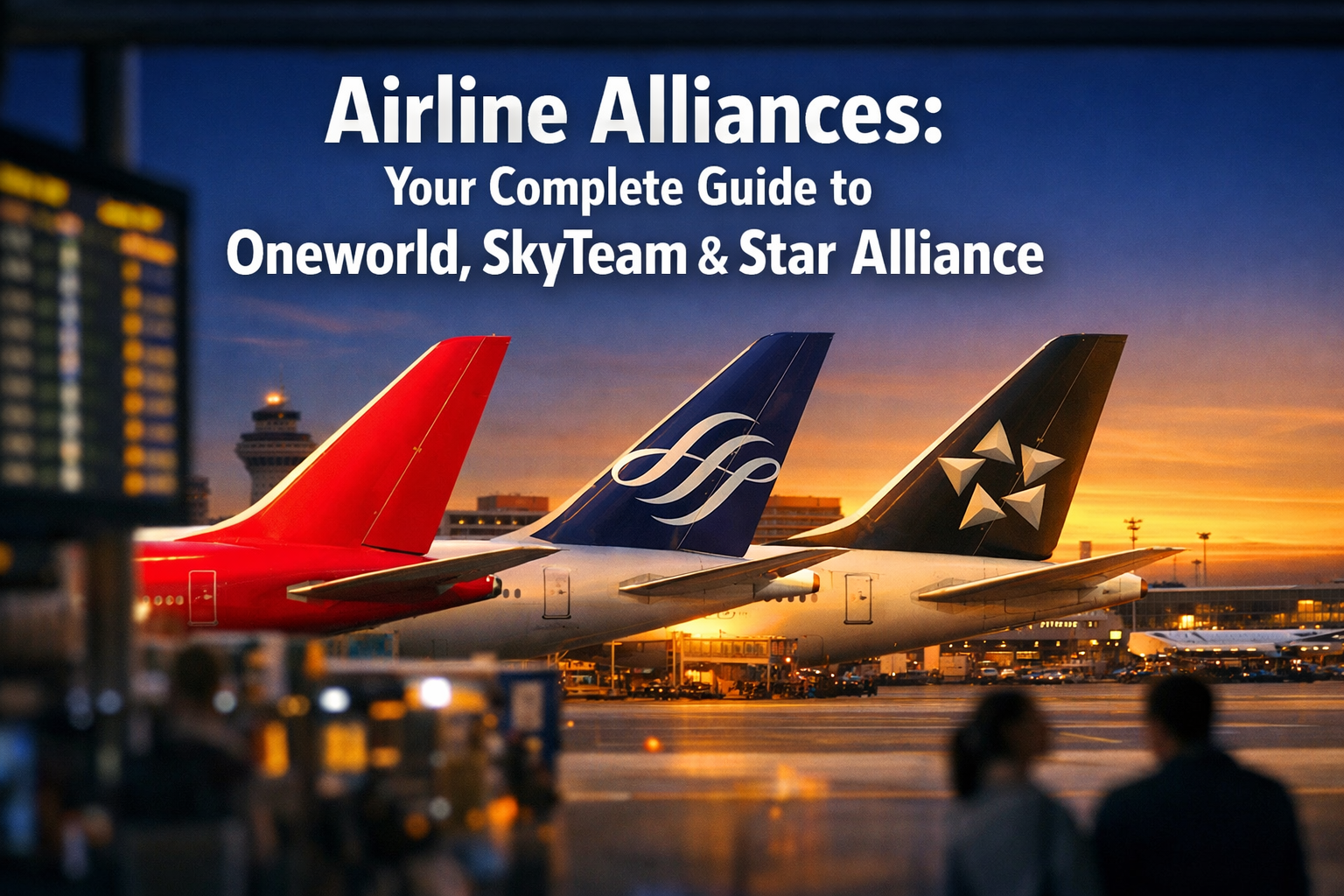
Airline alliances determine which airlines you can book using your hard-earned transferable points—and which routes, cabins, and redemption rates you’ll access. For travelers using Chase, Amex, Capital One, Citi, or Bilt points, understanding how Oneworld, SkyTeam, and Star Alliance work is essential to unlocking premium cabin awards and avoiding costly mistakes.
This guide explains how airline alliances function in the context of award travel, which alliance offers the best value for your booking strategy, and how to navigate partner availability without wasting points on poor redemptions.
Key Takeaways
- Airline alliances connect member airlines to share award seats, but each airline controls its own award pricing and availability rules
- The three major alliances—Oneworld, SkyTeam, and Star Alliance—serve different route networks and offer varying value for U.S.-based award travelers
- Transferable points programs partner with specific alliance members, not entire alliances; you must transfer to the right airline for your route
- Award availability on partner airlines is typically more limited than on the operating carrier’s own program and often requires flexible dates
- Fuel surcharges, routing rules, and booking fees vary significantly by program, even within the same alliance
- Alliance membership changes and devaluations happen regularly; verify current partnerships and pricing before transferring points
Helpful Tools for Award Planning
Before diving into alliance specifics, familiarize yourself with the Credit Card Transfer Partners table to see which airlines accept transfers from your points currency. Use the Award Travel Calculators—specifically the Cents Per Point (CPP) Calculator and Bank Points Transfer & Bonus Calculator—to evaluate whether a redemption delivers acceptable value before you commit points.
What Airline Alliances Are (In Plain English)
An airline alliance is a partnership among multiple airlines that agree to cooperate on certain operational and customer-facing activities. The three global alliances—Oneworld, SkyTeam, and Star Alliance—collectively include most major international carriers.
What alliances actually do:
- Allow member airlines to sell seats on each other’s flights
- Share airport lounges among elite status members
- Coordinate schedules and connecting flights
- Recognize elite status across member airlines
- Enable award bookings across partner carriers
What alliances do NOT do:
- Set uniform award pricing (each airline controls its own award chart)
- Guarantee award seat availability across all partners
- Standardize fuel surcharges or booking fees
- Merge frequent flyer programs
From an award travel perspective, alliance membership matters because it defines which airlines can theoretically access award space on each other’s flights. However, the practical reality is more complex than “transfer to any Star Alliance airline to fly any Star Alliance route.”
Each airline within an alliance maintains its own frequent flyer program with distinct rules, pricing structures, and partner availability. A United MileagePlus award to fly on Lufthansa will price differently from an Avianca LifeMiles award for the identical Lufthansa flight—even though both airlines belong to Star Alliance.
Why Alliances Matter for Award Travel
Understanding airline alliances helps you maximize points in three specific ways:
Access to broader route networks. No single airline flies everywhere. Alliances let you book complex itineraries combining multiple carriers. For example, you might use American AAdvantage miles to book a trip on Japan Airlines from Tokyo to Bangkok, then Qantas from Bangkok to Sydney—both Oneworld partners that American doesn’t compete with directly.
Multiple program options for the same flight. When you identify award space on a partner airline, you can often book that same seat through several different frequent flyer programs within the alliance. This creates opportunities to compare pricing and find better value. A business class seat on ANA (Star Alliance) might cost 88,000 United miles or 63,000 Avianca LifeMiles for the same route.
Strategic transfer partner selection. Chase Ultimate Rewards, Amex Membership Rewards, Capital One miles, and other flexible points programs each partner with specific airlines. Knowing which alliance each partner belongs to helps you identify which routes and airlines you can realistically access with your points portfolio.
The practical limitation: Award availability on partner airlines is almost always more restricted than availability on the operating airline’s own program. Airlines release fewer premium cabin seats to partners, often with advance booking requirements and blackout periods. Alliance membership opens doors—but doesn’t guarantee they’ll be unlocked when you want to travel.
The Big 3 Alliances: Oneworld vs SkyTeam vs Star Alliance
Each alliance offers distinct advantages depending on your home airport, preferred destinations, and points portfolio.
Star Alliance
Size: 26 member airlines (largest global alliance)
Key U.S. carriers: United
Major international partners: Air Canada, Lufthansa, Swiss, Austrian, Brussels Airlines, ANA, Singapore Airlines, Thai Airways, Air New Zealand, Avianca, Copa, TAP Portugal, Turkish Airlines, Scandinavian Airlines
Transfer partners from U.S. banks: United (Chase, Bilt), Air Canada (Amex, Capital One, Bilt), Avianca (Amex, Capital One, Citi), Singapore Airlines (Amex, Capital One, Chase, Citi, Bilt), Turkish Airlines (Capital One, Citi)
Best for: Extensive European coverage via Lufthansa Group; strong Asia-Pacific network through ANA and Singapore; United hub connectivity for U.S. domestic positioning
Limitations: United’s dynamic award pricing eliminates published sweet spots; Lufthansa imposes high fuel surcharges on many routes; limited options in the Middle East and Africa
Oneworld
Size: 13 member airlines (smallest alliance)
Key U.S. carriers: American Airlines, Alaska Airlines
Major international partners: British Airways, Iberia, Finnair, Qantas, Japan Airlines, Cathay Pacific, Qatar Airways, Malaysia Airlines, Royal Jordanian
Transfer partners from U.S. banks: American (Citi, Bilt), British Airways (Amex, Capital One, Chase, Bilt), Iberia (Amex, Capital One, Chase, Bilt), Qantas (Capital One), Qatar Airways (Capital One, Citi), Japan Airlines (Capital One)
Best for: Premium Middle East travel via Qatar Airways (often considered the best business/first class product); strong Japan coverage through JAL; Alaska’s generous partner award chart (though Alaska joined in 2021 and doesn’t follow all traditional Oneworld rules)
Limitations: British Airways imposes distance-based fuel surcharges that can exceed $1,000 on long-haul premium cabins; fewer European hub options than Star Alliance; American’s dynamic pricing reduces predictability
SkyTeam
Size: 19 member airlines
Key U.S. carriers: Delta
Major international partners: Air France, KLM, Virgin Atlantic, Korean Air, Aeromexico, Copa Airlines (joining 2026), ITA Airways, China Eastern, China Airlines, Vietnam Airlines
Transfer partners from U.S. banks: Air France/KLM (Amex, Capital One, Chase, Citi, Bilt), Virgin Atlantic (Amex, Capital One, Chase, Citi, Bilt), Aeromexico (Amex, Capital One, Citi), Korean Air (Capital One, Citi)
Best for: Air France/KLM Promo Rewards (monthly transfer bonuses); Virgin Atlantic’s exceptional sweet spots on ANA and JAL (despite not being in the same alliance); Korean Air’s reasonable premium cabin pricing
Limitations: Delta’s full dynamic pricing makes SkyTeam awards unpredictable and often poor value; fewer premium product options compared to Oneworld and Star Alliance; limited coverage in the Middle East and Oceania
Alliance comparison framework:
| Priority | Best Alliance | Reason |
|---|---|---|
| Most transfer partner options | Star Alliance | Five different transfer partners from U.S. banks |
| Premium cabin products | Oneworld | Qatar Qsuites, JAL business, Qantas first |
| Europe coverage | Star Alliance | Lufthansa Group hub network |
| Asia-Pacific coverage | Star Alliance | ANA, Singapore, Thai, Air New Zealand |
| Middle East access | Oneworld | Qatar Airways dominance |
| Transfer bonuses | SkyTeam | Air France/KLM monthly Promo Rewards |
| Predictable pricing | Oneworld | More programs still use fixed charts |
How Alliances Work With Transferable Points
Transferable points programs do not partner with alliances—they partner with individual airlines that happen to be alliance members. This distinction matters because you cannot “transfer to Star Alliance” broadly; you must transfer to a specific Star Alliance member like United, Air Canada, or Avianca.
The booking process:
- Identify the flight you want (operated by Airline X)
- Determine which alliance Airline X belongs to
- Check which airlines in that alliance are transfer partners from your points program
- Search for award availability on each potential partner program
- Compare pricing, fees, and booking rules across options
- Transfer points to the program offering the best value
- Book the award immediately after the transfer
Example scenario: You want to fly business class from New York to Frankfurt on Lufthansa (Star Alliance).
Your options with Chase Ultimate Rewards:
- Transfer to United and book for ~77,000-88,000 miles (dynamic pricing) plus minimal fees
- Transfer to Air Canada Aeroplan and book for 70,000 miles plus ~$100 in fees
- Transfer to Singapore KrisFlyer and book for 80,000 miles plus fees
You cannot transfer Chase points to Avianca or Turkish Airlines, even though both are Star Alliance members that could also book this flight, because Chase doesn’t partner with those programs.
Critical mistake to avoid: Never transfer points before confirming award availability. Points transfers are typically instant but irreversible. Search for available award space on the airline’s website or by phone first, then transfer only the exact amount needed.
Transfer bonus timing: Air France/KLM runs monthly transfer bonuses (typically 25-30% extra miles) that can dramatically improve the value for SkyTeam awards. Amex, Chase, and Citi periodically offer targeted transfer bonuses to various partners. Factor these into your decision framework, but don’t let a bonus drive you toward a poor-value redemption.
Award Space and Partner Booking Basics
Award availability on partner airlines follows different rules from booking the airline’s own flights.
How airlines release partner award space:
Airlines control how many seats they make available to partner programs. Most carriers release:
- More economy seats to partners than premium cabins
- Partner space closer to departure (often 1-2 weeks out) or far in advance (330+ days)
- Limited or no space during peak travel periods
- Different availability to different partners within the same alliance
Where to search for partner availability:
Each airline’s website shows different partner availability. Some programs display comprehensive partner space; others show limited options or require phone booking.
Strong search tools:
- United.com (shows most Star Alliance partners)
- Aeroplan.com (shows Star Alliance space, United might not)
- Qantas.com (shows broad Oneworld availability)
- British Airways.com (shows Oneworld partners)
Limited or unreliable search tools:
- Delta.com (shows minimal SkyTeam partner space online)
- American.com (inconsistent partner display; often requires phone calls)
Booking partner awards:
Most partner awards can be booked online if space appears in the search results. Complex itineraries involving multiple partners or airlines with restricted online booking (like Lufthansa first class) require calling the frequent flyer program.
Phone booking fees: Many programs charge $25-50 for phone bookings, though they typically waive the fee if the award cannot be booked online due to system limitations.
Waitlisting: Some programs allow you to waitlist for partner awards if no space is currently available. Success rates vary; this works best for flexible travelers willing to monitor availability.
Changes and cancellations: Partner award change and cancellation policies follow the frequent flyer program’s rules, not the operating airline’s rules. If you book a Lufthansa flight using United miles, United’s change policy applies—not Lufthansa’s.
Common Alliance Pitfalls (Rules, Fees, Availability)
Several alliance-specific issues catch award travelers off guard.
Fuel surcharges (carrier-imposed fees): Some airlines impose substantial surcharges on award tickets—often $400-1,200 for long-haul business or first class. These fees appear regardless of which program you use to book.
High-surcharge carriers:
- British Airways (distance-based surcharges on most routes)
- Lufthansa and Swiss (high surcharges on transatlantic and European routes)
- Air France (moderate to high surcharges)
- Virgin Atlantic (high surcharges on own flights; low on partners)
Low-surcharge programs for the same flights:
- United (passes through minimal fees on most partners)
- Avianca (low fees on most Star Alliance partners)
- ANA (low fees on Star Alliance partners)
Strategy: When booking a high-surcharge airline like Lufthansa, compare programs within Star Alliance. The same flight might cost $800 in fees via Air Canada but only $100 via United or Avianca.
Routing rules: Each frequent flyer program enforces its own routing rules for partner awards, limiting how you can combine flights.
Common restrictions:
- Maximum permitted mileage (MPM) between origin and destination
- Limits on stopovers (typically 0-1 on partner awards)
- Restrictions on backtracking or circuitous routing
- Open-jaw limitations
Example: United allows one stopover on international partner awards, but only if you book a round-trip. Air Canada Aeroplan allows one stopover on one-way awards, offering more flexibility for the same Star Alliance partners.
Mixed-cabin bookings: Most programs price awards by the highest cabin flown. If you book business class but one segment only has economy availability, you’ll pay the full business class rate.
Award availability visibility: Not all partner space shows online. Some airlines release space only to specific partners or require phone bookings for certain routes.
Devaluation risk: Airlines frequently devalue award charts, sometimes with minimal notice. Star Alliance and Oneworld have seen multiple major devaluations in recent years as programs shift toward dynamic pricing.
Recent devaluations:
- United eliminated its award chart entirely (2019-2022)
- American moved to dynamic pricing for most routes (2023)
- Avianca LifeMiles increased prices on popular routes (2024)
Risk mitigation: Don’t stockpile miles in a single program over the long term. Keep points in flexible currencies like Chase, Amex, or Capital One until you’re ready to book. Transfer only what you need when you need it.
Step-by-Step: Alliance Booking Checklist
Use this framework to book partner awards efficiently:
Step 1: Define your route and dates
- Identify origin, destination, and preferred travel dates
- Build in 2-3 days of flexibility if possible
- Determine acceptable cabin (economy, premium economy, business, first)
Step 2: Identify which airlines fly your route
- Use Google Flights to see which carriers operate the route
- Note which alliances those carriers belong to
- Focus on airlines known for releasing partner space (ANA, JAL, Qantas, Lufthansa)
Step 3: Determine which programs can book those flights
- List all airlines in the same alliance as your target carrier
- Cross-reference with your transferable points partners
- Identify 2-3 programs you can actually transfer to
Step 4: Search for award availability
- Check each program’s website for available space
- Search one-way flights (more flexibility than round-trip)
- Try dates around your target to find open space
Step 5: Compare pricing and fees
- Note the miles required for each program option
- Check fuel surcharges and booking fees
- Calculate cents per point value for each option
Step 6: Verify the booking details
- Confirm correct dates, times, and routing
- Check connection times (minimum 90-120 minutes for international)
- Review cancellation and change policies
Step 7: Transfer points and book immediately
- Transfer exact points needed (plus small buffer for fees)
- Book within 24 hours of transfer while space is available
- Save confirmation numbers and booking details
Step 8: Monitor your reservation
- Check booking status 24-48 hours after booking
- Set calendar reminders for online check-in (24 hours before departure)
- Verify seat assignments and special requests
Common mistakes to avoid:
❌ Transferring points before confirming availability
❌ Assuming all alliance partners show the same award space
❌ Ignoring fuel surcharges when comparing programs
❌ Booking without checking connection times
❌ Forgetting to account for different time zones
❌ Waiting too long to book after finding space (it disappears)
Frequently Asked Questions
Can I use miles from one alliance to book flights on another alliance?
No. You can only book award flights on airlines within the same alliance as your frequent flyer program, with rare exceptions. For example, you cannot use Star Alliance United miles to book Oneworld American flights. However, some airlines have partnerships outside their alliance—Virgin Atlantic (SkyTeam) partners with ANA and JAL (Star Alliance and Oneworld, respectively).
Which airline alliance offers the best value for award travel?
No single alliance is universally “best.” Star Alliance offers the most transfer partner options and route coverage. Oneworld provides superior premium cabin products via Qatar Airways and JAL. SkyTeam offers frequent transfer bonuses through Air France/KLM. The best alliance depends on your specific route, points portfolio, and travel priorities.
Do I need elite status to book partner award flights?
No. Elite status is not required to book partner awards. However, elite status can offer benefits such as waived phone booking fees, better award availability on some routes, and confirmed upgrades. For pure award bookings, elite status is helpful but not necessary.
Why can’t I find award space on a partner airline even though the alliance website says they’re partners?
Airlines control how much space they release to partners and which partners receive access. Some carriers allocate minimal premium cabin space to partners, or release it only close to departure. Additionally, not all partner spaces are displayed on every program’s website—you may need to call or check multiple programs to find availability.
How do I avoid high fuel surcharges on partner awards?
Choose frequent flyer programs known for low pass-through fees. For Star Alliance, United and Avianca typically charge lower fees than Air Canada or Lufthansa’s own program. For Oneworld, Alaska and American often have lower surcharges than British Airways. For SkyTeam, Korean Air generally passes through fewer fees than Air France/KLM.
Can I mix airlines from different alliances on one award ticket?
Generally no. Most award tickets must include only airlines within the same alliance (or specific non-alliance partners). You cannot book a single award combining Star Alliance and Oneworld flights. You would need to book separate awards for each alliance, using miles from different programs.
Conclusion
Airline alliances create the framework for booking partner awards, but the value you extract depends on understanding how individual frequent flyer programs interact with alliance partnerships. The three major alliances—Oneworld, SkyTeam, and Star Alliance—each offer distinct advantages for travelers using transferable points to book international premium cabin awards.
Master the fundamentals: identify which airlines fly your route, determine which alliance they belong to, compare pricing across programs you can transfer to, verify award availability before transferring points, and factor in fuel surcharges when calculating value.
The alliance system rewards strategic flexibility. Keep points in transferable currencies until you’re ready to book, maintain transfer relationships with at least one airline in each major alliance, and search multiple programs to find the best combination of pricing and fees for your specific route.
Start by reviewing your current points portfolio using the tools and frameworks outlined here. Identify which alliances you can access through your existing transfer partners, then practice searching for award space on routes you plan to travel in the next 12 months. The alliance system appears complex initially, but becomes manageable once you understand the decision framework.

