

Last updated: March 6, 2026
When Alaska Airlines and Hawaiian Airlines merged their loyalty programs into Atmos Rewards in 2026, they created something rare in today’s airline landscape: a program where you can earn meaningful elite status without boarding a single flight. This Alaska Atmos Rewards Guide 2026 shows you exactly how to reach Silver, Gold, or even Platinum status through everyday spending—credit cards, rideshares, shopping portals, and hotel bookings.
Unlike Delta, United, or American, which require significant flight activity or massive credit card spending to unlock even basic status, Atmos Rewards built legitimate non-flight pathways that make elite perks accessible to travelers who fly occasionally but spend strategically. NerdWallet named it the Best Airline Rewards Program for 2026, and the recognition reflects a program that still rewards distance flown—not just dollars spent—while offering flexibility most competitors abandoned years ago.
Key Takeaways
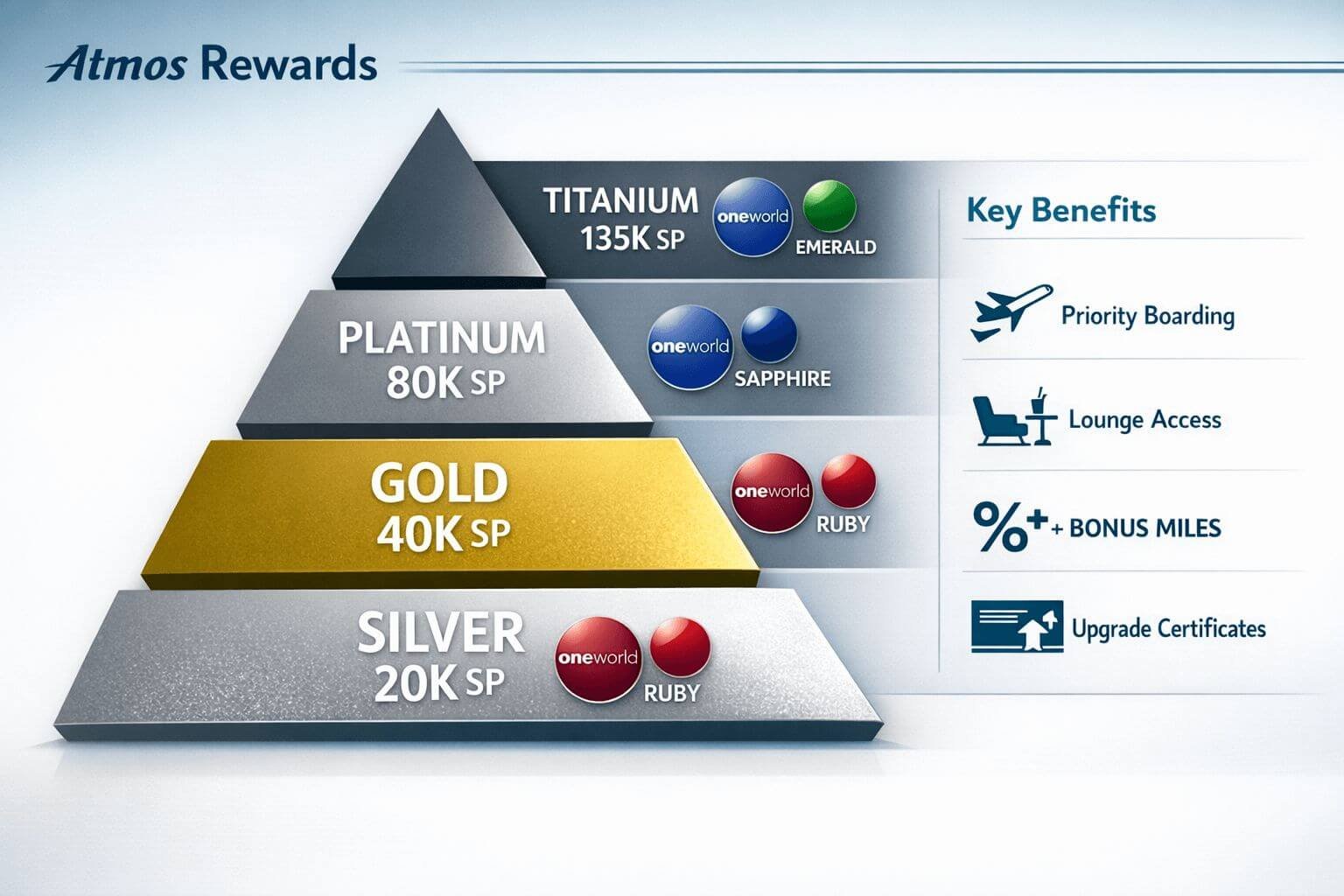
- Atmos Rewards offers four elite tiers (Silver at 20K status points, Gold at 40K, Platinum at 80K, Titanium at 135K) aligned with the Oneworld alliance benefits
- You can earn Silver status without flying through $25,000 annual spend on the Alaska Summit Visa Infinite card (50K status points), plus 10K anniversary bonus
- Non-flight earning channels include Atmos Rewards Shopping portal, Lyft rides, CLEAR membership, and Alaska/Hawaiian Vacations hotel bookings
- The program remains distance-based for flight earnings—one of the few U.S. carriers still rewarding miles flown rather than ticket price alone
- Complimentary global upgrades launch mid-2026 for Platinum and Titanium members across Alaska and Hawaiian networks
What Is Atmos Reward,s and How Did It Replace Mileage Plan?
Atmos Rewards is the merged loyalty program combining Alaska Airlines’ former Mileage Plan with Hawaiian Airlines’ HawaiianMiles, launched in early 2026 following the airlines’ merger. The program maintains Alaska’s distance-based earning structure—you earn points based on miles flown, not ticket price—which sets it apart from Delta SkyMiles, United MileagePlus, and American AAdvantage.
The merger preserved what made Alaska’s program valuable: generous partner-earning rates (up to 250% on Premium Cabin partner flights), reasonable award pricing on key routes, and expanded access to Hawaiian’s inter-island network and Pacific destinations. Members of both legacy programs had their accounts automatically converted to Atmos Rewards, with status and points transferred at a 1:1 ratio.
Why This Program Matters in 2026
Most major U.S. carriers shifted to revenue-based earnings years ago, making elite status nearly impossible without either flying constantly or spending $50,000+ annually on co-branded credit cards. Atmos Rewards bucked that trend by building multiple non-flight earning channels that actually add up to meaningful status thresholds.
The program also maintains oneworld alliance membership, giving elite members reciprocal benefits on American Airlines, British Airways, Cathay Pacific, Qantas, and other partners—crucial for international travelers who want lounge access and priority boarding across multiple carriers.
For context on how Atmos Rewards fits into the broader alliance landscape, see our complete Oneworld alliance guide.
Atmos Rewards Status Tiers and Benefits Breakdown
Atmos Rewards has four elite tiers, each with specific status point thresholds and progressively better perks. Status points (SP) differ from redeemable Atmos Rewards points—you earn both simultaneously on flights, but only status points count toward tier qualification.
| Tier | Status Points Required | oneworld Equivalent | Key Benefits |
|---|---|---|---|
| Silver | 20,000 SP | Ruby | 50% bonus points, priority boarding, free checked bag, standby priority |
| Gold | 40,000 SP | Sapphire | 75% bonus points, complimentary upgrades on Alaska/Hawaiian, Alaska Lounge access (2 guests), priority check-in/security |
| Platinum | 80,000 SP | Emerald | 100% bonus points, complimentary global upgrades (mid-2026), Alaska Lounge access (2 guests), 4 one-way upgrade certificates, priority boarding on all oneworld flights |
| Titanium | 135,000 SP | Emerald | 125% bonus points, complimentary global upgrades, Alaska Lounge access (4 guests), 8 one-way upgrade certificates, dedicated phone line, MVP Gold 100K benefits |
Understanding Oneworld Alliance Benefits
Each Atmos Rewards tier maps to an Oneworld status level, which matters when flying partner airlines. Silver members get oneworld Ruby (priority boarding and check-in on American, British Airways, etc.). Gold members receive oneworld Sapphire (lounge access when flying internationally on any oneworld carrier). Platinum and Titanium both earn oneworld Emerald, the alliance’s top tier.
This alignment means your Atmos status works on 13 global airlines, not just Alaska and Hawaiian. If you’re flying Cathay Pacific from Hong Kong to New York in economy, your Platinum status gets you into the Cathay Pacific lounge before departure—a benefit competitors like Southwest or JetBlue can’t match.
What Changes in Mid-2026
Alaska announced complimentary global upgrades for Platinum and Titanium members launching later in 2026. These upgrades will apply on the day of departure across Alaska and Hawaiian networks, similar to how American handles Platinum Pro and Executive Platinum upgrades. The exact inventory allocation and upgrade priority rules haven’t been published yet, but this represents a significant enhancement for top-tier members.
Later in 2026, Alaska will also introduce “flexible earning,” letting members choose whether to earn points based on distance, segments, or ticket price for each flight. This feature could benefit business travelers who buy expensive last-minute tickets and prefer revenue-based earnings for specific trips.
How to Earn Status Points Without Stepping on a Plane
The Alaska Atmos Rewards Guide 2026 wouldn’t be complete without breaking down the non-flight earning pathways that make this program unique. Here’s how to accumulate status points through everyday activities.
Alaska Summit Visa Infinite Card: The Core Strategy
The Alaska Airlines Visa Signature and Summit Visa Infinite cards both earn status points, but the Summit card ($395 annual fee) offers the most efficient path to elite status:
- 2 status points per $1 spent on all purchases (no category restrictions)
- 10,000 status points awarded annually on your cardmember anniversary
- 3 Atmos Rewards points per $1 on Alaska/Hawaiian flights and eligible purchases
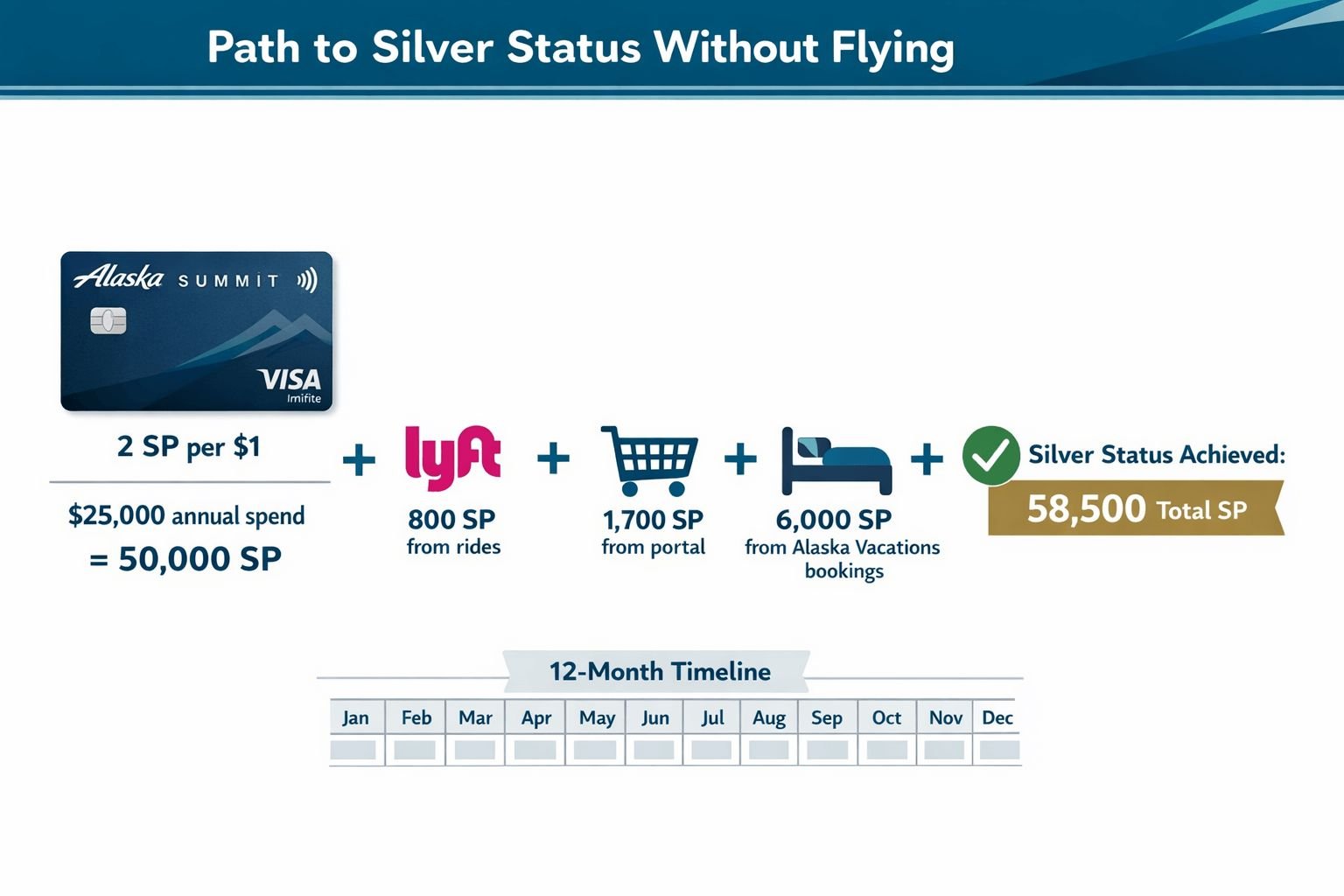
Math to Silver status: Spend $25,000 in a calendar year ($50,000 status points), plus receive your 10,000-point anniversary bonus = 60,000 status points. That’s triple the 20,000 SP threshold for Silver.
Math to Gold status: Spend $40,000 in a calendar year (80,000 status points) plus 10,000 anniversary bonus = 90,000 status points—well above the 40,000 SP Gold threshold.
The standard Alaska Airlines Visa Signature card ($95 annual fee) earns 1.5 status points per $1 spent, making it less efficient but still viable if you’re combining it with other earning channels.
Common mistake: Confusing redeemable Atmos Rewards points with status points. The Summit card earns both 3 redeemable points and 2 status points per dollar—but only the status points count toward elite tiers.
Atmos Rewards Shopping Portal
Alaska’s online shopping portal partners with 900+ retailers and awards status points for purchases made through portal links. Earning rates vary by merchant:
- 1-10 status points per $1 spen,t depending on retailer and promotions
- Common rates: Apple Store (1 SP/$), Nike (3 SP/$), Macy’s (5 SP/$)
- Seasonal bonuses: Holiday promotions occasionally offer 15-20 SP/$ at select merchants
Realistic annual earnings: If you route $5,000 in online shopping through the portal at an average 3 SP/$ rate, you’d earn 15,000 status points. Combined with modest credit card spend, that’s three-quarters of the way to Silver status.
Best for: People who already shop online and remember to access retailers through the portal. Not worth buying things you don’t need, but valuable for purchases you’d make anyway.
Lyft Rides
Link your Lyft account to Atmos Rewards and earn 1 status point per $1 spent on Lyft rides. This channel works best for urban dwellers who regularly use rideshares.
Realistic annual earnings: If you spend $2,000 annually on Lyft (roughly $40/week for commuters), you’d earn 2,000 status points—10% of the Silver threshold.
Limitation: Only Lyft qualifies, not Uber or other rideshare services. The earning rate is modest, so this works best as a supplemental channel rather than a primary strategy.
CLEAR Membership
Enroll in CLEAR through Atmos Rewards and earn 1,000 status points upon membership activation. CLEAR costs $189/year (often discounted to $149 with credit card benefits), so you’re effectively paying $0.15-0.19 per status point.
Best for: Travelers who already use CLEAR for airport security. If you weren’t planning to join CLEAR, the 1,000 status points alone don’t justify the membership cost.
Alaska/Hawaiian Vacations Hotel Bookings
Book hotel stays through Alaska Airlines Vacations or Hawaiian Airlines Vacations and earn 1 status point per $1 spent on the hotel portion of your booking.
Realistic annual earnings: A family booking two week-long vacations at $1,500/week in hotel costs would earn 3,000 status points.
Tradeoff: You’ll often find better hotel rates by booking directly or through other channels. The status points are valuable, but compare total costs before committing. If the Alaska Vacations rate is $150/night and you can book directly for $130/night, you’re paying $20/night for ~150 status points—not a good deal.
For broader context on earning hotel elite status through similar shortcuts, see our guide to hotel status earning strategies.
Real-World Example: Earning Silver Without Flying
Meet Alex, a Seattle-based consultant who flies 4-6 times per year for leisure but doesn’t travel enough for work to earn status through flights alone.
Alex’s 2026 status point earning:
- Alaska Summit Visa Infinite card: $30,000 annual spend = 60,000 SP
- Anniversary bonus: 10,000 SP
- Atmos Rewards Shopping: $3,000 purchases at avg 4 SP/$ = 12,000 SP
- Lyft rides: $1,200 annual = 1,200 SP
- CLEAR membership: 1,000 SP
- Total: 84,200 status points (Platinum tier)
Alex reached Platinum—the third-highest tier—without counting a single flight. Adding even modest flying (4 round-trips from Seattle to Los Angeles = ~9,600 status points) would push Alex well into Platinum territory with cushion for the following year.
Best Atmos Rewards Credit Cards for Status and Miles
Choosing the right credit card determines how efficiently you earn status points. Here’s how the Alaska Airlines cards compare in 2026.
Alaska Airlines Visa Signature ($95 Annual Fee)
Status earning: 1.5 status points per $1 on all purchases. Redeemable points: 3 points per $1 on Alaska/Hawaiian flights, 1 point per $1 elsewhere. Annual bonus: None for status point.s Companion fare: $99 (+taxes/fees) after $6,000 annual spend
Best for: Travelers who want Alaska status benefits without committing to the Summit card’s $395 fee. You’ll need to spend more to hit status thresholds, but the companion fare benefit can offset the slower earning rate if you use it annually.
Math to Silver: $13,334 annual spend gets you to 20,000 status points (no anniversary bonus to help).
Alaska Airlines Visa Infinite Summit ($395 Annual Fee)
Status earning: 2 status points per $1 on all purchases. Redeemable points: 3 points per $1 on Alaska/Hawaiian flights, 1 point per $1 elsewhere. Annual bonus: 10,000 status points on cardmember anniversary. Companion fare: None (but Platinum/Titanium status includes upgrade certificates)
Best for: Travelers serious about earning Gold or Platinum status through credit card spend. The 10,000 SP anniversary bonus effectively reduces your required spending by $5,000 compared to the Signature card.
Math to Gold: $40,000 annual spend + 10,000 anniversary bonus = 90,000 SP (Gold requires 40,000 SP, so you’d have 50,000 SP cushion or be halfway to Platinum).
Hawaiian Airlines World Elite Mastercard ($99 Annual Fee)
Status earning: 1.5 status points per $1 on all purchases Redeemable points: 3 points per $1 on Hawaiian Airlines flights, 2 points per $1 on gas/dining/groceries, 1 point per $1 elsewhere Annual bonus: 5,000 redeemable points (not status points) after first purchase each year Companion discount: 50% off one companion ticket annually (restrictions apply)
Best for: Hawaiian Airlines loyalists or travelers based in Hawaii who fly Hawaiian frequently. The earning structure mirrors Alaska’s Signature card but without status point anniversary bonuses, making it less efficient for pure status earning.
Comparing to Competitor Airline Cards
Delta Reserve American Express ($650 annual fee): Earns 1 MQD (Medallion Qualifying Dollar) per $10 spent with no cap, plus 2,500 annual MQD boost. To reach Delta Silver (28,000 MQDs), you’d need $255,000 in annual spending—far less efficient than Alaska’s Summit card.
United Quest Card ($250 annual fee): Earns 0.5 PQP (Premier Qualifying Points) per $1 spent, plus 1,000 annual PQP bonus. Silver status requires 12,000 PQPs, so you’d need $22,000 spending—comparable to Alaska’s Signature card but with a higher annual fee.
American Airlines AAdvantage Executive Card ($595 annual fee): Earns 1 Loyalty Point per $1 spent with no cap. Gold status requires 80,000 Loyalty Points, so you’d need $80,000 annual spending—double Alaska’s requirement for the same tier level.
Verdict: Alaska’s Summit card offers the most efficient path to mid-tier elite status (Gold/Sapphire) among major U.S. carriers, based on required annual spend.
For a comprehensive breakdown of how transferable points work with Alaska and other carriers, see our bank transfer partners guide.
Milestone Perks: Choosing the Right Rewards at Each Threshold
Atmos Rewards introduced milestone rewards at specific status point thresholds, letting you choose from a menu of perks when you hit 55,000, 95,000, and 150,000 status points in a calendar year.
55,000 Status Points (Between Gold and Platinum)
Choice of:
- 10,000 redeemable Atmos Rewards points
- Two one-way upgrade certificates (valid on Alaska/Hawaiian flights)
- $100 Alaska Lounge+ membership discount
Best choice for most: The 10,000 redeemable points typically offer the most flexibility. At a conservative 1.5 cents per point valuation, that’s $150 in travel value. Upgrade certificates can be worth more on specific routes (Seattle to Hawaii in premium class = $300-500 value), but they come with availability restrictions and expiration dates.
Choose upgrade certificates if: You have specific trips planned where you’d use them before expiration, and upgrade space is typically available on your routes.
95,000 Status Points (Between Platinum and Titanium)
Choice of:
- 20,000 redeemable Atmos Rewards points
- Four one-way upgrade certificates
- Alaska Lounge+ annual membership ($550 value)
Best choice for most: The 20,000 points ($300 value at 1.5 CPP) make sense unless you’re based in a city with an Alaska Lounge and would use it 15+ times per year. The lounge membership becomes cost-effective at that frequency, especially if you’re not yet Platinum (which includes lounge access).
Choose the lounge membership if: You’re based in Seattle, Portland, San Francisco, Los Angeles, or Anchorage and regularly have 2+ hour layovers where you’d use the lounge.
150,000 Status Points (Above Titanium Threshold)
Choice of:
- 30,000 redeemable Atmos Rewards points
- Six one-way upgrade certificates
- Alaska Lounge+ annual membership plus 10,000 redeemable points
Best choice for most: The combined lounge membership + 10,000 points option delivers the most total value ($550 lounge value + $150 points value = $700). If you’re hitting 150,000 status points, you’re already Titanium with lounge access, so the membership would let you bring additional guests beyond your included allowance.
Choose points if: You rarely use lounges or don’t fly through Alaska hub cities where lounges are located.
Common Mistake: Letting Milestone Rewards Expire
Milestone rewards must be claimed within 60 days of reaching the threshold and used within their validity period (typically 12 months for upgrade certificates; points have no expiration). Set a calendar reminder as you approach a milestone threshold so you don’t miss the claim window.
Atmos Rewards Sweet Spots for Booking Award Flights
Earning status points is half the equation—redeeming Atmos Rewards points matters efficiently just as much. The program maintains several award booking sweet spots that deliver outsized value compared to competitor programs.
Japan Airlines Business Class to Asia
Route: West Coast (Seattle, San Francisco, Los Angeles) to Tokyo Cost: 60,000 Atmos Rewards points one-way in business class Cash equivalent: $3,000-5,000 depending on season Value: 5-8 cents per point
Japan Airlines operates excellent Business Class service with lie-flat seats, Japanese cuisine, and access to JAL First Class lounges in Tokyo (for oneworld Emerald members). This redemption offers significantly better value than using points for domestic economy flights.
Availability note: JAL releases partner award space inconsistently. Book 330 days in advance when the calendar opens for best availability, especially for travel during cherry blossom season (March-April) or fall foliage (October-November).
Cathay Pacific First Class to Hong Kong
Route: West Coast to Hong Kong Cost: 70,000 Atmos Rewards points one-way in first class Cash equivalent: $8,000-12,000 depending on season Value: 11-17 cents per point
Cathay Pacific’s First Class product ranks among the world’s best, with private suites, on-demand dining, and access to Cathay’s exceptional lounges. At 70,000 points, this represents one of the best First Class redemptions available to U.S.-based travelers.
Availability note: Cathay releases limited First Class award space to partners. You’ll find better availability on weekday flights and during off-peak seasons (January-February, September-October). Book 11+ months in advance.
For more context on booking premium cabin awards across airline alliances, see our guide to Oneworld award bookings.
Hawaiian Inter-Island Flights
Route: Any Hawaiian inter-island route (Honolulu to Maui, Kauai, Big Island) Cost: 7,500-10,000 Atmos Rewards points one-way Cash equivalent: $80-150 depending on season Value: 1-2 cents per point
Inter-island Hawaii flights offer solid value when cash prices spike during peak travel periods. These short flights (25-45 minutes) provide a practical use for smaller point balances.
Best for: Travelers planning multi-island Hawaii trips who want to preserve cash for hotels and activities.
Alaska Airlines Transcontinental Flights
Route: West Coast to East Coast (Seattle to New York, San Francisco to Boston, etc.) Cost: 12,500-25,000 Atmos Rewards points one-way in economy (dynamic pricing) Cash equivalent: $150-400 depending on season Value: 1.2-3.2 cents per point
Alaska’s transcontinental routes offer competitive award pricing, especially during off-peak periods when you’ll find 12,500-point one-way awards. Premium class awards on these routes run 25,000-40,000 points one-way.
Tradeoff: Alaska uses dynamic pricing, meaning award costs fluctuate based on demand. You’ll see better point values during off-peak travel periods (January-February, September-October) than during holidays or summer.
What to Avoid: High-Surcharge Partners
British Airways, Qantas, and some other oneworld partners impose significant fuel surcharges on award tickets—sometimes $300-800 in fees on top of the points required. When booking partner awards, check the total out-of-pocket cost before confirming.
Better alternative: If you’re booking transatlantic travel, consider using American AAdvantage miles (which you can earn through Citi ThankYou transfers) instead of Atmos Rewards points when flying British Airways. American members pay lower surcharges on the same flights.
For a detailed breakdown of how to calculate whether an award redemption offers good value, see our cents-per-point guide.
Atmos Rewards vs. Other Airline Programs in 2026
Understanding how Atmos Rewards compares to competitor programs helps you decide whether to focus your earning efforts here or split loyalty across multiple carriers.
Atmos Rewards vs. Delta SkyMiles
Status earning: Atmos requires 20,000 status points for Silver; Delta requires 28,000 MQDs (Medallion Qualifying Dollars) plus 8,000 MQMs (Medallion Qualifying Miles) or 35 MQSs (segments). Delta’s structure heavily favors expensive tickets, while Atmos offers multiple non-flight pathways.
Award pricing: Delta uses fully dynamic pricing with no award charts—you’ll pay whatever Delta decides for a given flight. Atmos maintains distance-based pricing with some dynamic elements, generally offering more predictable redemption costs.
Route network: Delta operates a larger domestic network with more daily frequencies. Alaska/Hawaiian combined offer stronger West Coast and Pacific coverage but fewer options in the Southeast and Midwest.
Verdict: Choose Atmos if you value predictable award pricing and achievable status through everyday spending. Choose Delta if you fly their routes frequently and buy expensive tickets that generate MQDs quickly.
Atmos Rewards vs. United MileagePlus
Status earning: Atmos requires 20,000 status points for Silver; United requires 12,000 PQPs (Premier Qualifying Points) plus 12 PQFs (Premier Qualifying Flights). United’s flight requirement makes status harder to earn without flying, though their credit cards help close the gap.
Award pricing: United uses dynamic pricing but maintains an award chart as a baseline. You’ll find both good and poor values depending on route and date. Atmos generally offers better pricing on partner awards to Asia.
Route network: United operates the largest international network among U.S. carriers, with strong coverage to Europe, Asia, and Latin America. Alaska/Hawaiian focus on West Coast, Hawaii, and select international routes.
Verdict: Choose Atmos if you fly West Coast or Pacific routes frequently. Choose United if you need extensive international coverage or fly from United hubs (Chicago, Denver, Houston, Newark, San Francisco).
Atmos Rewards vs. American AAdvantage
Status earning: Atmos requires 20,000 status points for Silver; American requires 30,000 Loyalty Points plus $4,000 in qualifying spending. American’s structure is more accessible than Delta but less flexible than Alaska.
Award pricing: American uses dynamic pricing but maintains published award charts for partner airlines. You’ll find excellent value on partner awards (especially Japan Airlines and Cathay Pacific) but poor value on American-operated flights.
Route network: American operates the largest domestic network and strong coverage to Latin America and Europe. Alaska/Hawaiian offer better West Coast and Pacific options.
Verdict: Choose Atmos if you’re based on the West Coast or fly to Hawaii/Asia frequently. Choose American if you’re based in Dallas, Charlotte, Miami, Phoenix, or Philadelphia and fly their routes regularly.
Atmos Rewards vs. Southwest Rapid Rewards
Status earning: Southwest doesn’t offer traditional elite status—their A-List and A-List Preferred tiers require 25 or 50 one-way flights annually, or 35,000/70,000 tier-qualifying points. Atmos offers more achievable status through non-flight earnings.
Award pricing: Southwest uses dynamic pricing based on cash ticket costs, but awards are refundable and never have blackout dates. Atmos offers better value on premium cabin international awards but worse value on domestic economy.
Route network: Southwest operates point-to-point domestic service with no international flights (except Mexico/Caribbean). Alaska/Hawaiian offers international reach through oneworld partners.
Verdict: Choose Atmos if you want international travel options and premium cabin awards. Choose Southwest if you value simplicity, refundable awards, and flying primarily domestic routes.
For more context on how Alaska fits into the broader Oneworld alliance ecosystem, see our complete Oneworld guide.
How to Maximize Atmos Rewards Earning in 2026
This Alaska Atmos Rewards Guide 2026 wouldn’t be complete without specific strategies to optimize your earnings across all channels.
Strategy 1: Front-Load Credit Card Spending Early in the Year
Status points reset on December 31, and you need to reach your target tier within a calendar year. If you spend $40,000 on the Summit card evenly across 12 months, you’ll hit Gold status in October—giving you only 2-3 months to use those benefits before resetting.
Better approach: Concentrate spending in Q1-Q2 to reach your target tier by June, giving you 6+ months to enjoy benefits. If you have large planned expenses (home renovation, business purchases, tax payments), schedule them for January-March when possible.
Strategy 2: Stack Shopping Portal Bonuses
The Atmos Rewards Shopping portal runs periodic promotions offering 2-5x bonus status points at specific retailers. Sign up for email alerts and time major purchases (electronics, furniture, appliances) to coincide with these promotions.
Example: If Best Buy normally offers 2 SP/$ and runs a 3x bonus promotion, you’d earn 6 SP/$ during the promotion window. A $2,000 laptop purchase would generate 12,000 status points instead of 4,000—a meaningful difference.
Strategy 3: Combine Status Earning With Redeemable Points
The Summit card earns both status points (2 per $1) and redeemable Atmos Rewards points (1 per $1 on most purchases, 3 per $1 on Alaska/Hawaiian flights). This dual earning means your status-building spending also accumulates points for award flights.
Math: $40,000 annual spending generates 80,000 status points (Gold tier) plus 40,000 redeemable points—enough for a roundtrip business class award to Japan (120,000 points roundtrip, so you’d need one more year of earning or a few paid flights).
Strategy 4: Book Alaska Vacation Packages Strategically
Alaska vacation packages earn 1 status point per $1 spent on hotels, but you’ll often find better rates by booking directly. The status points are valuable, but don’t overpay for them.
Decision framework: If the Alaska Vacations rate is within 5% of the best available rate, book through Alaska Vacations for the status points. If the price difference exceeds 5%, book directly and earn status points through other channels.
Example: Alaska Vacations quotes $1,800 for a week in Maui. You find the same hotel directly for $1,650. The $150 difference buys you 1,800 status points—about $0.08 per status point. That’s expensive. Book direct and put the $150 savings toward credit card spending that earns 2 SP/$ (300 status points), plus keep $120 in your pocket.
Strategy 5: Use Lyft Strategically for Incremental Points
Don’t switch from Uber to Lyft solely for Atmos status points—the 1 SP/$ earning rate is modest. But if ride costs are equivalent, choose Lyft to capture incremental status points.
When it matters: If you’re 1,000-2,000 status points short of a tier threshold in December, shifting your rideshare spending to Lyft for the final month can push you over the line without additional credit card spending.
Strategy 6: Monitor Flexible Earning Options (Launching Late 2026)
Alaska announced that later in 2026, members will be able to choose how they earn status points on flights: distance-based (current system), segment-based, or revenue-based. This flexibility could benefit specific traveler profiles.
Who benefits from revenue-based earnings: Business travelers buying expensive last-minute tickets on short routes. Example: A $600 Seattle-San Francisco ticket (678 miles) earns 678 status points under distance-based earning but could earn 6,000+ status points under revenue-based earning (if Alaska implements 10 SP per $1 spent, similar to competitors).
Who benefits from segment-based earning: Travelers taking many short flights. Example: A Seattle-Portland-San Francisco-Los Angeles routing (3 segments) might earn more status points than the total distance flown if segment-based earning awards 500+ points per segment.
Action step: When this feature launches, calculate your earnings under each method for upcoming trips and select the option that maximizes status points.
Common Mistakes to Avoid With Atmos Rewards
Mistake 1: Confusing Status Points With Redeemable Points
Status points determine elite tier qualification. Redeemable Atmos Rewards points book award flights. They’re tracked separately, and you can’t convert one to the other.
How this trips people up: Someone sees they have 50,000 “points” in their account and assumes they’re halfway to Platinum (80,000 SP), but those 50,000 are redeemable points, not status points. Check your account dashboard—status points are displayed separately from redeemable points.
Mistake 2: Letting Milestone Rewards Expire Unclaimed
You have 60 days to claim milestone rewards after reaching 55,000, 95,000, or 150,000 status points. Miss that window and you forfeit the rewards.
Prevention: Set a calendar reminder when you’re within 5,000 status points of a milestone threshold. When you cross it, claim your reward immediately—you can always decide later whether to use upgrade certificates or let points sit in your account.
Mistake 3: Booking Partner Awards Without Checking Surcharges
British Airways, Qantas, and some other oneworld partners add substantial fuel surcharges to award tickets—sometimes $500-800 on top of the required points. Always check the total cost before confirming a partner award.
How to check: When searching for award availability on Alaska’s website, the booking page shows “Taxes and Fees” before you confirm. If this number exceeds $200-300 for an international award, you’re probably looking at high surcharges.
Mistake 4: Overspending to Reach Status Thresholds
Status benefits have value, but don’t manufacture spending just to hit a tier. The benefits need to justify the cost.
Decision framework: Calculate the value of benefits you’ll actually use. If you’re 5,000 status points short of Gold and would need to spend $2,500 more on your credit card to reach it, ask: “Will I use $2,500 worth of Gold benefits?” If you fly 2-3 times per year and rarely check bags, probably not. If you fly 10+ times per year and would use complimentary upgrades and lounge access, probably yes.
Mistake 5: Ignoring Award Availability Patterns
Atmos Rewards points are only valuable if you can find award availability when you want to travel. Some routes and partners release abundant space; others are nearly impossible to book.
Routes with good availability: Alaska-operated flights to Hawaii, West Coast transcontinental routes, Japan Airlines to Tokyo (if booked far in advance).
Routes with poor availability: Cathay Pacific first class, British Airways transatlantic flights during summer, partner awards during major holidays.
Action step: Before accumulating 100,000+ points, do a test search for your target redemption 11 months in advance. If you see zero availability, that route may not be viable for award travel—adjust your earning strategy or target different redemptions.
For more on planning aspirational trips when award space is limited, see our 2026 award space strategy guide.
What’s Coming to Atmos Rewards Later in 2026
Alaska announced several features launching later in 2026 that could significantly change how you earn and use Atmos Rewards.
Atmos Communities
Alaska is building location-based and interest-based “communities” that offer exclusive perks to members. Details remain sparse, but the concept appears similar to Delta’s SkyMiles Communities or United’s MileagePlus partnerships.
Potential benefits: Bonus earnings at local retailers, exclusive award availability, and community-specific events or experiences.
Who this helps: Members based in Alaska hub cities (Seattle, Portland, San Francisco, Los Angeles, Anchorage) who can access location-specific perks.
Flexible Earning Options
As mentioned earlier, Alaska will let members choose how they earn status points on each flight: distance-based, segment-based, or revenue-based.
Strategic implication: This could make Atmos Rewards more competitive for business travelers who currently earn status faster on Delta or United’s revenue-based systems. If you’re buying $800 tickets on 500-mile routes, revenue-based earning would generate 8,000+ status points per roundtrip instead of 1,000 under distance-based earning.
Tradeoff: If Alaska makes revenue-based earnings optional rather than mandatory, they preserve the program’s appeal to leisure travelers flying cheap tickets on long routes while capturing business travelers’ expensive short-haul tickets.
Expanded Partner Earnings
Alaska hinted at additional oneworld partner earning opportunities launching in 2026, though the specific airlines weren’t named. The most likely candidates are Royal Jordanian, SriLankan Airlines, and Fiji Airways (oneworld connect member).
Why this matters: More partners mean more opportunities to earn status points on flights outside Alaska/Hawaiian’s network, especially for travelers in regions those carriers don’t serve directly.
Frequently Asked Questions
Can you earn Atmos Rewards status without flying at all?
Yes. The Alaska Summit Visa Infinite card earns 2 status points per $1 spent, plus 10,000 status points annually. Spending $25,000 per year generates 60,000 status points—enough for Silver (20,000 SP) or Gold (40,000 SP) status without boarding a flight. Add shopping portal purchases, Lyft rides, and hotel bookings to reach higher tiers.
How do Atmos Rewards status points differ from redeemable points?
Status points determine elite tier qualification (Silver, Gold, Platinum, Titanium). Redeemable Atmos Rewards points book award flights and upgrades. You earn both simultaneously on flights and through credit cards, but they’re tracked separately. You cannot convert status points to redeemable points or vice versa.
Do Atmos Rewards points expire?
Redeemable Atmos Rewards points expire after 24 months of inactivity. Any earnings or redemptions—even 1 point—reset the 24-month clock. Status points reset on December 31 each year; you must re-qualify for elite status annually.
Which credit card is best for earning Atmos Rewards status?
The Alaska Airlines Visa Infinite Summit ($395 annual fee) offers the most efficient earning: 2 status points per $1 spent on all purchases, plus 10,000 status points annually. You’d need $25,000 annual spending to reach 60,000 status points (including anniversary bonus), enough for Gold status. The Alaska Airlines Visa Signature ($95 annual fee) earns 1.5 status points per $1 but lacks an anniversary bonus.
Can you transfer points from Chase, Amex, or Citi to Atmos Rewards?No. Atmos Rewards is not a transfer partner of any major bank transferable points program. You can only earn Atmos Rewards points directly through Alaska/Hawaiian flights, partner flights, Alaska credit cards, shopping portals, and other program-specific channels. For transfer partner options, see our complete transfer partners guide.
What oneworld benefits do Atmos Rewards elite members receive?
Silver members get oneworld Ruby (priority boarding/check-in). Gold members get oneworld Sapphire (lounge access when flying internationally on any oneworld carrier, priority boarding, extra baggage allowance). Platinum and Titanium members get oneworld Emerald (all Sapphire benefits plus First Class lounge access when available, priority baggage handling).
How do you book partner awards with Atmos Rewards points?
Search award availability on Alaska Airlines’ website or mobile app. Partner awards appear alongside Alaska/Hawaiian flights when availability exists. You can also call Alaska’s reservations line (1-800-252-7522) to book partner awards by phone. Some partners (like Cathay Pacific first class) may show more availability when calling than online.
Are there fuel surcharges when booking partner awards?
Some partners impose fuel surcharges—most notably British Airways, Qantas, and Iberia. Surcharges can add $300 – $800 to an award ticket. Other partners like Japan Airlines, Cathay Pacific, and American Airlines charge minimal fees ($50-150 for international awards). Always check the total cost before confirming a booking.
Can you pool Atmos Rewards points between family members?
No. Atmos Rewards doesn’t allow point pooling or transfers between accounts. However, you can book award tickets for anyone using your points—you don’t need to be traveling yourself. This lets you effectively “share” points by booking flights for family members.
What happens to your status if you move mid-year?
Status is tied to your account, not your location. If you earn Gold status in Seattle and move to Miami mid-year, you keep Gold status through December 31. However, your status benefits become less valuable if you move to a city where Alaska/Hawaiian don’t operate many flights and oneworld partners are limited.
How much are Atmos Rewards points worth?
Point value varies by redemption. Domestic economy flights typically deliver 1-1.5 cents per point. Premium Cabin international awards on partners like Japan Airlines or Cathay Pacific can deliver 5-15 cents per point. For a detailed breakdown of point valuations across programs, see our 2026 points valuations guide.
Can you use Atmos Rewards points for hotels or car rentals?
Yes, but it’s almost never a good value. Atmos Rewards lets you redeem points for hotels, car rentals, and other non-flight options at roughly 0.5-0.8 cents per point—far below the 1.5-8 cents per point you’d get booking flights. Save your points for flights and pay cash for hotels/cars, or use hotel points programs for hotel stays.
Key Takeaways
- Atmos Rewards combines Alaska’s Mileage Plan with Hawaiian Airlines’ program, creating a oneworld-aligned loyalty program that rewards distance flown while offering multiple non-flight earning channels
- Four elite tiers require 20K, 40K, 80K, and 135K status points, with benefits including priority boarding, lounge access, complimentary upgrades, and bonus points on all flights
- The Alaska Summit Visa Infinite card ($395 annual fee) offers the most efficient path to status, earning 2 status points per $1 spent plus 10,000 status points annually—enough to reach Gold with $40,000 annual spending
- Non-flight earning channels include shopping portal (1-10 SP/$), Lyft rides (1 SP/$), CLEAR membership (1,000 SP), and Alaska Vacations hotel bookings (1 SP/$)
- Milestone rewards at 55K, 95K, and 150K status points let you choose bonus points, upgrade certificates, or lounge memberships—claim within 60 days or forfeit
- Award sweet spots include Japan Airlines business class (60K points one-way) and Cathay Pacific first class (70K points one-way) from the West Coast to Asia
- The program maintains distance-based earning, making it more valuable than fully revenue-based competitors for leisure travelers buying cheaper tickets on long routes
- Watch for fuel surcharges on British Airways, Qantas, and Iberia partner awards—sometimes $500-800 in fees on top of required points
- Flexible earning options launch late 2026, letting members choose distance-based, segment-based, or revenue-based earning for each flight
- Complimentary global upgrades for Platinum/Titanium members arrive mid-2026, applying on day of departure across Alaska and Hawaiian networks
Conclusion
The Alaska Atmos Rewards Guide 2026 reveals a program that stands apart from competitors by making elite status genuinely achievable without constant flying. Between the Alaska Summit Visa Infinite card’s generous earning rate, shopping portal bonuses, and partner earning opportunities, reaching Silver or Gold status through everyday spending is realistic for many travelers—not just road warriors.
This accessibility matters because Atmos Rewards delivers meaningful benefits even at lower tiers: priority boarding, free checked bags, and bonus points at Silver; complimentary upgrades and lounge access at Gold. When you factor in oneworld alliance reciprocity, your Atmos status works across 13 global airlines, making it valuable whether you’re flying Alaska to Hawaii or Cathay Pacific to Hong Kong.
The program isn’t perfect. Award availability on premium cabin partner flights can be scarce, especially on popular routes during peak seasons. Some partners impose hefty fuel surcharges that erode the value of points. And Alaska’s increasing volatility with partner redemption rates (as NerdWallet noted) means today’s sweet spots might disappear tomorrow.
But for West Coast-based travelers, frequent Hawaii visitors, or anyone who values predictable award pricing and achievable status, Atmos Rewards offers a compelling alternative to the Big Three carriers’ increasingly revenue-focused programs.
Next Steps
If you’re new to Atmos Rewards, Start by applying for the Alaska Airlines Visa Signature or Summit card based on your annual spending capacity. Link your Lyft account and sign up for the shopping portal. Set a status point target for 2026 (Silver at 20K SP is realistic for most people) and track your progress quarterly.
If you’re deciding between airline programs, compare your typical routes against Alaska/Hawaiian’s network. If you fly West Coast-Hawaii, West Coast-Mexico, or West Coast-Asia regularly, Atmos Rewards likely offers better value than Delta, United, or American. If you fly primarily East Coast routes or to Europe, consider American or United instead.
If you’re already earning Atmos Rewards points: Audit your earning strategy. Are you maximizing credit card spend? Using the shopping portal for online purchases? If you’re close to a status threshold, calculate whether incremental spending to reach the next tier delivers positive ROI based on the benefits you’ll actually use.
If you’re planning award bookings, Search availability 11 months in advance for Premium Cabin partner awards. Book Japan Airlines and Cathay Pacific flights as soon as the calendar opens. For Alaska/Hawaiian-operated flights, you’ll find better availability and can book closer to departure.
For more on how Atmos Rewards fits into your broader points strategy, explore our guide to comparing transfer partners and the Alaska Airlines transfer partners page.
The merger created something rare in 2026: an airline loyalty program that still rewards distance, offers achievable status through non-flight channels, and maintains predictable award pricing on many routes. Whether that continues as the program matures remains to be seen—but for now, Atmos Rewards delivers genuine value for travelers willing to engage strategically.

