
Last updated: March 29, 2026
Key Takeaways
- As of January 1, 2026, Aeroplan moved from distance-based earning to revenue-based earning: members now earn points per dollar spent rather than per mile flown.
- Status Qualifying Miles (SQM), Segments (SQS), and Dollars (SQD) are replaced by a single metric: Status Qualifying Credits (SQC).
- Base members earn approximately 1 Aeroplan point per dollar spent on eligible Air Canada fares; elite tiers earn 2x–6x multipliers.
- Basic fares earn zero SQC and zero points — a critical detail for budget travelers.
- Premium cabin and high-fare travelers benefit most; cheap long-haul economy flyers earn fewer points and SQC than before.
- Award redemption pricing has not changed — these updates affect only earning and status qualification.
- Rollover SQM from 2025 converts to SQC at a 5:1 ratio (up to 40,000 SQC), deposited by March 31, 2026.
- Credit card SQC earning is capped at 25,000 SQC per year across all co-branded Aeroplan cards.
- Milestone Benefits replace some legacy perks, with rewards unlocking every 10,000 SQC earned.
- US-based flyers crediting Star Alliance flights to Aeroplan should reassess whether United MileagePlus now offers better value for their specific travel patterns.
Quick Answer
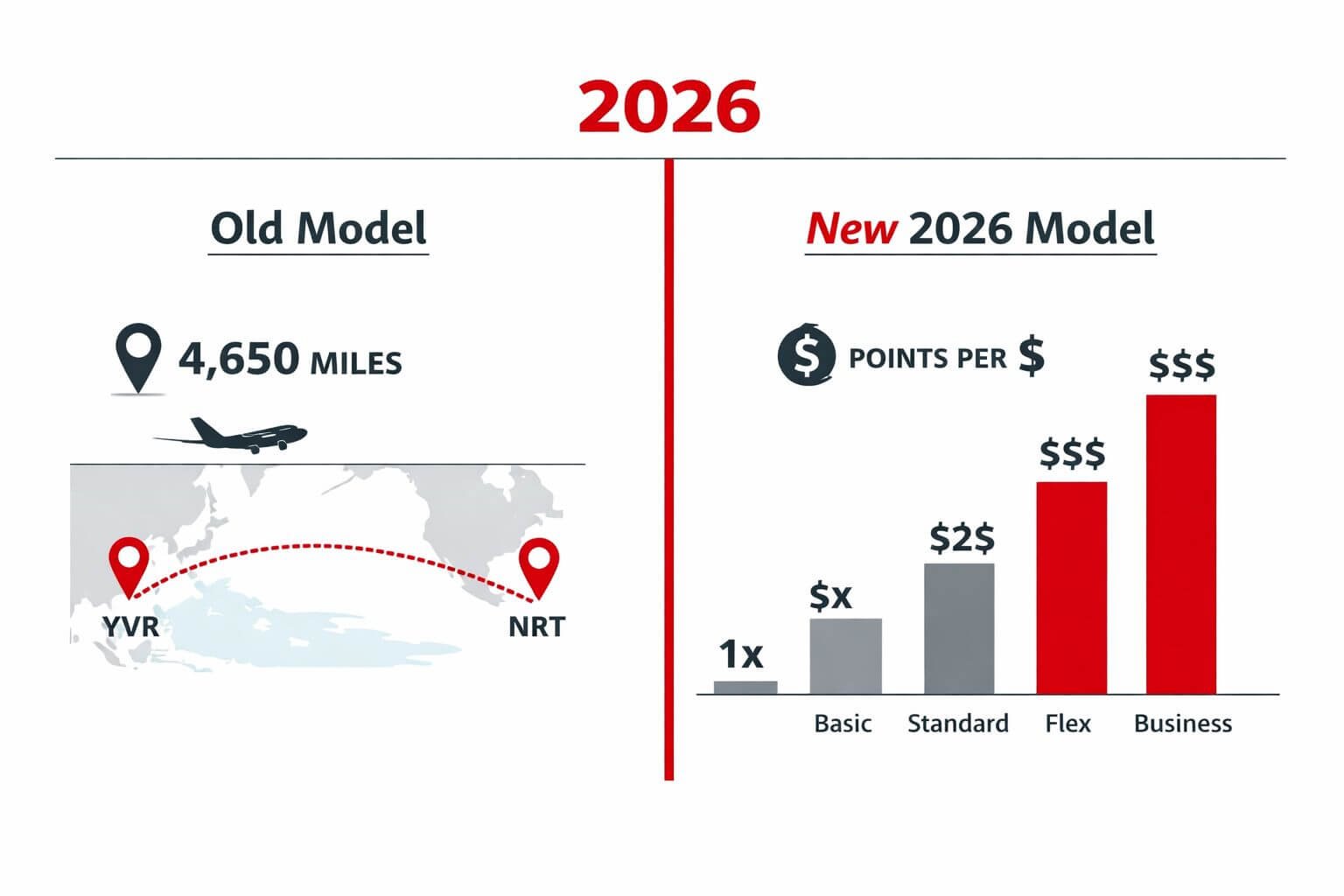
Starting January 1, 2026, Aeroplan awards points and Status Qualifying Credits based on how much you spend on a fare, not how far you fly. A single SQC metric replaces the old SQM/SQS/SQD system. This benefits high-spend and Premium Cabin travelers while reducing value for budget long-haul flyers. Award redemption costs are unchanged.
What Exactly Changed with Aeroplan in 2026?
The Aeroplan 2026 changes represent the most significant structural overhaul of the program in years. Before 2026, Aeroplan awarded points and status credits based on the distance flown and the fare class booked. Starting January 1, 2026, Air Canada switched to a revenue-based model for all Air Canada-operated and Air Canada-ticketed flights.
The core shift:
- Old model: Points and status credits tied to distance flown × fare class multiplier
- New model: Points and SQC tied to dollars spent on the fare
This mirrors changes already made by Delta SkyMiles and American AAdvantage, which moved to revenue-based earning years earlier. Aeroplan is now aligned with that industry direction.
What did not change:
- Award redemption pricing (Aeroplan still uses a partner award chart for most redemptions)
- Points transfer ratios from Amex, Chase, Capital One, Citi, and Bilt
- Partner airline earning (Star Alliance and other partners have separate earning rates)
For US-based travelers who use transferable points to book Star Alliance business class awards, the redemption side of Aeroplan remains intact. The changes affect how you accumulate points and status when flying, not what those points cost to redeem.
How Does Revenue-Based Earnings Work Under the New Aeroplan Rules?
Direct answer: Base members earn approximately 1 Aeroplan point per dollar (CAD) spent on eligible Air Canada fares. Elite members earn 2x to 6x that base rate, depending on their tier. Basic fares earn nothing.
Earning Rates by Tier
| Elite Tier | Points per $1 Spent | SQC per $1 Spent |
|---|---|---|
| Base Member | ~1x | 1 SQC per $1 |
| Aeroplan 25K | ~2x | 1 SQC per $1 |
| Aeroplan 35K | ~3x | 1 SQC per $1 |
| Aeroplan 50K | ~4x | 1 SQC per $1 |
| Aeroplan 75K | ~5x | 1 SQC per $1 |
| Super Elite 100K | ~6x | 1 SQC per $1 |
Note: SQC earning rate is consistent across tiers; point multipliers are the elite benefit. Basic fares earn 0 points and 0 SQC regardless of tier.
Before vs. After: Real Route Examples
The impact varies sharply by route type and fare class. Here are realistic before/after comparisons (amounts in approximate Aeroplan points earned by a base member):
| Route | Fare Type | Old Points (est.) | New Points (est.) | Change |
|---|---|---|---|---|
| YYZ–YUL (Toronto–Montreal) | Standard Economy | ~162 | ~203 | +25% |
| YVR–YYZ (Vancouver–Toronto) | Economy Flex | ~1,100 | ~850 | -23% |
| YYZ–LHR (Toronto–London) | Economy Flex | ~3,200 | ~2,600 | -19% |
| YVR–NRT (Vancouver–Tokyo) | Economy Flex | ~4,660 | ~3,550 | -24% |
| YYZ–LHR | Business Class | ~5,800 | ~9,200 | +59% |
Assumptions: Base member, approximate CAD fare values used for new model calculation. Actual results vary by exact fare paid and booking date.
Key pattern: Short-haul and premium fares benefit. Long-haul economy fares lose ground. This is the same tradeoff seen when Delta and American made similar moves.
Common mistake: Assuming the new model uniformly hurts all members. It specifically penalizes members who book cheap, long-distance economy tickets — the classic “mileage runner” profile. Members who spend more per flight, especially on premium fares, come out ahead.
How Does the New SQC Status System Work?
Direct answer: SQC (Status Qualifying Credits) is a single metric that replaces the previous three-part system of SQM, SQS, and SQD. You earn 1 SQC per dollar spent on eligible Air Canada fares. Reach threshold amounts to qualify for each elite tier.
SQC Thresholds for 2026 Elite Status
| Status Tier | SQC Required |
|---|---|
| Aeroplan 25K | 25,000 SQC |
| Aeroplan 35K | 35,000 SQC |
| Aeroplan 50K | 50,000 SQC |
| Aeroplan 75K | 75,000 SQC |
| Super Elite 100K | 100,000 SQC |
Super Elite 125K requires 125,000 SQC and is the top published tier.
Milestone Benefits: Every 10,000 SQC
One genuinely positive addition in the Aeroplan 2026 changes is the Milestone Benefits structure. Members unlock rewards every 10,000 SQC earned during their status year — including eUpgrade credits, companion passes, and lounge passes. This replaces some legacy perks that were tied to specific status tiers.
Note: Several frequent flyers on FlyerTalk and Reddit’s r/aircanada have flagged that eUpgrade credit allocations under milestones are lower than those received by top-tier members under the old system. This is a real tradeoff worth factoring in if eUpgrades are central to your Air Canada strategy.
Credit Card SQC: The 25,000 Cap
Co-branded Aeroplan credit cards (TD, CIBC, Amex Canada) allow cardholders to earn SQC through spending — roughly 1,000 SQC per $5,000 spent. However, this is capped at 25,000 SQC per year across all co-branded cards combined.
What this means in practice: Credit card spend alone can get a base member to 25K status, but reaching 50K or above requires meaningful flying. Super Elite (125K SQC) is essentially impossible through credit card spend alone.
Who Wins and Who Loses Under the Aeroplan 2026 Changes?
This is the question most members are asking. The answer depends almost entirely on your travel pattern.
Winners
- Premium cabin travelers: Business and first class fares are expensive, so revenue-based earning generates more points and SQC per trip.
- High-fare short-haul flyers: Domestic Canada routes on Flex or higher fares now generate more points than before.
- Credit card spenders chasing 25K status: The SQC card cap aligns well with the 25K threshold, making status achievable without flying.
- Members already at 50K or above: Higher multipliers (4x–6x points per dollar) amplify the benefit of every dollar spent.
Losers
- Budget long-haul economy travelers: A cheap YVR–NRT Economy ticket earns significantly fewer points than under the old distance model.
- Basic fare buyers: Zero points, zero SQC. Full stop. This is the starkest cut in the program.
- Mileage runners: The classic strategy of booking cheap long-haul tickets to accumulate SQM is no longer viable. SQC requires spending, not distance.
- Members who relied on SQS (segment-based qualification): That path is gone. Frequent short-hop flyers who booked cheap fares to rack up segments will find the new math works against them unless their fares are reasonably priced.
Air Canada has stated publicly that the changes are designed to recognize “loyal, engaged members” — meaning those who spend more with the airline ecosystem, not just those who fly the most miles on the cheapest tickets.
Three Traveler Personas: How the 2026 Rules Change Your Path to Status
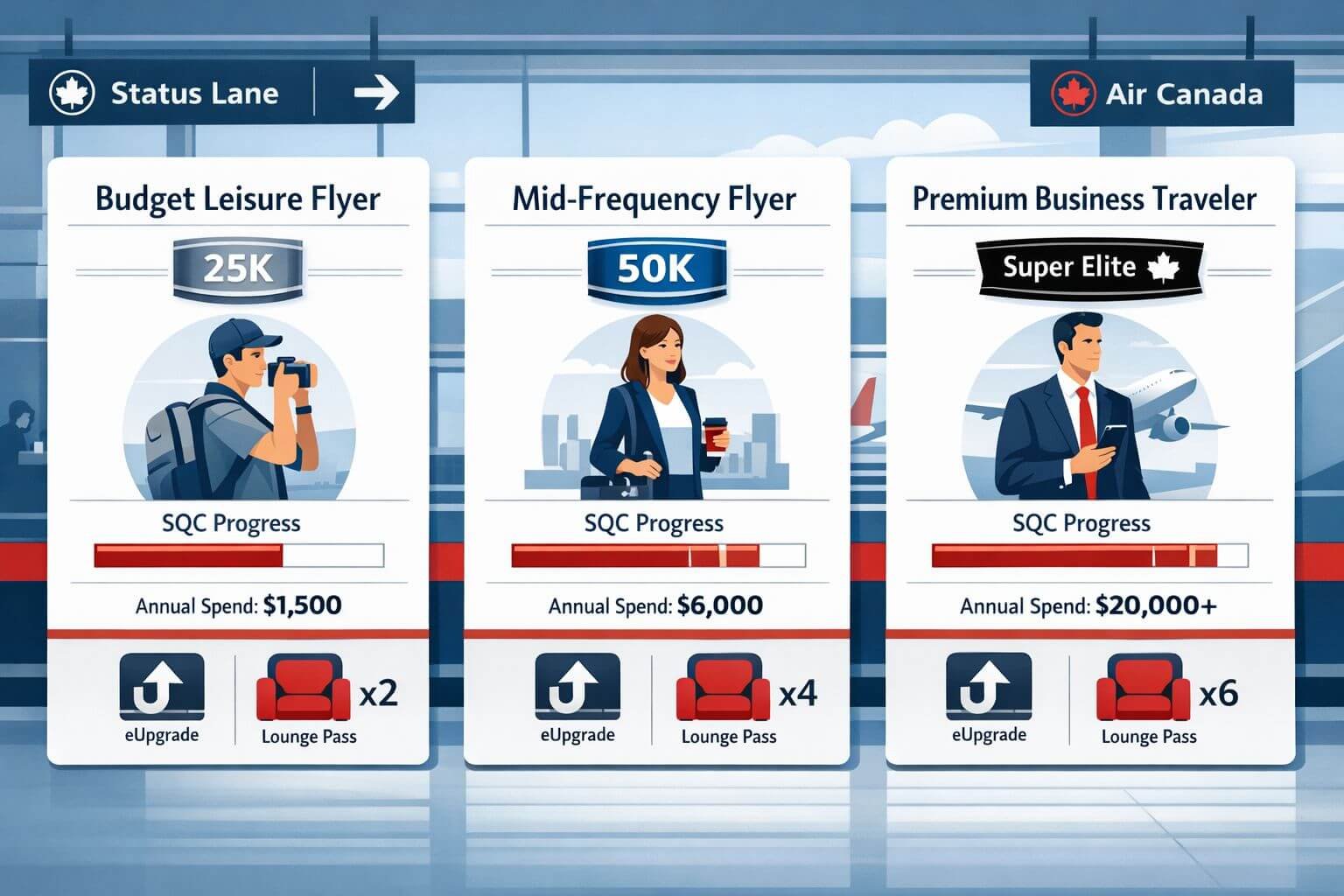
Understanding the Aeroplan 2026 changes is easier with concrete examples. Here are three realistic member profiles and how their status paths shift.
Persona 1: Budget Leisure Flyer
Profile: Flies 4–6 times per year, mostly Economy Standard or Basic, mix of domestic Canada and one transatlantic trip. Annual Air Canada spend: ~CA$3,500.
- Old path: Could reach 25K status via a mix of SQM and SQS from long-haul flights.
- New path: At CA$3,500 in eligible spend (excluding Basic fares), earns roughly 3,500 SQC from flying. With co-branded card spend, could add up to 25,000 SQC — but only if they put significant everyday spend on an Aeroplan card.
- Verdict: Status is harder to reach through flying alone. Must lean on credit card SQC to close the gap. Basic fares are now a trap — zero SQC, zero points.
Persona 2: Mid-Frequency Business Traveler
Profile: Flies 15–20 segments per year, mostly Economy Flex and occasional Business, primarily within Canada and one or two US routes. Annual Air Canada spend: ~CA$10,000 on eligible fares.
- Old path: Likely reached 35K–50K status through a combination of SQM and SQD.
- New path: CA$10,000 in Standard/Flex fare spend generates approximately 10,000 SQC from flying. Add 25,000 SQC from co-branded card spend (at the cap), and this member reaches 35K status. Reaching 50K requires either more flying or upgrading fare classes.
- Verdict: 50K status is achievable but requires intentional fare selection. Booking Standard or Flex over Basic on every trip is now a financial decision, not just a comfort one.
Persona 3: Premium Business Traveler
Profile: Flies Business Class on most Air Canada routes, 20–25 segments per year. Annual Air Canada spend: ~CA$25,000–CA$35,000 on eligible fares.
- Old path: Reached 75K or Super Elite through SQM accumulation on long-haul business fares.
- New path: CA$25,000 in Business Class spend generates approximately 25,000 SQC from flying alone, plus 25,000 SQC from card spend — reaching 50K status. With CA$35,000 in flying spend, this member is approaching 75K status. Super Elite (125K SQC) requires very heavy spend or a combination of flying and card activity near the cap.
- Verdict: This profile benefits most from the multiplier structure. The 6x points multiplier at the Super Elite level means every dollar spent generates significantly more redeemable points than before.
Should US-Based Flyers Still Credit Flights to Aeroplan?
Direct answer: It depends on your fare spend and whether you hold an Aeroplan co-branded card. For US flyers without a co-branded card, United MileagePlus deserves a fresh comparison.
Aeroplan remains a strong Star Alliance redemption program — its award chart still offers competitive pricing on Air Canada metal and partner airlines. The question is whether earning through Aeroplan still makes sense for your flying pattern.
Credit to Aeroplan if:
- You fly Air Canada metal frequently and spend CA$5,000+ per year on eligible fares
- You hold a TD, CIBC, or Amex Canada Aeroplan card and can use the SQC card cap
- You target Aeroplan redemptions specifically (Air Canada business class, Star Alliance Business Class awards, or award flight stopovers on Air Canada)
Consider United MileagePlus instead if:
- You fly primarily on United-operated flights or other Star Alliance carriers
- Your Air Canada flying is infrequent or mostly Basic fares
- You don’t hold an Aeroplan co-branded card and can’t access SQC card earning
- You value United’s Premier status benefits over Aeroplan’s milestone structure
For US-based points collectors who transfer Amex, Chase, Capital One, Citi, or Bilt points to Aeroplan for redemptions, nothing has changed on that side. Aeroplan remains a transfer partner for all five major transferable points currencies, and the award chart for redemptions is intact. The 2026 changes affect earnings, not redemption value.
For a broader view of how Aeroplan fits within your transferable points strategy, see our comparison of transfer partners across Chase, Amex, Citi, and Capital One.
Smart Strategies to Protect Your Status and Points Value in 2026
Given the Aeroplan 2026 changes, here are the highest-impact adjustments to make now.
1. Eliminate Basic Fares From Your Booking Habit
Basic fares earn zero points and zero SQC. The savings on a Basic fare rarely justify the complete loss of earnings. Even Standard Economy generates SQC and points. Run the math: if a Standard fare costs CA$40 more than Basic on a CA$400 ticket, you’re paying 10% more but earning 100% more toward status and points.
2. Use Your SQC Rollover Before March 31, 2026
If you had rollover SQM from 2025, Air Canada converts these to SQC at a 5:1 ratio, up to 40,000 SQC, and deposits them by March 31, 2026. Check your account to confirm this has posted correctly.
3. Max Out Co-Branded Card SQC Early
The 25,000 SQC annual card cap resets with your status year. If you’re targeting 25K or 35K status, front-loading card spend early in the year locks in your card SQC before any program changes could affect it. This is especially relevant given the broader trend of devaluation risk across loyalty programs.
4. Prioritize Flex and Business Fares on Key Routes
Under the old model, fare class mattered for multipliers but distance was the primary driver. Under the new model, every dollar of fare spend counts directly. Upgrading from Standard to Flex on a CA$600 ticket might add CA$80 to the fare but generates 80 additional SQC and proportionally more points.
5. Reassess Mileage Running Completely
Traditional mileage running — booking cheap long-haul tickets to accumulate SQM — is no longer viable. A CA$400 round-trip YYZ–LHR Basic fare earns nothing. A CA$400 round-trip on Standard earns 400 SQC. Neither generates the volume of status credits that a CA$400 ticket would have generated under the old distance model for a ~7,000-mile round trip. Mileage running as a strategy is effectively dead for Aeroplan.
6. Track Cents Per Point on Redemptions
The earning side has changed, but the redemption side hasn’t — yet. Aeroplan still offers strong value on Air Canada business class and select partner redemptions. Use our cents-per-point guide to verify you’re getting at least 1.5–2 CPP on Aeroplan redemptions before transferring points. Dynamic pricing risk remains real; award availability on popular Air Canada routes can be tight.
Frequently Asked Questions
Q: Do the Aeroplan 2026 changes affect how much awards cost to book? No. Award redemption pricing is unchanged. The 2026 updates affect how you earn points and SQC when flying, not what you pay in points when redeeming.
Q: What happens to my 2025 SQM rollover? Air Canada converts rollover SQM from 2025 to SQC at a 5:1 ratio, capped at 40,000 SQC. This should appear in your account by March 31, 2026.
Q: Can I reach 25K status entirely through credit card spend? Yes. The co-branded card SQC cap is 25,000 per year. A base member who maxes out card SQC and earns no flying SQC can still qualify for 25K status — though they’d need to confirm the card SQC posts before the status year closes.
Q: Does Basic fare still earn any Aeroplan points? No. Basic fares earn zero Aeroplan points and zero SQC under the 2026 rules. This applies to both earning and status qualification.
Q: Is mileage running still worth it under SQC? No. SQC is tied to dollars spent, not distance flown. Cheap long-haul tickets generate very few SQC relative to their cost. The mileage running math no longer works for Aeroplan status.
Q: How does Aeroplan SQC compare to United’s PQP system? Both are revenue-based. United’s Premier Qualifying Points (PQP) work similarly — dollars spent generate status credits. The key difference is that Aeroplan’s co-branded card SQC contribution (up to 25,000/year) is more generous than United’s card PQP cap for most mid-tier status levels.
Q: Do partner airline flights (Lufthansa, United, etc.) earn SQC? No. SQC is earned only on Air Canada-operated and Air Canada-ticketed flights. Partner airline flights earn Aeroplan points at separate partner earning rates but do not generate SQC toward Aeroplan status.
Q: Will Aeroplan change award pricing next? No official announcement has been made. However, the broader industry trend toward dynamic pricing is real. Aeroplan has maintained its award chart structure while other programs have moved to dynamic pricing. This is worth monitoring — see our award travel trends guide for 2026 for context.
Q: What are Milestone Benefits, and how do they work? Milestone Benefits unlock every 10,000 SQC earned during your status year. Rewards include eUpgrade credits, lounge passes, and companion vouchers. The specific rewards per milestone are listed on Air Canada’s elite benefits page. Note that some longtime members report the eUpgrade allocation under milestones is lower than what top-tier members received under the old annual allocation system.
Q: Should I transfer Amex or Chase points to Aeroplan now? The redemption value of Aeroplan points is unchanged, so transfers for specific award bookings still make sense when the math works. Don’t transfer speculatively — only transfer when you have a confirmed booking target and verified award availability. Check our guide to maximizing Aeroplan awards with current transfer bonuses before moving points.
Conclusion: What to Do Now
The Aeroplan 2026 changes are a structural realignment — not a collapse of the program. For members who spend meaningfully on Air Canada fares, especially in premium cabins or on Flex fares, the new model is neutral to positive. For budget long-haul travelers and anyone relying on Basic fares, the math has gotten worse.
Your immediate action list:
- Check your rollover SQC — confirm your 2025 SQM converted correctly by March 31, 2026.
- Stop booking Basic fares unless the savings are substantial and you’ve accepted zero earnings.
- Calculate your SQC target — use the thresholds above to determine whether 25K, 50K, or a higher tier is realistic given your expected Air Canada spend.
- Reassess your credit card strategy — if you don’t hold an Aeroplan co-branded card, the 25,000 SQC card cap is a meaningful benefit worth evaluating.
- Decide your Star Alliance crediting home — if most of your Star Alliance flying is on United metal, run the comparison against United MileagePlus before defaulting to Aeroplan.
- Protect your redemption value — Aeroplan award charts are intact for now. Use our cents-per-point framework to confirm you’re getting strong value before redeeming or transferring points.
For a broader context on how these changes fit into the 2026 points landscape, see our award travel predictions for 2026 and our guide to planning aspirational trips with points when award space is competitive.

