
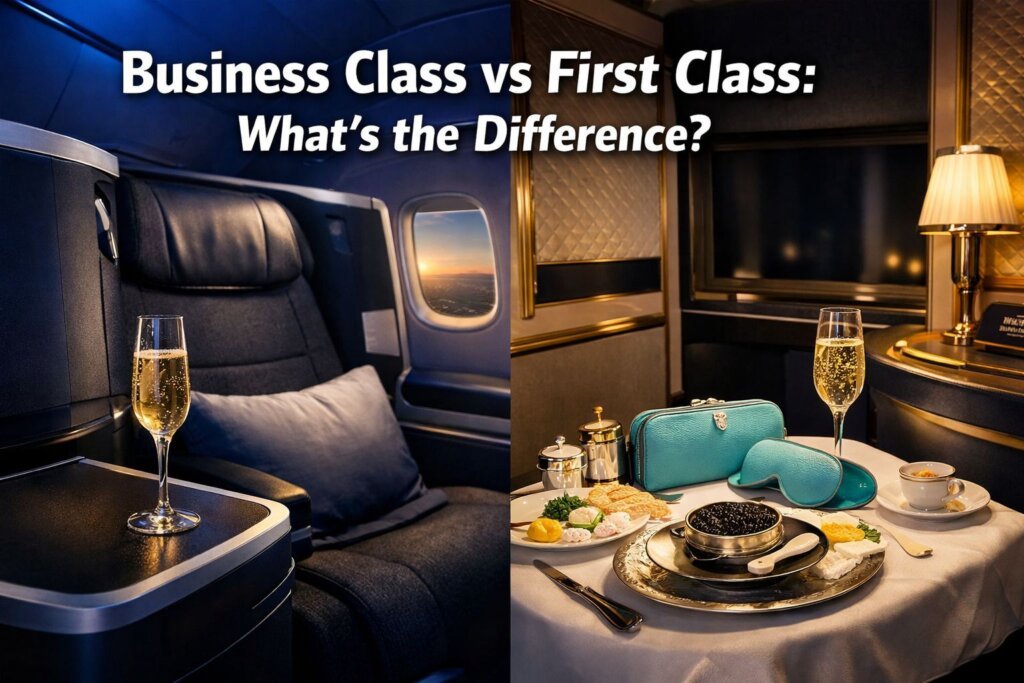
Last updated: May 3, 2026
Quick Answer: Business class offers lie-flat seats, priority services, and premium dining — enough for most long-haul travelers. First class adds private suites with closing doors, dedicated check-in, higher crew-to-passenger ratios, and elevated dining like caviar service. The award cost gap is real: expect to pay 40–60% more miles for first class on most carriers. Whether that premium is worth it depends on the specific airline, the route, and how you value privacy over value.
Key Takeaways
- Business class (booking code J/C) delivers lie-flat seats, priority boarding, and multi-course meals on most major long-haul carriers — a strong sweet spot for most premium cabin award redemptions.
- First class (booking code F) offers private suites with closing doors, a dedicated lounge and check-in facilities, higher crew ratios (roughly 1:4 vs. 1:12 in business), and signature amenities such as caviar service or spa access.
- The award cost gap is significant: long-haul business class typically runs 50,000–90,000 miles one-way; first class runs 90,000–140,000+ miles for the same route.
- Not all “first class” products are equal. Some carriers (like United) no longer operate a true first class cabin on international routes, while others (Singapore, Emirates, Lufthansa) offer genuinely transformative products.
- Qatar’s Qsuite business class competes directly with first class on privacy, making the business vs. first class debate more nuanced than ever in 2026.
- First class award space is scarcer than business class, with many carriers releasing seats only close to departure or to top-tier elite members.
- The best programs for First Class redemptions include Air Canada Aeroplan, ANA Mileage Club, and Avianca LifeMiles for Star Alliance carriers, and American AAdvantage for Oneworld.
- Fuel surcharges on First Class awards (especially on Lufthansa via Miles & More) can add $500–$1,000+ in fees, significantly altering the value equation.
Hard Product: How Do the Seats Actually Differ?
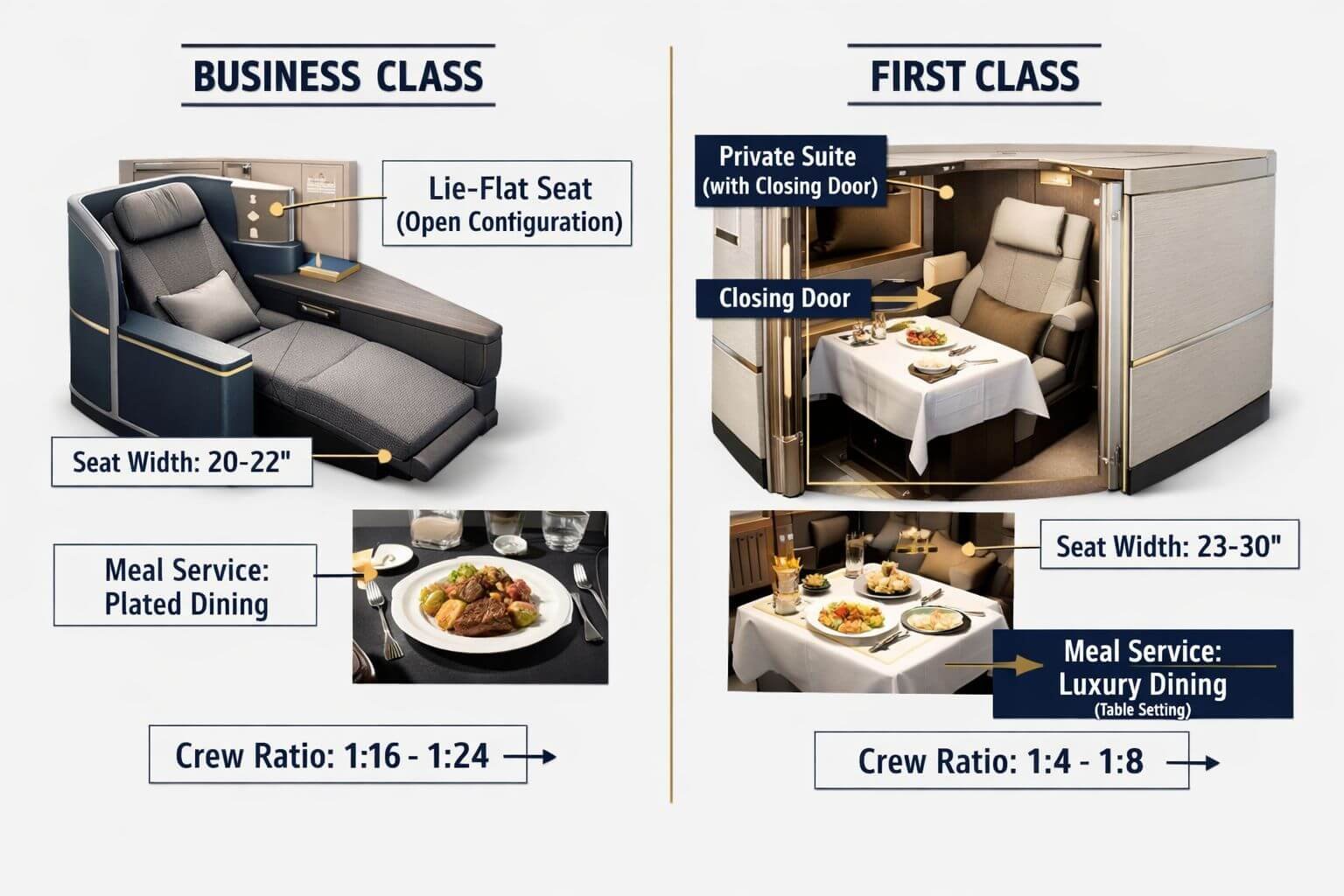
Business class and first class diverge most visibly in seat design, privacy, and personal space. Business class on most modern long-haul aircraft features lie-flat beds in a 1-2-1 or 1-1 configuration, with direct aisle access for every passenger. First class takes that further with enclosed suites, sliding or hinged doors, and significantly more square footage per passenger.
Business class seat benchmarks (2026):
- Lie-flat bed, typically 6–7 feet long
- 20–24 inches wide at the shoulder
- Direct aisle access in most modern configurations
- Soft divider or partial shell between seats
- Large personal entertainment screen (15–18 inches)
First class seat benchmarks (2026):
- Fully enclosed suite with a closing door (on leading products)
- Separate bed and seat in some configurations (Lufthansa First, Singapore Suites)
- 25–35+ square feet of personal space
- Vanity mirror, storage compartments, and a dedicated wardrobe
- Entertainment screens up to 32 inches
The privacy gap is the defining hard-product difference. In business class, even the best products — like Qatar’s Qsuite — offer a door that closes for privacy but still share a cabin with 30–40 other passengers in close proximity. Singapore Airlines Suites and Emirates First Class provide a genuinely apartment-like experience, where you can close the door and feel entirely separate from the rest of the aircraft.
Decision rule: If a lie-flat bed and direct aisle access are your primary needs, business class delivers. If you want to feel genuinely alone — to work, sleep, or simply decompress without any awareness of other passengers — first class suites justify the premium on the right carriers.
Soft Product: Service, Dining, and Amenities
The soft product — everything beyond the seat itself — is where first class most clearly earns its price premium. Service ratios, dining quality, and ground amenities all step up meaningfully.
Service ratios (approximate):
- First class: roughly 1 flight attendant per 4 passengers
- Business class: roughly 1 flight attendant per 8–12 passengers
You may be interested


That ratio difference translates to proactive, personalized service rather than reactive cabin management. In first class, flight attendants learn passenger names before boarding, anticipate preferences, and deliver a restaurant-style experience rather than a coordinated service cycle.
Dining differences:
- Business class: pre-set multi-course meals with a choice of 3–4 entrées, served on proper tableware with wine pairings
- First class: à la carte menus with no fixed service times, caviar as a standard course on carriers like Lufthansa, Singapore, and Emirates, and in some cases, tableside preparation
Ground amenities that only First Class passengers receive on select carriers:
- Dedicated First Class check-in terminal (Lufthansa at Frankfurt, Emirates at Dubai)
- Private immigration fast-track lanes
- Exclusive First Class lounges (separate from Business Class lounges)
- Chauffeur ground transfer (Emirates, Etihad, Singapore)
- Spa and shower access at the airport (Emirates First Class Terminal in Dubai)
Amenity kits also differ in quality. Business class kits have improved significantly — many carriers now offer pajamas and premium skincare. See which airlines offer pajamas in business class for a full breakdown. First class kits on carriers like Singapore Airlines have historically featured Lalique or Ferragamo products; Emirates First provides Bulgari amenities.
Common mistake: Assuming the first class lounge is always better than the business class lounge. On some carriers and at some airports, the difference is marginal. At Lufthansa’s Frankfurt hub or Emirates’ Dubai terminal, however, the first class facility is genuinely a separate building — a meaningful part of the overall experience.
Carrier Showdown: Business Class vs First Class Across 6 Airlines
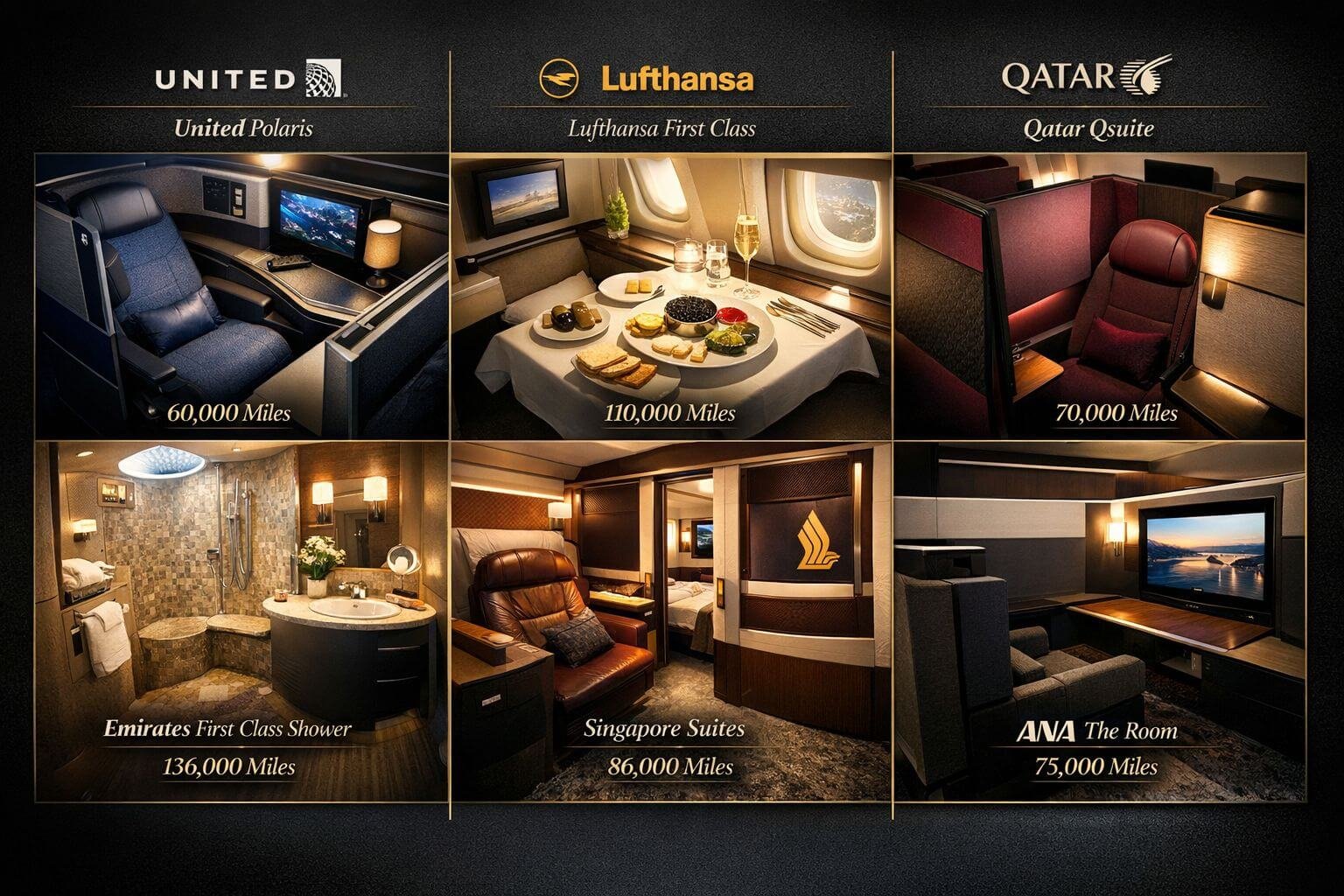
The Business Class vs First Class gap varies enormously by carrier. Here’s a practical breakdown of the six most relevant products for U.S.-based award travelers in 2026.
1. United Polaris (Business Class Only)
United does not operate a true international First Class cabin. Polaris business class is the top product, featuring lie-flat seats in a 1-2-1 configuration, Saks Fifth Avenue bedding, and a solid dining program. In 2026, United’s new Boeing 787-9 Dreamliners include “Polaris Studios” — extra-space suites with caviar service on select long-haul routes.
- Award cost: ~70,000 United MileagePlus miles one-way to Europe (saver level)
- Verdict: Strong value for business class; no first class option to compare
2. Lufthansa First Class
Lufthansa First is one of the few remaining true First Class products on transatlantic routes. Private suites with closing doors, a dedicated First Class terminal in Frankfurt, caviar service, and a 1:4 service ratio. Air France launched a competing “La Première” product in 2025 with a chaise lounge and a massive entertainment screen, described as the most luxurious seat flying between the U.S. and Europe.
- Business Class award: ~62,000 miles one-way (NYC–FRA via partner programs)
- First Class award: ~72,000 miles one-way (NYC–FRA via partner programs)
- Gap: ~10,000 miles (roughly 16% more for first class)
- Verdict: One of the narrowest award gaps in premium aviation. Worth it if you value the ground experience and suite privacy. Book via Air Canada Aeroplan or Avianca LifeMiles to avoid Miles & More fuel surcharges. See the Lufthansa Miles & More transfer partners guide for program details.
3. Qatar Qsuite (Business Class)
Qatar does not operate a separate First Class cabin. Qsuite is a Business Class product that competes directly with first class on privacy — closing doors, double beds for couples, and a genuinely suite-like feel. The dining and service quality rivals many First Class products.
- Award cost: ~70,000–85,000 miles one-way to the Middle East/Asia (via Avios or AA AAdvantage)
- Verdict: The strongest argument for skipping first class entirely. Qsuite delivers first-class privacy at business class prices on Oneworld. See the Oneworld award booking guide for the booking strategy.
4. Emirates First Class
Emirates First Class is the most amenity-rich product in the sky for many travelers — a private suite with a minibar, a 32-inch screen, and access to the onboard shower spa on A380 flights. The Emirates First Class Terminal in Dubai is a destination in itself.
- Business Class award: ~77,000 Emirates Skywards miles one-way (U.S.–Dubai)
- First Class award: ~115,000 Emirates Skywards miles one-way (U.S.–Dubai)
- Gap: ~38,000 miles (roughly 49% more for first class)
- Verdict: The shower spa and private suite justify the gap for the right traveler. But availability is tight, and Skywards miles are harder to earn via transferable points.
5. Singapore Airlines Suites (First Class)
Singapore Suites on the A380 represent the pinnacle of commercial aviation privacy — a fully enclosed cabin with a real closing door, a double bed made up in-flight, and Lalique amenities. The Book the Cook dining program allows pre-ordering from an extensive menu.
- Business class award: ~86,000 miles one-way (U.S.–Singapore via KrisFlyer or partner programs)
- First class (Suites) award: ~119,000 miles one-way via KrisFlyer
- Gap: ~33,000 miles (roughly 38% more for Suites)
- Verdict: If the experience matters more than the value of math, Singapore Suites is the benchmark. Award availability is extremely limited — typically 1–2 seats per flight, often released close to departure.
6. ANA “The Room” (Business Class)
ANA’s “The Room” Business Class product features a fully enclosed suite with a closing door — making it functionally equivalent to first class on many other carriers. ANA does operate a First Class product on select routes, but The Room has largely closed the gap.
- Business class (The Room) award: ~88,000 miles one-way (U.S.–Japan via Virgin Atlantic Flying Club or Air Canada Aeroplan)
- First class award: ~110,000 miles one-way
- Gap: ~22,000 miles
- Verdict: The Room is one of the best business class products available. ANA First is exceptional but harder to find on award space. Bilt points transfer to ANA — check for Bilt Rent Day promotions that occasionally include transfer bonuses to ANA partners.
Award Pricing Gap: The Points Math on Business Class vs First Class
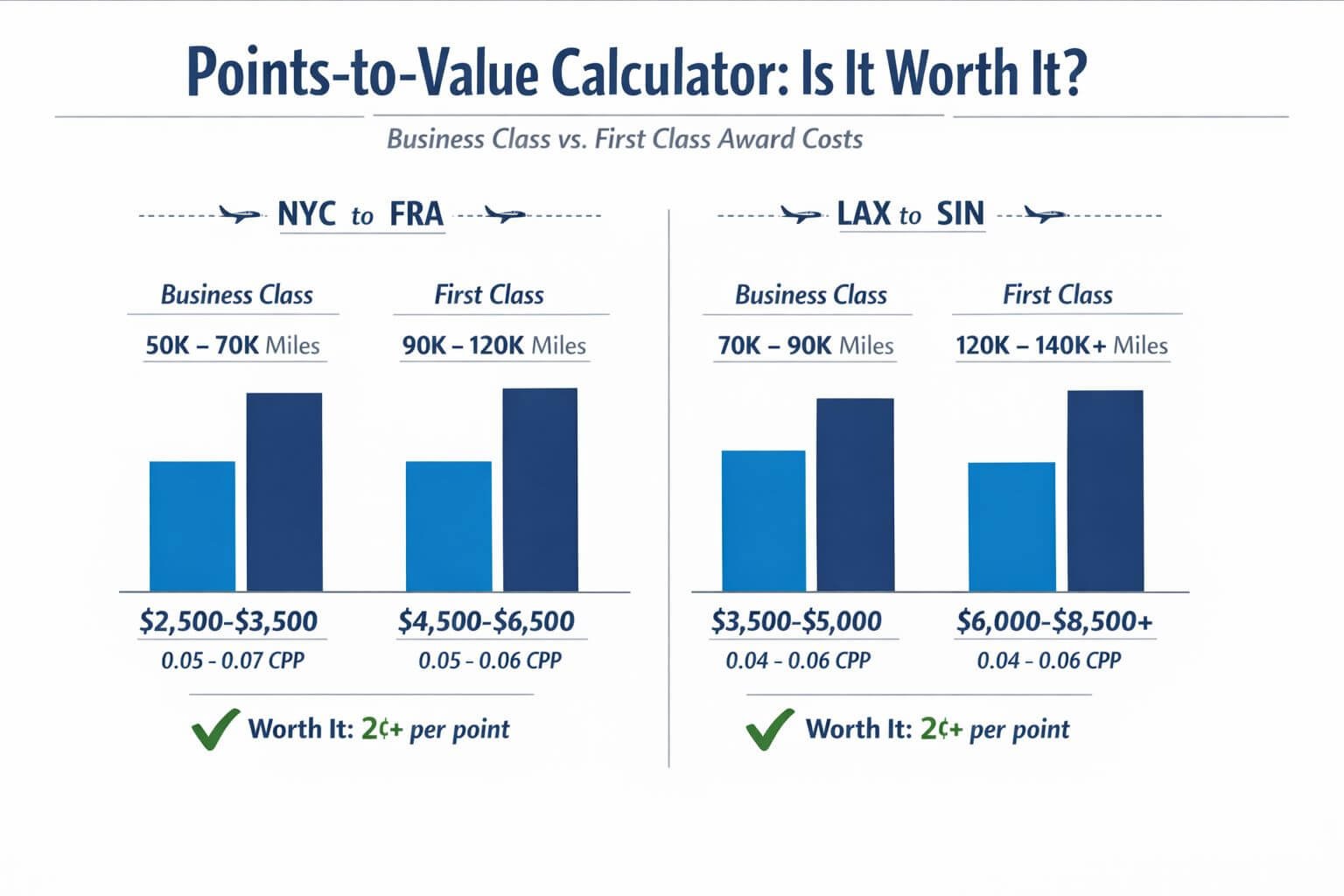
The core question for award travelers: Does first class deliver enough extra value to justify 40–60% more miles?
Here’s the travel rewards math on two key routes, using mid-2026 award pricing:
| Route | Cabin | Program | Miles (One-Way) | Est. Cash Value | CPP |
|---|---|---|---|---|---|
| NYC–FRA | Business (LH) | Aeroplan | 62,000 | ~$3,500 | ~5.6¢ |
| NYC–FRA | First (LH) | Aeroplan | 72,000 | ~$5,500 | ~7.6¢ |
| LAX–SIN | Business (SQ) | KrisFlyer | 86,000 | ~$4,200 | ~4.9¢ |
| LAX–SIN | Suites (SQ) | KrisFlyer | 119,000 | ~$8,000+ | ~6.7¢ |
| JFK–DXB | Business (EK) | Skywards | 77,000 | ~$3,800 | ~4.9¢ |
| JFK–DXB | First (EK) | Skywards | 115,000 | ~$6,500 | ~5.7¢ |
Assumptions: Cash prices based on publicly available fares in Q1–Q2 2026. CPP (cents per point) is calculated by dividing the cash value by the cost per mile. These are estimates; actual fares vary significantly by date and booking window.
For a deeper look at how to calculate and apply CPP to your own redemptions, see the 2026 guide to cents-per-point math.
Key observations:
- The CPP on First Class redemptions is often higher than Business Class, because cash First Class fares are disproportionately expensive.
- But the absolute mile cost matters too. Spending 119,000 miles on Singapore Suites means those miles aren’t available for two solid business class redemptions.
- Fuel surcharges can significantly erode the value of First Class. Lufthansa first class booked via Miles & More carries $500–$900+ in carrier-imposed surcharges. Booking via Aeroplan or LifeMiles avoids most of these fees.
Common pitfall: Focusing only on CPP without considering opportunity cost. If your transferable points balance is 120,000 Amex points, spending all of them on one Singapore Suites seat leaves nothing for a companion or a future trip. For a full comparison of which programs offer the best transfer options, see comparing transfer partners in 2026.
When Does First Class Actually Make Sense?
First class is worth the mile premium in specific, well-defined situations. It’s not the right call for every traveler or every trip.
Choose first class if:
- The specific carrier’s first class product is genuinely differentiated (Singapore Suites, Emirates First, Lufthansa First — not a rebranded business class)
- The mile gap is narrow relative to the cash price gap (Lufthansa’s ~10,000-mile difference is a strong case)
- You’re traveling for a milestone occasion (honeymoon, significant birthday) where the experience itself is the point
- You have surplus miles in a single program with limited other redemption options
- The route includes a long overnight segment (14+ hours) where suite privacy meaningfully improves rest quality
- You can access first class award space, which often requires booking 330+ days out or within 2 weeks of departure
Skip first class if:
- The carrier’s first class is a minor upgrade over business (some U.S. domestic “first class” products are simply economy with more legroom)
- The mile gap exceeds 40,000 miles, and you could use those miles for a companion business class seat
- Fuel surcharges on the First Class award erode the cash value advantage
- Award availability is so scarce that you’d need to significantly compromise routing or dates
- Your primary goal is to maximize total trips rather than to maximize a single experience
The broader trend is worth noting: airlines are investing heavily in premium cabins across all tiers. Delta, American, United, and JetBlue are competing aggressively in premium economy and Business Class products like Qsuite and ANA The Room have closed the gap with traditional first class significantly. For context on where the loyalty landscape is heading, see award travel predictions for 2026.
Routes and Programs Where First Class Redemptions Shine
Not all routes have First Class options, and not all programs price them well. Here are the sweet spots in 2026.
Best programs for First Class redemptions:
- Air Canada Aeroplan (Chase, Amex, Capital One transfer partner): Strong pricing on Lufthansa First and Swiss First, with low or no fuel surcharges. One of the most flexible programs for Star Alliance first class. See the Star Alliance business class awards guide for booking mechanics that apply equally to first class.
- Avianca LifeMiles (Amex, Citi transfer partner): Competitive pricing on Star Alliance first class with no fuel surcharges. Amex LifeMiles transfer bonuses occasionally make this even more attractive.
- ANA Mileage Club (Amex transfer partner): Exceptional pricing for round-trip first class awards on ANA and Lufthansa, but requires round-trip booking and has limited partner availability.
- American AAdvantage (Citi, Bilt transfer partner): Good pricing for Cathay Pacific First Class and Japan Airlines First Class on Oneworld. Citi ThankYou points now transfer to American Airlines, expanding earning options.
- Virgin Atlantic Flying Club (Amex, Chase, Capital One transfer partner): Historically strong pricing for ANA First Class, though availability is the limiting factor.
Best routes for First Class award value:
- New York (JFK/EWR) to Frankfurt (FRA): Lufthansa First, bookable via Aeroplan
- Los Angeles (LAX) to Tokyo (NRT/HND): ANA First, bookable via Virgin Atlantic or ANA Mileage Club
- New York (JFK) to Dubai (DXB): Emirates First, bookable via Skywards (limited transfer partners)
- Houston (IAH) or San Francisco (SFO) to Singapore (SIN): Singapore Suites, bookable via KrisFlyer
Availability note: First class award space is the single biggest constraint. Many carriers release First Class awards only to top-tier elite members or within 2 weeks of departure. Building flexibility into travel dates and using tools like Air Canada’s Aeroplan search or United’s partner award search to find availability before transferring points is essential. Never transfer points speculatively for a First Class redemption — confirm the seat first.
Frequently Asked Questions
Is first class worth it over business class? It depends on the carrier. On Singapore Airlines, Emirates, and Lufthansa, first class delivers a meaningfully different product — private suites, dedicated ground facilities, and service ratios that business class cannot match. On many other carriers, the gap is much smaller, and Business Class offers better value per mile.
What is the main difference between business class and first class? The primary differences are privacy (enclosed suites with closing doors in First Class), service ratio (roughly 1:4 in first vs. 1:8–12 in business), dining style (à la carte with no fixed service times in first), and ground amenities (dedicated terminals, lounges, and chauffeur service on leading carriers).
Does every airline have both business class and first class? No. Many carriers — including United on international routes and all of Qatar Airways — operate Business Class as their highest cabin. True international first class is offered by a shrinking number of carriers: Lufthansa, Singapore Airlines, Emirates, Etihad, ANA, Japan Airlines, and a few others.
How many miles does first class cost compared to business class? On most major routes, first class costs 40–60% more miles than business class. Emirates First runs ~115,000 Skywards miles vs. ~77,000 for business on U.S.–Dubai routes. Lufthansa First is closer to business class in award pricing, at roughly 72,000 vs. 62,000 miles via Aeroplan on transatlantic routes.
Can I book first class with Chase or Amex points? Yes, through transfer partners. Chase Ultimate Rewards transfers to Air Canada Aeroplan and Virgin Atlantic Flying Club, both of which allow booking of first class on partner airlines. Amex Membership Rewards transfers to Aeroplan, ANA Mileage Club, Avianca LifeMiles, and others. Always confirm award availability before transferring.
Is Qatar Qsuite considered business class or first class? Qsuite is officially business class. However, its enclosed suite design with a closing door makes it functionally comparable to first class in terms of privacy. Qatar does not operate a separate First Class cabin on most routes, making Qsuite its top product.
What are fuel surcharges, and how do they affect First Class awards? Fuel surcharges (also called carrier-imposed surcharges) are fees that some airlines pass on to award passengers. Lufthansa, for example, charges $500–$900+ on first class awards booked through Miles & More. Booking the same Lufthansa First Class seat through Aeroplan or LifeMiles typically reduces or eliminates these fees, significantly improving the value of the redemption.
How far in advance should I search for First Class award space? Search as early as possible — many carriers release first class award seats 330–355 days before departure. A secondary release window often opens 2–14 days before departure when unsold seats become available. Flexibility on dates and the willingness to monitor availability over time are both important for First Class bookings.
What transferable points programs are best for First Class bookings? Air Canada Aeroplan (Chase, Amex, Capital One), Avianca LifeMiles (Amex, Citi), ANA Mileage Club (Amex), and American AAdvantage (Citi, Bilt) are the most practical programs for First Class redemptions in 2026. Each has different partner airline coverage, pricing, and surcharge policies.
Is domestic first class the same as international first class? No. Domestic First Class in the U.S. is typically a recliner seat with slightly more legroom and a basic meal — not a lie-flat bed or private suite. International first class on carriers like Singapore, Emirates, or Lufthansa is a fundamentally different product. The term “first class” means very different things depending on the carrier and route.
Conclusion: Making the Call for Your Next Redemption
The business class vs first class decision comes down to three variables: the specific carrier’s product quality, the mile gap on your target route, and what you’re optimizing for — value or experience.
For most award travelers, business class is the right call. Products like Qatar Qsuite, ANA The Room, and United Polaris deliver exceptional comfort at a lower mile cost, with better award availability and fewer constraints. The step-by-step guide to booking business class with points is the right starting point for most readers.
First class makes sense when the carrier’s product is genuinely differentiated (Singapore Suites, Emirates First, Lufthansa First), the mile gap is narrow relative to the cash price difference, and availability aligns with your travel dates. The Lufthansa First via Aeroplan routing — roughly 10,000 more miles than business class for a private suite and dedicated terminal — is one of the most defensible first class upgrades in award travel today.
Practical next steps:
- Identify your target route and check which carriers operate true first class on that routing.
- Compare award pricing across at least two programs before transferring any points.
- Search for first class award availability before transferring — use Aeroplan, United, or the KVS Tool to check partner space.
- Calculate the CPP gap between business and first class on your specific route.
- If First Class availability is scarce or the mile gap exceeds 40,000, default to the best available Business Class product.
The premium cabin market is expanding rapidly — airlines added 35% more premium seats on transatlantic routes compared to 2019 — but first class remains a genuinely rare and differentiated experience on the carriers that do it well. Know which carriers those are, understand the award math, and the decision becomes straightforward.


Content on Award Travel Hub is independently created by Award Travel Hub Editorial Desk and, where noted, reviewed by Award Travel Hub Review Desk. Some pages may contain affiliate links, but compensation does not determine our coverage, opinions, or methodology.