

}
Last updated: April 26, 2026
Quick Answer
A smart hotel loyalty strategy after devaluation in 2026 is usually not “stay loyal no matter what.” For most travelers, the best move now is to match loyalty style to actual stay patterns: one-chain loyalty only if elite benefits and footprint still save real money, a free-agent approach if rates and locations matter more, or a barbell strategy if you want one program for aspirational redemptions and another for practical coverage.
Key Takeaways
- Hyatt’s 2026 award changes make top-end redemptions meaningfully more expensive, even if some lower-tier stays get slightly cheaper.
- Marriott, Hilton, and IHG have been shifting value away from fixed sweet spots toward more dynamic pricing, making point costs less predictable.
- Travelers doing 20 to 30 nights per year often get the best results from a hybrid strategy, not full-chain loyalty.
- Travelers doing 60 to 80+ nights per year can still justify concentrated loyalty, but only if elite benefits, footprint, and employer-paid stays support it.
- Mid-tier status can still be worth chasing for breakfast, lounge access, late checkout, and free parking on award stays where offered.
- A “loyalty mirage” feeling is real: many experienced travelers now see less value in blind loyalty as the risk of devaluation keeps rising.
- Transferable points matter more than ever because they reduce lock-in and let you compare cash rates, hotel points, and transfer bonuses before booking.
- Hyatt still has reasons to matter, but many travelers should now treat Hyatt as a selective redemption program rather than an all-in primary chain.
- The best response is a simple decision framework: choose monogamous, free agent, or barbell based on nights, destination mix, and benefit use.
- Before moving points, check award availability, cancellation rules, and your likely cents per point (CPP), not just the headline award price.
What changed in hotel loyalty programs heading into 2026?
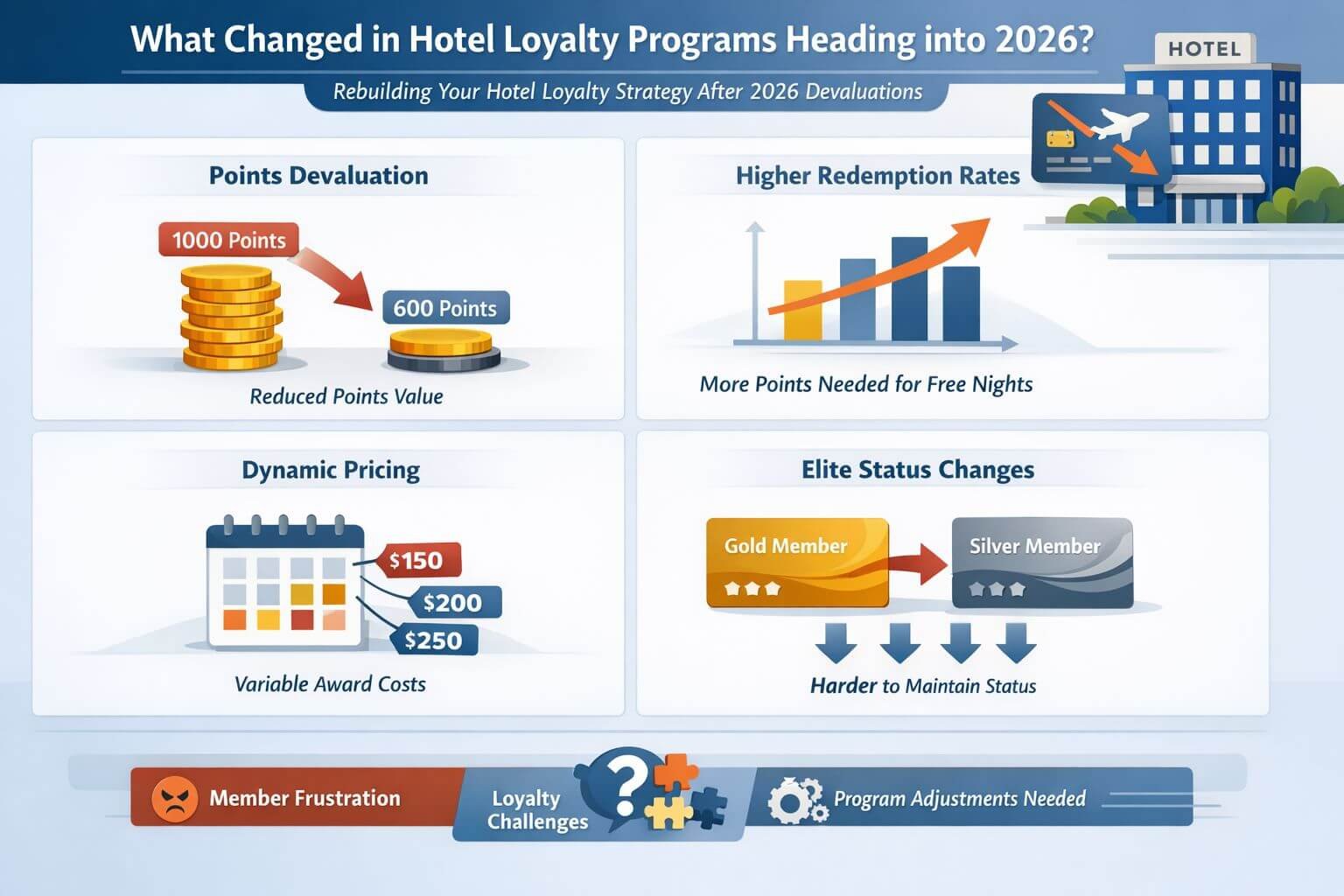
The short version: value got harder to predict, especially at the high end. Hyatt’s award-chart overhaul is the clearest headline, but the broader story is that major hotel chains continue to raise redemption costs, reduce fixed-value sweet spots, and push travelers toward more flexible, less generous pricing models.
Hyatt is the most visible example. On February 25, 2026, Hyatt announced a new five-tier award chart structure rolling out from May 2026, with only limited nights moving to the highest pricing tiers this year and broader use possible later. Coverage from NerdWallet and The Points Guy described the change as a major devaluation, especially for luxury stays, even though some Category 1 to 3 off-peak and standard nights can cost less.
Key Hyatt facts that matter for strategy:
- Category 8 can now reach 75,000 points at the top end.
- All-inclusive Category F can reach 85,000 points.
- Hyatt also launched digital points transfers, replacing older PDF forms, which makes family pooling easier.
- World of Hyatt cardholders and elites at Explorist and above get one month of early access to some awards, which helps at high-demand properties.
- Hyatt will continue annual category reviews, which means more repricing risk remains.
Other chains matter too, even if the changes look different:
- Marriott Bonvoy still wins on footprint for many travelers, especially when destination flexibility matters.
- Hilton Honors remains easier to earn through Amex points and Hilton credit cards, and free night certificates can still create strong value at expensive properties.
- IHG One Rewards often works best as a tactical program, especially when promotions, fourth-night-free benefits, or fast-track status line up.
Many frequent travelers now describe hotel loyalty as a “loyalty mirage”: the branding still promises consistency, but redemption math is getting worse.
You may be interested



That frustration is understandable. But “loyalty is dead” is too broad. A better conclusion is this: blind loyalty is weaker; selective loyalty still works.
What does a hotel loyalty strategy look like after devaluation now?
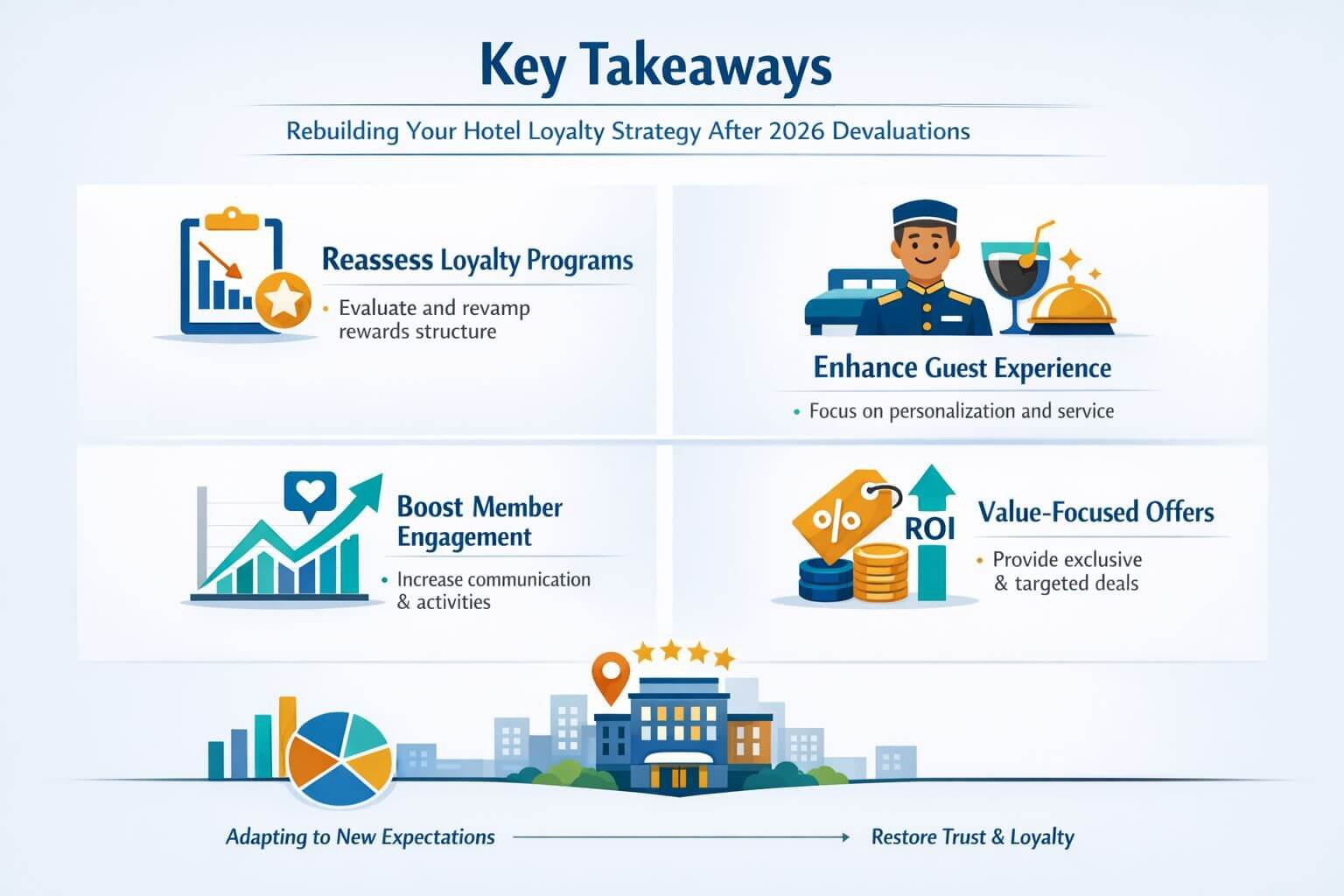
A strong hotel loyalty strategy after devaluation starts with one question: Are points the main goal, or are benefits the main goal? If you cannot answer that clearly, it is easy to overvalue status and overlook cheaper or better bookings elsewhere.
Use this decision framework:
Stay mostly loyal to one chain if:
- You stay enough nights to reach meaningful elite tiers
- That chain has strong coverage where you actually travel
- You consistently use the benefits, such as breakfast, lounge access, upgrades, late checkout, and free parking on award stays
- Work travel helps fund personal rewards nights
Go free agent if:
- You stay mostly in cities or leisure markets with many comparable options
- Cash rates vary a lot, and you often choose based on price
- You earn mostly transferable points, not hotel-specific points
- You rarely get enough stays to unlock high-value elite treatment
Use a barbell strategy if:
- You want one program for aspirational redemptions and another for footprint
- You still value one elite track, but do not want all of your hotel spend trapped in one ecosystem
- You care about reducing devaluation risk
For many ATH readers, the best barbell in 2026 is something like:
- Hyatt for selective high-value redemptions and maybe elite pursuit if your footprint fits
- Marriott or Hilton for broad coverage, work travel, and easier backup options
If Hyatt’s changes are your main concern, see ATH’s deeper breakdown of the Hyatt award chart changes in 2026 and the companion analysis on the World of Hyatt award chart 2026 changes and hidden deals.
Common mistake
A common mistake is staying loyal to a chain that has weak local coverage just because the program once had better award charts. If the chain forces worse locations, higher nightly rates, or extra transport costs, the points gain may not be worth it.
Who should still stay loyal to one hotel chain?
Single-chain loyalty still makes sense for travelers who actually unlock elite benefits often enough to offset weaker redemption value. The best candidates are road warriors, consultant-type travelers, and leisure travelers with a very consistent destination pattern.
A concentrated strategy still works best when three conditions line up:
- You can hit status without mattress runs
- The chain has solid footprint in your usual destinations
- Benefits save real cash on real trips
Examples where loyalty still pays:
- A traveler doing 70 nights a year in secondary U.S. cities may get more practical value from Marriott or Hilton than Hyatt because footprint matters more than theoretical points value.
- A family doing several resort stays per year may still get strong value from Hyatt if breakfast, suite upgrades, and a few planned redemptions at high-cash-rate properties remain achievable.
- A frequent traveler with an employer paying cash rates may earn enough points and elite night credits that a single-chain strategy still compounds well.
Best for
- 60 to 80+ nights a year
- Travelers with employer-paid stays
- Travelers who repeatedly use breakfast, lounge access, guaranteed late checkout, and milestone perks
Not for
- Travelers with fewer than 25 nights a year
- Travelers who book mostly independent hotels, vacation rentals, or boutique properties
- Travelers who primarily care about lowest total trip cost
For shortcut strategies, ATH’s guide to best credit card and loyalty shortcuts to earn hotel status in 2026 is useful if you want benefits without committing all stays to one chain.
When does a free agent or hybrid approach beat loyalty?
A free-agent or hybrid strategy wins when flexibility saves more than status earns. In 2026, that is increasingly common because dynamic pricing and award inflation reduce the upside of keeping all your nights in one bucket.
A hybrid approach is usually stronger if you:
- Book hotels in expensive cities where cash deals can vary wildly
- Use Amex points, Chase points, Capital One miles, Citi points, or Bilt points as your main rewards currency
- Want the option to transfer only when award availability makes sense
- Prefer to compare chains on every trip
This is where transferable points become a defensive tool. They cannot stop a devaluation, but they can reduce lock-in. If one hotel chain inflates, transferable currencies let you pivot. ATH’s comparison of transfer partners in 2026 is helpful if your hotel decisions depend on which bank points you earn most.
Quick rule
Choose the free-agent model if your annual stays are low and your destinations are broad. Choose the barbell model if you still want a single status relationship and a backup ecosystem.
Edge case
Some travelers should be “free agents” on paid stays, but still keep one favorite hotel program for awards only. That is often the right answer for former Hyatt loyalists who still want occasional sweet spots but no longer want to route every paid stay to Hyatt.
How should 20-, 40-, and 60-night travelers adjust in 2026?
Different night counts lead to different optimal strategies. That matters more now because the gap between “almost elite” and “meaningfully rewarded” is wider after repeated devaluations.
Suggested strategy by traveler type
| Traveler profile | Typical pattern | Best approach in 2026 | Why it works |
|---|---|---|---|
| 20–30 nights | Mix of leisure and a few work trips | Hybrid or free agent | Hard to earn top-tier value consistently; better to book best rate/location and use points selectively |
| 35–45 nights | Moderate frequency, some repeat markets | Barbell strategy | Enough nights to value one chain, but not enough to ignore footprint and price elsewhere |
| 60–80+ nights | Heavy business travel or long leisure patterns | Primary chain + backup | Elite benefits and milestone rewards can still justify concentration, but backup coverage matters |
Typical traveler: 20 to 30 nights per year
A traveler at this level should usually avoid overcommitting. The best path is often:
- Keep earning transferable points
- Hold one hotel card if the annual free night or status helps
- Concentrate only enough stays to hit a useful mid-tier if easy
- Book cash when rates are low, points when rates spike
Example: A traveler with 24 nights annually, mostly domestic weekends plus one resort trip, may get more value by:
- Booking Marriott or Hilton paid stays based on rate and location
- Saving Hyatt points for one or two aspirational redemptions
- Using free night certificates where cash rates are inflated
Road warrior: 60 to 80+ nights per year
A traveler at this level can still justify chain loyalty, but should now stress-test it every year.
A practical setup might be:
- Primary: Marriott or Hilton for footprint and employer-paid stay accumulation
- Secondary: Hyatt for specific redemptions or known-value stays
- Wildcard: IHG for promotion-driven runs or markets where it dominates
Common mistake
Do not value points in isolation. If a chain’s footprint forces a $40 rideshare each way or a much higher nightly rate, the loyalty math can flip quickly. Use a basic travel rewards math approach, not just points totals. ATH’s 2026 guide to cents-per-point math can help if you want a cleaner valuation method.
Is Hyatt still worth it after the 2026 changes?
Yes, but for fewer travelers as a primary chain. Hyatt is still worth it if you can use its remaining strong spots, early award access, points sharing, and selective luxury redemptions, but the case for all-in loyalty is weaker after the new five-tier chart.
That is the core reset many experienced travelers are making.
Why Hyatt still matters:
- Some low-category nights got cheaper, which helps budget-conscious redemptions.
- Hyatt still offers a clearer structure than fully opaque dynamic pricing.
- Digital family points transfers make it easier to combine balances for a real redemption goal.
- Cardholders and elites getting earlier access to awards can matter a lot at competitive properties.
Why some travelers are pulling back:
- The biggest pain lands on luxury and aspirational stays.
- Some analysts argue that the new structure is starting to resemble dynamic pricing in practice, just with chart-style language.
- Repeated annual revisions increase uncertainty.
For a chain-specific view, ATH’s maximize Hyatt points guide for luxury hotels is the better next read if Hyatt is still central to your plans.
How do Marriott, Hilton, and IHG fit into a hotel loyalty strategy after devaluation?
Marriott, Hilton, and IHG now look more attractive when footprint, promotions, and ease of earning matter more than preserving a traditional fixed award chart. In other words, they may be weaker on paper in some redemption scenarios, but stronger in real-world usability.
Marriott
Marriott often works best for travelers who need:
- Broad global footprint
- Lots of urban, suburban, and secondary-market options
- Consistent backup choices when plans change
- Fifth-night-free redemptions on longer award stays
Marriott is less exciting for travelers who want predictable award charts, but often better for those who need hotels almost everywhere. For more details, see ATH’s Marriott Bonvoy points devaluation 2026 guide and the broader Marriott Bonvoy guide for 2026.
Hilton
Hilton often works best for travelers who want:
- Easier points earning through Amex points and Hilton cards
- Frequent promotions and milestone-style engagement
- Strong use cases for free night certificates
- A large footprint with many leisure and resort options
Hilton can be frustrating on standard points pricing, but it is often practical. It also works well for travelers with lots of Amex points who prefer optionality.
IHG
IHG is best viewed as a tactical program rather than a primary home base.
Choose IHG if:
- You benefit from fourth-night-free redemptions
- Promotions move the math in your favor
- A fast-track or status shortcut gives you an outsized return
ATH’s IHG Diamond fast track in 2026 is relevant if IHG is more attractive to you now than before.
How can you future-proof your hotel strategy against the next devaluation?
The best future-proofing move is to reduce commitment before you need to. A strong hotel loyalty strategy after devaluation is built around optionality, not faith that a program will stay generous.
Use this checklist:
Step-by-step guide
Audit your last 12 months of hotel stays
- Count nights
- Note destinations
- Estimate how often you used elite benefits
Split your goals into two buckets
- Practical stays: airport, road trip, work, family visits
- Aspirational stays: resorts, peak-season trips, special occasions
Assign one program to each bucket
- For example, Hyatt is aspirational
- Marriott or Hilton for broad practical coverage
Prioritize transferable points over speculative hotel balances
- Transfer only when you are ready to book
- Watch for transfer bonuses, but do not let them force a bad redemption
Track real redemption value
- Compare the points cost to the cash rate
- Include taxes, resort fees, parking, and breakfast
Reassess every six months
- Devaluation risk is now ongoing, not occasional
ATH readers should also revisit the broader strategy pieces on award travel predictions for 2026 and award travel trends shaping 2026 points strategy.
Common pitfalls
- Hoarding hotel points without near-term use
- Treating historical sweet spots as permanent
- Ignoring the footprint when comparing programs
- Chasing top-tier status from too far away
- Transferring bank points before confirming award availability
Related reading
- Hyatt Award Chart Changes 2026: New 5-Tier Pricing Guide
- World of Hyatt Award Chart 2026: Category Increases & Hidden Deal
- Marriott Bonvoy Points Devaluation 2026: What Changed
- Best Credit Card and Loyalty Shortcuts to Earn Hotel Status in 2026
- Comparing Transfer Partners 2026: Chase vs Amex vs Citi vs Capital One
FAQ
Should I stay loyal to hotels in 2026?
Stay loyal only if you can use elite benefits often, and the chain has strong coverage for your trips. If not, a hybrid or free-agent strategy is usually better.
What is the best hotel loyalty program after the 2026 devaluations?
There is no single best program for everyone. Hyatt still offers strong, targeted value; Marriott often wins on footprint; Hilton is easy to earn; and IHG can be strong when promotions align.
Is Hyatt still worth it vs Marriott after the 2026 changes?
Hyatt is still worth it for selective redemptions and some elites, but Marriott can be the better everyday chain if footprint and convenience matter more than aspirational value.
Are hotel elite benefits still worth it?
Hotel elite benefits are still worth it when they save cash on breakfast, parking, lounge access, or upgrades often enough to offset higher rates or reduced redemption value.
When should I switch hotel programs?
Switch when your current chain no longer fits your destinations, your night count no longer supports useful status, or your redemption goals no longer justify the lock-in.
Is free agent better than hotel status now?
Free agent is often better for travelers under about 25 to 30 nights a year, especially if they earn mostly transferable points and compare rates trip by trip.
How should a 20-night traveler respond to the devaluation of hotel points?
A 20-night traveler should usually focus on flexibility, book the best rate or location, and use hotel points only for targeted high-value stays rather than chasing top-tier status.
Should I transfer Chase points or Amex points to hotel programs now?
Transfer only when you have found bookable award availability and confirmed the math. Devaluation risk makes speculative transfers harder to justify.
Conclusion
A good hotel strategy in 2026 is less about loyalty as identity and more about loyalty as a tool. That is the big shift.
For many intermediate travelers, the right hotel loyalty strategy after devaluation is no longer “pick one chain and never look back.” It is usually one of three paths:
- Stay loyal if you travel enough to unlock real elite value
- Go free agent if flexibility and price matter most
- Use a barbell strategy if you want one aspirational program and one practical workhorse
The best next step is simple: review your last year of stays, assign one chain to practical bookings, assign one chain to aspirational redemptions, and keep most new earning in transferable points until you are ready to book.
If Hyatt changes pushed you into this reset, start with ATH’s Hyatt-specific guides. If footprint is now the deciding factor, compare Marriott and Hilton based on where you actually sleep, not where you wish you did.


Content on Award Travel Hub is independently created by Award Travel Hub Editorial Desk and, where noted, reviewed by Award Travel Hub Review Desk. Some pages may contain affiliate links, but compensation does not determine our coverage, opinions, or methodology.