
Last updated: April 16, 2026
If the annual fee just hit and the first thought was “should I cancel the United Club card?”, the short answer is: cancel only if the card no longer covers its fee through lounge access, bag savings, credits, or United-specific perks you actually use. For many cardholders in 2026, the better move is to downgrade rather than fully cancel, because it keeps account history and some United benefits while reducing costs.
Key Takeaways
- The United Club card became harder to justify after the 2025 refresh raised the annual fee to $695 for many cardholders.
- The card still makes sense for frequent United flyers who use lounge access often, check bags, and can use credits without breakage.
- A downgrade to Quest, Explorer, or Gateway often beats outright cancellation if the goal is to lower costs while preserving the credit line and some United perks.
- A full cancellation is usually best for lounge-only users who rarely fly United or can replace lounge access more cheaply.
- The value gap often comes down to three inputs: lounge visits, checked bag savings, and United flight frequency.
- United’s 2026 MileagePlus changes may add value for some co-branded cardholders through higher mile earnings, but that does not automatically justify a $695 fee.
- If bonus PQPs matter, read the terms before downgrading or closing because United may remove certain bonus PQPs after account changes during the qualification year.
- If flexibility matters more than loyalty to United, a general travel card with transferable points may be a better long-term replacement.
Quick Answer
Keep the United Club card if you fly United enough to use Club access regularly, save meaningfully on checked bags, and can reliably use the card’s statement credits. Downgrade if you still want United benefits, but the $695 annual fee feels too high. Cancel if the card has become a substitute for a lounge membership rather than a core part of your travel setup.
Why do premium airline cards feel worse in 2026?
Premium airline cards feel worse in 2026 because fees have risen faster than perceived value, and many benefits now depend on behaviors most cardholders do not consistently exhibit. The United Club card is a clear example: after the 2025 card refresh, the annual fee increasedfrom $450 to $695 for many cardholders.
What changed matters more than the headline fee:
- The annual fee jumped sharply after the United card overhaul in 2025.
- Some new value came in the form of small recurring credits, which are useful only if cardholders remember to use them.
- Lounge access remains valuable, but only for travelers who actually pass through Club locations often enough.
- United also announced 2026 MileagePlus changes that can improve earnings for co-branded cardholders, but extra miles help most for cardholders who already spend heavily on the card.
A common pattern appeared in frequent-flyer discussions: cardholders knew the card felt worse, but could not tell whether the right answer was to keep, downgrade, or cancel.
A premium airline card usually becomes a bad fit when the value comes from “maybe” benefits instead of benefits used every trip.
For a broader review of annual fees, see ATH’s annual fee keep, downgrade, or cancel guide.
What does the United Club card still do well?
The United Club card still works well for high-frequency United flyers who want airport lounge access tied to actual United travel. It is strongest when one card replaces both a lounge membership and several smaller travel conveniences.
You may be interested



Core areas that can still carry real value:
- United Club access, which remains the main reason most people keep the card.
- United-specific travel perks, such as free checked bags and priority travel benefits when flying United.
- United earning and award advantages, including MileagePlus-related perks that can matter for regular flyers.
- Potentially stronger value for heavy users after United’s 2026 co-branded earnings changes.
There is also a meaningful edge case: heavy travelers who can unlock stronger lounge privileges through spending or status may still get outsize value from the Club card compared with mid-tier United cards.
Quick decision rule
Keep the United Club card if all three are true:
- You visit a United Club often enough that buying day passes or a separate lounge solution would cost about the same.
- You check bags or travel with companions often enough to create recurring savings.
- You fly United regularly enough that United-only benefits matter more than flexible points.
Common mistake
The most common mistake is valuing every credit at face value. If a $10 monthly benefit is used only six times a year, its real value is closer to $60 than the advertised total suggests.
Should I cancel my United Club card if I only use it for lounge access?
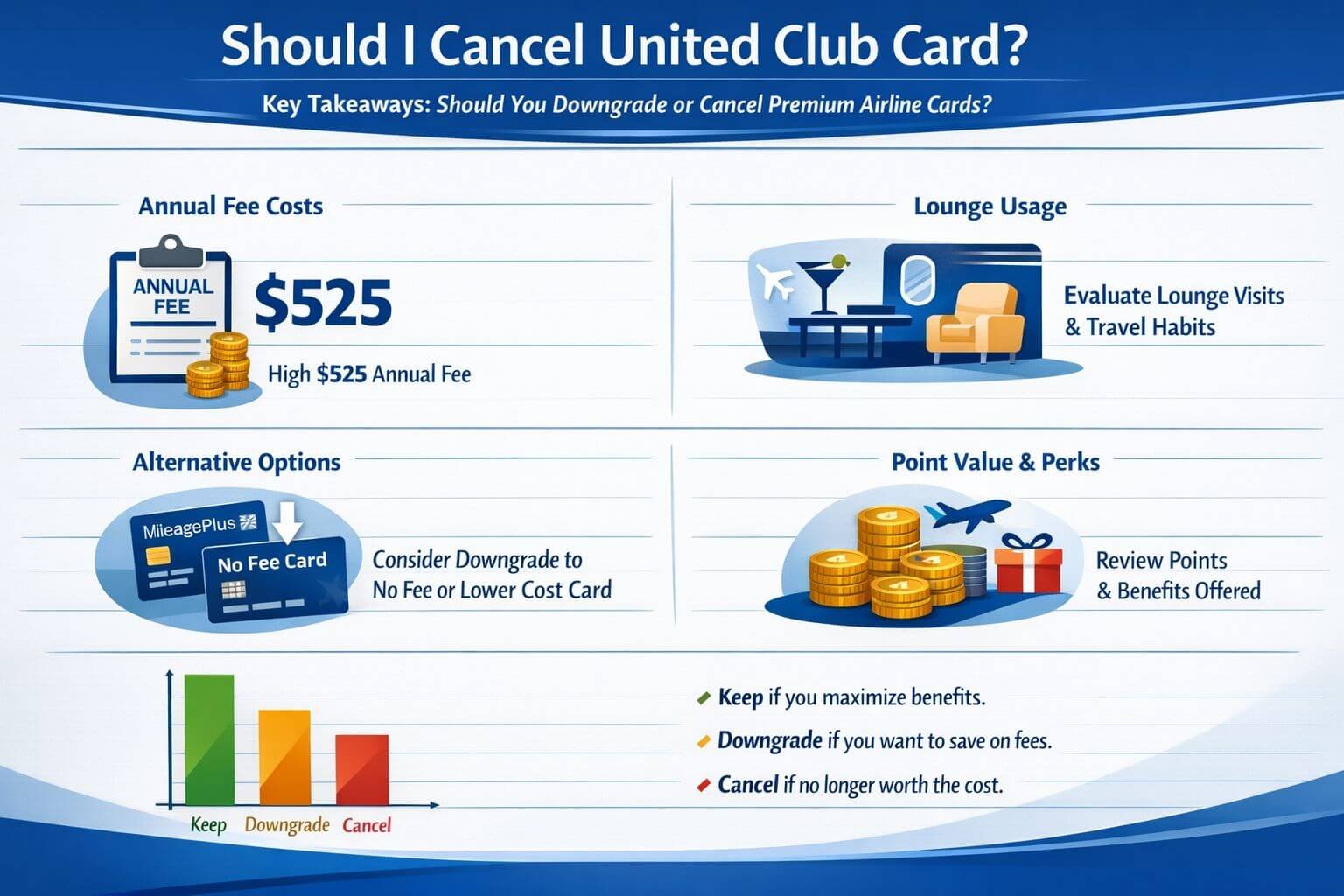
Yes, if lounge access is the only real benefit you use, canceling or replacing the card is often the right move. A $695 annual fee is difficult to defend when the cardholder is not also using bag savings, United travel frequency, or meaningful spend-based benefits.
Use this rough break-even framework:
| Profile | Likely best move | Why |
|---|---|---|
| Heavy United flyer | Keep or downgrade to Quest | Lounge use plus bag savings and United loyalty can justify cost |
| Occasional United flyer | Downgrade | Keeps some perks without paying for a premium setup |
| Lounge-only user | Cancel or replace | Paying mainly for one benefit is usually inefficient |
Sample profile 1: Heavy United flyer
Assumptions:
- 15 United round-trips a year
- 18 lounge visits
- 8 checked bags across trips
- Can use most credit cards
Likely outcome: Keep
Why:
- Lounge use is frequent enough to create real replacement cost.
- Checked bag savings stack quickly.
- United-specific perks are used often rather than occasionally.
- Changes to MileagePlus earning rates may improve the card’s overall return if spending is meaningful.
Sample profile 2: Occasional flyer
Assumptions:
- 4 United round-trips a year
- 5 lounge visits
- 2 to 4 checked bags annually
- Uses some, but not all, credits
Likely outcome: Downgrade
Why:
- The card still has some value, but not enough to support a $695 fee.
- A lower-fee United card may preserve access to preferred awards and useful trip-day benefits.
Sample profile 3: Lounge-only user
Assumptions:
- 2 United trips a year
- 6 lounge visits
- Rarely checks bags
- Does not use monthly credits consistently
Likely outcome: Cancel
Why:
- The card is acting as a costly substitute for a lounge membership.
- A general travel card or pay-as-you-go lounge strategy is often cheaper.
Should I cancel the United Club card or downgrade it instead?
For most cardholders, asking “Should I cancel the United Club card?” downgrading is the safer default before canceling. A downgrade can reduce the annual fee, preserve account age, and keep at least some United-specific benefits.
Frequent Miler-style logic, echoed across card strategy coverage, is straightforward: preserve the credit line if a lower-fee product still fits the travel pattern.
Common downgrade paths
- United Quest: Better for mid-frequency United flyers who still want meaningful airline value at a lower annual fee.
- United Explorer: Better for lighter United users who still want basic airline perks.
- United Gateway: Best if the goal is to preserve account history and a United relationship, with no annual fee.
The downgrade path matters because Chase and United cardholders may still care about:
- account age
- credit utilization
- maintaining access to a United-family product
- avoiding a full reset in card strategy
The practical how-to is simple:
- Wait for the annual fee to post.
- Review whether any retention or downgrade offers exist.
- Call the number on the back of the card and ask for available product changes within the United family.
- Confirm whether any annual fee refund is available if the change happens shortly after the fee posts. FlyerTalk discussions and card strategy coverage suggest this can matter, especially in the first 30 days, but outcomes can vary.
For a deeper framework, read ATH’s Credit Card Downgrade Versus Cancel Decision Guide and the best downgrade options guide.
When is canceling the right move?
Canceling is the right move when the United Club card no longer fits the travel pattern and no downgrade option resolves the issue. That is most common for people who now prefer transferable points over airline-specific perks or who no longer fly United enough to justify a premium airline fee.
Cancel if most of these are true:
- United is no longer the main airline.
- Lounge visits dropped sharply.
- Checked bag savings are minimal.
- Monthly or use-it-or-lose-it credits go unused.
- A flexible points card would better support bookings across alliance partners, hotels, and partner airlines.
- The cardholder values optionality because of dynamic pricing and devaluation risk in airline programs.
A practical example: a traveler once took 12 United trips a year for work, then changed jobs and now flies only 3 times a year. The emotional instinct is often to keep the card “just in case.” The math usually says otherwise.
Edge case: watch status-related timing
If bonus PQPs or status strategy matters, check the timing before downgrading or closing. Chase terms note that United may cancel bonus PQPs if the account is downgraded or closed during the qualification year.
How should you do the keep, downgrade, or cancel math?
The best math is simple: count only the benefits you will actually use in the next 12 months. If the total is comfortably above the annual fee, keep it. If not, downgrade or cancel.
Use this checklist:
- Annual fee: Start with $695 if that is your renewal rate.
- Lounge use: How many real visits will happen this year?
- Checked bag savings: Count expected trips and travelers.
- Credits: Discount for breakage. If usage is uncertain, do not value at 100%.
- Earning rate: Estimate only if spending genuinely goes on the card.
- United-specific perks: Include only if they change booking behavior or cost.
Decision framework
- Keep it if the expected value exceeds the fee by a clear margin.
- Downgrade if the value is positive, but not premium-fee positive.
- Cancel if the card needs optimistic assumptions to break even.
ATH readers who want a more systematic review can use this alongside the credit card annual fee ROI approach and compare it with general travel-card alternatives in Unlock Flexibility & Transfer Power: Top 5 Travel Credit Cards for 2025.
What are the best alternatives if you walk away?
If you cancel the United Club card, the best alternative depends on whether the goal is lounge access, airline perks, or flexible rewards. Most ex-cardholders should replace the old value with a card that addresses their actual needs, not just another premium fee.
Best for lounge replacement
Choose a general premium travel card if:
- lounge variety matters more than United-only access
- trips involve multiple airlines
- you want broader travel credits
Best for United loyalty on a budget
Choose a lower-fee United card if:
- free checked bags still matter
- you want to keep some United-specific benefits
- United remains the main carrier, but lounge visits are infrequent
Best for flexibility
Choose a flexible ecosystem if:
- you collect Chase points, Amex points, Capital One miles, Citi points, or Bilt points
- you want access to multiple points transfer partners
- you book across airlines and hotel programs based on award availability, not one brand
That flexibility matters more in 2026 because premium cabin awards, Business Class deals, and hotel redemptions often require moving fast when transfer bonuses or sweet spots appear. A rigid airline card can be less useful than a card earning transferable points.
Helpful next reads:
- premium United card benefits after the refresh
- best lounge-access cards in 2026-style travel setups
- United MileagePlus transfer partners guide
What mistakes should cardholders avoid before canceling?
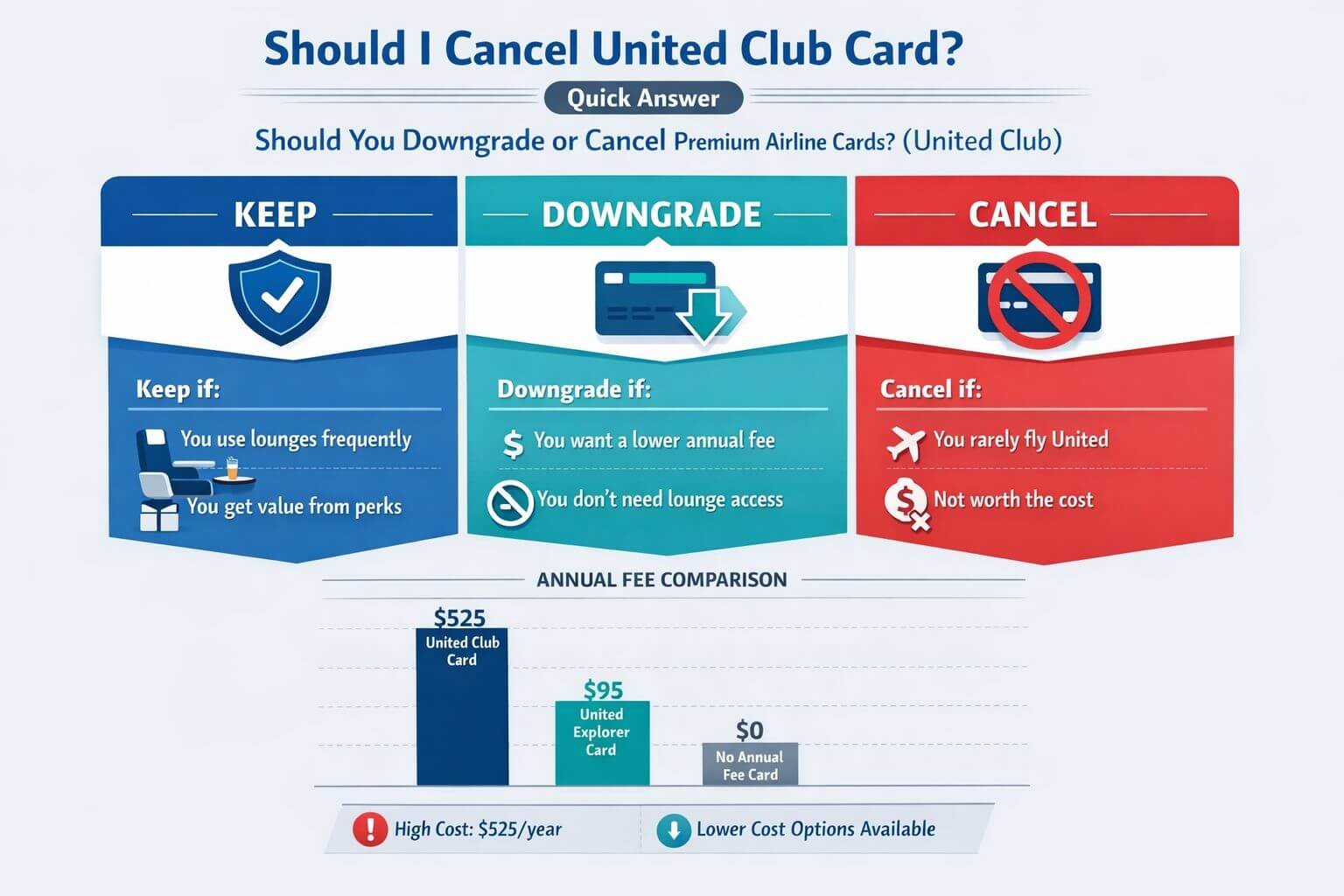
The biggest mistake is canceling too quickly without checking downgrade paths, timing, and replacement strategy. The second biggest mistake is keeping a premium card out of habit.
Avoid these common pitfalls:
- Canceling before the annual fee posts, then missing a downgrade or review window.
- Ignoring account-history impact, when a downgrade could preserve the credit line.
- Overvaluing credits that go unused.
- Missing status consequences, including possible bonus PQP issues.
- Replacing one overpriced card with another without running the same math.
- Forgetting booking flexibility, especially if transferable points would fit better than airline-specific miles.
If your travel has shifted away from one airline, ATH’s broader points strategy content on Secrets to Booking Award Flights with Flexible Points can help compare options.
FAQ
Should I cancel the United Club card after the annual fee posts?
Usually, yes, that is the best time to review options. Many cardholders wait for the fee to post, then ask Chase about downgrade choices or possible refund treatment if they act quickly.
Is downgrading better than canceling a United Club card?
For many people, yes. Downgrading often preserves account age and credit line while reducing the annual fee burden.
Can the United Club card still be worth it in 2026?
Yes, but mainly for frequent United flyers who use lounge access often and get consistent value from airline perks and credits.
Should I cancel my United Club card if I fly United only a few times a year?
Usually, yes, or at least downgrade. A few trips per year rarely justify a $695 annual fee unless the cardholder heavily uses multiple benefits.
Does United’s 2026 mileage update make the card worth keeping?
Sometimes. Higher mileage earning can help heavy spenders and loyal United flyers, but it does not fix weak lounge usage or low travel frequency.
Will canceling hurt my credit score?
It can affect utilization or average age of accounts over time, which is why downgrading is often considered first.
What is the best downgrade from the United Club card?
That depends on the travel pattern. Quest often fits mid-frequency United flyers, Explorer fits lighter users, and Gateway fits those who want no annual fee.
Should a points-and-miles traveler keep airline cards at all?
Yes, sometimes. Airline cards work best when they solve a specific problem, such as checked bags or elite-style trip benefits, while flexible points handle the rest of the booking strategy.
Conclusion
If the question is “should I cancel my United Club card?”, the most practical answer is not emotional. It is mathematical.
Keep the card if United Club access, checked bag savings, and real card use clearly outweigh the fee.
Downgrade if United still matters, but premium pricing no longer does.
Cancel if the card has become an expensive habit or a weak lounge substitute.
The next step is simple: review the last 12 months of actual United trips, honestly estimate the next 12 months, and make the decision based on used value, not advertised value. If flexibility matters more than one airline now, compare replacement cards that earn transferable points and open up more partner airlines, award charts, and booking paths.
Related reading
- Credit Card Downgrade Versus Cancel Decision Guide
- Best travel card annual fee review for 2026
- Maximize the new benefits of Chase United’s travel cards
- Best lounge-access travel cards
- United MileagePlus Transfer Partners Guide (2026)


Content on Award Travel Hub is independently created by Award Travel Hub Editorial Desk and, where noted, reviewed by Award Travel Hub Review Desk. Some pages may contain affiliate links, but compensation does not determine our coverage, opinions, or methodology.