

Last updated: April 11, 2026
Key Takeaways
- The Chase Sapphire Preferred’s current welcome bonus (75,000 points after $5,000 spend in 3 months) is enough to cover a round-trip economy flight to Europe for one person—and potentially two, depending on the partner and route.
- The Chase Travel portal gives you a guaranteed 1.25 cents per point (cpp) on any flight, but transferring to airline partners like Air France–KLM Flying Blue or Air Canada Aeroplan can push your value to 1.6–2.0+ cpp on the same routes.
- Flying Blue and Aeroplan are the two strongest Chase transfer partners for US–Europe economy and business class awards in 2026. Virgin Atlantic Flying Club is excellent for transatlantic business class.
- British Airways Avios, while a Chase partner, often carries fuel surcharges of £100–250 per award, significantly reducing its effective value.
- United MileagePlus uses dynamic pricing for its own flights, making costs unpredictable; it’s better used for Turkish Airlines partner bookings (45,000 miles for business class to Europe).
- Transfers from Chase to airline partners are instant for most programs and irreversible—only transfer once you have confirmed award space.
- 60,000–75,000 Chase points can realistically cover a round-trip economy ticket to Europe from the East Coast; West Coast travelers typically need 70,000–85,000 points for the same value.
- Set up award search alerts before transferring points—availability is the biggest variable in this strategy.
Quick Answer
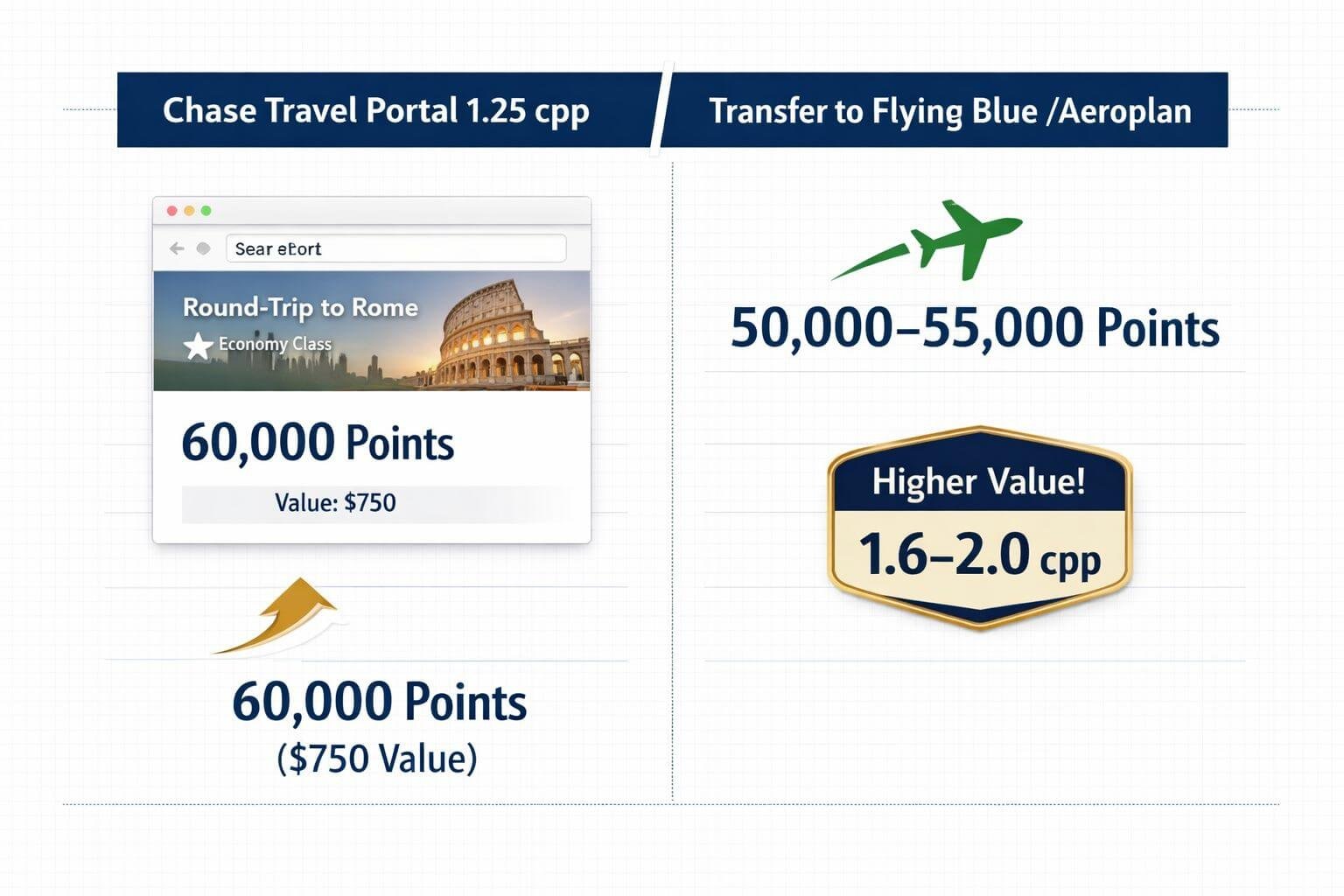
A Chase Sapphire Preferred Europe trip is achievable with 60,000–75,000 Ultimate Rewards points, either through the Chase Travel portal at 1.25 cpp or via transfer partners like Flying Blue or Aeroplan at 1.6–2.0+ cpp. For most beginners, the portal is the safest starting point; transfer partners offer better value but require more planning. The welcome bonus alone can cover a round-trip economy flight for one person.
How Many Chase Points Do You Really Need for a Europe Trip?
For a round-trip economy flight from the US to Europe, plan to need 50,000–80,000 Chase Ultimate Rewards points, depending on your departure city, travel dates, and booking method.
Here’s a realistic breakdown using 2026 shoulder-season and late-summer fares:
| Route | Cash Fare (Est.) | Portal Points (1.25 cpp) | Transfer Partner Points | CPP via Partner |
|---|---|---|---|---|
| New York (JFK) → Rome (FCO) | ~$850 RT | ~68,000 pts | ~55,000 (Flying Blue) | ~1.55 cpp |
| Los Angeles (LAX) → Paris (CDG) | ~$1,050 RT | ~84,000 pts | ~65,000 (Aeroplan) | ~1.62 cpp |
| Boston (BOS) → Amsterdam (AMS) | ~$780 RT | ~62,400 pts | ~50,000 (Flying Blue) | ~1.56 cpp |
| Chicago (ORD) → London (LHR) | ~$900 RT | ~72,000 pts | ~60,000 (Aeroplan) | ~1.50 cpp |
Assumptions: Shoulder season (May or September 2026), economy class, one traveler, taxes and fees paid separately in cash (typically $50–$150 per ticket via partner programs).
Key rule of thumb: If you’re booking through the Chase Travel portal, divide the cash fare by $0.0125 to determine the number of points required. If you’re targeting a transfer partner, check award availability first—then calculate your cpp using ATH’s 2026 Guide to Cents-Per-Point.
East Coast vs. West Coast difference: East Coast travelers have a meaningful advantage. Shorter transatlantic routes from JFK, BOS, or EWR mean lower cash fares and lower award costs. West Coast travelers flying from LAX or SFO typically need 15,000–20,000 more points for comparable value.
When to Use Chase Travel vs. Transfer to Airline Partners
Use the Chase Travel portal when you want simplicity and guaranteed availability. Transfer to an airline partner when the cash fare is high enough that 1.6–2.0 cpp meaningfully outperforms 1.25 cpp.
You may be interested



Here’s a simple decision framework:
Choose the Chase Travel portal if:
- You’re booking within 2–4 weeks of departure and need confirmed space immediately
- The cash fare is under $700 round-trip (the math rarely favors transfers at low fare levels)
- You prefer earning airline miles on the booking (portal bookings code as revenue tickets)
- You’re not comfortable with the transfer-and-search process yet
Choose a transfer partner if:
- The cash fare is $850+ round-trip, and you’ve confirmed that award space exists before transferring
- You’re flexible on dates and can search 4–11 months in advance
- You want to stretch 60,000–75,000 points further than the portal allows
- You’re targeting business class, where the cpp gap between portal and partners widens significantly
Common mistake: Transferring points to an airline before confirming award availability. Transfers are irreversible. Always search for and hold (or screenshot) the award space first, then transfer. See ATH’s guide on how to find partner award space fast before initiating any transfer.
For a deeper look at how Chase compares to Amex, Capital One, and Citi on transfer partner quality, see ATH’s Comparing Transfer Partners 2026 guide.
Example 2026 Europe Trips You Can Book With Chase Points
Three realistic redemption paths for a Chase Sapphire Preferred Europe trip in 2026, each with concrete point costs and tradeoffs.
Path 1: Chase Travel Portal — New York to Rome, September 2026
- Cash fare: ~$850 round-trip on Alitalia/ITA Airways or Lufthansa
- Points required: 68,000 UR at 1.25 cpp
- Taxes/fees: Included in the points price
- Value: 1.25 cpp — reliable, but leaves points on the table
- Best for: First-time award bookers who want a no-stress booking experience
The portal works like Expedia or Google Flights, except you’re paying with points. You’ll see real-time availability, can filter by airline, and the booking is confirmed instantly. The tradeoff is that 68,000 points for this route is roughly 13,000 more than you’d spend via Flying Blue.
Path 2: Flying Blue (Air France–KLM) — Boston to Amsterdam, May 2026
- Cash fare: ~$780 round-trip
- Points required: ~50,000 Flying Blue miles (transferred 1:1 from Chase UR)
- Taxes/fees: ~$75–$120 paid separately in cash
- Value: ~1.56 cpp (based on $780 fare minus $100 in fees)
- Best for: Travelers with flexible dates who can monitor Flying Blue’s monthly promo awards
Flying Blue runs promotional award discounts multiple times per year—typically 20–25% off select routes. During a promo, that 50,000-mile economy award to Amsterdam could drop to 40,000 miles, pushing your cpp above 1.9. Check the Flying Blue transfer partners guide for current promo windows and how to stack them with Chase transfers.
Practical note: Flying Blue uses a zone-based award chart for economy, which makes pricing predictable. North America to Europe economy is consistently in the 25,000–30,000 miles one-way range outside of promos.
Path 3: Aeroplan (Air Canada) — Chicago to London, Late Summer 2026
- Cash fare: ~$900 round-trip on United or Lufthansa (Star Alliance partners)
- Points required: ~60,000 Aeroplan points (transferred 1:1 from Chase UR)
- Taxes/fees: ~$80–$130 paid separately
- Value: ~1.50 cpp
- Best for: Travelers who want Star Alliance access without United’s dynamic pricing unpredictability
Aeroplan’s distance-based award chart is one of the most transparent in the industry. Chicago to London on a Star Alliance carrier runs approximately 30,000 Aeroplan points each way in economy, or 55,000–60,000 points round-trip with a stopover option. For a full breakdown of Aeroplan’s sweet spots, see ATH’s guide on maximizing Aeroplan awards with Chase transfer bonuses.
What about British Airways Avios? Avios can work for short-haul intra-Europe flights (e.g., London to Dublin at 13,000 Avios), but fuel surcharges of £100–250 per transatlantic award make it a poor choice for the US–Europe long-haul leg. Factor those fees into your cpp calculation before transferring.
Step-by-Step: Transferring and Booking Your First Award
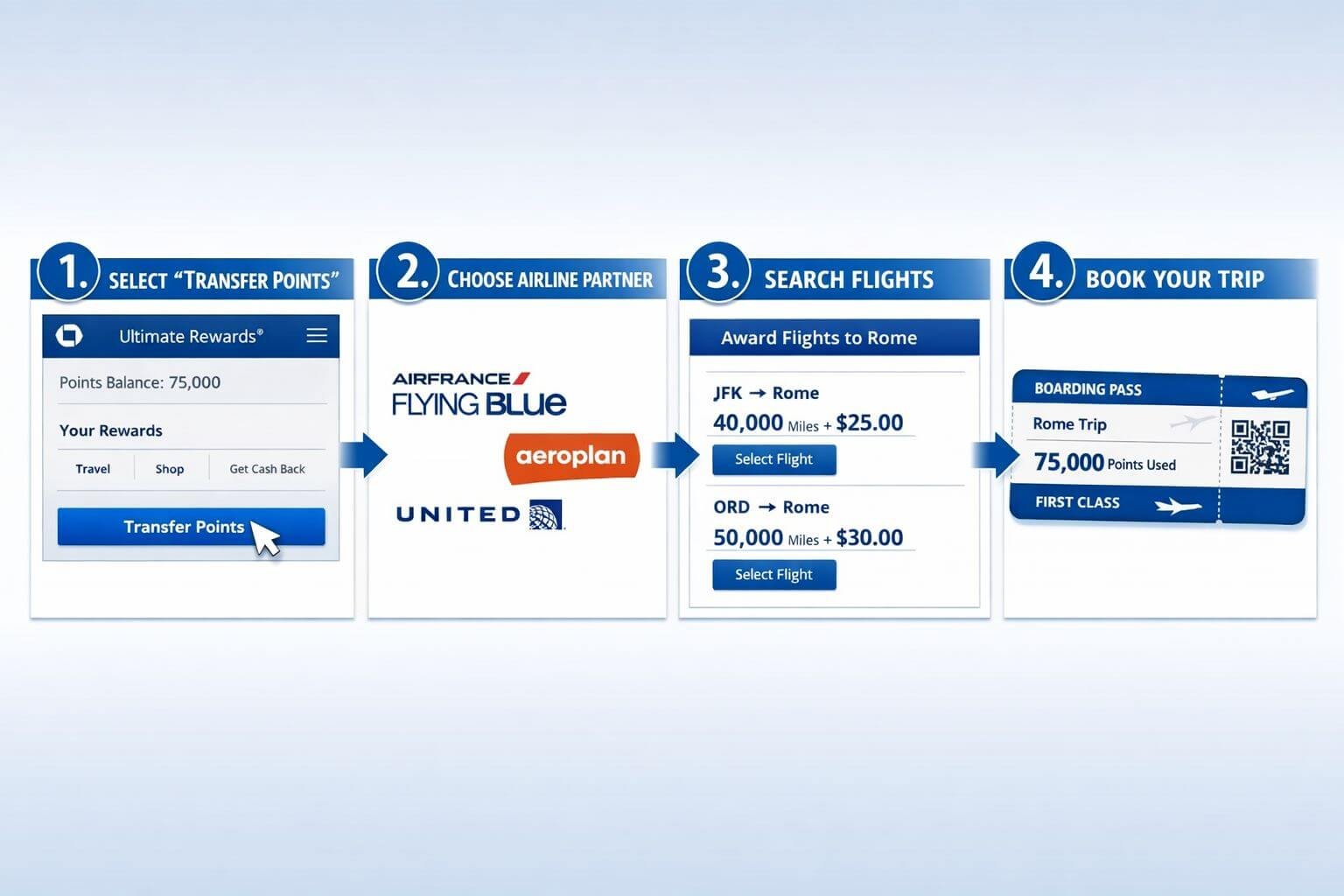
This is the full process for a Chase Sapphire Preferred Europe trip booking via a transfer partner. Follow these steps in order.
Step 1: Search for award availability (before touching your points)
- For Flying Blue: Go to airfranceklm.com and search as a Flying Blue member, or use ExpertFlyer (paid) for availability alerts.
- For Aeroplan: Search directly at aeroplan.com—it clearly shows partner availability.
- For United: Use united.com to search, then book via Aeroplan if the routing works (avoids United’s dynamic pricing on its own metal).
Write down the flight numbers, dates, and cabin class. Screenshot the availability.
Step 2: Create a frequent flyer account with the partner program
- Flying Blue, Aeroplan, and United MileagePlus accounts are free to open.
- You’ll need the account number before initiating the Chase transfer.
Step 3: Transfer points from Chase Ultimate Rewards
- Log into your Chase account → Ultimate Rewards → “Transfer Points”
- Select your airline partner (Flying Blue, Aeroplan, etc.)
- Enter your frequent flyer account number
- Confirm the transfer amount
Most transfers post within minutes. Some (like Aeroplan) are instant. Do not transfer more points than you need for this specific booking.
Step 4: Book the award
- Return to the airline’s website and book the award using your newly transferred miles.
- Pay the taxes and fees with your Chase Sapphire Preferred (which offers trip cancellation/interruption insurance on award tickets paid with the card).
Step 5: Confirm and document
- Save your booking confirmation and note the fare basis code.
- If you’re using Chase’s travel protections, keep records of the taxes/fees charged on your card.
For a broader walkthrough of the award booking process, ATH’s complete Chase Transfer Partners Guide covers every partner with current transfer ratios.
Simple Card Strategy to Grow Enough Points for Your Chase Sapphire Preferred Europe Trip
The fastest path to 60,000–75,000 Chase points is the welcome bonus, supplemented by category spending. Most readers can reach this threshold within 3–6 months.
Welcome Bonus Math (2026)
The Chase Sapphire Preferred is currently offering 75,000 bonus points after $5,000 spend in the first 3 months (as of early 2026). That’s enough for a round-trip economy flight to Europe via the portal, or a high-value transfer partner redemption with points to spare.
Note: This is down from the 100,000-point offer available in late 2025. If you’re deciding between the Preferred and Reserve, see ATH’s Chase Sapphire Preferred vs. Reserve 2026 breakdown for the full annual fee math.
Earning Beyond the Bonus
| Spending Category | CSP Earn Rate | Example Annual Spend | Points Earned |
|---|---|---|---|
| Travel (booked via Chase) | 5x | $2,000 | 10,000 |
| Dining | 3x | $4,000 | 12,000 |
| Streaming services | 3x | $600 | 1,800 |
| All other purchases | 1x | $10,000 | 10,000 |
A typical cardholder earning on dining and travel can add 20,000–30,000 points annually on top of the welcome bonus—enough to cover a second traveler or upgrade to premium economy.
Pairing with Other Chase Cards
If you also hold a Chase Freedom Flex or Freedom Unlimited, you can combine points into your Sapphire Preferred account and transfer them to airline partners. The Freedom Flex earns 5x on rotating quarterly categories; the Freedom Unlimited earns 1.5x on everything. This “Chase trifecta” approach is one of the most efficient ways to accumulate transferable points without paying multiple premium annual fees.
Important: Chase’s 5/24 rule applies—you generally won’t be approved for new Chase cards if you’ve opened 5+ credit cards (any issuer) in the past 24 months. Check ATH’s Chase 5/24 rule guide before applying for additional cards.
Best for: Beginners who want a single-card strategy with a clear path to a trip to Europe within 6–12 months.
Not for: Travelers who need business class on a tight timeline—60,000–75,000 points won’t cover a round-trip business class award to Europe on most programs (you’d typically need 100,000–130,000 points).
Common Mistakes to Avoid
- Transferring points speculatively. Never transfer to a partner “just in case.” Confirm the award space first.
- Ignoring taxes and fees. Partner award bookings still charge taxes. Budget $75–$150 per ticket in cash, especially for transatlantic routes.
- Redeeming for cash back or gift cards. Chase points redeemed for cash back are worth 1.0 cpp—significantly less than even the portal’s 1.25 cpp. This is the most common way beginners undervalue their points.
- Booking through the portal for business class. The portal charges the full cash fare in points. A $3,000 business class ticket costs 240,000 points at 1.25 cpp. Transfer partners can cover the same seat for 60,000–80,000 points.
- Waiting too long to search. The best award space for summer 2026 has already been released. For 2027 travel, start searching in fall 2026. See ATH’s guide on award travel predictions and timing for 2026.
FAQ
How many Chase points do I need for a round-trip economy flight to Europe? Plan on 50,000–80,000 points depending on your departure city and booking method. East Coast travelers can often book via Flying Blue for 50,000–55,000 points; West Coast travelers typically need 65,000–80,000 points for comparable value.
Can I use Chase Sapphire Preferred points directly on airline websites? No. You first transfer points from Chase Ultimate Rewards to a partner airline’s frequent flyer program (1:1 ratio), then book the award on the airline’s website using those miles.
Is the Chase Travel portal worth using for Europe flights? Yes, for simplicity and guaranteed availability at 1.25 cpp. It’s the right choice when cash fares are under $700 or when you need to book quickly. For higher-fare routes, transfer partners typically offer better value.
Which Chase transfer partner is best for Europe in 2026? Flying Blue (Air France–KLM) and Aeroplan (Air Canada) are the top two for economy and premium economy. Virgin Atlantic Flying Club is excellent for transatlantic business class (50,000–60,000 points one-way). British Airways Avios works for short-haul intra-Europe segments but carries high fuel surcharges on long-haul awards.
Are Chase point transfers reversible? No. Once transferred to an airline partner, points cannot be returned to Chase Ultimate Rewards. Always confirm award availability before transferring.
Does the Chase Sapphire Preferred have foreign transaction fees? No. The Chase Sapphire Preferred has no foreign transaction fees, making it a solid card to use for purchases while traveling in Europe.
Can I combine points from multiple Chase cards? Yes. Points from Chase Freedom Flex, Freedom Unlimited, and Ink Business cards can all be transferred into your Sapphire Preferred account and then sent to airline partners.
What’s the best time to book an award for Europe for summer 2026? If you’re targeting summer 2026 travel, availability is already thinning. Book as soon as you find space. For summer 2027, start searching in September–October 2026 when airlines release award inventory.
Is 75,000 Chase points enough for two people to fly to Europe? For two people in economy via the portal, you’d need roughly 120,000–160,000 points, depending on the route—more than the welcome bonus alone. Two people can fly on 75,000 points only if you find a deeply discounted Flying Blue promo award (around 35,000–40,000 miles round-trip per person during promotions).
Should I get the Sapphire Preferred or Reserve for a Europe trip? For most beginners, the Preferred is the right starting point. The Reserve’s 1.5 cpp portal rate is more valuable if you book frequently through the portal, but its $795 annual fee requires significant spending to justify. See the full Preferred vs. Reserve 2026 comparison for the break-even math.
Conclusion
A 2026 Europe trip with a Chase Sapphire Preferred card is one of the most achievable goals in travel rewards—especially for beginners. The welcome bonus alone covers a round-trip economy flight for one person, and a basic understanding of two or three transfer partners can meaningfully increase that value.
Your next steps:
- If you don’t have the card yet: Review the complete Chase Sapphire Preferred 2026 guide and confirm the current welcome offer before applying.
- If you have the card and points: Open a Flying Blue and Aeroplan account today (free, takes 5 minutes each). Start searching for award availability for your target dates before transferring a single point.
- If you’re ready to book: Follow the step-by-step transfer process above, confirm availability first, then transfer only what you need.
- If you want to earn more points faster, look at adding a no-annual-fee Chase Freedom card to your wallet to capture 5x categories and pool points with your Sapphire Preferred.
The gap between “I have points” and “I booked flights” is almost always a search problem, not a points problem. Start searching, and the booking will follow.
Related Reading:
- Chase Transfer Partners Guide 2026
- How to Book Business Class with Points: 2026 Guide
- Best Award Travel Tools and Alerts for 2026 Bookings
- 2026 Guide to Cents-Per-Point
- Maximizing Aeroplan Awards with Chase Transfer Bonuses


Content on Award Travel Hub is independently created by Award Travel Hub Editorial Desk and, where noted, reviewed by Award Travel Hub Review Desk. Some pages may contain affiliate links, but compensation does not determine our coverage, opinions, or methodology.