
Last updated: February 27, 2026
World of Hyatt is replacing its three-tier award pricing (off-peak, standard, peak) with a five-tier system — Lowest, Low, Moderate, Upper, and Top — effective May 2026. The result: Category 8 properties can now cost up to 75,000 points per night, a 67% increase over the current 45,000-point peak rate. This is the most significant Hyatt award chart change since peak/off-peak pricing launched in 2021, and it fundamentally alters the math on Chase-to-Hyatt transfers, aspirational bookings, and long-term points strategy.
Here’s what changed, what it costs, and what to do about it before May.
Key Takeaways
- Five tiers replace three: Lowest, Low, Moderate, Upper, and Top replace off-peak, standard, and peak across all eight categories.
- Category 8 Top tier hits 75,000 points — up 67% from the current 45,000-point peak.
- 40 distinct price points now exist for standard rooms alone (5 tiers × 8 categories), ranging from 3,000 to 75,000 points.
- The new “Moderate” tier averages ~25% higher than current peak pricing in most categories, meaning even “middle” pricing is a devaluation.
- Seven properties changed categories immediately on February 24, 2026 — including Grand Hyatt Grand Cayman, jumping from Cat 6 to Cat 8.
- Gradual rollout: Hyatt says the Upper and Top tiers will appear at a limited set of properties in 2026, with broader adoption in subsequent years.
- Booking before May locks in current pricing for existing reservations, though future modifications may reprice.
- Chase Ultimate Rewards, Bilt points, and other transferable points that transfer 1:1 to Hyatt are directly affected by this devaluation.
Quick Answer
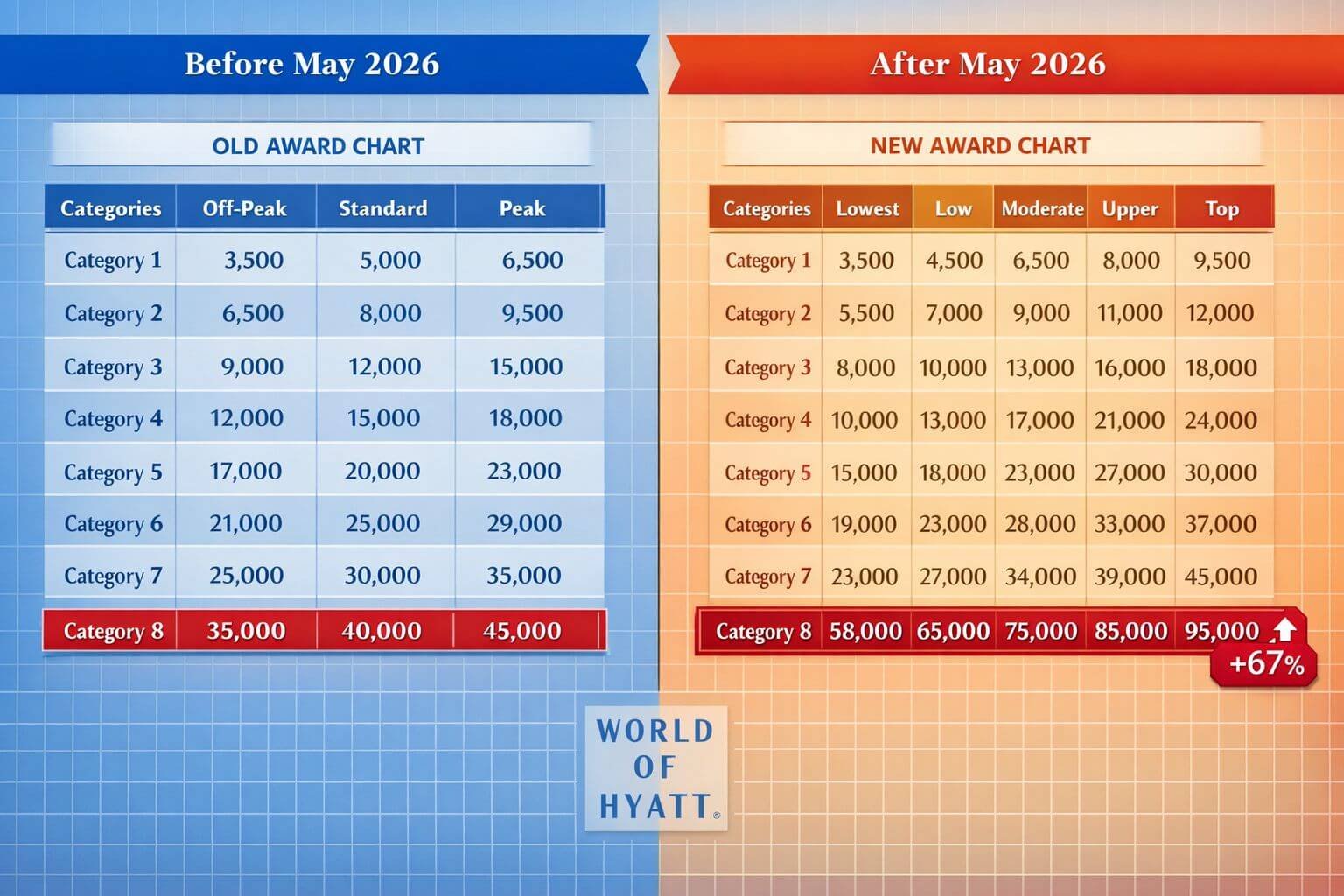
Hyatt’s May 2026 award chart changes expand pricing from 3 tiers to 5 tiers per category, with the new upper tiers pushing costs well beyond current peak rates. For aspirational properties in Categories 7–8, the worst-case scenario is paying 67% more points than today’s peak. Book high-value stays before May, and recalculate whether Chase-to-Hyatt transfers still deliver strong cents-per-point value at the new Upper and Top tiers.
What Is Hyatt’s New 5-Tier Award Chart?
The new system replaces off-peak, standard, and peak with five pricing bands: Lowest, Low, Moderate, Upper, and Top. Each of Hyatt’s eight hotel categories will have all five tiers, creating 40 possible price points for a standard room night.
Hyatt’s SVP of Global Marketing & Loyalty, Laurie Blair, framed the change as a way to keep a “published award chart with fixed point thresholds” while making the program “sustainable and rewarding for years to come”. In practice, this is a structured move toward semi-dynamic pricing — the chart exists, but the range within each category is now wide enough that Hyatt has significant flexibility to price properties higher without ever changing their category.
Here’s the full new chart:
| Category | Lowest | Low | Moderate | Upper | Top |
|---|---|---|---|---|---|
| 1 | 3,000 | 3,500 | 4,500 | 5,500 | 7,000 |
| 2 | 5,000 | 6,000 | 8,000 | 10,000 | 12,000 |
| 3 | 7,000 | 8,500 | 11,000 | 13,500 | 17,000 |
| 4 | 10,000 | 12,500 | 15,000 | 19,000 | 23,000 |
| 5 | 14,000 | 17,000 | 21,000 | 26,000 | 32,000 |
| 6 | 18,000 | 22,000 | 27,000 | 34,000 | 42,000 |
| 7 | 23,000 | 28,000 | 35,000 | 43,000 | 53,000 |
| 8 | 28,000 | 35,000 | 43,000 | 55,000 | 75,000 |
Key observation: The “Moderate” tier — the middle of five — is already more expensive than current peak pricing for most categories. Doctor of Credit calculates a 20%–37.5% increase at the standard (now roughly “Moderate”) level.
Old vs. New: How Much More Will You Pay?
The current three-tier system and the new five-tier system overlap at roughly the Low and Moderate levels, but the ceiling is dramatically higher.
| Category | Current Off-Peak | Current Standard | Current Peak | New Top | % Increase (Peak → Top) |
|---|---|---|---|---|---|
| 1 | 3,500 | 5,000 | 5,000 | 7,000 | +40% |
| 2 | 5,000 | 8,000 | 8,000 | 12,000 | +50% |
| 3 | 7,500 | 12,000 | 12,000 | 17,000 | +42% |
| 4 | 10,000 | 15,000 | 18,000 | 23,000 | +28% |
| 5 | 14,000 | 20,000 | 25,000 | 32,000 | +28% |
| 6 | 18,000 | 25,000 | 30,000 | 42,000 | +40% |
| 7 | 23,000 | 30,000 | 35,000 | 53,000 | +51% |
| 8 | 28,000 | 35,000 | 45,000 | 75,000 | +67% |
You may be interested



Note: Some categories currently lack a distinct peak rate (Categories 1–3 have standard = peak). Percentage increases are calculated against the highest current published rate.
The damage concentrates at the top. Categories 7 and 8 — where Park Hyatt, Alila, and premium Andaz properties live — see the steepest increases. A Park Hyatt Maldives night, currently costing 45,000 points at peak, could reach 75,000 points at the Top tier.
For a deeper look at how these category shifts interact with existing hidden deals, see the World of Hyatt award chart category analysis on ATH.
Which Properties Jump the Most — and Which Stay Reasonable?
Seven properties changed categories immediately on February 24, 2026, ahead of the standard April adjustment cycle:
Moving up:
- Grand Hyatt Grand Cayman Resort & Spa — Category 6 → Category 8 (two-category jump; opening 2026)
- Hyatt Centric Malta — Category 2 → Category 3
- Hyatt Regency Kotor Bay Resort — Category 4 → Category 5
- Andaz Pattaya Jomtien Beach — Up one category
- Grand Hyatt Incheon — Up one category
- Hyatt Place San Antonio-Northwest/Medical Center — Up one category
Moving down:
- The Barnett, JdV by Hyatt — Down one category
The Grand Cayman jump is particularly notable. A property that would have maxed at 30,000 points (Cat 6 peak) can now reach 75,000 points at Category 8 Top — a 150% increase in maximum cost before it even opens.
Common mistake: Assuming your favorite property stays at its current tier. Hyatt can assign any of the five tiers to any night without changing the hotel’s category. A property that’s been reliably “standard” priced could shift to “Upper” during high-demand periods with no advance notice.
CPP Analysis: When Hyatt Points Still Deliver Strong Value
The critical question isn’t just how many points a night costs — it’s whether the cents-per-point (CPP) value still justifies transferring Chase points, Bilt points, or other transferable points to Hyatt instead of using them elsewhere.
Using March 2026 cash rates for four popular aspirational properties, here’s how CPP shifts across the new tiers:
| Property (Category) | Cash Rate (Mar 2026) | Lowest Tier | CPP at Lowest | Top Tier | CPP at Top |
|---|---|---|---|---|---|
| Park Hyatt Maldives (8) | ~$1,800/night | 28,000 | 6.4¢ | 75,000 | 2.4¢ |
| Andaz Tokyo (6) | ~$450/night | 18,000 | 2.5¢ | 42,000 | 1.1¢ |
| Park Hyatt New York (7) | ~$900/night | 23,000 | 3.9¢ | 53,000 | 1.7¢ |
| Ventana Big Sur (8) | ~$2,200/night | 28,000 | 7.9¢ | 75,000 | 2.9¢ |
Assumptions: Cash rates are approximate averages for standard rooms in March 2026, sourced from Hyatt.com. CPP = cash rate ÷ points required.
The verdict: At Lowest and Low tiers, Hyatt points still deliver exceptional value — often 3–8 cents per point, well above the commonly cited 1.8¢ baseline. But at Top-tier pricing, even aspirational properties can dip below 2¢ per point, approaching the threshold where paying cash or using points through a portal might be competitive.
Use the ATH points valuation calculators to run your own numbers against specific properties and dates. For a broader framework on when points beat cash, the cents-per-point math guide breaks down the decision process.
Decision rule: If a Hyatt redemption delivers less than 1.5¢ per point at the assigned tier, consider paying cash or redirecting those transferable points to airline partners where premium cabin awards often yield 2–5¢+ per point.
Book Before May: Strategic Pre-Devaluation Moves
Current pricing remains in effect until May 2026 (exact date TBD, though industry sources predict May 1). That creates a window for action.
Step-by-step pre-devaluation checklist:
Identify your 2026 aspirational stays. Focus on Categories 6–8 properties where the spread between the current peak and the new Top tier is widest.
Book refundable award nights now. Hyatt’s cancellation policy on award stays is generous — lock in current rates and cancel if plans change. Review the award cancellation rules before booking.
Transfer points strategically. If you hold Chase Ultimate Rewards, Bilt points, or Capital One miles, transfer only what you need for confirmed bookings. Speculative transfers carry devaluation risk if you don’t use them. For guidance on timing, see the transfer bonus strategy guide.
Check for transfer bonuses. Periodic transfer bonuses from Chase, Amex, or Bilt to Hyatt can offset the devaluation. A 20–30% bonus effectively brings Top tier pricing closer to current peak rates.
Consider suite and club upgrades now. Suite pricing will also increase under the new tiers. If you’ve been debating a points upgrade, the math favors acting before May.
Who should rush to book: Anyone planning stays at Park Hyatt, Alila, or high-demand Andaz properties during summer 2026 or holiday periods when Top tier pricing is most likely.
Who can wait: Travelers targeting Category 1–3 properties, where the absolute point increases are smaller (a few thousand points per night), and the Lowest tier may actually be cheaper than current off-peak.
How Gradual Implementation Affects 2026 vs. 2027 Bookings
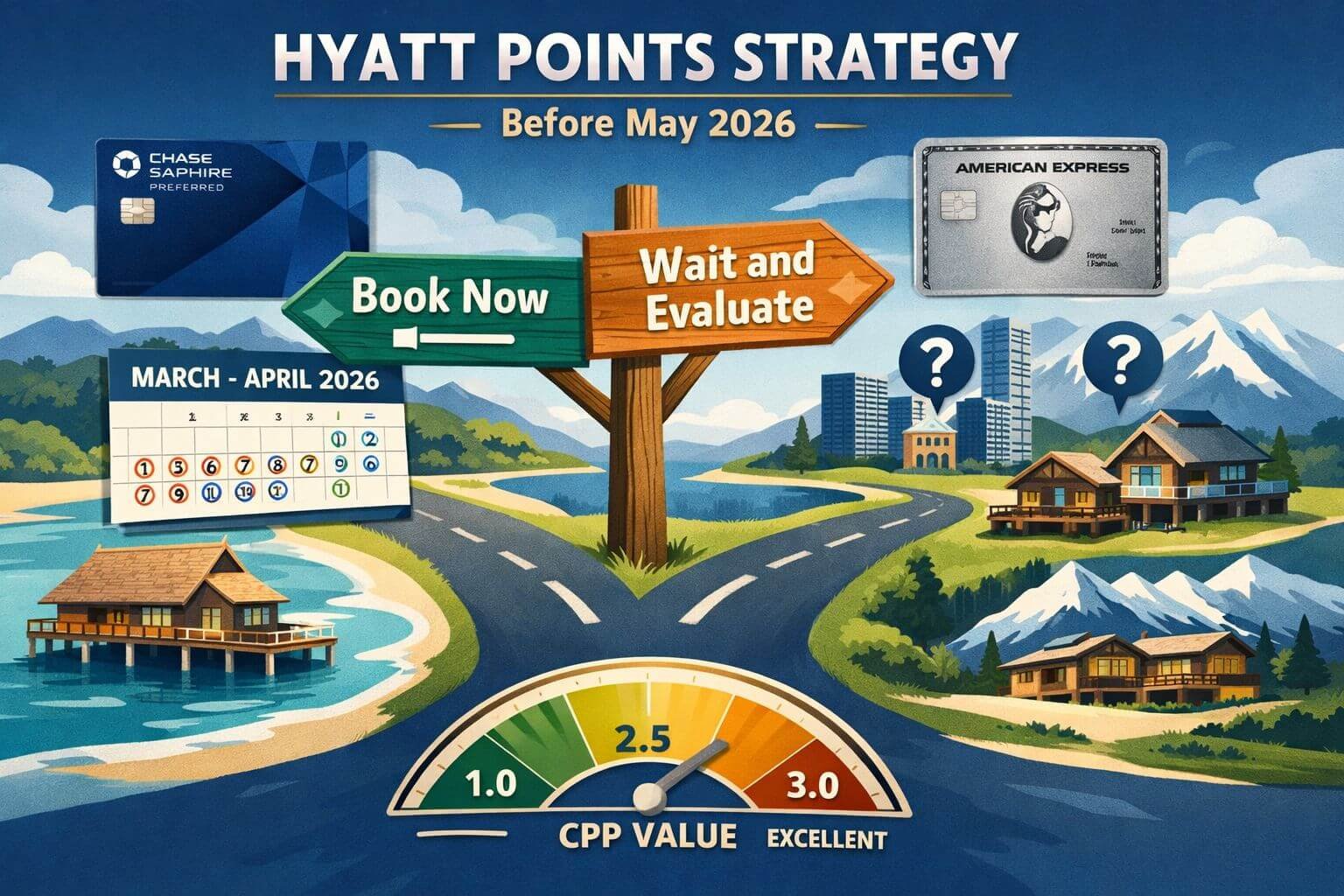
Hyatt has stated that Upper and Top tiers will appear at “limited” properties in 2026, with broader rollout in subsequent years. This matters for planning.
What “gradual” likely means in practice:
- In 2026, most nights at most properties will probably be priced at the Lowest through Moderate tiers
- Upper and Top tiers will initially appear at the most popular properties during peak demand periods (holidays, major events, high season)
- By 2027–2028, expect Upper and Top pricing to become common at aspirational properties
Head for Points notes that while the short-term impact may be manageable, “the trajectory is not good” — Hyatt has explicitly designed this chart to be “future-proof” for at least five years, meaning the Upper and Top tiers give them room to increase effective pricing without any further structural changes.
The risk: This is semi-dynamic pricing wearing an award chart’s clothing. Hyatt can gradually shift more nights into higher tiers without announcing anything, because the chart itself doesn’t change. Monitoring actual tier assignments at your target properties will be essential.
What This Means for Chase-to-Hyatt Transfers Going Forward
World of Hyatt has been the consensus best hotel transfer partner for Chase Ultimate Rewards holders. That calculus is shifting but not broken.
Still strong: At Lowest and Low tiers, the 1:1 Chase-to-Hyatt transfer remains one of the highest-value uses of transferable points in the hotel space. A Category 8 property at 28,000 points (Lowest) is the same as the current off-peak rate.
Getting weaker: At Upper and Top tiers, the value proposition erodes significantly. A 75,000-point night at a Category 8 property represents a massive commitment of Chase points that might deliver better value through airline transfers for premium cabin awards.
Comparison with Marriott: Marriott Bonvoy already uses full dynamic pricing, with award nights ranging from 5,000 to 100,000+ points. Hyatt’s new system is more predictable (with published tiers and fixed prices), but the gap between the two programs is narrowing. For context on Marriott’s approach, see the Marriott Bonvoy devaluation analysis.
Decision framework for transferable points holders:
- Chase points: Still transfer to Hyatt for Lowest–Moderate tier bookings. At Upper/Top, compare against airline sweet spots first. See the Chase vs. Amex vs. Citi vs. Capital One comparison for the full picture.
- Bilt points: Same 1:1 transfer ratio. Bilt’s value proposition for rent-paying Hyatt loyalists remains strong at lower tiers but faces the same ceiling problem.
- Capital One miles: Transfer at 1:1 to Hyatt. Evaluate against Capital One’s airline partners for premium cabin bookings when hotel pricing hits Upper/Top.
- Amex and Citi points: Neither transfers directly to Hyatt. If Hyatt is your primary hotel program, this reinforces the importance of Chase and Bilt as earning currencies.
For a broader context on how this fits into the 2026 points landscape, the award travel predictions for 2026 cover program-wide trends.
What About Globalist Status Value?
Globalist members receive suite upgrades, complimentary breakfast, and other benefits that add cash value on top of the points redemption. At higher tiers, these perks become even more important to the overall value equation.
Example: A Park Hyatt New York night at 53,000 points (Top tier) delivers roughly 1.7¢ per point on room rate alone. But add a confirmed suite upgrade (worth $200–$400 in cash rate differential) and breakfast for two ($80–$100 value), and the effective CPP rises to 2.5–3.0¢. Globalist benefits partially offset the devaluation at premium properties.
Without a Globalist status, the math at Upper and Top tiers becomes harder to justify for high-category properties. Consider whether strategies to maximize Hyatt points — including status-earning approaches — should be part of your 2026 plan.
Frequently Asked Questions
When exactly do the Hyatt award chart changes for 2026 take effect? Hyatt has confirmed May 2026 but hasn’t announced the exact date. Industry sources predict May 1, 2026. Book before then to lock in current pricing.
Is this dynamic pricing? Not technically. Hyatt maintains a published chart with fixed point values for each tier. But with five tiers per category and Hyatt controlling which tier applies to any given night, it functions similarly to semi-dynamic pricing.
Will my existing reservations be repriced? Existing award reservations made before the changeover should retain their current pricing. However, modifications after the new chart takes effect may trigger repricing at new tier rates. Confirm with Hyatt before making changes.
Which categories are hit hardest? Categories 7 and 8 see the largest absolute and percentage increases. Category 8 Top tier (75,000 points) is 67% higher than the current peak of 45,000.
Can I still get good value from Hyatt points after May 2026? Yes — at Lowest and Low tiers, value remains strong (often 2.5–6+ CPP at aspirational properties). The concern is that high-demand dates will increasingly be priced at Upper and Top tiers.
Should I stop transferring Chase points to Hyatt? No, but be more selective. Transfer for specific bookings at known tier pricing rather than speculatively stockpiling Hyatt points. The 1:1 transfer ratio still delivers excellent value at lower tiers.
How does this compare to Marriott Bonvoy’s pricing? Marriott uses full dynamic pricing with no published chart, meaning prices fluctuate freely. Hyatt’s approach is more transparent (40 fixed-price points), but the new ceiling of 75,000 points still falls within Marriott’s upper range for comparable properties.
Will Hyatt add more categories beyond 8? Hyatt hasn’t announced plans for a Category 9, but the five-tier structure gives them significant room to increase pricing within existing categories without adding new ones.
Do transfer bonuses help offset this devaluation? Significantly. A 30% Chase-to-Hyatt transfer bonus would make 75,000 points cost roughly 57,700 Chase points — closer to the current 45,000-point peak plus a reasonable premium. Watch for transfer bonus opportunities.
What about Points + Cash bookings? Hyatt hasn’t detailed how Points + Cash will interact with the new tiers. Expect an update closer to the May implementation date.
Conclusion
The Hyatt award chart changes for 2026 represent the most consequential hotel loyalty devaluation of the year. The shift from three tiers to five creates a wider pricing range, giving Hyatt the flexibility to charge significantly more points during high-demand periods — up to 75,000 points per night at Category 8 properties, a 67% increase over current peak rates.
But this isn’t a reason to abandon Hyatt. At Lowest and Low tiers, the program still delivers some of the best hotel redemption values available through transferable points. The key is adapting your strategy.
Your next steps:
- Book any planned 2026 aspirational Hyatt stays before May to lock in current pricing.
- Hold transferable points in flexible currencies (Chase, Bilt, Capital One) rather than speculatively transferring to Hyatt.
- Monitor tier assignments at your target properties after May to understand how aggressively Hyatt deploys Upper and Top pricing.
- Run CPP calculations on every booking using the ATH calculators — the days of assuming every Hyatt redemption is a good deal are over.
- Watch for transfer bonuses from Chase and Bilt that can meaningfully offset the higher-tier pricing.
The award chart still exists, and that’s worth something. But the range within it now demands the same careful analysis that airline award bookings have always required.


Content on Award Travel Hub is independently created by Award Travel Hub Editorial Desk and, where noted, reviewed by Award Travel Hub Review Desk. Some pages may contain affiliate links, but compensation does not determine our coverage, opinions, or methodology.