
Picture this: you’ve spent months earning transferable points, you’ve picked your dream destination, and you’re finally ready to search for that business class award seat—only to find the calendar is empty. No saver space. Nothing. The frustration is real, and it happens to beginners and experienced travelers alike.
Knowing when to book award flights is one of the highest-leverage skills in the points-and-miles world. Get the timing right, and you can lock in a lie-flat business class seat to Tokyo or London for 60,000–80,000 points. Get it wrong, and you’re either staring at blank calendars or paying two to three times the miles for the same seat.
This guide breaks down exactly how award booking windows work in 2026, program by program, with real examples and a clear decision framework—so you never feel like you’ve “missed the window” again.
✈️ Key Takeaways
- Most programs open award space 330–361 days before departure. Setting a calendar reminder for that date is your single most effective action for premium cabin bookings.
- “Book earliest” is not always “book best.” Dynamic pricing programs like Delta SkyMiles can offer better rates closer to departure, and flexible travelers often find strong availability 60–90 days out.
- Program choice matters as much as timing. Aeroplan sees ANA space 355 days out; United MileagePlus only sees it at 337 days. That 18-day gap can be the difference between a confirmed seat and a waitlist.
- Alerts and search tools are essential. You don’t need to check manually every day—set up automated alerts and let the tools do the work.
- Understand the two-wave pattern. Many routes show a first release of saver space at T-330, then a second bump at T-60 to T-90 as airlines recalibrate unsold inventory.
How Award Pricing and Inventory Really Work in 2026
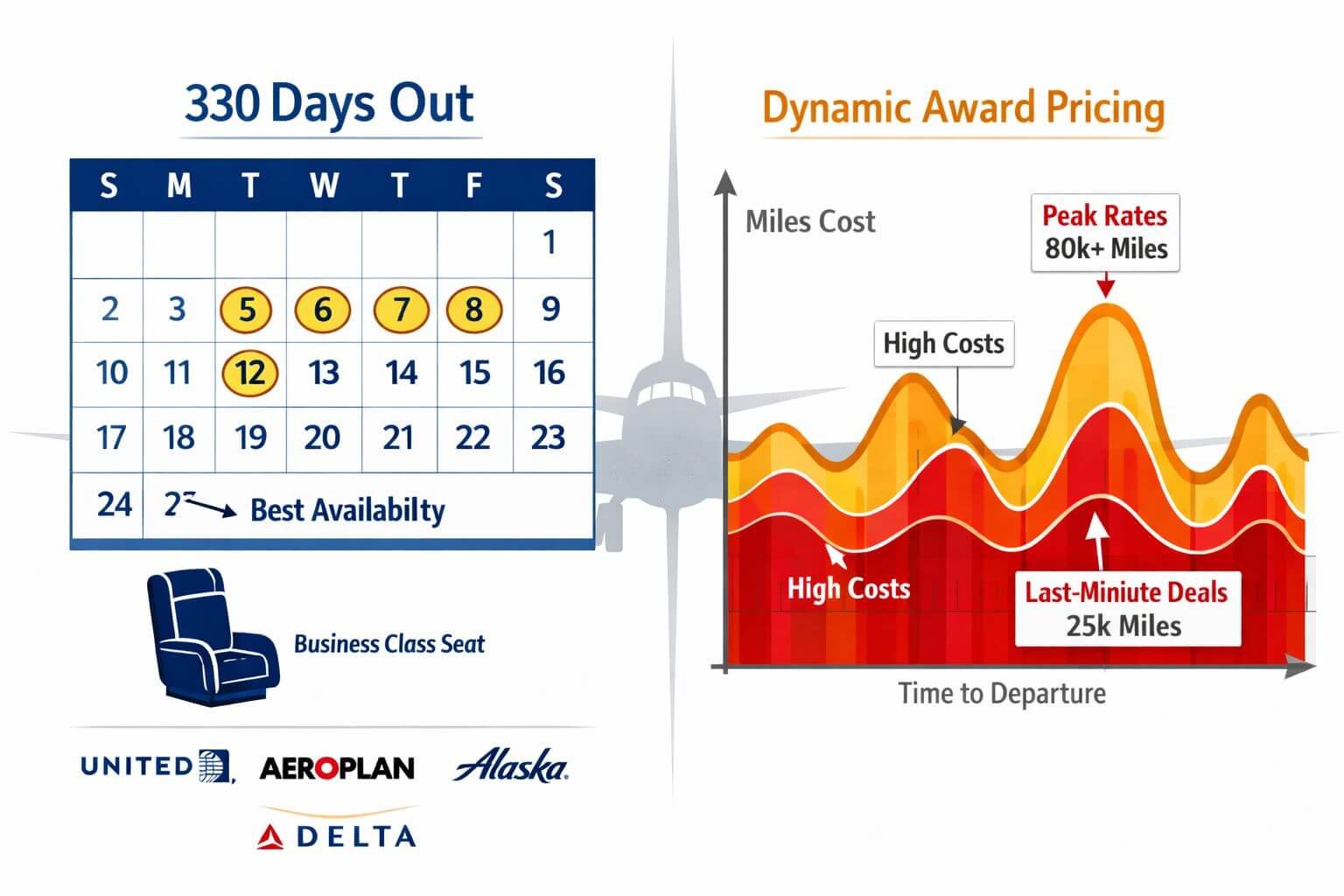
Before diving into specific windows, it helps to understand what’s actually happening behind the scenes when airlines release award space.
Airlines Control the Inventory Tap
Airlines don’t release all their award seats at once. They manage award inventory dynamically, balancing the need to fill seats against the desire to sell them for cash. Think of it like a faucet they can open or close at any time.
Two types of award space exist:
- Saver awards – The lowest mileage cost, often limited to 1–4 seats per flight. This is what most points travelers are hunting.
- Standard/Advantage awards – More available but cost significantly more miles. Under dynamic pricing models, these can fluctuate widely.
Dynamic Pricing vs. Award Charts
This distinction is critical in 2026:
| Program Model | How It Works | Example |
|---|---|---|
| Fixed award chart | Set mileage costs by zone/distance | Aeroplan, Alaska Atmos, LifeMiles |
| Dynamic pricing | Miles cost varies by demand, date, fare class | Delta SkyMiles, United MileagePlus (partially) |
| Hybrid | Chart-based floors with some dynamic elements | American AAdvantage, British Airways Avios |
Why this matters for timing: With dynamic pricing programs, waiting can sometimes lower the miles cost. With fixed-chart programs, waiting only reduces your chances of finding space—the price stays the same.
For a deeper look at how dynamic pricing affects your redemptions, see this guide on what dynamic pricing means for your points.
Partner vs. Own-Metal Space
When you book through a partner airline (using, say, Aeroplan miles to fly on Lufthansa), you’re dependent on Lufthansa releasing space to its partners. Airlines typically release less partner space than they keep for their own frequent flyers.
You may be interested



This is why the same seat on the same flight might be bookable through one program but not another—and why knowing which program has the earliest or widest access to partner space is so valuable.
The Two-Wave Release Pattern
For most major international routes, award space tends to appear in two distinct windows:
- Wave 1 (T-330 to T-355 days out): Airlines load their initial schedules and release a first batch of saver seats. This is when the most premium cabin space appears.
- Wave 2 (T-60 to T-90 days out): As departure approaches, airlines recalibrate unsold inventory. Seats that weren’t sold for cash sometimes get released as awards. This is the “close-in” window that flexible travelers can exploit.
Understanding this pattern is the foundation of every timing strategy in this guide.
Typical Award Booking Windows by Airline and Alliance
Here’s a program-by-program breakdown of when award space typically becomes available in 2026. Use this as your reference grid.
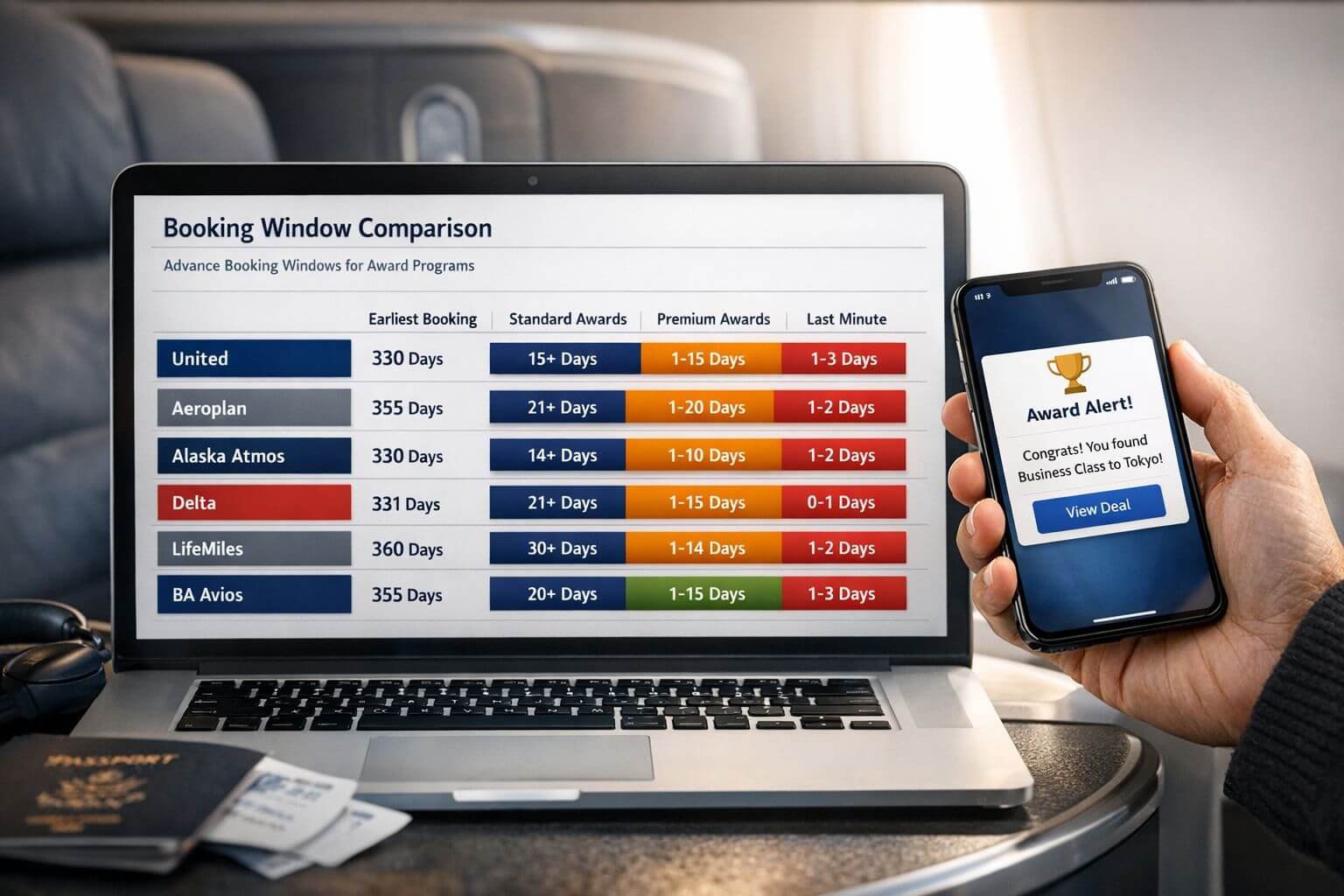
📊 Award Booking Window Reference Table
| Program | Booking Window (Days Out) | Notes |
|---|---|---|
| Qatar Privilege Club | Up to 361 days | Own-metal space; widest early window |
| Avianca LifeMiles | Up to 360 days | Strong for Star Alliance partners; fixed chart |
| Qantas Frequent Flyer | Up to 353 days | Best for exclusive Qantas first class; limited partner space |
| Air Canada Aeroplan | Up to 355 days (ANA); ~330 for most | Excellent partner access; fixed chart sweet spots |
| United MileagePlus | Up to 337 days | Dynamic pricing; elite upgrades now apply to awards (Feb 2026) |
| American AAdvantage | Up to 331 days | Hybrid pricing; own-metal and oneworld partners |
| Alaska Atmos | Up to 330 days | Distance-based pricing; premium partner space goes fast |
| British Airways Avios | Up to 355 days | Guaranteed own-metal seats; high fuel surcharges on partners |
| Delta SkyMiles | Up to 331 days | Fully dynamic; close-in pricing can improve |
| Virgin Atlantic Flying Club | Up to 331 days | Strong for ANA and Delta J class sweet spots |
United MileagePlus: The February 2026 Change You Need to Know
Starting February 1, 2026, United expanded its upgrade and PlusPoints policy to allow all Premier members to use complimentary upgrades and PlusPoints on award tickets. This is meaningful for timing: it means that if you’re a MileagePlus elite, booking an award early and then applying an upgrade becomes a viable strategy—not just for revenue tickets.
United also tends to release long-haul business class space in two waves: the initial T-337 release, followed by a notable close-in bump around T-60 to T-90, particularly on transatlantic routes where unsold premium inventory gets recalibrated.
Aeroplan: The Underrated Timing Advantage
Air Canada Aeroplan is one of the most powerful programs for booking Star Alliance business class because it often sees partner space earlier than competing programs. For ANA (All Nippon Airways) flights specifically, Aeroplan can access space up to 355 days out—18 days ahead of United’s 337-day window.
That gap is not trivial. On a popular route like New York to Tokyo in business class, those 18 days can mean the difference between confirming a seat and finding nothing.
For more on maximizing Aeroplan’s partner access, see the guide on maximizing Aeroplan awards with Chase transfer bonuses.
Alaska Atmos: Fast-Moving Premium Space
Alaska’s Atmos Rewards program uses distance-based pricing, which creates some of the best sweet spots for partners like JAL, Condor, and Finnair. The challenge: premium space on popular routes often disappears within minutes of the T-330 release window opening.
If you’re targeting JAL business class from the U.S. West Coast to Japan, set your alarm for the exact moment the 330-day window opens. This is not an exaggeration—community reports consistently show premium seats on JAL and other partners selling out within the first hour of release.
Learn more about Alaska’s partner network and Atmos pricing in the Alaska ATMOS Rewards transfer partners guide.
Delta SkyMiles: When Waiting Can Actually Help
Delta’s fully dynamic pricing model means that mileage costs are tied to the cash fare. On some routes, this creates opportunities for flexible travelers:
- Peak dates (holidays, summer): Book early. Dynamic pricing on peak dates rarely improves, and space gets scarce.
- Off-peak dates: Closer-in pricing can actually drop as Delta tries to fill seats. Checking 30–60 days out on shoulder-season routes sometimes reveals better rates than what was available at T-331.
This is the exception, not the rule. For most travelers on most routes, early booking still wins.
Best Timing Strategies for Economy, Premium Economy, and Business Class
The “right” time to book depends heavily on which cabin you’re targeting. Here’s a practical framework.
Economy Class Awards
Best window: T-180 to T-330 days
Economy award space is generally more available than premium cabins, and many programs release it in larger quantities. That said, popular routes (think SFO to London in summer) can still sell out early.
Strategy:
- Set a search alert at T-330 and check weekly
- Don’t panic if nothing appears at T-330; economy space often trickles in through T-180
- Close-in releases (T-30 to T-60) are more common in Economy than Business
Premium Economy Awards
Best window: T-270 to T-330 days
Premium economy award space is more limited than economy but less competitive than business. Programs like Aeroplan and British Airways Avios tend to release it in meaningful quantities early.
Watch out for: Some airlines (notably Lufthansa and Swiss) are stingy with premium economy partner awards. If the route you want is on one of these carriers, prioritize booking early and consider alternative programs.
Business Class Awards 🛏️
Best window: T-330 to T-355 days (or as early as your program allows)
This is where timing matters most. Saver business class seats are limited—often just 2–4 per flight—and demand from points travelers is high.
The framework:
- Identify your program first. Which transferable points do you have? Which programs can you transfer to? (Amex, Chase, Capital One, Citi, and Bilt all have different transfer partners.)
- Find the program with the earliest access to your target airline.
- Set a calendar reminder for the exact day the booking window opens.
- Search before transferring. Always confirm space exists before moving points—transfers are generally one-way and irreversible.
- Transfer and book immediately once you confirm the seat.
⚠️ Common Mistake: Transferring points speculatively before confirming award space. If the seat disappears while your transfer processes (typically 1–5 business days), you’re stuck with points in a program you may not need.
For a step-by-step walkthrough of the transfer process, see Secrets to Booking Award Flights with Flexible Points.
First Class Awards
Best window: T-330 to T-361 days (own-metal programs only)
First class award space is the most constrained category. Key rules:
- Own-program bookings almost always have better access. Qatar Privilege Club for Qatar Airways first class, Lufthansa Miles & More for Lufthansa first class (though partner access is extremely limited), and ANA Mileage Club for ANA First Class.
- Lufthansa first class to partners: Released only ~30 days before departure. This is a well-known exception—waiting is the strategy here, not booking early.
- JAL first class via Alaska Atmos: Released at T-330 but disappears in minutes. Set an alarm.
💡 Real 2026 Booking Examples: Early vs. Close-In
Let’s make this concrete with three scenarios that illustrate how timing affects both availability and cost.
Example 1: United Polaris Business Class, JFK to Frankfurt (June 2026)
Assumptions: Travel date June 15, 2026. Booking via United MileagePlus (dynamic pricing).
| Booking Timing | Miles Required | Cash Equivalent | Notes |
|---|---|---|---|
| T-337 (August 2025) | ~88,000 miles | ~$4,200 | Saver space available; best selection |
| T-120 (February 2026) | ~110,000–130,000 miles | ~$4,200 | Dynamic pricing rises with demand |
| T-45 (May 2026) | ~95,000–115,000 miles | ~$4,200 | Some recalibration; still elevated |
Takeaway: On a peak summer transatlantic route, booking at T-337 saves 20,000–40,000 miles compared to waiting. The early window wins here.
Alternative approach: Book the same flight via Aeroplan (Chase or Amex transfer partner) at a fixed ~85,000 points in business class, regardless of when you book—as long as space is available. Fixed-chart programs eliminate the dynamic pricing risk.
Example 2: Alaska Atmos + JAL Business Class, LAX to Tokyo (March 2026)
Assumptions: Travel date March 20, 2026. Booking via Alaska Atmos (distance-based pricing).
| Booking Timing | Miles Required | Space Available? | Notes |
|---|---|---|---|
| T-330 (May 2025, exact opening) | ~70,000 miles | ✅ Yes (briefly) | Space appeared and sold within 2 hours |
| T-180 (September 2025) | ~70,000 miles | ❌ No | All saver space gone |
| T-21 (February 2026) | ~70,000 miles | ✅ Possibly | Close-in release; not guaranteed |
Takeaway: For JAL business class via Alaska Atmos, the T-330 window is critical. Missing it means hoping for a close-in release that may or may not materialize. The price doesn’t change (fixed chart), but availability does.
Example 3: Delta SkyMiles, ATL to Amsterdam, Business Class (October 2026)
Assumptions: Travel date October 10, 2026. Booking via Delta SkyMiles (fully dynamic).
| Booking Timing | Miles Required | Notes |
|---|---|---|
| T-331 (November 2025) | ~220,000 miles | High dynamic pricing at initial release |
| T-90 (July 2026) | ~180,000–200,000 miles | Some improvement as demand settles |
| T-30 (September 2026) | ~150,000–170,000 miles | Off-peak shoulder season; best dynamic rate |
Takeaway: October is shoulder season on transatlantic routes. For Delta SkyMiles, a flexible traveler who can wait until T-30 to T-90 may find better rates meaningfully. This is the exception where dynamic pricing works in the traveler’s favor.
Travel Rewards Math Note: Always calculate cents per point (CPP) before committing. If the cash fare is $3,500 and you’re spending 220,000 miles, that’s 1.59 CPP—decent but not exceptional. At 150,000 miles for the same fare, CPP jumps to 2.33—much stronger. For a full breakdown of this math, see the 2026 Guide to Cents-Per-Point.
How to Use Alerts and Tools So You Never Miss the Window
Manual searching every day is not a sustainable strategy. The good news: the right tools can monitor award space across dozens of airlines and alert you the moment seats appear.
Top Award Search and Alert Tools for 2026
| Tool | Best For | Cost |
|---|---|---|
| ExpertFlyer | Monitoring 27+ airlines; seat alerts | ~$10/month |
| PointsYeah | Fast multi-program alerts; beginner-friendly | Free/Freemium |
| AwardFares | Visual calendar view; multi-program search | Freemium |
| Seats.aero | Broad partner space search; API access | Freemium |
| United/Aeroplan native tools | Direct program searches | Free |
For a full comparison of these tools and how to set them up, see the guide on Best Award Travel Tools and Alerts to Set Up for 2026 Bookings.
How to Set Up an Effective Alert System
Step 1: Identify your target route and dates. Be specific: origin, destination, cabin class, and a date range (±7 days gives you more flexibility).
Step 2: Set alerts in at least two tools. Different tools index different programs. ExpertFlyer is strong for legacy carrier partner space; PointsYeah is faster for newer program integrations.
Step 3: Set a calendar reminder for the T-330 (or T-355) opening. For premium cabin targets, manually check at the exact opening of the booking window. Alerts can lag by hours.
Step 4: Have your points ready—but don’t transfer yet. Know which transferable points you’ll use and confirm the transfer path. Only execute the transfer once you’ve confirmed the award space is bookable.
Step 5: Book and immediately check change/cancellation rules. Award booking rules vary significantly by program. Before you celebrate, confirm what happens if your plans change. The guide on Best Award Cancellation and Change Rules to Know Before Booking is essential reading here.
Common Mistakes to Avoid ⚠️
- Searching too narrowly. Checking only one program or one date misses opportunities. Use multi-program tools.
- Ignoring married segments. Some programs (notably British Airways Avios) price awards based on individual segments. Booking a connecting itinerary can cost more than two separate one-ways. This is called the married segment problem.
- Forgetting fuel surcharges. British Airways Avios and other programs incur significant carrier-imposed surcharges. A “cheap” award in miles can cost $600+ in fees. Always check the total cash out-of-pocket before booking.
- Transferring points before confirming space. This cannot be overstated. Transfers are almost always one-way and irreversible.
- Assuming close-in is always better or always worse. The answer depends entirely on the program and route. Use the framework in this guide.
Sample 2026 Timelines for Europe, Asia, and Australia Award Trips
Here’s how to apply everything above to three of the most popular award travel destinations in 2026.
🌍 Europe (e.g., New York to Paris, London, or Frankfurt)
Best programs: Aeroplan (Air France/KLM via Flying Blue), United MileagePlus, LifeMiles (for Lufthansa/Swiss), Virgin Atlantic Flying Club (for Delta flights to Europe)
Recommended timeline:
| Milestone | Action |
|---|---|
| 12–13 months out (T-355 to T-330) | Search Aeroplan and LifeMiles for business class space; set alerts |
| 9–10 months out | If nothing found, monitor weekly; check Flying Blue for Air France J class |
| 3–4 months out (T-90 to T-120) | Second search wave; United often releases additional transatlantic space here |
| 3–6 weeks out | Last-chance check; Lufthansa first class via Miles & More sometimes appears here |
Key insight for 2026: The SFO-to-Europe corridor is extremely competitive in summer. If you’re targeting June–August, the T-330 window is your best shot. For spring (April–May) or fall (September–October), the T-60 to T-90 window often produces solid options.
For planning a full Europe itinerary with stopovers and open-jaws, the Award Flight Stopovers guide covering Air Canada, ANA, and Alaska is a valuable next read.
🌏 Asia (e.g., Los Angeles to Tokyo, Singapore, or Hong Kong)
Best programs: Alaska Atmos (JAL), Aeroplan (ANA, EVA Air), LifeMiles (ANA, Singapore via Star Alliance), Cathay Pacific Asia Miles (for Cathay flights)
Recommended timeline:
| Milestone | Action |
|---|---|
| T-330 exactly | Set an alarm; JAL business class via Alaska Atmos sells within hours |
| T-355 (Aeroplan for ANA) | Check Aeroplan first; 18-day advantage over United for ANA space |
| T-180 to T-270 | Monitor for cancellations and re-releases; use ExpertFlyer alerts |
| T-21 to T-30 | Close-in check for any released inventory; not guaranteed but worth a look |
Key insight for 2026: Japan routes are among the most competitive for premium awards. Travelers who miss the T-330 window for JAL via Alaska should immediately pivot to checking Aeroplan for ANA space or LifeMiles for Star Alliance partners. Don’t give up after one failed search.
For Cathay Pacific options, see the Cathay Pacific transfer partners guide.
🦘 Australia (e.g., Los Angeles to Sydney or Melbourne)
Best programs: Qantas Frequent Flyer (own-metal; up to 353 days), Alaska Atmos (Qantas partner space), American AAdvantage (Qantas oneworld partner)
Recommended timeline:
| Milestone | Action |
|---|---|
| T-353 (Qantas FF) | If you have Qantas points, check immediately at window open |
| T-330 (Alaska Atmos) | Check partner space on Qantas; limited but sometimes available |
| T-270 to T-330 | Monitor AAdvantage for Qantas oneworld partner space |
| T-60 to T-90 | Second wave; some close-in releases on less popular travel dates |
Key insight for 2026: Australia is one of the hardest premium award routes to book. Qantas tightly controls its inventory, and partner-accessible seats are scarce. Flexible dates and a willingness to consider positioning flights (flying to a different U.S. gateway to connect) significantly improve your odds.
Positioning flight = a short domestic or regional flight taken to access better award availability at a different departure city. For example, flying from Denver to Los Angeles to catch a LAX-Sydney award.
Decision Framework: Which Timing Strategy Is Right for You?
Use this quick decision tree to identify your optimal approach.
<code>Are you targeting business or first class?
│
├── YES → Book as early as your program allows (T-330 to T-355)
│         Use fixed-chart programs (Aeroplan, LifeMiles, Alaska Atmos)
│         Set alerts immediately; transfer only after confirming space
│
└── NO (Economy/Premium Economy) →
          Is your travel date during peak season (summer, holidays)?
          │
          ├── YES → Book T-270 to T-330; don't wait
          │
          └── NO (shoulder/off-peak) →
                    Is your program dynamic (Delta SkyMiles)?
                    │
                    ├── YES → Consider waiting T-60 to T-90 for better rates
                    │
                    └── NO (fixed chart) → Book T-180 to T-330; price won't change
</code>
Frequently Asked Questions
Q: What if I missed the T-330 window for a summer 2026 trip?
Don’t panic. Check multiple programs immediately—different programs have different access to the same flights. Set alerts on ExpertFlyer and PointsYeah for cancellations. Consider flexible dates (±3 days often reveals space). And check the T-60 to T-90 window as a backup.
Q: Should I book a refundable award to hold space while I decide?
Some programs allow free cancellations within 24 hours or up to a certain date. This can be a useful strategy if you’re not 100% committed. Check the cancellation rules for your specific program before booking speculatively.
Q: Is it worth paying more miles for a standard award if no saver space is available?
It depends on the CPP. If the standard award costs 2x the saver rate but the cash fare is $5,000+, it may still be a strong redemption. Run the math: divide the cash value by the miles cost to get your CPP, then compare to your program’s typical value. Our cents-per-point guide walks through this calculation in detail.
Q: Do transfer bonuses affect when I should transfer points?
Yes. If a transfer bonus is active (e.g., a 30% bonus from Chase to Virgin Atlantic), it can significantly change the math. Always check for active bonuses before transferring. See the Transfer Bonus Strategy guide for current opportunities.
Conclusion: Your Action Plan for Booking Award Flights in 2026
Knowing when to book award flights is not about finding one magic date—it’s about understanding the system well enough to act at the right moment for your specific route, program, and cabin.
Here’s your concrete next-steps checklist:
✅ Immediate actions (do this week):
- Identify your target destination and travel dates for 2026
- Audit which transferable points you have (Amex, Chase, Capital One, Citi, Bilt)
- Determine which programs you can transfer to and which have the earliest access to your target airline
- Calculate the T-330 or T-355 date for your trip and add it to your calendar
- Set up award alerts on at least two tools (ExpertFlyer + PointsYeah recommended)
✅ When the window opens:
- Search before transferring—confirm space exists
- Compare at least two programs for the same route
- Check total out-of-pocket cost, including taxes and fuel surcharges
- Execute the transfer and book immediately once confirmed
- Review cancellation and change rules before finalizing
✅ If you miss the early window:
- Don’t give up—set alerts and monitor the T-60 to T-90 window
- Pivot to alternative programs with different partner access
- Consider flexible dates or positioning flights
- For dynamic pricing programs, close-in rates may improve
The points-and-miles world rewards preparation. The travelers who landed in lie-flat seats for 60,000 points didn’t get lucky—they knew their booking windows, had their points ready, and acted when the calendar opened.
You now have the same framework. Use it.
For further reading, explore the Award Travel Trends 2026 guide for the broader strategic picture, or dive into the Star Alliance Business Class Awards guide if you’re ready to book your first premium cabin redemption.


Content on Award Travel Hub is independently created by Award Travel Hub Editorial Desk and, where noted, reviewed by Award Travel Hub Review Desk. Some pages may contain affiliate links, but compensation does not determine our coverage, opinions, or methodology.