
Last updated: February 2026
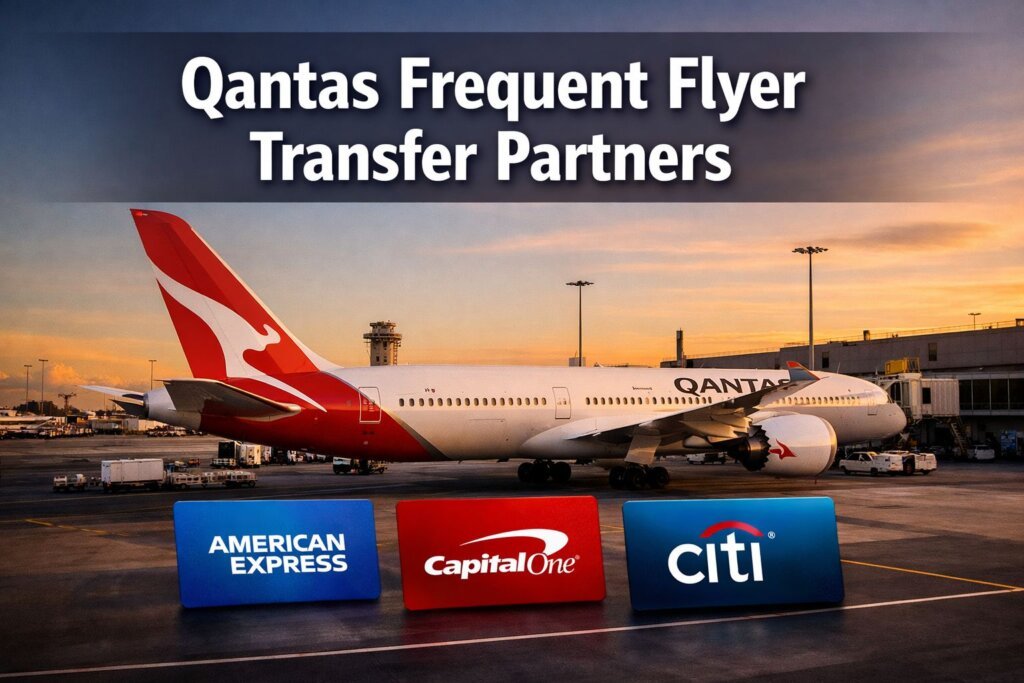
Three U.S. credit card programs transfer points directly to Qantas Frequent Flyer: Amex Membership Rewards (1:1, instant), Capital One Miles (1:1, 1–2 days), and Citi ThankYou Points (1:1, 1–2 days). Chase Ultimate Rewards, Bilt Rewards, Wells Fargo, and Rove do not offer direct transfers to Qantas.
That distinction matters. Qantas Frequent Flyer points can unlock excellent value on short-haul partner flights—particularly American Airlines domestic routes, but the program also carries real drawbacks, including high fuel surcharges on long-haul Qantas-operated flights and recent restrictions on premium Emirates redemptions. Knowing which transferable points programs connect to Qantas, how fast those transfers process, and when the transfer is actually worth making will save both points and frustration.
This guide covers every direct Qantas Frequent Flyer transfer partner available to U.S.-based points collectors, the exact ratios and timing, the best (and worst) uses of Qantas points, and the common pitfalls that catch even experienced award travelers.
Key Takeaways
- Three direct transfer partners: Amex Membership Rewards, Capital One Miles, and Citi ThankYou Points all transfer to Qantas at a 1:1 ratio.
- Amex is the fastest: Transfers from Amex are typically instant, while Capital One and Citi take 1–2 business days.
- Chase, Bilt, Wells Fargo, and Rove do not offer direct Qantas transfers (per the ATH transfer table).
- Best value: Short-haul American Airlines awards (as low as 8,000 Qantas points one-way for flights under 600 miles) and oneworld partner flights with low surcharges.
- Biggest risk: High fuel surcharges on Qantas-operated long-haul flights and recent restrictions on Emirates First Class redemptions can erode value quickly.
Which Credit Card Programs Transfer Directly to Qantas Frequent Flyer?
Only three major U.S. transferable points currencies offer a direct path into Qantas Frequent Flyer. Here’s the full breakdown:
| Credit Card Program | Transfers to Qantas? | Transfer Ratio | Typical Transfer Time | Minimum Transfer |
|---|---|---|---|---|
| Amex Membership Rewards | ✅ Yes | 1:1 | Instant (sometimes minutes) | 1,000 points |
| Capital One Miles | ✅ Yes | 1:1 | 1–2 business days | 1,000 miles |
| Citi ThankYou Points | ✅ Yes | 1:1 | 1–2 business days | 1,000 points |
| Chase Ultimate Rewards | ❌ No direct transfer | — | — | — |
| Bilt Rewards | ❌ No direct transfer | — | — | — |
| Wells Fargo Rewards | ❌ No direct transfer | — | — | — |
| Rove Miles | ❌ No direct transfer | — | — | — |
Why this matters: If you hold Chase or Bilt points and want Qantas Frequent Flyer miles, there is no legitimate direct path. You’d need to use those points with a different oneworld partner instead – British Airways Avios is a common alternative that accepts Chase and Amex transfers, for example.
Decision rule: If you’re choosing which points currency to earn specifically for Qantas redemptions, Amex Membership Rewards is the strongest option because of instant transfer speed and the same 1:1 ratio. Capital One and Citi are solid backups but add 1–2 days of transfer delay.
For a full view of which banks connect to which airlines and hotels, see the complete credit card transfer partners guide.
How Do Amex Membership Rewards Transfer to Qantas?
Amex Membership Rewards points transfer to Qantas Frequent Flyer at a 1:1 ratio with instant processing—the fastest and most flexible option among all Qantas transfer partners.
Key details:
- Ratio: 1 Amex point = 1 Qantas point
- Speed: Instant in most cases; occasionally takes up to a few minutes
- Minimum: 1,000 points
- Increments: 1,000-point increments
- Eligible cards: Amex cards enrolled in Membership Rewards (Gold, Platinum, Business Gold, Business Platinum, Green, EveryDay Preferred, etc.)
The instant transfer speed is a significant advantage. It means you can search for award availability on Qantas.com, confirm a seat exists, then transfer exactly the points needed and book immediately—all in one session. With Capital One or Citi, the 1–2-day delay creates a real risk that the award seat will be gone before your points arrive.
Common mistake: Transferring Amex points to Qantas speculatively, before confirming award availability. Even though the transfer is instant, it’s irreversible. Always search first, then transfer.
For a deeper look at all Amex Membership Rewards airline and hotel partners, see the Amex transfer partners guide.
How Do Capital One Miles Transfer to Qantas?
Capital One miles transfer to Qantas Frequent Flyer at a 1:1 ratio, but transfers typically take 1–2 business days to complete.
Key details:
- Ratio: 1 Capital One mile = 1 Qantas point
- Speed: 1–2 business days
- Minimum: 1,000 miles
- Increments: 1,000-mile increments
- Eligible cards: Capital One Venture X, Venture X Business, Venture, Spark Miles (cards that earn transferable Capital One miles)
The 1–2 day processing window is the main trade-off compared to Amex. For time-sensitive bookings—say, a single Business Class seat on a partner flight that could vanish overnight—this delay adds meaningful risk. But for planned redemptions where you’ve identified consistent availability over several days, Capital One works fine.
Edge case: Capital One occasionally runs transfer bonuses to select partners. These bonuses are uncommon for Qantas specifically, but worth watching. A 20–30% bonus would meaningfully change the math on longer-haul redemptions.
For the full list of Capital One airline and hotel partners, check the Capital One Miles transfer partners guide.
How Do Citi ThankYou Points Transfer to Qantas?
Citi ThankYou Points transfer to Qantas Frequent Flyer at a 1:1 ratio with 1–2 business day processing—identical terms to Capital One.
Key details:
- Ratio: 1 Citi ThankYou point = 1 Qantas point
- Speed: 1–2 business days
- Minimum: 1,000 points
- Increments: 1,000-point increments
- Eligible cards: Citi Premier, Citi Custom Cash (when linked to a Premier), Citi Double Cash (when linked to a Premier), Citi Strata Premier
Citi’s transfer to Qantas works well as a secondary option, especially if you already hold a Citi Premier for its other strong transfer partners. But because Citi ThankYou also transfers directly to American Airlines AAdvantage, you should compare whether booking through AA’s own program or through Qantas offers better pricing for the specific route.
When Citi-to-Qantas makes sense: Qantas’ award chart prices American Airlines domestic flights competitively, sometimes cheaper than booking through AAdvantage for short-haul routes. If you find a route where Qantas charges fewer points than AA’s dynamic pricing, transferring Citi points to Qantas can be the better play.
For all Citi ThankYou transfer options, see the Citi transfer partners guide.
What About Marriott Bonvoy Transfers to Qantas?
Marriott Bonvoy points can transfer to Qantas Frequent Flyer, but at a 3:1 ratio (3 Marriott points = 1 Qantas point). Marriott also offers a 5,000-point bonus for every 60,000 Marriott points transferred, which slightly improves the effective ratio.
Here’s the math:
- 60,000 Marriott points → 25,000 Qantas points (20,000 base + 5,000 bonus)
- Effective ratio: 2.4:1
This conversion rate is poor for most purposes. Marriott points are generally worth around 0.7–0.8 cents each, while Qantas points can be worth 1.3–1.5 cents on good redemptions. The conversion destroys value in most scenarios. Use Marriott-to-Qantas transfers only as a last resort—for example, to top off an account that’s a few thousand points short of a specific award.
What Programs Do NOT Transfer to Qantas Frequent Flyer?
Several popular U.S. transferable points programs have no direct transfer relationship with Qantas Frequent Flyer:
- Chase Ultimate Rewards — No direct transfer (per ATH table)
- Bilt Rewards — No direct transfer (per ATH table)
- Wells Fargo Rewards — No direct transfer (per ATH table)
- Rove Miles — No direct transfer (per ATH table)
If you primarily earn Chase or Bilt points and want to fly on Qantas metal or oneworld partners, consider transferring to a different oneworld program instead. British Airways Avios, Cathay Pacific Asia Miles, and Iberia Plus Avios all accept Chase transfers and can book many of the same oneworld partner flights.
For Bilt holders, the story is similar—Bilt transfers to several oneworld programs, but not directly to Qantas. See the Bilt transfer partners guide for the full list.
What Are the Best Uses of Qantas Frequent Flyer Points?
Qantas points deliver the strongest value on short-haul partner flights (especially American Airlines domestic routes) and oneworld Classic Reward seats with low surcharges. They perform poorly on long-haul Qantas-operated flights due to steep fuel surcharges.
Best value redemptions
1. American Airlines domestic flights (under 600 miles)
- Cost: 8,000 Qantas points one-way in economy
- Taxes/fees: Approximately $5.60
- Estimated value: 1.5–4+ cents per point (CPP), depending on the cash fare
This is the single best sweet spot for U.S.-based travelers using Qantas points. Routes like New York–Washington, Dallas–Houston, or Los Angeles–San Francisco often cost $150–$250+ in cash but cost just 8,000 Qantas points with minimal fees.
2. Oneworld partner flights with low surcharges. Airlines like Japan Airlines, Cathay Pacific, and Qatar Airways generally charge lower carrier surcharges than Qantas does. Booking these carriers through Qantas’ Classic Reward chart can offer solid value, particularly in business class.
3. Short-to-medium haul flights within Australia/New Zealand. If you’re traveling within the region, Qantas Classic Reward seats on domestic Australian or trans-Tasman routes can be a good use of points, though availability can be tight.
Redemptions to approach carefully
Long-haul Qantas-operated flights: A Sydney–Dallas business class award might cost 72,000 Qantas points one-way, but fuel surcharges and taxes can add $600–$1,200+ on top. That dramatically reduces the cents-per-point value.
Emirates First Class via Qantas: As of January 2026, Qantas tightened access to Emirates First Class awards with new elite-status requirements, age restrictions, and a roughly 20% price increase. This was previously one of the program’s marquee redemptions, but it’s now significantly harder and more expensive to book.
Calculator example: Is transferring to Qantas worth it?
Scenario: You want to fly American Airlines from Dallas (DFW) to Austin (AUS), a route under 600 miles.
| Factor | Value |
|---|---|
| Cash fare (economy) | $187 |
| Qantas points required | 8,000 |
| Taxes and fees | $5.60 |
| Net value covered by points | $187 − $5.60 = $181.40 |
| Cents per point (CPP) | $181.40 ÷ 8,000 = 2.27 CPP |
At 2.27 CPP, this is a strong redemption. The generally accepted baseline value for Qantas points is around 1.3 CPP, so anything above that is a good use.
Compare this to a poor redemption: DFW to Sydney (SYD) in economy costs 51,200 Qantas points + approximately $105 in fees. If the cash fare is $1,227, the CPP is ($1,227 − $105) ÷ 51,200 = 2.19 CPP. Looks decent on paper, but economy long-haul is rarely the best use of transferable points—you’d likely get more value from a different program with lower surcharges or by targeting a premium cabin.
What Fees and Surcharges Should You Watch For?
Qantas Frequent Flyer is known for passing through carrier-imposed surcharges on award tickets, particularly on Qantas-operated long-haul flights. This is one of the program’s biggest drawbacks for U.S.-based travelers.
Key fee considerations:
- Qantas-operated long-haul flights: Surcharges can range from $200 to $1,200+ per person, per direction, depending on the route and cabin class. Business and first class surcharges are the highest.
- Partner airline flights: Surcharges vary widely by carrier. American Airlines, Japan Airlines, and Cathay Pacific generally have low or no fuel surcharges. British Airways and Qantas itself charge the most.
- Booking fees: Qantas charges a modest booking fee for award tickets, though this is typically small compared to fuel surcharges.
Rule of thumb: Before transferring points to Qantas, always price out the full cost of the award ticket (points + cash fees) on Qantas.com. If the cash component exceeds 20–25% of what you’d pay for a revenue ticket, reconsider whether the redemption is worth it.
Common pitfall: Transferring a large balance to Qantas for a long-haul business class flight, only to discover $800+ in surcharges at checkout. Since transfers are irreversible, those points are now stuck in a program where you may not find a better use for them.
How to Transfer Points to Qantas Frequent Flyer: Step-by-Step
Follow these steps to transfer points from any of the three direct partners. The process is similar across all three programs.
Before you transfer
- Create a Qantas Frequent Flyer account at qantas.com if you don’t already have one. You’ll need your Qantas Frequent Flyer number.
- Search for award availability on qantas.com → “Use Points” → “Classic Reward” before transferring any points. Confirm the specific flight, date, and point cost.
- Verify your account details match. The name on your credit card loyalty account must match the name on your Qantas Frequent Flyer account. Mismatches can delay or block transfers.
Transfer steps (Amex example)
- Log in to your Amex account at americanexpress.com or the Amex app.
- Navigate to Membership Rewards → Transfer Points.
- Select Qantas Frequent Flyer from the airline partner list.
- Enter your Qantas Frequent Flyer number (if not already linked).
- Enter the number of points to transfer (minimum 1,000, in 1,000-point increments).
- Confirm the transfer.
- Points should appear in your Qantas account within minutes (instant for Amex).
Transfer steps (Capital One / Citi)
The process is nearly identical—log in, navigate to the miles/points transfer section, select Qantas, enter your FF number, and confirm. The key difference: expect 1–2 business days for points to post. Plan accordingly and don’t wait until the last minute.
After transferring
- Log in to qantas.com and confirm the points have posted.
- Book the award immediately—don’t wait, as Classic Reward availability can change.
- Save your booking confirmation and note the ticket number.
Setup block: To link your Qantas Frequent Flyer account to a transfer partner for the first time, you’ll need: (a) your Qantas FF number, (b) the name on your Qantas account (must match your credit card program name), and (c) your credit card program login credentials. First-time linking takes an extra 1–2 minutes but only needs to be done once per partner.
When Should You Transfer Points to Qantas vs. Another Program?
Qantas Frequent Flyer is the right choice in specific situations, but it’s not a default recommendation for most U.S.-based travelers. Here’s a decision framework:
Transfer to Qantas when:
- You’ve found a short-haul American Airlines award (under 600 miles) at 8,000 points—this is one of the best sweet spots in any loyalty program.
- You want to book an Oneworld partner flight with low surcharges (JAL, Cathay Pacific, Qatar Airways) and competitive Qantas award chart prices.
- You’re booking domestic Australian flights and have confirmed Classic Reward availability.
- Qantas is running a points-required discount on specific routes (they occasionally do this).
Consider a different program when:
- You want long-haul Qantas-operated flights—the surcharges often make these poor value. Look at ANA Mileage Club (for Star Alliance routes) or British Airways Avios (for short-haul oneworld) instead.
- You’re targeting Emirates First Class—the January 2026 restrictions make this much harder through Qantas. Consider Emirates Skywards directly.
- You hold Chase or Bilt points—these don’t transfer to Qantas, so look at British Airways, Cathay Pacific, or other oneworld partners that accept those currencies.
- You need premium cabin awards on non-Oneworld airlines—Qantas points are only useful within the Oneworld alliance and select partners.
Best for / Not for
| Best for | Not for |
|---|---|
| Short-haul AA domestic awards | Long-haul Qantas-operated flights with high surcharges |
| Oneworld partner flights with low fees | Emirates First Class (post-January 2026 restrictions) |
| Travelers with Amex, Capital One, or Citi points | Chase or Bilt point holders (no direct transfer) |
| Specific sweet spots on the Qantas award chart | Speculative transfers without confirmed availability |
Common Mistakes When Transferring to Qantas Frequent Flyer
Avoid these pitfalls—each one has cost real travelers real points:
Transferring before checking availability. All transfers to Qantas are one-way and irreversible. If you transfer 50,000 points and the award seat you wanted is gone, those points are stuck in Qantas indefinitely.
Ignoring surcharges. A “cheap” award in points can become expensive when $500–$1,200 in carrier surcharges are added. Always check the full cash cost at checkout before transferring.
Using Qantas for long-haul economy. The CPP math on long-haul economy redemptions is rarely compelling. Transferable points are almost always better spent on premium cabin awards or short-haul sweet spots.
Not comparing with other oneworld programs. British Airways Avios, Cathay Pacific Asia Miles, and Iberia Plus Avios can often book the same partner flights at different point costs and fee structures. Always compare before committing.
Assuming all credit card programs transfer to Qantas. Chase, Bilt, Wells Fargo, and Rove do not. Verify before building a points strategy around Qantas redemptions.
Forgetting about married segments. When searching award availability on qantas.com, the system sometimes shows availability only for specific itineraries (married segments) that aren’t available when booked as individual legs. If you see availability for a connecting itinerary but not for the individual flights, the seats may only be bookable as a package.
Transferring during a transfer bonus to the wrong partner. Transfer bonuses are exciting, but only valuable if you have a specific redemption in mind. A 20% bonus on a transfer to Qantas is worthless if you end up using the points for a 1.0 CPP redemption.
Qantas Frequent Flyer Transfer Partners FAQ
Q: Can I transfer Chase Ultimate Rewards points to Qantas? No. Chase Ultimate Rewards does not have a direct transfer partnership with Qantas Frequent Flyer. If you want to use Chase points for oneworld flights, consider transferring to British Airways, Iberia, or another oneworld partner that Chase supports. See the Chase transfer partners guide for options.
Q: Can I transfer Bilt points to Qantas? No. Bilt Rewards does not offer a direct transfer to Qantas Frequent Flyer. Bilt does transfer to several other oneworld programs, including British Airways and Cathay Pacific.
Q: What is the transfer ratio from Amex to Qantas? 1:1. One Amex Membership Rewards point converts to one Qantas Frequent Flyer point.
Q: How long does a transfer from Capital One to Qantas take? Typically 1–2 business days. Plan ahead and avoid same-day transfers for time-sensitive bookings.
Q: Are transfers to Qantas reversible? No. Once points are transferred from any credit card program to Qantas Frequent Flyer, they cannot be transferred back. This is standard across virtually all airline loyalty programs.
Q: What’s the minimum transfer amount? 1,000 points from all three direct partners (Amex, Capital One, Citi), in increments of 1,000.
Q: Do Qantas points expire? Qantas points expire after 18 months of account inactivity. Any earning or redemption activity resets the clock. If you transfer points in and don’t use them quickly, make sure to have some form of activity within 18 months.
Q: Does Qantas charge fuel surcharges on award tickets? Yes, on Qantas-operated flights, particularly long-haul routes. Surcharges can be substantial—ranging from $200 to $1,200+, depending on the route and cabin. Partner airlines vary; American Airlines and Japan Airlines generally have low or no surcharges.
Q: Can I book American Airlines flights with Qantas points? Yes. American Airlines is a oneworld partner, and Qantas’ award chart prices AA flights competitively, especially for short-haul domestic U.S. routes. This is one of the best uses of Qantas points for U.S.-based travelers.
Q: Are there ever transfer bonuses to Qantas? Transfer bonuses to Qantas from U.S. credit card programs are rare but not unheard of. Amex, Capital One, and Citi all run periodic transfer bonus promotions across their partner lists. There’s no predictable schedule—check current promotions before transferring.
Q: How do I search for Qantas award availability? Use the “Classic Reward” search on qantas.com. Log in to your Qantas Frequent Flyer account, select “Use Points,” and search for Classic Reward flights. You can also use third-party search tools to simultaneously scan availability across multiple programs.
Q: Is Qantas Frequent Flyer part of an airline alliance? Yes. Qantas is a founding member of the Oneworld alliance, which includes American Airlines, British Airways, Cathay Pacific, Japan Airlines, Qatar Airways, and others. For a full overview, see the Oneworld award booking guide.
Conclusion and Next Steps
Qantas Frequent Flyer has a narrow but valuable set of transfer partners for U.S.-based points collectors. The three direct options—Amex Membership Rewards, Capital One Miles, and Citi ThankYou Points—all transfer at a clean 1:1 ratio, with Amex offering the critical advantage of instant transfers.
The program shines brightest for short-haul American Airlines awards and select oneworld partner flights with low surcharges. It’s a poor fit for long-haul Qantas-operated flights (due to steep fuel surcharges) and has become less attractive for Emirates First Class following the January 2026 restrictions.
Your next steps:
- Check if you hold Amex, Capital One, or Citi points. If so, Qantas is available as a transfer option for you.
- Search for award availability first on qantas.com before transferring anything. Look specifically at short-haul AA routes for the best value.
- Compare Qantas pricing against other oneworld programs (British Airways, Cathay Pacific, Iberia) for the same flights—different programs charge different rates and fees.
- Only transfer the exact points needed for a confirmed booking. Never transfer speculatively.
- Bookmark the ATH transfer partners table to quickly check which banks connect to which airlines before planning any redemption.
For a broader strategy for using transferable points across all programs, explore the bank transfer partners overview or dive into specific airline guides, such as ANA Mileage Club and Avianca LifeMiles, which offer complementary sweet spots.


Content on Award Travel Hub is independently created by Award Travel Hub Editorial Desk and, where noted, reviewed by Award Travel Hub Review Desk. Some pages may contain affiliate links, but compensation does not determine our coverage, opinions, or methodology.