

The Capital One Venture X launched as one of the most straightforward premium travel cards on the market — and for a while, it was almost too good. A $395 annual fee largely offset by automatic credits, generous lounge access for the whole family, and free authorized users made the value math simple. But 2026 changed the equation. With new lounge guest fees, a $125 authorized user charge, and modified Priority Pass rules all taking effect on February 1, 2026, the full picture of Venture X benefits now requires a closer look — especially for travelers who don’t fly solo.
This guide breaks down every Venture X benefit that matters in 2026, runs the real math on whether the card still pays for itself, and provides a clear keep-or-cancel decision framework based on how you actually travel.
Key Takeaways
- The core value proposition still works for solo travelers. The $300 Capital One Travel credit plus 10,000 anniversary miles (year 2+) offset nearly the entire $395 annual fee before you swipe the card once.
- Lounge access got significantly more expensive for guests. As of February 1, 2026, adult guests cost $45 each at Capital One Lounges ($25 for ages 2–17), and Priority Pass guests cost $35 each.
- Authorized users now cost $125 per user per year. Previously free on the personal Venture X, this is a meaningful hit for couples and families.
- Big spenders get a carve-out. Hitting $75,000 in calendar-year spend unlocks complimentary guests (2 at Lounges, 1 at Landings) for that year and the following year.
- Capital One miles remain a strong transferable currency. With 16+ airline and hotel transfer partners, the earning and redemption side of the card is unchanged.
Venture X Benefits: The True Value Math for 2026
Before evaluating any individual perk, start with the bottom line: what does this card actually cost after built-in offsets?
Annual Fee Offset Breakdown
| Component | Value |
|---|---|
| Annual fee | −$395 |
| $300 Capital One Travel credit | +$300 |
| 10,000 anniversary miles (year 2+, valued at 1.0 CPP) | +$100 |
| Effective annual cost | −$0 to +$5 |
💡 The effective annual fee is approximately $0 for any cardholder who uses the $300 travel credit and values Capital One miles at ~1.0 cents per point (CPP). At 1.5 CPP — achievable through strong transfer partner redemptions — the anniversary bonus alone is worth $150, putting the card into positive territory before any spending.
For a deeper dive into cents-per-point math, see the 2026 Guide to Cents-Per-Point.
How the $300 Travel Credit Works Now
The $300 annual credit applies automatically as a discount when booking through the Capital One Travel portal. A few things to note:
- It’s a checkout discount, not a statement credit. This means the credited portion of a booking does not earn miles. On a $300 hotel booking, the entire charge is offset — but no miles are earned on that $300.
- Estimated lost earnings: 1,500–3,000 miles per year (depending on whether the booking would have earned 5x or 10x), worth roughly $15–$54 at 1.0–1.8 CPP.
- Cancellation workarounds no longer apply. The old method of booking, earning miles, then canceling to get a statement credit refund is no longer available.
Despite this change, the credit remains one of the simplest in the premium card space — no enrollment, no category restrictions, no quarterly caps. Book any travel through the portal, and it applies.
For tips on activating all your card perks at the start of the year, check out the guide to best credit card perks to activate in January.
What Changed in 2026: Lounge Access, Guest Fees, and Authorized Users
The February 1, 2026, changes represent the most significant Venture X devaluation since the card launched. Here is exactly what shifted — and what stayed the same.
Capital One Lounges and Landings: New Guest Pricing
| Access Type | Before Feb 1, 2026 | After Feb 1, 2026 |
|---|---|---|
| Primary cardholder | ✅ Free | ✅ Free (unchanged) |
| Adult guest (18+) | ✅ Free (2 guests) | ❌ $45 per visit |
| Guest age 2–17 | ✅ Free | ❌ $25 per visit |
| Guest under 2 | ✅ Free | ✅ Free (unchanged) |
| Authorized user | ✅ Free | ❌ Requires $125/yr AU fee |
Priority Pass Select: New Guest Fee
| Access Type | Before Feb 1, 2026 | After Feb 1, 2026 |
|---|---|---|
| Primary cardholder | ✅ Free | ✅ Free (unchanged) |
| Guests | ✅ Free | ❌ $35 per guest |
⚠️ Note: The Venture X Business card retains two free Priority Pass guests for the primary cardholder and each paid AU. This distinction matters if you hold both cards.
The $75,000 Spend Exception
Capital One introduced a spending threshold that restores some guest access:
- Spend $75,000 in a calendar year on the Venture X, and unlock:
- 2 complimentary guests at Capital One Lounges
- 1 complimentary guest at Capital One Landings
- Duration: The benefit applies for the calendar year in which the threshold is met, plus the following calendar year.
- Priority Pass guests are NOT included in this exception.
You may be interested



This is a meaningful carve-out for high spenders, but $75,000 in annual card spend is well above the median for most Venture X holders.
For a complete breakdown of the lounge policy changes, read the Venture X Lounge Changes Feb 2026: Guest Policy Impact guide.
Authorized User Fee: $125 Per Year
Previously, the personal Venture X allowed free authorized users with full lounge access. That benefit is gone. Key details:
- $125 per authorized user, up to four.
- Each paid AU receives their own lounge access (Capital One Lounges, Landings, and Priority Pass) — but no free guests unless the $75,000 spend threshold is met on the primary account.
- If you don’t add an AU, you pay nothing extra — but your partner or family member has no independent access.
Venture X Benefits: Complete 2026 Perk List
Beyond the headline credits and lounge access, the Venture X still carries a solid set of travel benefits. Here’s the full roster:
Earning Rates
| Category | Miles per $1 |
|---|---|
| Hotels and rental cars booked through Capital One Travel | 10x |
| Flights booked through Capital One Travel | 5x |
| All other purchases | 2x |
The flat 2x earning rate on non-bonus spending is one of the strongest among premium cards. It simplifies the “which card should I use?” decision for everyday purchases.
Travel and Purchase Protections
- Trip cancellation/interruption insurance — up to $10,000 per trip
- Trip delay reimbursement — up to $500 per ticket after 6+ hours
- Lost luggage reimbursement — up to $3,000 per passenger
- Primary rental car coverage (CDW) — covers theft and collision damage
- Purchase protection — up to $10,000 per claim
- Extended warranty — extends the manufacturer’s warranty by one year
- No foreign transaction fees
- Global Entry or TSA PreCheck credit — up to $100 every four years
For more on travel insurance coverage across premium cards, see the Credit Card Travel Insurance guide.
Additional Perks
- Hertz President’s Circle status — top-tier rental car status at no extra cost
- Capital One Travel portal — price-match guarantee, price-drop protection
- Cell phone protection — up to $800 per claim (with $25,000 annual cap) when you pay your phone bill with the card
Earning and Redeeming Capital One Miles: Where the Real Value Lives
The Venture X’s earning structure is straightforward, but the redemption side is where experienced travelers can push value well beyond 1.0 CPP.
Transfer Partners Overview
Capital One miles transfer to 16+ airline and hotel partners, including:
- Turkish Airlines Miles&Smiles — one of the best-value Star Alliance programs for business and first class
- Air Canada Aeroplan — strong for mixed-cabin awards and stopover rules
- Avianca LifeMiles — low-surcharge Star Alliance sweet spots
- Virgin Atlantic Flying Club — excellent for ANA first class and Delta redemptions
- British Airways Avios — useful for short-haul awards and Oneworld partners
- Air France/KLM Flying Blue — SkyTeam sweet spots with frequent promo awards
- Wyndham Rewards — solid for budget hotel stays at 1:1 transfer ratio
Most transfers occur at a 1:1 ratio (some partners differ), and Capital One periodically offers transfer bonuses of 15–30% to select partners. These bonuses can dramatically increase the value of a redemption.
For the full list and current bonuses, visit the Capital One Miles Transfer Partners Guide.
Best Use of Capital One Miles in 2026
Here are three high-value redemption examples:
- ANA First Class (via Virgin Atlantic): Transfer 55,000 Capital One miles → 55,000 Virgin Atlantic points → one-way Tokyo. Cash value: $15,000+. That’s roughly 27 CPP.
- Turkish Airlines Business Class to Europe: Transfer 45,000 miles → 45,000 Turkish Miles&Smiles → one-way business class to Istanbul. Cash value: ~$3,500. That’s roughly 7.8 CPP.
- Air Canada Aeroplan stopover bookings: Transfer 70,000 miles → 70,000 Aeroplan points → round-trip economy to Asia with a free stopover in a connecting city.
📌 Important: Award availability varies by route and season. Always search availability before transferring miles — transfers are one-way and non-reversible.
For a step-by-step walkthrough on booking premium cabins, see How to Book Business Class with Points: 2026 Guide.
When transfer bonuses appear, they can significantly shift the calculus. Recent examples include a 30% bonus to Japan Airlines and a 15% bonus to Avianca LifeMiles.
Worked Examples: Solo, Couple, and Family Value in 2026
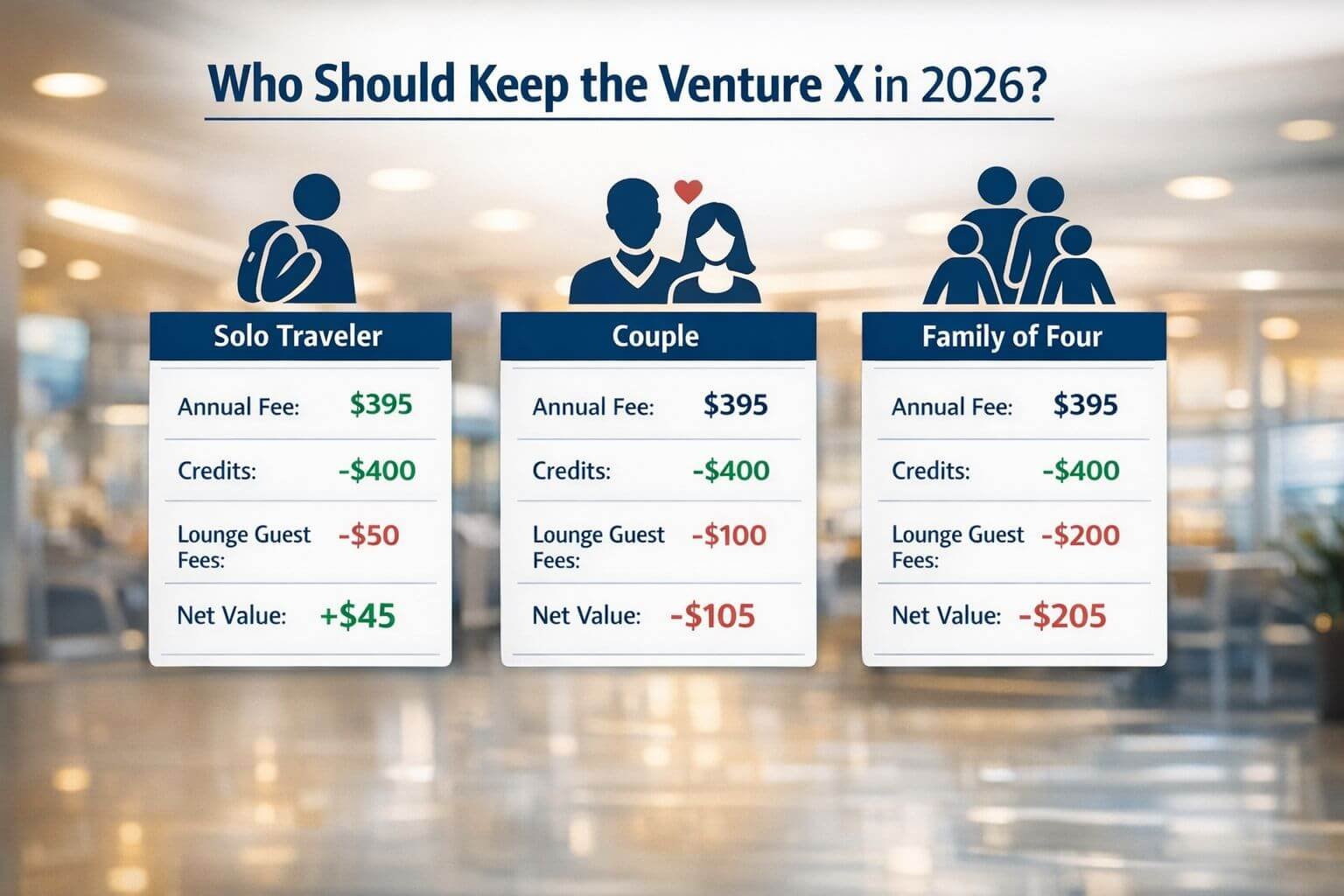
The following table models three common traveler profiles, assuming each visits Capital One Lounges four times per year and uses the $300 travel credit in full. All figures are annual.
Assumptions
- Capital One miles valued at 1.0 CPP (conservative; transfer partner redemptions can yield 1.5–2.0+ CPP)
- Anniversary bonus of 10,000 miles applies (year 2+)
- Couple scenario: one paid authorized user
- Family scenario: two paid authorized users, two children ages 8 and 12
| 🧳 Solo Traveler | 👫 Couple (1 AU) | 👨👩👧👦 Family of 4 (2 AUs, 2 kids) | |
|---|---|---|---|
| Annual fee | $395 | $395 | $395 |
| AU fees | $0 | $125 | $250 |
| $300 travel credit | −$300 | −$300 | −$300 |
| 10,000 anniversary miles | −$100 | −$100 | −$100 |
| Lounge guest fees (4 visits) | $0 (solo) | $0 (AU has own access) | $200 ($25 × 2 kids × 4 visits) |
| Total annual cost | −$5 (net positive) | $120 | $445 |
| With $75k spend exception | −$5 | $120 (AU still needs fee) | $45 (2 free guests at Lounges; kids still pay at Landings) |
What This Means
- Solo travelers: The Venture X remains essentially free. Primary cardholder lounge access is untouched. This is the strongest profile for the card in 2026.
- Couples: Adding one AU at $125 brings the effective cost to ~$120/year. That’s still reasonable if the AU travels independently and uses lounge access — but it’s no longer the slam-dunk it was when AUs were free.
- Families: The math gets expensive quickly. Four lounge visits per year with two children adds $200 in guest fees on top of $250 in AU fees. Unless you hit the $75,000 spend threshold, a family of four may find better value elsewhere.
🔗 Run your own numbers using the Award Travel Hub calculators to model your specific spending and travel patterns.
Venture X vs. Competing Premium Cards in 2026
How does the Venture X stack up after the 2026 changes? Here’s a quick comparison of the three major premium travel cards:
| Feature | Venture X ($395) | Amex Platinum ($895) | Chase Sapphire Reserve ($795) |
|---|---|---|---|
| Effective fee after credits | ~$0 | ~$900+ (complex credits) | ~$500+ (complex credits) |
| Lounge network | Capital One Lounges + Priority Pass | Centurion Lounges + Priority Pass + Delta Sky Clubs (with Delta ticket) | Priority Pass (restaurants only at some locations) |
| Free lounge guests | ❌ (post-Feb 2026) | ✅ 2 guests at Centurion | Varies by PP location |
| Transfer partners | 16+ | 20+ | 14+ |
| Flat earn rate (non-bonus) | 2x | 1x | 1x (3x on dining/travel) |
| Best for | Solo travelers, simplicity, flat earning | Luxury lounge access, Amex transfer partners | Dining rewards, Chase ecosystem |
For a detailed partner-by-partner comparison, see Comparing Transfer Partners 2026: Chase vs Amex vs Citi vs Capital One.
Key takeaway: The Amex Platinum now holds a clear lounge advantage for travelers with guests, thanks to its continued Two Free Guest policy at Centurion Lounges. However, its $695 fee and complex credit structure make it harder to justify on fee math alone. The Venture X remains the simplest premium card to break even on.
Common Mistakes to Avoid
❌ Keeping the card solely for lounge access when you always travel with guests. Post-February 2026, a couple visiting Capital One Lounges together without an AU will pay $45 per visit for the second person. Four visits = $180 in guest fees alone.
❌ Forgetting to use the $300 travel credit. It doesn’t roll over. Book anything through the Capital One Travel portal — even a budget hotel — to capture this value.
❌ Transferring miles without checking award availability first. Capital One mile transfers are irreversible. Always confirm that seats are bookable with the partner program before initiating a transfer.
❌ Ignoring transfer bonuses. Capital One regularly offers 15–30% bonuses to select partners. Timing a transfer to coincide with a bonus can save thousands of miles on a premium cabin booking.
❌ Assuming 1 CPP is the best you can do. Using miles through the Capital One portal at 1 CPP (or slightly more with the “erase” feature) leaves significant value on the table. Transfer partner sweet spots routinely yield 1.5–5+ CPP.
Keep, Downgrade, or Cancel: Your 2026 Decision Framework
Use this checklist to determine the right move for your situation:
✅ Keep the Venture X If:
- You travel at least a few times per year and will use the $300 credit
- You value primary lounge access for yourself (solo or with a paid AU partner)
- You earn Capital One miles and plan to use transfer partners for premium cabin awards
- You appreciate the flat 2x earning rate on all non-bonus spending
- You spend $75,000+ annually and qualify for complimentary guest access
⚠️ Consider Downgrading If:
- You rarely travel and struggle to use the $300 credit
- Your primary reason for the card was free family lounge access
- You don’t use transfer partners and only redeem at 1 CPP through the portal
- A no-annual-fee Capital One card (like the VentureOne) would preserve your miles while you reassess
For downgrade strategies that protect your points balance, see the guide on downgrade paths that preserve points, perks, and flexibility.
❌ Cancel If:
- You have no Capital One miles balance to protect (or can transfer them out first)
- You’ve found a competing card that better fits your travel profile
- The annual fee renewal is approaching, and none of the above “keep” criteria apply
📌 Timing tip: Contact Capital One 30–60 days before your anniversary date. You may receive a retention offer, and you’ll have time to downgrade without losing accumulated miles.
Conclusion: Where Venture X Benefits Stand in 2026
The Capital One Venture X is no longer the unqualified “best premium card for everyone” it was at launch. The February 2026 lounge changes — particularly the loss of free guest access and the $125 authorized user fee — meaningfully reduce its value for couples and families.
But for solo travelers and high spenders, the math still works. A $395 annual fee offset by $300 in travel credits and 10,000 anniversary miles leaves the effective cost near zero. Primary cardholder lounge access is untouched. And Capital One miles remain a strong transferable currency with access to sweet spots like ANA first class via Virgin Atlantic and low-surcharge Star Alliance awards via LifeMiles.
Your Next Steps
- Run your personal break-even calculation using the Award Travel Hub calculators.
- Review Capital One’s current transfer partners and bonuses on the Capital One Miles Transfer Partners page.
- Compare the Venture X against other premium cards in the 2026 transfer partner comparison guide.
- If you’re keeping the card, make sure to book through the Capital One Travel portal early in your card year to capture the $300 credit — and watch for transfer bonuses before moving miles to partner programs.
- If you’re leaning toward canceling, explore downgrade options first to preserve your miles and credit history.
The Venture X remains a strong card in 2026 — but only if it fits your travel pattern. Do the math, make the call, and put those Capital One miles to work on the redemptions that matter most.




Content on Award Travel Hub is independently created by Award Travel Hub Editorial Desk and, where noted, reviewed by Award Travel Hub Review Desk. Some pages may contain affiliate links, but compensation does not determine our coverage, opinions, or methodology.