
When Sarah Chen booked a quick Dallas to Chicago flight in January 2026, she expected her usual 500 AAdvantage miles to post within days. Two weeks later, her account still showed zero activity. After contacting American Airlines, she learned the disappointing truth: her American Airlines basic economy ticket no longer earned any miles or Loyalty Points. The $189 she spent on her flight—money that previously contributed toward elite status and future award travel—now offered nothing beyond transportation.
American Airlines implemented a significant policy change in January 2026 that fundamentally altered the value proposition of its cheapest fare class. Basic economy tickets no longer earn AAdvantage miles, Loyalty Points, or contribute toward elite status qualification. This shift represents the most aggressive basic economy restriction among U.S. carriers and forces travelers to recalculate whether saving $30-50 on a ticket makes financial sense when factoring in the loss of rewards.
Key Takeaways
- American Airlines basic economy tickets booked from January 2026 forward earn zero AAdvantage miles and zero Loyalty Points, eliminating all frequent flyer benefits from the fare class
- The breakeven threshold is approximately $19-24 in fare difference between basic economy and main cabin when valuing AAdvantage miles at 1.55 cents per point (cpp) on typical domestic routes
- Elite status qualification became significantly harder for budget-conscious travelers, as basic economy flights no longer contribute Loyalty Points toward status thresholds
- American now has the most restrictive basic economy policy among major U.S. carriers—both Delta and United still award miles on their basic economy fares, though at reduced rates
- Credit card earning strategies remain unchanged, as Citi AAdvantage cardholders still earn miles on basic economy purchases, just not flight credit from the airline
What Changed: American’s New Basic Economy Earning Policy
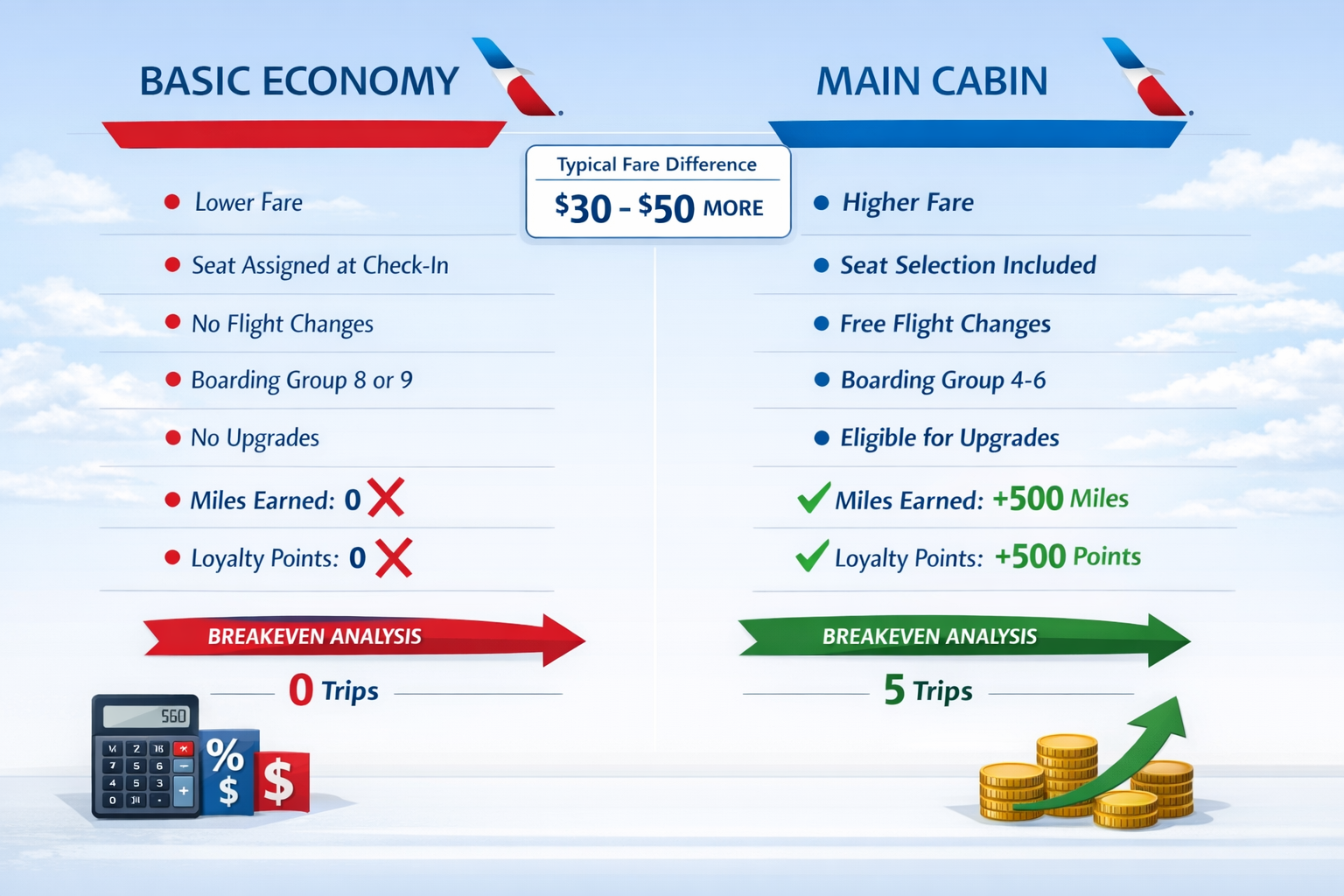
American Airlines quietly updated its AAdvantage program terms in late December 2025, with changes taking effect for all tickets purchased on or after January 1, 2026. The modification eliminated all mileage and Loyalty Point accrual for basic economy tickets, regardless of route distance or ticket price.
The Specifics of the Policy Change
Prior to January 2026, american airlines basic economy passengers earned:
- 5 AAdvantage miles per dollar spent on the base fare
- Full Loyalty Points based on dollars spent (typically matching the ticket price)
- Eligible Qualifying Dollars toward elite status requirements
Under the new policy, basic economy tickets earn:
- Zero AAdvantage miles
- Zero Loyalty Points
- Zero credit toward elite status qualification
The change applies universally across American’s domestic and international network. A basic economy ticket from New York to Los Angeles that costs $250 previously earned 1,250 AAdvantage miles and 250 Loyalty Points. That same ticket now earns nothing from a frequent flyer perspective.
What Still Works
Despite the earning restrictions, basic economy passengers retain certain benefits:
You may be interested



✅ Credit card earning remains intact – Citi AAdvantage cardholders still earn miles on basic economy purchases (2x miles on American Airlines purchases with most co-branded cards)
✅ Free in-flight Wi-Fi for AAdvantage members continues to apply, as covered in our guide to AAdvantage members getting free in-flight Wi-Fi on American Airlines flights
✅ Personal item allowance – One personal item that fits under the seat remains included
✅ Same-day flight changes for AAdvantage elite members still apply to basic economy tickets
✅ Upgrade eligibility for elite members on certain routes (though this varies by fare rules)
Why American Made This Change
American Airlines hasn’t publicly detailed the rationale behind eliminating basic economy earning, but industry analysis points to several factors:
Revenue optimization pressure – Airlines increasingly view basic economy as a price-matching tool against ultra-low-cost carriers like Spirit and Frontier, rather than a product for their core frequent flyers. Removing loyalty benefits creates clearer differentiation and encourages upgrades to main cabin.
Status qualification management – The pandemic-era status extensions and reduced travel volumes created an oversupply of elite members. Making status harder to earn through basic economy helps American manage upgrade inventory and lounge crowding.
Competitive positioning – While Delta and United still offer reduced earning on basic economy, American’s move may signal future industry trends. Airlines have consistently reduced basic economy benefits since the fare class launched in 2017.
Cost-Benefit Analysis: Basic Economy vs. Main Cabin Breakeven Math
Understanding when to pay extra for main cabin requires calculating the value of lost AAdvantage miles and Loyalty Points. The math varies based on how you value miles, your elite status goals, and your route.
Calculating Your Breakeven Point
The Points Guy values AAdvantage miles at 1.55 cents per point (cpp) based on average redemption value across domestic and international awards. Using this benchmark, here’s the breakeven analysis:
Example: New York (JFK) to Los Angeles (LAX)
- Basic economy fare: $220
- Main cabin fare: $265
- Fare difference: $45
Main cabin earning:
- Base fare miles: 2,485 miles (distance-based on this route)
- Loyalty Points: 265 LP (dollar-based)
- Total mile value: 2,485 × $0.0155 = $38.52
Verdict: Basic economy saves $45 but costs $38.52 in mile value—a net savings of only $6.48. Factor in main cabin’s free carry-on bag (valued at $35-75 if you need it), and main cabin becomes the better value.
Example: Dallas (DFW) to Houston (IAH)
- Basic economy fare: $89
- Main cabin fare: $119
- Fare difference: $30
Main cabin earning:
- Base fare miles: 239 miles (short distance route)
- Loyalty Points: 119 LP
- Total mile value: 239 × $0.0155 = $3.70
Verdict: Basic economy saves $30 and only sacrifices $3.70 in mile value—a clear win if you don’t need a carry-on bag and aren’t pursuing elite status.
Breakeven Threshold Table
| Route Distance | Typical Miles Earned | Mile Value @ 1.55 cpp | Breakeven Fare Difference |
|---|---|---|---|
| 0-500 miles | 200-500 | $3.10-$7.75 | $3-8 |
| 501-1,000 miles | 501-1,000 | $7.76-$15.50 | $8-16 |
| 1,001-2,000 miles | 1,001-2,000 | $15.51-$31.00 | $16-31 |
| 2,001+ miles | 2,001-3,000 | $31.01-$46.50 | $31-47 |
Rule of thumb: If the fare difference between basic economy and main cabin exceeds the mile value by less than $20, choose main cabin—especially when you need a carry-on bag or are working toward elite status.
The Loyalty Point Factor
For travelers pursuing AAdvantage elite status, Loyalty Points carry additional value beyond redeemable miles. American’s status tiers require:
- Gold: 40,000 Loyalty Points
- Platinum: 75,000 Loyalty Points
- Platinum Pro: 125,000 Loyalty Points
- Executive Platinum: 200,000 Loyalty Points
Every dollar spent on main cabin tickets earns one Loyalty Point. A traveler taking 20 domestic round-trips annually at an average of $300 per ticket would earn 12,000 Loyalty Points on main cabin fares—but zero on basic economy.
That gap means basic economy flyers need to make up the difference through:
- Credit card spending (Citi AAdvantage cards earn 1 LP per dollar on eligible purchases)
- American’s centennial promotion offering 15,000 Loyalty Points as a reward tag for certain activities
- Purchasing Loyalty Points (rarely cost-effective at 3.5 cents per point)
For context on airline and hotel status matches, alternative pathways exist to jumpstart elite status without relying solely on flight activity.
Impact on Elite Status Qualification and Loyalty Point Earning
The elimination of Loyalty Point earning on american airlines basic economy fundamentally changes status qualification strategy for budget-conscious travelers.
Status Math Before and After
Scenario: Frequent domestic traveler
- 30 one-way flights per year
- Average ticket price: $200
- Mix: 50% basic economy, 50% main cabin (pre-2026 behavior)
Previous earning (2025):
- Basic economy flights (15): 3,000 Loyalty Points
- Main cabin flights (15): 3,000 Loyalty Points
- Total: 6,000 Loyalty Points
New earning (2026+):
- Basic economy flights (15): 0 Loyalty Points
- Main cabin flights (15): 3,000 Loyalty Points
- Total: 3,000 Loyalty Points (50% reduction)
This traveler would need to double their main cabin flying or find 3,000 additional Loyalty Points elsewhere to maintain the same qualification trajectory.
Alternative Loyalty Point Sources
Citi AAdvantage Credit Cards
The most practical workaround involves maximizing credit card spend on co-branded cards:
| Card | Loyalty Point Earning | Best For |
|---|---|---|
| Citi AAdvantage Platinum Select | 1 LP per $1 everywhere; 2 LP per $1 on American purchases, gas, restaurants | General spending |
| Citi AAdvantage Executive World Elite | 1 LP per $1 everywhere; 2 LP per $1 on American purchases; 10 LP per $1 on hotels/car rentals via American | High spenders ($40k+ annually) |
| Citi AAdvantage Business | 1 LP per $1 everywhere; 2 LP per $1 on American, gas, telecom, cable | Business expenses |
Example calculation: A cardholder spending $3,000 monthly on a Citi AAdvantage Platinum Select card earns 36,000 Loyalty Points annually—enough to nearly reach Gold status without any flight activity.
American’s 15,000 Loyalty Point Reward Tag
As part of American’s centennial celebration, select promotions offer 15,000 Loyalty Point bonuses for completing specific activities (booking certain routes, reaching spending thresholds, or participating in partner promotions). These targeted offers can partially offset lost basic economy earning, though they’re not consistently available.
Strategic Considerations
Travelers serious about elite status should:
- Concentrate spending on Citi AAdvantage cards rather than transferable point cards when status qualification matters more than redemption flexibility
- Book main cabin on longer routes where the Loyalty Point gap is largest
- Use basic economy strategically on short hops where Loyalty Point loss is minimal
- Consider status matches from other programs if you hold elite status elsewhere—our 2025 status match guide covers current opportunities
When American Airlines Basic Economy Still Makes Sense (And When It Doesn’t)
Despite the earning restrictions, american airlines basic economy remains the right choice in specific situations. The decision framework depends on your travel profile, status goals, and baggage needs.
✅ Book Basic Economy When:
You’re traveling light with only a personal item
- Short business trips or weekend getaways where a backpack suffices
- No checked bag fees to worry about
- Main cabin’s carry-on allowance offers no additional value
The route is under 500 miles
- Minimal Loyalty Point loss (typically 80-150 LP)
- Mile value at 1.55 cpp equals only $1.24-$2.33
- Fare difference often exceeds $25-40
You have no elite status goals
- Casual travelers flying 1-4 times annually
- Loyalty Points provide no practical benefit
- Maximizing cash savings matters more than future award travel
The fare difference exceeds $40-50
- Even on longer routes, savings may outweigh lost mile value
- Particularly true on competitive routes where basic economy pricing is aggressive
You’re earning miles through credit card spend anyway
- Citi AAdvantage cardholders still earn 2x miles per dollar on American purchases
- The flight credit becomes less important when card earning covers the gap
Real-world example: A solo traveler flying Austin to Dallas (190 miles) for a day meeting with only a laptop bag. Basic economy at $79 vs. main cabin at $129. The $50 savings far exceeds the ~$3 in lost mile value, and no carry-on is needed.
❌ Avoid Basic Economy When:
You need a carry-on bag
- Main cabin includes free carry-on (valued at $35-75 if you’d otherwise pay)
- Basic economy charges $35-60 for carry-on at the gate
- The math flips immediately when baggage is factored
You’re working toward elite status
- Every flight on basic economy creates a Loyalty Point deficit
- Particularly problematic when you’re within 10,000-20,000 LP of the next tier
- The long-term value of status benefits (upgrades, free bags, boarding priority) typically exceeds short-term savings
The route is over 1,500 miles
- Loyalty Point loss becomes substantial (1,500+ LP on transcontinental routes)
- Mile earning loss reaches $23-47 at 1.55 cpp valuation
- Fare differences often narrow on longer routes
You’re booking last-minute
- Basic economy and main cabin pricing converges within 7-14 days of departure
- The fare difference may be only $10-20, making the main cabin the obvious choice
You value flexibility
- Basic economy tickets are non-changeable and non-refundable (even with a fee)
- Main cabin tickets can be changed for a fee or, with elite status, sometimes free
- Trip uncertainty makes the upgrade worthwhile as insurance
You’re traveling with family
- Seat assignment restrictions on basic economy mean you may not sit together
- The main cabin allows advance seat selection
- The stress factor alone often justifies the upgrade
For travelers who frequently book premium cabin awards, understanding how to maximize transferable points matters more than accumulating AAdvantage miles on domestic economy flights.
How American Compares to Delta and United Basic Economy Policies
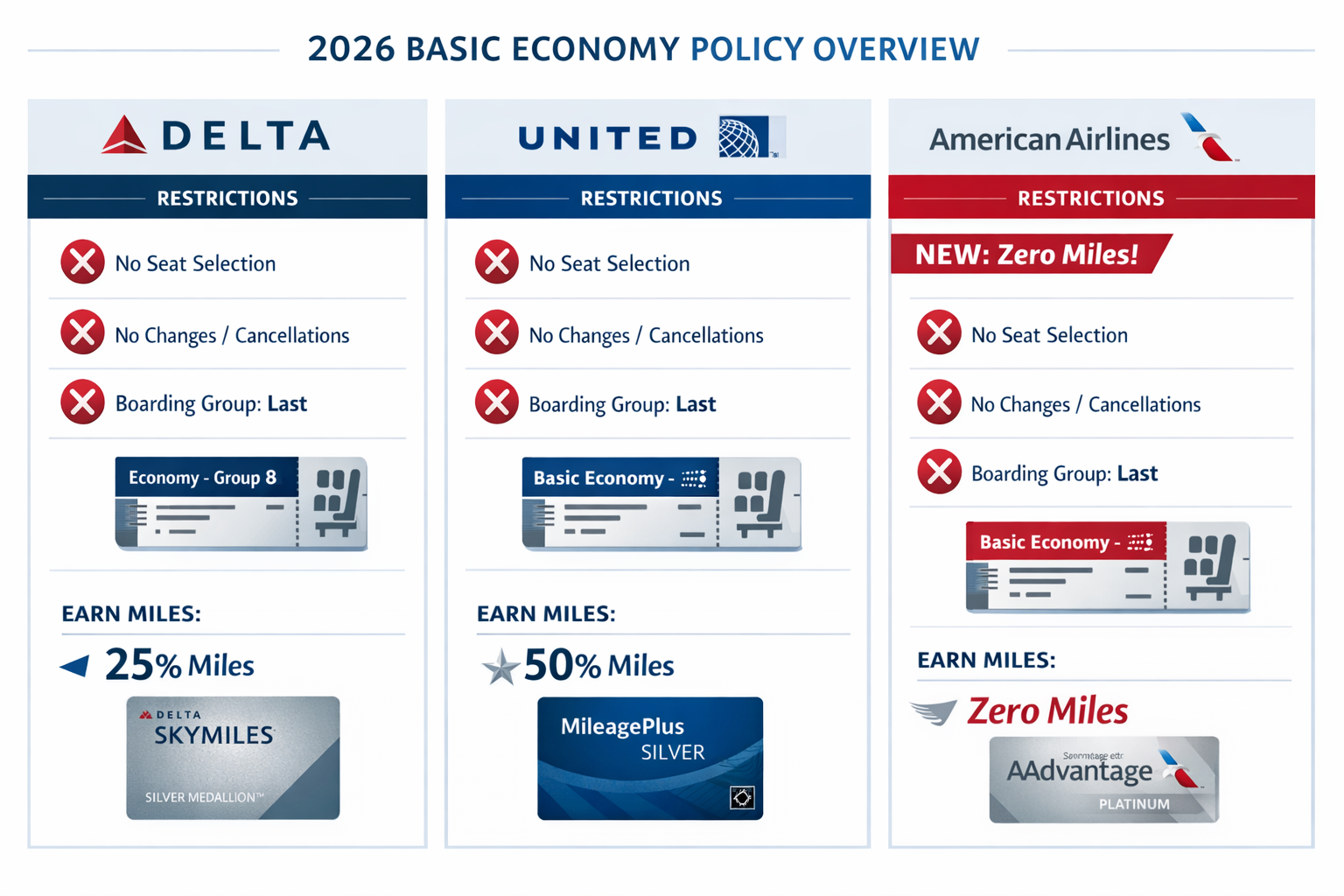
American Airlines decision to eliminate all earnings on its basic economy fares makes it an outlier among major U.S. carriers. Both Delta and United maintain some level of mileage accrual, though with restrictions.
Three-Carrier Comparison
| Feature | American Basic Economy | Delta Basic Economy | United Basic Economy |
|---|---|---|---|
| Redeemable Miles | ❌ 0% earning | ✅ 50% earning | ✅ 50% earning |
| Elite Qualifying Miles | ❌ 0 EQMs | ✅ 50% EQMs | ✅ 50% PQPs |
| Status Dollars/Points | ❌ 0 Loyalty Points | ✅ 50% MQDs | ✅ 50% PQPs |
| Carry-on Bag | ❌ Personal item only | ❌ Personal item only | ❌ Personal item only |
| Seat Selection | ❌ At check-in only | ❌ At check-in only | ❌ At check-in only |
| Changes/Cancellations | ❌ Not allowed | ❌ Not allowed | ❌ Not allowed |
| Upgrades | ⚠️ Limited | ⚠️ Limited | ⚠️ Limited |
| Credit Card Earning | ✅ Full earning | ✅ Full earning | ✅ Full earning |
Delta SkyMiles Basic Economy
Delta’s basic economy tickets earn 50% of redeemable SkyMiles and 50% Medallion Qualifying Dollars (MQDs) toward elite status. On a $300 ticket from Atlanta to Seattle:
- Redeemable miles: ~750 SkyMiles (50% of normal earning)
- MQDs: $150 (50% of ticket price)
- Status credit: Counts toward Medallion qualification at reduced rate
While still restrictive, Delta’s policy allows budget-conscious travelers to make incremental progress toward status—something American’s zero-earning policy eliminates entirely.
United MileagePlus Basic Economy
United’s approach mirrors Delta’s, offering 50% Premier Qualifying Points (PQPs) and 50% award miles on basic economy tickets. A $250 ticket from Newark to San Francisco earns:
- Award miles: ~1,300 miles (50% of distance-based earning)
- PQPs: 125 PQPs (50% of ticket price)
- Status credit: Partial progress toward Premier status
United also offers “Basic Economy Lite” on certain routes, which includes some additional flexibility while maintaining reduced earnings.
Why American Airlines’ Policy Is More Restrictive
American’s complete elimination of earning represents the most aggressive basic economy devaluation among major carriers. The likely drivers:
- Fleet and route structure – American’s extensive domestic network faces more direct competition from ultra-low-cost carriers, creating pressure to match bottom-tier pricing
- Status liability management – American may have concluded that partial earnings still created too many status qualifiers
- Revenue segmentation – Complete elimination creates the sharpest differentiation between fare classes, potentially driving more main cabin bookings
For travelers who value flexibility in earning, this policy shift may influence carrier choice on routes where all three airlines compete. A traveler flying Chicago to Los Angeles might choose United or Delta’s basic economy over American’s, knowing they’ll still earn 50% credit.
Our analysis of 2026 award travel trends suggests airlines will continue differentiating basic economy products, potentially making American’s zero-earning policy a competitive disadvantage.
Credit Card Strategies to Offset Lost Earning Opportunities
While American Airlines basic economy tickets no longer earn flight credit, strategic use of credit cards can partially offset the loss of miles and Loyalty Points.
Maximize Citi AAdvantage Co-Branded Cards
Citi AAdvantage Platinum Select Mastercard
This card remains the foundation for casual American flyers:
- 2 AAdvantage miles per $1 on American Airlines purchases (including basic economy tickets)
- 2 miles per $1 at gas stations and restaurants
- 1 mile per $1 on all other purchases
- Annual companion certificate after spending $30,000 in a calendar year (valuable for couples)
- First checked bag is free for you and up to 4 companions on the same reservation
Example: A $200 basic economy ticket earns zero miles from the flight itself, but 400 AAdvantage miles when purchased with the Platinum Select card—partially offsetting the loss.
Citi AAdvantage Executive World Elite Mastercard
For high spenders pursuing elite status:
- 2 AAdvantage miles per $1 on American purchases
- 10 miles per $1 on hotels and car rentals booked through American
- Admirals Club membership included (valued at $650 annually)
- $40,000 annual spend threshold unlocks a $125 American Airlines discount voucher and 10,000 Loyalty Points
The Loyalty Point earning is particularly valuable: $40,000 in annual spend generates 40,000 Loyalty Points (1 LP per $1), enough to reach Gold status without any flight activity.
Transferable Points Strategy for Non-Status Seekers
Travelers who don’t prioritize American elite status might reconsider their card strategy entirely. If basic economy tickets earn nothing from American, why not earn transferable points that offer broader redemption flexibility?
Alternative approach:
- Use transferable point cards for all travel purchases, including American basic economy tickets
- Earn Chase Ultimate Rewards, Amex Membership Rewards, Capital One miles, Citi ThankYou Points, or Bilt points instead of AAdvantage miles
- Transfer to partner programs when booking awards, choosing the best value option (often not American)
Example card setup:
- Chase Sapphire Reserve or Capital One Venture X: 3x points on travel purchases, including basic economy tickets
- Amex Platinum: 5x points on flights booked directly with airlines
- Citi Premier: 3x ThankYou Points on travel (and ThankYou Points transfer to multiple airline partners)
A $200 basic economy ticket earns 600-1,000 transferable points (depending on card) versus 0 AAdvantage miles. Those transferable points can be moved to programs like:
- British Airways Avios for short-haul American flights (often better value than AAdvantage)
- Etihad Guest for American-operated flights at competitive rates
- Qatar Airways Privilege Club for oneworld partner awards
For detailed strategies on maximizing transferable points, see our guide to the best cards for international travel.
Hybrid Approach: Split Your Strategy
Recommendation for most travelers:
- Keep one Citi AAdvantage card for the free checked bag benefit and occasional 2x earning
- Use transferable point cards for the majority of spending
- Book the main cabin on American when pursuing status or when the value equation favors it
- Book basic economy only when the math clearly works in your favor
This approach maintains flexibility while avoiding over-commitment to a single airline program during a period of aggressive devaluation.
Alternative Ways to Earn AAdvantage Miles and Status in 2026
With American Airlines’ basic economy no longer contributing to your AAdvantage account, diversifying your earning strategy becomes essential.
Shopping Portals and Dining Programs
AAdvantage eShopping
American Airline online shopping portal offers miles for purchases at 850+ retailers:
- Typical earning: 1-5 miles per dollar (varies by merchant)
- Bonus promotions: 10-15 miles per dollar during special events
- Stack with credit cards: Earn portal miles plus card rewards
Example: A $500 purchase at a retailer offering 3 miles per dollar earns 1,500 AAdvantage miles—equivalent to the earning from a $300 main cabin flight.
AAdvantage Dining
Link credit cards to earn miles at participating restaurants:
- 3 miles per $1 at registered restaurants
- 5 miles per $1 during promotional periods
- Bonus miles for reviewing restaurants
A frequent diner spending $200 monthly earns 7,200 AAdvantage miles annually—more than many basic economy flyers would accumulate.
Partner Hotel and Car Rental Programs
American maintains partnerships with hotel chains and car rental companies:
Hotel Partners:
- Marriott Bonvoy: 1 AAdvantage mile per $1 spent (or convert Bonvoy points to AAdvantage at 3:1 ratio)
- IHG One Rewards: 1,000-3,000 miles per stay
- Radisson Rewards: 500-2,000 miles per stay
Car Rental Partners:
- Avis: 500 miles per rental
- Budget: 500 miles per rental
- Hertz: 500 miles per rental
Strategy tip: These partnerships rarely offer competitive value compared to earning hotel/car rental loyalty points directly. Use them only when you have no loyalty to the partner program or when targeted bonuses make the math work.
Buy Miles Strategically (Usually Don’t)
American periodically offers mile purchase bonuses, typically:
- Base cost: 3.5 cents per mile
- Bonus promotions: Up to 60% bonus (effective cost ~2.2 cents per mile)
- Annual limit: 150,000 purchased miles per account
Analysis: At 2.2 cents per mile (with maximum bonus), purchased miles cost more than the 1.55 cpp average redemption value. Buying miles makes sense only for:
- Topping off an account when you’re 2,000-5,000 miles short of an award
- Specific high-value redemptions where you’ve calculated a redemption value above 2.5 cpp
- Preventing expiration (though there are cheaper ways to keep accounts active)
Transfer from Credit Card Partners
While American isn’t a transfer partner for most major transferable point currencies, Citi ThankYou Points transfer to AAdvantage at a 1:1 ratio:
- Citi Premier: Earns 3x ThankYou Points on travel, gas, and restaurants
- Citi Prestige: Earns 5x points on air travel and dining
- Transfer ratio: 1,000 ThankYou Points = 1,000 AAdvantage miles
This provides a backdoor way to earn “AAdvantage miles” on basic economy tickets: use a Citi Premier card (3x points on travel), then transfer the points to AAdvantage when you need miles for a specific redemption.
Important consideration: ThankYou Points also transfer to 18 other airline partners, including Singapore KrisFlyer, Virgin Atlantic, and Turkish Miles&Smiles. Before transferring to AAdvantage, compare award pricing across programs—you may find better value elsewhere.
For a broader context on transfer strategies, our guide to avoiding common travel rewards mistakes covers when to transfer and when to hold.
Focus on Partner Airlines for Better Value
American’s oneworld alliance membership means you can earn AAdvantage miles on partner flights:
High-earning partner airlines:
- British Airways: 100% distance-based miles on most fare classes
- Qatar Airways: 100-150% distance-based miles depending on fare class
- Cathay Pacific: 100% distance-based miles on most fare classes
- Qantas: 100% distance-based miles on most fare classes
Strategy: When traveling internationally, consider booking with a partner airline instead of American if the fare class earns better mileage rates. A British Airways flight from New York to London in economy earns 3,459 AAdvantage miles—far more than you’d earn on most domestic American routes.
Decision Framework: How to Book American Airlines Flights in 2026
Use this step-by-step framework to determine the optimal fare class when booking American Airlines flights:
Step 1: Assess Your Baggage Needs
Question: Will you need a carry-on bag?
- Yes → Skip to Step 2 (main cabin becomes more attractive)
- No → Continue to Step 3 (basic economy remains viable)
Rationale: The Main cabin’s free carry-on (valued at $35-75) often eliminates the price advantage of basic economy. If you’d pay for a carry-on anyway, the decision is simple.
Step 2: Calculate the True Fare Difference
Formula:
True Cost Difference = (Basic Economy Fare + Carry-on Fee) - Main Cabin Fare
Example:
- Basic economy: $180 + $60 carry-on fee = $240
- Main cabin: $230
- True cost difference: +$10 (main cabin is cheaper)
Decision: If the main cabin costs less than or within $10 of the BasicEconomy after baggage fees, choose the main cabin.
Step 3: Evaluate Elite Status Goals
Question: Are you actively pursuing AAdvantage elite status?
If yes, calculate Loyalty Point gap:
| Your Annual Flight Activity | LP from Main Cabin | LP from Basic Economy | Annual LP Gap |
|---|---|---|---|
| 10 round-trips @ $300 avg | 6,000 LP | 0 LP | 6,000 LP |
| 20 round-trips @ $300 avg | 12,000 LP | 0 LP | 12,000 LP |
| 30 round-trips @ $300 avg | 18,000 LP | 0 LP | 18,000 LP |
Decision rules:
- Within 15,000 LP of next status tier: Book main cabin to maintain qualification trajectory
- More than 30,000 LP away: Basic economy won’t meaningfully impact your timeline
- No status goals: Proceed to Step 4
Step 4: Calculate Mile Value Loss
Formula:
Mile Value Loss = (Expected Miles from Main Cabin) × $0.0155
Quick reference:
| Route Distance | Approximate Miles | Value Loss @ 1.55 cpp |
|---|---|---|
| Under 500 miles | 200-500 | $3.10-$7.75 |
| 500-1,000 miles | 500-1,000 | $7.75-$15.50 |
| 1,000-2,000 miles | 1,000-2,000 | $15.50-$31.00 |
| Over 2,000 miles | 2,000-3,000 | $31.00-$46.50 |
Decision: If the fare difference exceeds the mile value loss by more than $20, basic economy makes sense from a pure value perspective.
Step 5: Consider Flexibility and Comfort Factors
Additional considerations:
✈️ Seat selection: Do you need to sit with companions? (Main cabin allows advance selection)
✈️ Change likelihood: Any chance you’ll need to modify the trip? (Basic economy tickets are non-changeable)
✈️ Boarding priority: Does early boarding matter to you? (Main cabin boards earlier)
✈️ Upgrade potential: Do you hold elite status that might clear upgrades? (Basic economy is typically upgrade-ineligible)
Step 6: Apply the Final Decision Matrix
| Scenario | Recommendation |
|---|---|
| Need carry-on + fare difference <$30 | Main Cabin |
| Pursuing status + within 20,000 LP of tier | Main Cabin |
| Route >1,500 miles + fare difference <$40 | Main Cabin |
| Personal item only + no status goals + fare difference >$35 | Basic Economy |
| Route <500 miles + fare difference >$25 + no baggage | Basic Economy |
| Uncertain travel plans | Main Cabin (flexibility) |
Real-World Application Examples
Example 1: Business traveler, Austin to Chicago, pursuing Platinum status
- Basic economy: $165
- Main cabin: $205
- Fare difference: $40
- Needs carry-on: Yes
- Status goal: 15,000 LP away from Platinum
Analysis:
- Carry-on fee ($60) makes basic economy $225 total vs. $205 main cabin
- 205 Loyalty Points help toward status goal
- Decision: Main cabin (cheaper after baggage, supports status goal)
Example 2: Leisure traveler, Phoenix to Las Vegas, no status goals
- Basic economy: $79
- Main cabin: $119
- Fare difference: $40
- Needs carry-on: No (weekend trip, personal item only)
- Status goal: None
Analysis:
- Route distance: 256 miles = ~$4 in lost mile value
- $40 savings far exceeds $4 value loss
- Decision: Basic economy (clear savings, no status impact)
Example 3: Couple traveling, New York to Los Angeles, occasional flyers
- Basic economy: $220 each ($440 total)
- Main cabin: $265 each ($530 total)
- Fare difference: $90 total
- Needs carry-on: Yes (both travelers)
- Status goal: None
Analysis:
- Carry-on fees: $120 total ($60 × 2) makes basic economy $560 vs. $530 main cabin
- Seat assignment uncertainty problematic for couple
- Decision: Main cabin (cheaper after baggage, guaranteed seats together)
For travelers who frequently use points for premium cabin awards, understanding fuel surcharges on award tickets becomes more important than maximizing domestic economy earnings.
Conclusion
American Airlines’ January 2026 policy change, eliminating mile and Loyalty Point earning on American Airlines basic economy tickets, represents a significant devaluation for budget-conscious travelers. The decision to remove all frequent flyer benefits from the cheapest fare class creates the most restrictive basic economy product among major U.S. carriers and forces travelers to carefully evaluate whether short-term savings justify long-term opportunity costs.
The breakeven analysis is straightforward: on routes under 500 miles where you don’t need a carry-on bag and aren’t pursuing elite status, basic economy still makes financial sense. The $25-40 you save typically exceeds the $3-8 in lost mile value. However, on longer routes, when you need baggage or when you’re working toward status qualification, the math shifts decisively in favor of main cabin.
For travelers who previously relied on basic economy flights to make incremental progress toward elite status, the path forward requires strategic adjustment. Concentrating credit card spend on Citi AAdvantage co-branded cards, taking advantage of targeted Loyalty Point bonuses, and selectively upgrading to main cabin on longer routes can help maintain qualification trajectory. Alternatively, shifting focus to transferable point currencies and away from airline-specific loyalty may provide better long-term value in an era of continued program devaluations.
Actionable Next Steps
If you’re pursuing AAdvantage elite status:
- Audit your projected Loyalty Point earnings for 2026 based on planned travel
- Apply for a Citi AAdvantage credit card if you don’t already hold one (prioritize Executive for high spenders, Platinum Select for moderate spenders)
- Book main cabin on routes over 1,000 miles to maximize Loyalty Point accumulation
- Use basic economy strategically only on short hops where LP loss is minimal
- Monitor American’s targeted Loyalty Point promotions and participate when the math works
If you’re a casual traveler focused on maximizing value:
- Calculate the breakeven point for each booking using the framework in this guide
- Factor in baggage fees before assuming basic economy is cheaper
- Consider switching to transferable point cards for broader redemption flexibility
- Compare Delta and United basic economy on competitive routes where 50% earning may offer better value
- Use AAdvantage miles strategically for high-value redemptions rather than accumulating for the sake of loyalty
If you’re reconsidering your overall points strategy:
- Review your credit card portfolio and consider whether AAdvantage co-branded cards still align with your goals
- Explore the best airline credit cards for free checked bags if baggage fees are driving costs
- Evaluate transferable point programs that offer more flexibility during continued airline devaluations
- Read our analysis of 2026 award travel trends to understand broader industry shifts
The fundamental question American’s policy change raises isn’t just about basic economy—it’s about whether airline-specific loyalty still makes sense in an environment of accelerating devaluations. For travelers who fly exclusively with American and value elite benefits, the answer remains yes, but with increased vigilance in selecting fare classes. For those with more flexibility, the case for transferable points and opportunistic program use grows stronger with each restriction airlines impose.


Content on Award Travel Hub is independently created by Award Travel Hub Editorial Desk and, where noted, reviewed by Award Travel Hub Review Desk. Some pages may contain affiliate links, but compensation does not determine our coverage, opinions, or methodology.