

Picture this: You’ve just landed at JFK after a 12-hour flight from Tokyo. You’re exhausted, jet-lagged, and all you want is to get home. But first, you face a 90-minute customs line snaking through the terminal. Now imagine walking past that entire queue, scanning your fingerprints at a kiosk, and clearing customs in under two minutes.
That’s the power of Global Entry—and the right credit card can cover the $120 enrollment fee completely.
Global Entry credit cards offer one of the most practical travel perks available in 2026, yet many travelers overlook this benefit or don’t understand how it works. Whether you’re planning your first international trip or you cross borders monthly, knowing which cards reimburse the Global Entry fee—and how to maximize that benefit—can save you hours at the airport and potentially hundreds of dollars over time.
This guide breaks down everything you need to know: which programs to choose, which cards actually cover the cost, how the reimbursement process works, and the simple math to determine whether a card’s annual fee makes sense for your travel patterns.
Key Takeaways
✅ Global Entry includes TSA PreCheck and costs $120 for five years—the best value for anyone who travels internationally even once per year.
✅ Multiple credit cards reimburse the application fee through automatic statement credits, typically every 4-5 years when you renew.
✅ The cheapest cards with this benefit start around a $95 annual fee, while premium cards offer it alongside lounge access and other travel perks.
✅ Break-even math is simple: If a card’s annual fee minus its credits (including Global Entry) costs less than what you’d pay separately for those benefits, the card pays for itself.
You may be interested



✅ The reimbursement works automatically when you charge the Global Entry fee to your eligible card—no forms or advance registration required.
What Global Entry Credit Cards Actually Cover (And Why It Matters)
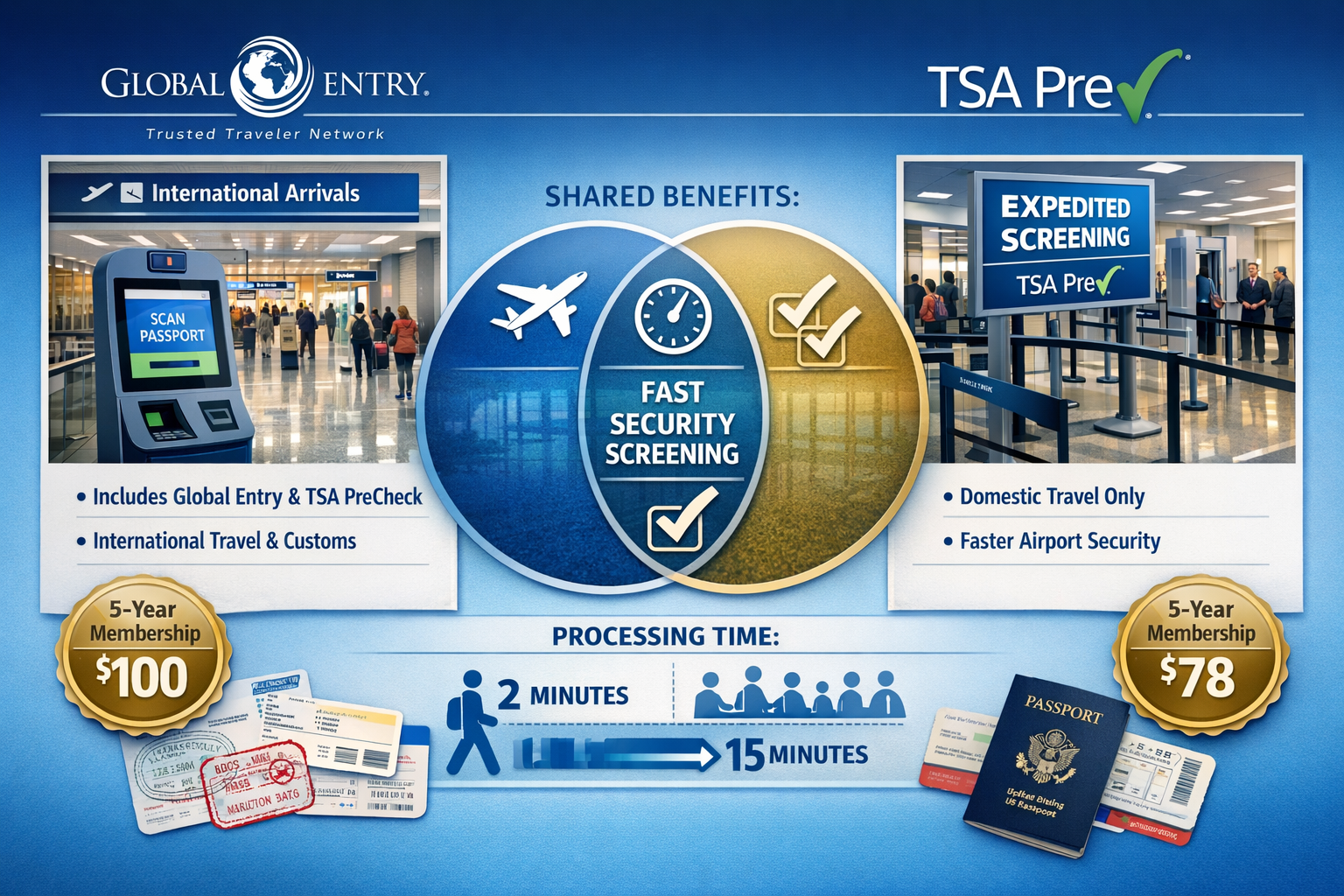
Global Entry credit cards provide a statement credit for the application or renewal fee for U.S. Customs and Border Protection’s Trusted Traveler Programs. This typically means a $120 credit every 4-5 years, though some cards also cover TSA PreCheck ($78) or the newer TSA PreCheck with photo option.
Here’s what the credit covers:
- ✈️ Global Entry application fee ($120, valid 5 years)
- 🛂 TSA PreCheck application fee ($78, valid 5 years)
- 📸 TSA PreCheck with photo enrollment (pricing varies)
- 🔄 Renewal fees for any of the above programs
The credit posts to your account automatically within 1-2 billing cycles after you charge the fee to your card. You don’t need to register in advance or submit documentation—the charge code triggers the reimbursement.
Why this matters more than you might think:
Time savings compound quickly. Global Entry members report average customs clearance times of 2-5 minutes, compared with 30-90 minutes in standard lines during peak hours.[1] If you travel internationally just twice per year, you’re saving 1-3 hours annually. Over five years, that’s a full day of your life back.
The included TSA PreCheck benefit is valid at 200+ U.S. airports, so you also skip domestic security lines. For frequent travelers, this dual benefit becomes one of the highest-value credit card perks available—especially when the card covers it at no additional cost beyond the annual fee you’re already paying for other benefits.
Global Entry vs TSA PreCheck: Which Program Should You Choose?
Before selecting a credit card, understand which trusted traveler program fits your travel patterns. The wrong choice means leaving benefits on the table.
Global Entry: Best for International Travelers
What you get:
- Expedited U.S. customs and immigration clearance when returning from abroad
- Automatic TSA PreCheck enrollment (included at no extra cost)
- Access to Global Entry kiosks at 60+ U.S. airports and 15 preclearance locations
- Valid for 5 years from the approval date
Cost: $120 for 5 years ($20/year)
Requirements:
- U.S. citizen, U.S. lawful permanent resident, or citizen of select countries (Mexico, Germany, UK, etc.)
- In-person interview at an enrollment center
- Background check and fingerprinting
- No serious criminal history or customs violations
Best for: Anyone who travels internationally at least once per year. Since Global Entry includes TSA PreCheck, you get both benefits for just $22 more than TSA PreCheck alone.
TSA PreCheck: Best for Domestic-Only Travelers
What you get:
- Expedited security screening at 200+ U.S. airports
- Keep shoes, belt, and a light jacket on
- Leave laptop and liquids in carry-on bag
- Dedicated TSA PreCheck lanes (typically 5-10 minute wait times)
Cost: $78-$85 for 5 years, depending on the enrollment provider
Requirements:
- U.S. citizen or lawful permanent resident
- In-person enrollment appointment (fingerprinting)
- Background check
- Does NOT include international customs benefits
Best for: Travelers who fly domestically 3+ times per year but rarely leave the country. If you never take international trips, the $22 savings versus Global Entry make sense.
Decision Framework
Use this simple rule:
Choose Global Entry if:
- You take at least one international trip per year
- You want maximum flexibility for future travel
- Your credit card reimburses the full $120 (most do)
Choose TSA PreCheck if:
- You exclusively fly domestic routes
- You’re certain you won’t travel internationally in the next 5 years
- Your card only covers TSA PreCheck (rare in 2026)
For most readers of Award Travel Hub, Global Entry is the clear winner. Even if you’re not traveling internationally today, having the option costs just $4.40 more per year—and your credit card’s travel perks likely cover it completely.
Complete List of Global Entry Credit Cards in 2026
The following cards reimburse Global Entry, TSA PreCheck, or both. We’ve organized them by card family and noted the credit renewal frequency—a critical detail many guides overlook.
Premium Travel Cards ($450-$695 Annual Fee)
These cards offer Global Entry credits, along with substantial travel benefits such as lounge access, hotel status, and travel credits.
The Platinum Card® from American Express
- Annual fee: $895
- Global Entry credit: $120 every 4-5 years (covers one application or renewal)
- How often: Once per 4-year membership period
- Other key benefits: $200 airline fee credit, $200 hotel credit, Centurion Lounge access, 5x points on flights
- Best for: Travelers who maximize Amex Membership Rewards points and use multiple card credits
- Annual fee: $798
- Global Entry credit: $120 every 4 years
- How often: Once per 4-year membership period
- Other key benefits: $300 annual travel credit, Priority Pass lounge access, 3x points on travel and dining
- Best for: Chase Ultimate Rewards earners who value flexible transfer partners
Capital One Venture X Rewards Credit Card
- Annual fee: $395
- Global Entry credit: $120 every 4-5 years
- How often: Once per membership period
- Other key benefits: $300 annual travel credit, Capital One lounge access, 10,000 anniversary bonus miles
- Best for: Travelers who want premium perks at a lower annual fee than Amex Platinum or Sapphire Reserve
Citi® / AAdvantage® Executive World Elite Mastercard®
- Annual fee: $450
- Global Entry credit: $120 every 5 years
- How often: Once per membership period
- Other key benefits: Admirals Club membership, first checked bag free, priority boarding
- Best for: Frequent American Airlines flyers who value lounge access
Mid-Tier Travel Cards ($95-$250 Annual Fee)
These cards offer the Global Entry benefit without the premium price tag—ideal for travelers who want the credit without paying for lounge access or hotel perks they won’t use.
United℠ Explorer Card
- Annual fee: $95 (waived first year)
- Global Entry credit: $120 every 4 years
- How often: Once per membership period
- Other key benefits: Free checked bag, priority boarding, 2x miles on United purchases
- Best for: United flyers who want the cheapest card with Global Entry coverage
IHG® One Rewards Premier Credit Card
- Annual fee: $99
- Global Entry credit: $120 every 4 years
- How often: Once per membership period
- Other key benefits: Annual free night certificate, 4th night free on award stays, Platinum Elite status
- Best for: Hotel loyalists who stay at IHG properties and want Global Entry as a bonus
Hilton Honors American Express Aspire Card
- Annual fee: $550
- Global Entry credit: $120 every 4-5 years
- How often: Once per membership period
- Other key benefits: $250 airline fee credit, $250 Hilton resort credit, Diamond status, Priority Pass
- Best for: Hilton loyalists who maximize hotel credits and elite benefits
Business Credit Cards with Global Entry
Several business cards offer the Global Entry benefit, and the credit often applies to employee cards as well—a valuable perk for small business owners.
The Business Platinum Card® from American Express
- Annual fee: $895
- Global Entry credit: $120 every 4-5 years (for cardholder and up to 99 employee cards)
- How often: Once per membership period per card
- Other key benefits: 1.5x points on purchases over $5,000, 35% points back on airfare, Dell and Adobe credits
- Best for: Business owners who can leverage multiple employee card credits
Chase Ink Business Preferred® Credit Card
- Annual fee: $95
- Global Entry credit: Not included (note: this is a common misconception—only personal Chase premium cards offer this benefit)
- Best for: Business spending categories, not Global Entry coverage
United℠ Business Card
- Annual fee: $99 (waived first year)
- Global Entry credit: $120 every 4 years
- How often: Once per membership period
- Other key benefits: Free checked bag, 2x miles on United, and dining
- Best for: Business travelers who fly United and want an affordable card with the benefit
Important Notes on Credit Renewal
⚠️ Critical detail most guides miss: The Global Entry credit renews based on your membership period, not the calendar year. If you enrolled in Global Entry in March 2021, your membership expires in March 2026. You can apply for renewal up to one year before expiration, and the credit will post when you charge the renewal fee to your eligible card.
Common mistake: Assuming the credit is annual. It’s not—it’s tied to your 4-5 year Global Entry membership cycle. Plan accordingly.
How the Global Entry Statement Credit Actually Works
The reimbursement process is straightforward, but understanding the mechanics prevents confusion and ensures you get your credit.
Step-by-Step Process
1. Apply for Global Entry through the official Trusted Traveler Programs website (ttp.dhs.gov). You’ll pay the $120 application fee during the online application.
2. Charge the fee to your eligible credit card. This is critical—the credit only posts if you use the specific card that offers the benefit. If you have multiple cards, choose the one with the Global Entry perk.
3. Wait for the automatic statement credit. The reimbursement typically posts within 1-2 billing cycles. You’ll see it listed as “Global Entry Fee Credit” or similar on your statement.
4. Complete your Global Entry interview. Schedule and attend your in-person interview at an enrollment center. Approval usually happens immediately, though background checks can take a few weeks.
5. Receive your Known Traveler Number (KTN). Once approved, you’ll get a KTN to add to your airline reservations for TSA PreCheck and your Global Entry card for international travel.
What Triggers the Credit
The statement credit activates when the charge posts with specific merchant codes associated with:
- U.S. Customs and Border Protection
- TSA PreCheck enrollment providers (Idemia, CLEAR, etc.)
- Global Entry renewal fees
You don’t need to:
- ❌ Register your card in advance
- ❌ Submit receipts or documentation
- ❌ Call customer service to request the credit
- ❌ Activate the benefit before applying
The credit is automatic based on the merchant code.
Common Mistakes to Avoid
Using the wrong card: If you have both a Platinum Card and a Gold Card from Amex, only the Platinum offers the Global Entry credit. Charging the fee to the Gold Card means no reimbursement.
Applying before getting the card: You can’t retroactively claim the credit. If you paid for Global Entry in January and got your Sapphire Reserve in March, you won’t be reimbursed. Wait until you have the card in hand.
Forgetting about renewal timing: Global Entry memberships last 5 years, but you can renew up to one year before expiration. If your card’s annual fee doesn’t justify keeping it long-term, time your renewal so you can cancel before it’s due.
Not checking credit limits: The $120 charge must post successfully. Ensure you have available credit, especially if you’re close to your limit.
Assuming family members are covered: Most cards only reimburse the primary cardholder’s fee, not family members. Exceptions include some business cards that cover employee cards. Check your specific card’s terms.
For more details on maximizing credit card benefits and avoiding common pitfalls, see our guide on avoiding travel rewards mistakes.
Best Global Entry Credit Card Picks by Traveler Type
Based on the break-even math and real-world usage patterns, here are the top recommendations for different traveler profiles in 2026.
🥇 Best Budget Option: United℠ Explorer Card
Why it wins:
- Lowest annual fee ($95) among cards with Global Entry credit
- First year fee waived, so you get Global Entry coverage free in year one
- Free checked bag benefit adds $70-$140/year value for frequent United flyers
- Solid earn rate: 2x miles on United purchases, hotels, and restaurants
Best for: Travelers who fly United 2-3+ times per year and want Global Entry without paying premium annual fees.
Watch out for: Limited lounge access (only United Club one-time passes, not ongoing membership). If you want lounges, consider a higher-tier card.
🥈 Best Premium Value: Capital One Venture X Rewards Credit Card
Why it wins:
- The $395 annual fee is $155-$300 less than competing premium cards
- $300 annual travel credit effectively reduces the fee to $95
- 10,000 anniversary bonus miles are worth ~$120
- Capital One lounge access (growing network)
- Global Entry credit every 4-5 years
Best for: Travelers who want premium perks (lounges, credits, Global Entry) at the lowest price point in the premium category.
Watch out for: Capital One’s transfer partners are more limited than Chase or Amex. If you’re deep in another points ecosystem, this might not fit your strategy. Review the credit card transfer partners to see if Capital One miles work for your travel goals.
🥉 Best for Amex Ecosystem: The Platinum Card® from American Express
Why it wins:
- Unmatched lounge access: Centurion Lounges, Priority Pass, Delta Sky Club (when flying Delta), and more
- Multiple annual credits ($200 airline, $200 hotel, $155 Walmart+, others)
- 5x points on flights booked directly with airlines or through Amex Travel
- Global Entry credit for the cardholder
Best for: Frequent travelers who can maximize Amex credits, value Centurion Lounge access, and already earn Membership Rewards points for premium cabin awards.
Watch out for: The $895 annual fee only makes sense if you use at least 3-4 of the annual credits. If you can’t use the hotel credit or don’t fly through Centurion Lounge airports, consider the Venture X or Sapphire Reserve instead.
🏆 Best for Chase Ecosystem: Chase Sapphire Reserve®
Why it wins:
- $300 annual travel credit is extremely flexible (flights, hotels, parking, tolls, etc.)
- Priority Pass lounge access with unlimited guest visits
- 3x points on travel and dining (broad categories)
- Global Entry credit every 4 years
- Strong travel protections and insurance
Best for: Chase Ultimate Rewards earners who value flexible transfer partners, easy-to-use travel credits, and comprehensive lounge access.
Watch out for: $795 annual fee is higher than Venture X. If you don’t value Priority Pass lounges or prefer Capital One’s transfer partners, Venture X offers better value.
💼 Best Business Card: The Business Platinum Card® from American Express
Why it wins:
- Global Entry credit applies to the cardholder AND up to 99 employee cards (huge value for teams)
- 2x points on purchases over $5,000 (each transaction)
- 35% points back on flights booked through Amex Travel (up to 500,000 points per year)
- Same lounge access as personal Platinum
Best for: Business owners who travel frequently, make large purchases, and can leverage employee card benefits.
Watch out for: $85 annual fee requires significant spending to justify. Run the numbers using the Award Travel Hub calculators before applying.
How to Apply for Global Entry and Maximize Your Credit Card Benefit
Once you’ve selected your Global Entry credit card, follow this process to enroll efficiently and ensure your credit posts correctly.
Step 1: Get Your Credit Card First
Don’t apply for Global Entry until you have the card in hand. The credit only works if you charge the fee to your eligible card. Applying before you’re approved for the card means paying out of pocket with no reimbursement.
Timeline:
- Apply for a credit card: 1-2 weeks for approval and delivery
- Apply for Global Entry: Same day you receive the card
- Interview scheduling: 2-8 weeks depending on location
- Approval: Usually immediate at interview, background check can take 2-4 weeks
Step 2: Create Your Trusted Traveler Programs Account
- Visit the official website: ttp.dhs.gov
- Click “Apply Now” and select “Global Entry.”
- Create a GOES account (Global Online Enrollment System)
- Complete the application (takes 20-30 minutes)
- Answer questions about travel history, employment, criminal record, and customs violations
Pro tip: Have your passport handy. You’ll need your passport number, issue date, and expiration date.
Step 3: Pay the $120 Fee with Your Credit Card
At the end of the application, you’ll pay the $120 non-refundable fee. Use the credit card that offers the Global Entry benefit.
The charge will appear on your statement as:
- “DHS – GOES” or
- “U.S. CUSTOMS AND BORDER PROTECTION” or
- Similar CBP-related merchant name
The statement credit will post automatically within 1-2 billing cycles. You don’t need to do anything else.
Step 4: Wait for Conditional Approval
Most applicants receive “conditional approval” within 3-7 days, though some background checks take longer. You’ll receive an email notification.
If your application is pending for more than 2 weeks, this is normal for applicants with extensive international travel history, previous customs issues, or common names that require additional verification. Be patient.
Step 5: Schedule Your Interview
Once conditionally approved:
- Log back into your GOES account
- Click “Schedule Interview”
- Choose an enrollment center (usually at major international airports)
- Select an available appointment time
Interview scheduling tips:
- Enrollment on Arrival: Some airports offer “Enrollment on Arrival” for conditionally approved applicants. If you’re returning from an international trip, you can complete your interview immediately upon landing instead of scheduling a separate appointment. Check if your arrival airport offers this—it’s the fastest way to get approved.
- Early morning or late evening appointments typically have shorter wait times
- Weekday appointments are less crowded than weekends
- Smaller enrollment centers (regional airports) often have availability within days versus weeks at major hubs
Step 6: Attend Your Interview
Bring:
- ✅ Valid passport
- ✅ Driver’s license or state ID
- ✅ Proof of residence (utility bill, lease, mortgage statement)
- ✅ Any required immigration documents (green card if applicable)
The interview takes 10-15 minutes and covers:
- Verification of application information
- Questions about travel history
- Fingerprinting
- Photo capture
- Explanation of program rules
Most applicants are approved on the spot. You’ll receive a “conditional pass” letter and your Known Traveler Number (KTN) immediately. Your physical Global Entry card arrives by mail in 7-10 days.
Step 7: Add Your KTN to Airline Profiles
Your Known Traveler Number enables you to use TSA PreCheck on domestic flights. Add it to:
- Airline frequent flyer profiles (do this once, applies to all future bookings)
- Individual flight reservations (if you don’t have a frequent flyer account)
- Online travel agencies (Expedia, etc., though direct airline profiles are more reliable)
The KTN is a 9-digit number found in your GOES account and on your approval letter.
Step 8: Use Global Entry When Returning to the U.S.
At the airport:
- Locate Global Entry kiosks (usually near baggage claim or customs area)
- Scan your passport or insert your Global Entry card
- Place your fingerprints on the scanner
- Answer customs declaration questions on the touchscreen
- Take your receipt and proceed to the exit
No talking to an officer is required unless you’re flagged for random inspection or declared items requiring review.
For comprehensive guidance on maximizing travel credit card benefits beyond Global Entry, see our beginner’s guide to travel rewards.
Common Questions About Global Entry Credit Cards
Can I use the credit for family members?
Generally, no. Most credit cards only reimburse the primary cardholder’s Global Entry fee.
Exception: Some business cards (like the Amex Business Platinum) offer the credit for employee cards. Each employee card can receive its own $120 Global Entry credit, making this a valuable perk for business owners who want to cover their team.
Workaround for families: If you and your partner each have an eligible credit card, you each receive a $120 credit. Two Sapphire Reserve cards in a household = two Global Entry memberships covered.
Does the credit cover TSA PreCheck instead?
Yes, in most cases. Cards that offer the “Global Entry credit” typically reimburse TSA PreCheck as well, since it’s a lower-cost program ($78-$85 vs. $120).
However, since Global Entry includes TSA PreCheck and only costs $42 more, there’s rarely a reason to choose TSA PreCheck if your card covers Global Entry.
Exception: If you’re not eligible for Global Entry (non-U.S. citizen from a country without a reciprocal agreement), TSA PreCheck might be your only option.
What happens if I cancel my credit card?
Your Global Entry membership remains active for the full 5-year term, even if you cancel the card that reimburses the fee. Global Entry is tied to your CBP enrollment, not your credit card.
However, when it’s time to renew in 4-5 years, you’ll need an eligible card to get the renewal fee reimbursed. If you’ve canceled your card, you’ll pay the $120 renewal out of pocket or get a new eligible card before renewing.
Strategy: If you’re considering canceling a premium card, time your Global Entry renewal so it’s completed before you cancel. This way, you lock in another 5 years of coverage.
Can I get the credit more than once?
Only when your Global Entry membership renews. The credit is tied to your 4-5 year membership cycle, not the calendar year.
You cannot:
- ❌ Get the credit annually
- ❌ Apply for multiple Trusted Traveler Programs and get reimbursed for each
- ❌ Get credited twice by having two eligible cards (the credit posts to whichever card you charge the fee to)
You can:
- ✅ Get the credit again when you renew your Global Entry membership in 4-5 years
- ✅ Switch to a different eligible card before renewing if you’ve changed cards
Does the credit work for Global Entry renewals?
Yes. The credit applies to both initial applications and renewals. The process is identical: charge the renewal fee to your eligible card, and the credit posts automatically.
Renewal tip: You can renew up to one year before your membership expires. If you’re planning to cancel your premium credit card, renew your Global Entry early to lock in the credit.
What if I’m denied for Global Entry?
The $120 fee is non-refundable, even if your application is denied. However, you’ll still receive the statement credit from your card—the credit is triggered by the charge, not by approval.
Common denial reasons:
- Criminal convictions (especially customs, immigration, or drug violations)
- Outstanding warrants
- Providing false information on the application
- Previous customs violations or fines
If you’re unsure about your eligibility, review the CBP eligibility requirements before applying.
Can I use Global Entry in other countries?
Global Entry only works when entering the United States. It does not provide expedited entry when arriving in other countries.
However, Several countries offer reciprocal programs:
- Canada: NEXUS (includes Global Entry benefits)
- Mexico: Viajero Confiable (trusted traveler program)
- UK, Germany, Singapore, and South Korea Have their own programs, but Global Entry doesn’t grant access
When leaving the U.S., you’ll go through the standard customs and immigration process of the destination country.
Next Steps: Choosing Your Card and Applying for Global Entry
You now have the framework to select a Global Entry credit card that fits your travel patterns and budget. Here’s your action plan:
1. Determine Your Traveler Profile
Ask yourself:
- How many international trips do I take per year? (1-2, 3-6, or 7+)
- Do I fly one airline frequently, or do I book across multiple carriers?
- Will I use airport lounges if I have access?
- Can I realistically use annual travel credits (airline fees, hotel bookings, etc.)?
- Am I already earning points in a specific ecosystem (Chase, Amex, Capital One)?
2. Run the Break-Even Math
Use the formula from earlier:
Net Annual Fee = Annual Fee – (Credits You’ll Actually Use)
Be honest about which credits you’ll use. The $200 airline fee credit on the Amex Platinum sounds great, but if you don’t fly airlines that charge for seat selection or baggage, it’s harder to use.
Use the Award Travel Hub calculators to model different scenarios and see which card delivers the best value for your specific spending and travel patterns.
3. Review Transfer Partners
If you’re earning transferable points for award travel, make sure your card’s transfer partners align with your goals.
- Chase Ultimate Rewards: Strong airline partners (United, Southwest, Air France-KLM, Virgin Atlantic, Singapore, etc.)
- Amex Membership Rewards: Widest selection (17 airlines, including ANA, Avianca, Air Canada, Delta)
- Capital One Miles: Growing network (Air Canada, Avianca, Turkish, Wyndham)
- Citi ThankYou Points: Solid airline options (Turkish, Air France-KLM, Singapore, Avianca)
See the complete credit card transfer partners guide to compare options and identify sweet spots for your target destinations.
4. Apply for Your Chosen Card
Once you’ve selected your card:
- Check for current welcome bonuses (these change frequently and can add significant value)
- Apply online through the issuer’s website
- Wait for approval and card delivery (1-2 weeks)
- Activate your card and set up online account access
5. Apply for Global Entry
Immediately after receiving your card:
- Visit ttp.dhs.gov
- Complete the Global Entry application
- Pay the $120 fee with your new credit card
- Wait for conditional approval (3-7 days typically)
- Schedule your interview
- Attend the interview and get approved
- Add your KTN to airline profiles
6. Verify the Statement Credit Posts
Check your credit card statement 1-2 billing cycles after the charge posts. You should see:
- Original charge: “DHS – GOES” or similar ($120)
- Statement credit: “Global Entry Fee Credit” or similar (-$120)
If the credit doesn’t post within 2 billing cycles, contact your card issuer’s customer service.
7. Plan Your Award Travel Strategy
With your Global Entry credit card in hand, you’re set up to:
- ✅ Clear customs quickly when returning from international trips
- ✅ Skip TSA security lines on domestic flights
- ✅ Earn transferable points on everyday spending
- ✅ Access airport lounges (if your card includes this benefit)
- ✅ Book premium cabin awards using transfer partners
The next step is learning how to maximize those transferable points for business class deals and hotel stays.
Conclusion
Global Entry credit cards offer one of the most straightforward value propositions in travel rewards: a $120 statement credit that saves you hours at the airport and costs you nothing beyond the annual fee you’re already paying for other benefits.
The decision framework is simple:
If you travel internationally even once per year, Global Entry pays for itself in time savings alone. The included TSA PreCheck benefit extends that value to domestic travel.
If you’re choosing a credit card primarily for the Global Entry credit, the United Explorer Card ($95 annual fee, waived first year) offers the lowest cost of entry. You get the credit, free checked bags, and solid earning rates without paying for premium perks you might not use.
If you’re already considering a premium travel card for lounge access, travel credits, or points earning, the Global Entry benefit is a bonus that sweetens the deal. Cards like the Capital One Venture X, Chase Sapphire Reserve, and Amex Platinum include the credit alongside comprehensive travel perks that can justify their annual fees for frequent travelers.
The math is transparent: calculate your net annual fee by subtracting the credits you’ll actually use. If the result is less than what you’d pay for those same benefits separately, the card pays for itself.
Start by determining your traveler profile, run the break-even math using the Award Travel Hub calculators, and select the card that fits your travel patterns and points strategy. Then apply for Global Entry, attend your interview, and start saving time on every trip.
Your next international arrival just got a lot faster. 🛂✈️


Content on Award Travel Hub is independently created by Award Travel Hub Editorial Desk and, where noted, reviewed by Award Travel Hub Review Desk. Some pages may contain affiliate links, but compensation does not determine our coverage, opinions, or methodology.