
You’re staring at two credit card applications. One promises 2% cash back on everything—simple, clean, no questions asked. The other offers points that “unlock premium travel”—but requires you to learn about transfer partners, award charts, and something called “cents per point.”
The credit card points vs cash back decision feels like choosing between guaranteed money in your pocket today or the possibility of flying business class to Tokyo for pennies on the dollar. Both camps have passionate advocates. Cash back enthusiasts point to simplicity and guaranteed value. Points collectors show off $15,000 business class flights booked for 80,000 points.
Here’s the truth: neither strategy is universally “better.” The right choice depends on how you actually live, travel, and manage your finances. This guide provides the decision framework you need to choose confidently—without the hype or oversimplification that plagues most rewards advice.
Key Takeaways
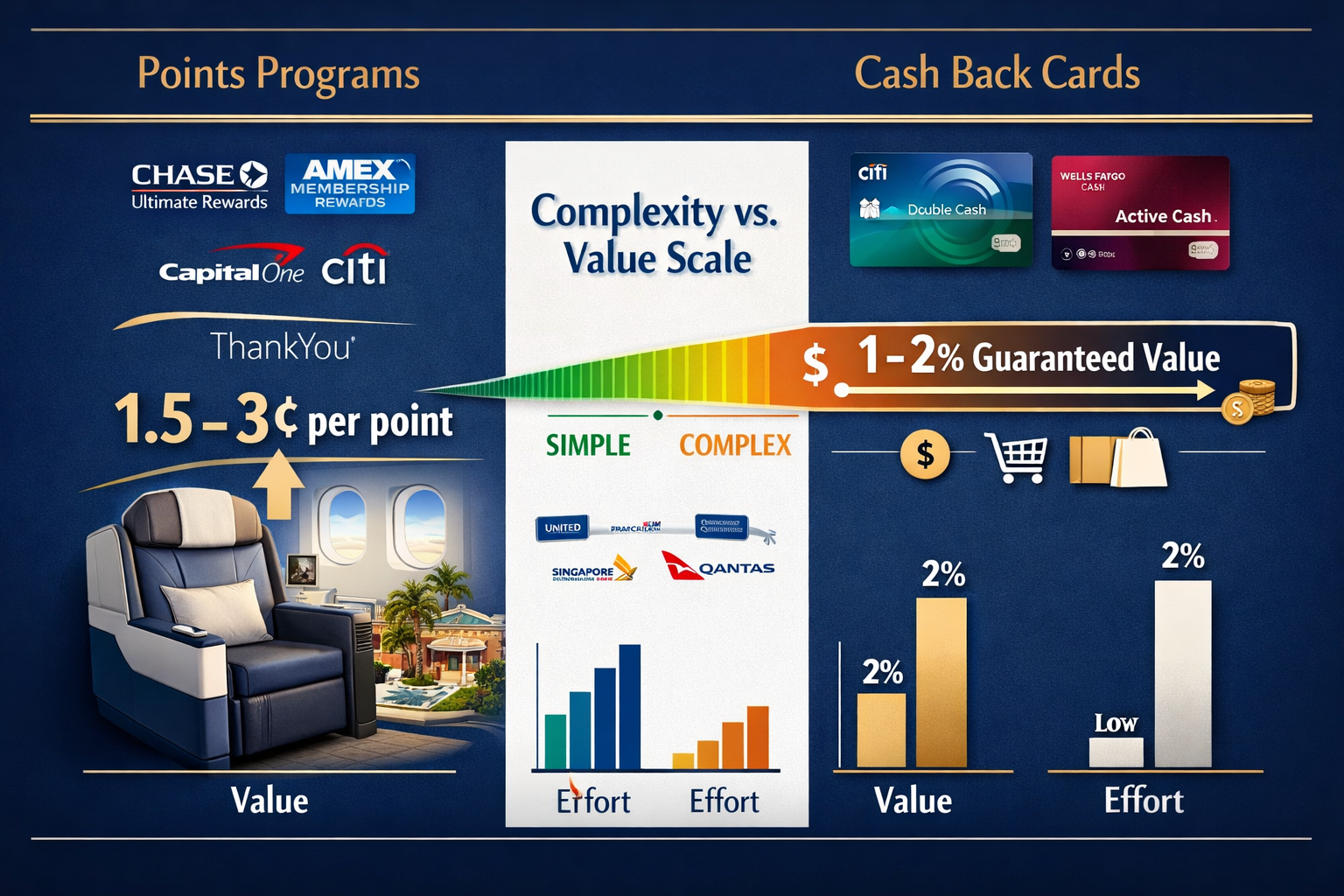
- Points programs deliver 1.5-3+ cents per point when transferred to airline and hotel partners, while cash back provides a guaranteed 1-2% value with zero complexity
- The breakeven threshold is typically $3,000+ in annual travel spending—below this, cash back’s simplicity often outweighs points’ potential upside
- Travel frequency matters most: 4+ trips annually strongly favors points; 0-1 trips makes cash back the practical winner
- Complexity tolerance is non-negotiable—points require ongoing learning about transfer partners, award availability, and program rules
- A hybrid approach works well for many: use cash back cards for everyday spending and points cards strategically for travel categories
Understanding the Credit Card Points vs Cash Back Fundamentals
The credit card points vs cash back debate starts with understanding what you’re actually comparing.
Cash back cards are straightforward: spend $100, earn $1.50 to $2.00 back. The value is fixed, liquid, and requires no strategy. Top performers in 2026 include:
- Citi Double Cash: 2% on everything (1% when you buy, 1% when you pay)
- Wells Fargo Active Cash: 2% flat rate with no categories
- Chase Freedom Unlimited: 1.5% base rate (higher with Chase ecosystem)
You receive statement credits or direct deposits. No learning curve. No devaluations. No availability concerns.
Points programs operate differently. You earn flexible points that transfer to airline and hotel partners at varying ratios. The major transferable points currencies in 2026:
- Chase Ultimate Rewards (Chase Sapphire Preferred, Sapphire Reserve, Ink cards)
- Amex Membership Rewards (Platinum, Gold, Business Platinum)
- Capital One Miles (Venture X, Venture)
- Citi ThankYou Points (Premier, Prestige)
- Bilt Points (Bilt Mastercard for rent payments)
You may be interested



These points don’t have fixed values. A Chase Ultimate Rewards point might be worth 1 cent when redeemed for cash back through the portal, 1.25-1.5 cents when booking travel through Chase’s portal, or 2-3+ cents when transferred to partners like United, Hyatt, or Southwest for specific award redemptions.
The complexity-value tradeoff defines this entire decision.
Value Comparison: What Points and Cash Back Actually Deliver
Let’s establish realistic value ranges based on how people actually use these programs—not best-case scenarios that require expert-level optimization.
Cash Back: Guaranteed 1-2% Returns
Cash back value is transparent:
| Card | Base Rate | Annual Value on $30,000 Spend |
|---|---|---|
| Citi Double Cash | 2% | $600 |
| Wells Fargo Active Cash | 2% | $600 |
| Chase Freedom Unlimited | 1.5% (3% Year 1) | $450 ($900 Year 1) |
| Discover it Cash Back | 1% base, 5% rotating | $450-600, depending on categories |
This value is guaranteed, liquid, and immediate. No learning required. No risk of devaluation. You can use it for anything—groceries, bills, debt payoff, or yes, even travel booked with cash.
Points Programs: 1.5-3+ Cents Per Point with Effort
Points value varies dramatically based on redemption choice and your skill level.
Portal redemptions (easiest, lowest value):
- Chase portal with Sapphire Preferred: 1.25 cents per point
- Chase portal with Sapphire Reserve: 1.5 cents per point
- Amex portal with Platinum: 1 cent per point (1.35cpp on flights)
- Capital One portal: 1 cent per mile (varies by card)
Transfer partner redemptions (more complex, higher value):
- Domestic economy flights: 1.3-1.8 cents per point
- International economy: 1.5-2.2 cents per point
- Premium cabin awards (business/first class): 2-5+ cents per point
- Luxury hotel redemptions: 1.5-2.5 cents per point
Here’s a concrete example. A business class flight from New York to London:
- Cash price: $4,500-6,000
- Points required: 60,000-80,000 transferable points (varies by airline and date)
- Effective value: 5.6-10 cents per point
But that same 70,000 points redeemed for cash back? Just $700.
The value gap is real—but only if you actually book those premium cabin awards and would have otherwise purchased them (or valued the experience at that cash equivalent).
The Realistic Middle Ground
Most points users don’t consistently extract 3+ cents per point. A realistic average for someone who:
- Books 2-3 award flights annually
- Mixes economy and premium cabin redemptions
- Uses hotels occasionally
- Sometimes redeems through portals for convenience
…typically achieves 1.8-2.2 cents per point over time.
That’s still better than 1.5-2% cash back—but the gap narrows when you factor in the time investment required to find good redemptions, monitor award availability, and manage multiple programs.
Breakeven Analysis: When Points Justify the Complexity
The critical question: how much do you need to travel annually to make points worth the effort?
The $3,000 Annual Travel Threshold
Based on typical spending patterns and redemption behavior, here’s the math:
Scenario 1: Cash Back Strategy
- Annual spend: $40,000
- 2% cash back: $800 value
- Time investment: minimal
- Flexibility: complete
Scenario 2: Points Strategy (Moderate Skill)
- Annual spend: $40,000
- 2x average earn rate on travel cards: 80,000 points
- Redemption value at 2cpp: $1,600
- Time investment: 10-15 hours annually learning and booking
- Flexibility: limited to travel
The points strategy delivers $800 more value—but requires ongoing education about transfer partners, award space, and booking techniques.
If your annual travel spending is under $3,000, the absolute dollar difference is often too small to justify the complexity:
- $2,000 travel spend difference between strategies = $40 extra value
- Is 10+ hours of learning worth $40? Probably not.
Above $5,000 in annual travel spending, the math shifts decisively toward points for most people:
- $5,000+ travel spend = $100-250+ extra value annually
- Compounds over time as you get better at redemptions
- Unlocks experiences (premium cabins) difficult to justify at cash prices
The Complexity Tax
There’s a hidden cost to points programs: the complexity tax. This includes:
- Learning which transfer partners offer the best value
- Monitoring for transfer bonuses (15-30% extra value opportunities)
- Understanding airline fuel surcharges that can add $400+ to “free” flights
- Tracking program devaluations and rule changes
- Managing point expiration policies
- Dealing with limited award availability on popular routes
For some people, this is genuinely enjoyable—a hobby that happens to save money. For others, it’s a frustrating barrier that prevents them from ever extracting full value.
Be honest about which camp you’re in.
Decision Matrix: Choosing Your Rewards Strategy
Use this framework to determine which approach fits your situation.
Choose Points Programs If You:
✅ Travel 4+ times annually (especially international or premium cabin)
✅ Spend $5,000+ on travel and dining each year
✅ Enjoy learning systems and optimizing for value
✅ Have flexibility in travel dates and destinations
✅ Value experiences over cash (business class, luxury hotels)
✅ Can meet minimum spend requirements for signup bonuses ($3,000-6,000 in 3 months)
✅ Won’t carry balances (interest charges destroy all rewards value)
Best starter cards for points beginners:
- Chase Sapphire Preferred (easiest transfer partners, good portal value)
- Capital One Venture X (simple 2x everywhere, flexible transfers)
- Amex Gold (4x dining/groceries, strong transfer partners)
Choose Cash Back If You:
✅ Travel 0-2 times annually or only domestically
✅ Prefer simplicity and guaranteed value
✅ Don’t want to learn transfer partners or monitor award space
✅ Need flexible redemption options (not just travel)
✅ Have irregular income or prefer conservative financial planning
✅ Travel last-minute (when award availability is limited)
✅ Value time over optimization
Best cash back cards for maximum simplicity:
- Citi Double Cash (2% everything, no categories)
- Wells Fargo Active Cash (2% everything plus cell phone protection)
- Chase Freedom Unlimited (1.5% base, option to upgrade to points later)
The Hybrid Approach: Best of Both Worlds
Many sophisticated rewards users combine strategies:
Strategy 1: Category Optimization
- Points cards for travel and dining (3-4x categories)
- Cash back for everything else (2% flat rate)
Example setup:
- Chase Sapphire Preferred: 3x dining, 2x travel
- Citi Double Cash: 2x everything else
- Result: Higher earn rates on bonus categories, guaranteed value on base spend
Strategy 2: Opportunistic Points
- Cash back as default
- Points cards for large signup bonuses only
- Redeem points immediately for travel, then return to cash back
This approach captures 50,000-100,000 point signup bonuses (worth $750-2,000 in travel) without committing to ongoing points optimization.
Strategy 3: Household Division
- One person manages the points strategy for family travel
- Another person uses simple cash back for household expenses
- Combines optimization with simplicity
Real-World Examples: Points Winners vs Cash Back Winners
Let’s examine actual scenarios to see where each strategy excels.
Example 1: The Frequent Business Traveler
Profile:
- 8-12 work trips annually (flights and hotels covered by employer)
- 2-3 personal trips (international preferred)
- $15,000 annual dining and personal travel spend
- Comfortable with complexity
Points Strategy:
- Amex Business Platinum: 5x flights, 1.5x purchases over $5,000
- Amex Gold: 4x dining and groceries
- Annual earnings: ~120,000 Membership Rewards points
- Redemption: Business class to Europe (60,000 points = $4,000+ value)
- Effective return: 3.3% value
Cash Back Strategy:
- 2% flat rate on $15,000 = $300
- Effective return: 2%
Winner: Points (by $200-300+ annually, plus premium cabin experience)
The frequent traveler has both the spending volume and redemption opportunities to justify the complexity of points. They also benefit from lounge access and other travel perks that compound value.
Example 2: The Young Professional
Profile:
- 1 annual vacation (domestic)
- Occasional weekend trips
- $2,500 annual travel/dining spend
- Prefers simplicity, building an emergency fund
Points Strategy:
- Chase Sapphire Preferred: 3x dining/travel
- Annual earnings: ~30,000 points
- Portal redemption: $375-450 travel value
- Effective return: 1.5-1.8%
Cash Back Strategy:
- 2% flat rate on all spend
- Annual return: $500+ (on $25,000 total spend)
- Effective return: 2%
Winner: Cash Back (more total value, complete flexibility, no complexity)
For someone with limited travel spending and a preference for simplicity, the guaranteed 2% cash back delivers better results. The small potential upside from points doesn’t justify the learning curve.
Example 3: The Family Traveler
Profile:
- 3-4 family trips annually (mix of domestic and international)
- $8,000 annual travel spend (flights, hotels, dining)
- Motivated to maximize value for family experiences
- Willing to learn but time-constrained
Hybrid Strategy:
- Chase Sapphire Preferred: 3x travel/dining ($24,000 spend = 72,000 points)
- Citi Double Cash: 2x everything else ($36,000 spend = $720)
- Annual points value: $1,080-1,440 (at 1.5-2cpp)
- Annual cash back: $720
- Total value: $1,800-2,160
Pure Cash Back:
- 2% on $60,000 total spend = $1,200
Winner: Hybrid (50-80% more value with moderate complexity)
The family traveler has enough spending in bonus categories to justify points cards, but uses cash back as a simple baseline for non-category spend. This approach captures most of the upside without requiring expert-level optimization.
They might also explore beginner strategies to gradually build points knowledge while maintaining cash back as their foundation.
Example 4: The Retiree
Profile:
- 2-3 leisure trips annually (flexibility in timing)
- $4,000 annual travel spend
- Fixed income values predictability
- Limited interest in learning complex systems
Cash Back Strategy:
- 2% flat rate: $800 annual return
- Predictable, liquid value
- Can be used for travel or other expenses
- Effective return: 2%
Points Strategy:
- Would require a learning curve
- Award availability requires flexibility (already has this)
- Potential 2-2.5cpp value = $800-1,000
- Effective return: 2-2.5%
Winner: Cash Back (simplicity matches life stage, minimal upside doesn’t justify effort)
Even though this retiree has the flexibility that benefits points redemptions, the modest spending volume and preference for predictability makes cash back the better fit. The potential extra $200 annually isn’t worth the ongoing management.
Common Mistakes to Avoid in the Credit Card Points vs Cash Back Decision
Mistake 1: Choosing Points Without Travel Plans
The error: Getting a premium travel card because “the signup bonus is amazing” when you have no concrete travel plans.
The reality: Points that go unused lose value due to devaluation. Annual fees ($95- $895) compound. You end up redeeming for cash back at 1 cent per point—worse than a free cash back card.
The fix: Only pursue points if you have specific travel goals within 12-18 months.
Mistake 2: Underestimating the Complexity Tax
The error: Assuming you’ll “figure it out later” and optimize redemptions when the time comes.
The reality: Without ongoing learning about transfer partners and award availability, most people redeem through portals at 1.25-1.5cpp—barely better than cash back, and worse when you factor in higher annual fees.
The fix: Commit to 2-3 hours monthly learning about your programs, or stick with cash back.
Mistake 3: Ignoring Annual Fees
The error: Focusing only on earn rates and signup bonuses while overlooking $95-550 annual fees.
The reality: A $550 annual fee (Chase Sapphire Reserve, Amex Platinum) requires $27,500+ in bonus category spend just to break even with a free 2% cash back card—before considering the value of travel credits and perks.
The fix: Calculate breakeven spend: (Annual Fee) ÷ (Points Earn Rate – 2%) = Required Spend
Example: $550 ÷ (3x – 2%) = $55,000 bonus category spend needed to break even
Mistake 4: Chasing Signup Bonuses Without Strategy
The error: Opening cards for signup bonuses without a plan to use the points effectively.
The reality: You accumulate points across multiple programs, diluting your balances and making it harder to book meaningful awards. Many points expire before you use them.
The fix: Focus on 1-2 transferable points ecosystems. Consolidate earnings to build balances large enough for premium redemptions.
Mistake 5: Overvaluing Aspirational Redemptions
The error: Calculating points value based on First Class redemptions you’ll realistically never book.
The reality: If you wouldn’t pay $15,000 for a First Class ticket, it’s not worth $15,000 to you—even if that’s the “cash price.” Your actual value is what you’d pay for the experience.
The fix: Value points based on redemptions you’ll actually use: economy flights you’d book anyway, hotel stays you’d purchase, or business class as an upgrade from economy you’d buy.
Mistake 6: Neglecting the Cash Back Baseline
The error: Assuming any points strategy beats cash back.
The reality: Poor points redemptions (0.8-1.2cpp) are common among casual users. A guaranteed 2% beats an uncertain 1.5% average return.
The fix: Track your actual redemption value over 12 months. If you’re consistently below 1.8cpp, switch to cash back.
Advanced Considerations: Transfer Bonuses, Devaluations, and Program Changes
If you’ve decided that points make sense for your situation, understand these dynamics that separate good from great outcomes.
Transfer Bonuses: The 15-30% Value Boost
Transfer bonuses offer 15-30% extra points when moving from credit card programs to airline/hotel partners. In 2026, these appear regularly:
- Amex → Virgin Atlantic (30% bonus = 39,000 points instead of 30,000)
- Chase → Aeroplan (20% bonus = 60,000 points instead of 50,000)
- Capital One → Avianca LifeMiles (periodic 15-20% bonuses)
Strategy: Don’t transfer points until you’re ready to book. Wait for transfer bonuses on your intended partner to get 15-30% more value.
Caveat: Transfer bonuses can create a false sense of urgency. Only transfer if you have a specific redemption in mind—don’t transfer speculatively.
Devaluation Risk: The Points Value Erosion
Unlike cash back’s fixed value, points programs regularly devalue:
- Award charts increase (what costs 50,000 points now costs 70,000)
- Dynamic pricing replaces fixed charts (points required vary by demand)
- Partner redemption rates increase
- Sweet spots disappear
Recent examples:
- Virgin Atlantic increased many partner awards by 20-40% in 2024
- Marriott moved to dynamic pricing, eliminating predictable redemption values
- Flying Blue (Air France/KLM) regularly adjusts award pricing
Protection strategy:
- Earn and burn—don’t stockpile points indefinitely
- Diversify across multiple programs
- Book travel 6-12 months out when you have specific plans
- Monitor program announcements for advance warning
Program Rule Changes
Airline and hotel programs change rules affecting redemption value:
- Stopover policies: Some programs allow free stopovers (visit two cities for one award), while others charge extra
- Close-in booking fees: Some airlines charge $75+ for awards booked within 21 days
- Partner availability: Airlines control which award seats they release to partners
- Fuel surcharges: British Airways charges $400-700 in fees on “free” transatlantic awards
Staying current on these rules requires ongoing attention—part of the complexity tax mentioned earlier.
For those committed to maximizing value, resources like award travel predictions help you stay ahead of changes.
Making Your Decision: A Step-by-Step Framework
Here’s your action plan for choosing between credit card points vs cash back in 2026.
Step 1: Calculate Your Annual Travel Spending
Include:
- Flights (personal, not reimbursed business travel)
- Hotels and vacation rentals
- Dining while traveling
- Dining at home (if considering cards with dining bonuses)
Total: $__________
If under $3,000: lean toward cash back
If $3,000-5,000: consider a hybrid approach
If over $5,000: points likely worth the effort
Step 2: Assess Your Complexity Tolerance
Answer honestly:
- Do you enjoy learning new systems and optimizing for value? (Yes/No)
- Can you commit 2-3 hours monthly to points education? (Yes/No)
- Are you comfortable with uncertain/variable values? (Yes/No)
- Do you have flexibility in travel dates and destinations? (Yes/No)
3-4 “Yes” answers: Points programs are a good fit
1-2 “Yes” answers: Consider a hybrid approach
0 “Yes” answers: Cash back is your best strategy
Step 3: Evaluate Your Travel Patterns
You’re a strong points candidate if:
- You book international travel 2+ times annually
- You’re interested in premium cabin experiences
- You have specific aspirational trips (honeymoon, anniversary, bucket list)
- You travel during off-peak times with good award availability
You’re a strong cash back candidate if:
- You travel domestically only
- You book last-minute frequently
- You prefer budget accommodations and economy flights
- You value flexibility over optimization
Step 4: Choose Your Starting Strategy
For Points Beginners:
Start with one of these ecosystems based on your situation:
- Chase Ultimate Rewards: Best for domestic travel, easy transfer partners, good hotel options (Hyatt)
- Amex Membership Rewards: Best for international premium cabins, largest transfer partner network
- Capital One Miles: Best for simplicity (2x everything), flexible transfers, good for those unsure
Get one card, learn the system, and evaluate after 12 months.
For Cash Back Simplicity:
Start with a single 2% flat-rate card:
- Citi Double Cash (no annual fee, straightforward)
- Wells Fargo Active Cash (cell phone protection included)
Add category cards only if you’ll genuinely track spending and maximize bonuses.
Step 5: Set a 12-Month Review
Track these metrics:
For points users:
- Total points earned
- Average redemption value (cents per point)
- Time spent learning/booking
- Satisfaction with redemptions
For cash back users:
- Total cash back earned
- Any missed opportunities (travel you wanted but couldn’t afford)
After 12 months: Recalculate whether your strategy delivered the value and experience you wanted. Switch if needed—there’s no permanent commitment.
Tools and Resources for Your Strategy
Regardless of which path you choose, these resources help maximize value:
For Points Users
Award search tools:
- Award availability search platforms help find the best redemptions
- Transfer partner comparison tools show optimal routing
- Points valuation calculators estimate redemption worth
Learning resources:
- Program-specific guides for Chase, Amex, Capital One, Citi, and Bilt
- Transfer partner sweet spot lists
- Award chart databases
Booking tools:
Visit Award Travel Hub’s calculators for value comparisons and redemption planning.
For Cash Back Users
Optimization tools:
- Category calendar trackers (for rotating 5% cards)
- Spending analyzers to identify the best card for each purchase
- Cash back portal aggregators for online shopping bonuses
For Hybrid Users
Portfolio management:
- Card benefit trackers (which card has the best insurance and protections)
- Annual fee calendars with retention offer reminders
- Spending category analyzers to optimize card usage
The Bottom Line: Your Rewards Strategy for 2026
The credit card points vs. cash back debate doesn’t have a universal answer—it has a personal one, based on your travel patterns, tolerance for complexity, and financial goals.
Choose cash back if: You value simplicity, guaranteed returns, and complete flexibility. You travel infrequently or prefer to book travel with cash. You don’t want to invest time learning transfer partners and award availability. The 2% guaranteed return beats the uncertainty of optimization.
Choose points if: You travel frequently (4+ times annually), especially internationally. You’re willing to invest time learning systems for 2-3x better returns. You value experiences like business class that you wouldn’t pay cash for. You have flexibility in travel dates and destinations.
Choose a hybrid approach if: You want to capture points upside down on travel and dining categories while maintaining cash back simplicity for everyday spending. You’re willing to manage 2-3 cards strategically. You want optionality without full commitment to points optimization.
The most important decision isn’t which strategy is theoretically better—it’s which one you’ll actually execute consistently. A simple 2% cash back strategy you follow perfectly beats a complex points strategy you abandon after six months.
Start with your honest assessment of travel spending and your tolerance for complexity. Choose the strategy that fits your actual behavior, not your aspirational self. You can always adjust after 12 months of real-world data.
The best rewards strategy is the one that delivers value without creating stress—whether that’s $800 in cash back or a business class flight to Europe for 70,000 points.
Next Steps: Implementing Your Strategy
If you chose cash back:
- Apply for a 2% flat-rate card (Citi Double Cash or Wells Fargo Active Cash)
- Set up automatic payments to avoid interest charges
- Redeem cash back quarterly or annually for statement credits
- Review annually to ensure it still fits your needs
If you chose points:
- Select one transferable points ecosystem (Chase, Amex, or Capital One)
- Get a starter card appropriate for your spend (Sapphire Preferred, Amex Gold, or Venture X)
- Commit to learning one transfer partner per month
- Book your first award redemption within 6 months to validate the strategy
- Explore beginner guides and travel hacking fundamentals
If you chose hybrid:
- Start with one points card for travel/dining categories
- Add one 2% cash back card for everything else
- Set calendar reminders to use the right card for each category
- Review quarterly to ensure you’re using each card optimally
The decision between credit card points and cash back is reversible. Start with the strategy that makes sense today, track your results, and adjust as your travel patterns and preferences evolve.
Your rewards strategy should serve your life—not the other way around.


Content on Award Travel Hub is independently created by Award Travel Hub Editorial Desk and, where noted, reviewed by Award Travel Hub Review Desk. Some pages may contain affiliate links, but compensation does not determine our coverage, opinions, or methodology.