
The landscape of award travel has shifted more dramatically in the past 18 months than in the previous five years combined. Airlines have accelerated devaluations, hotels have tightened award space, and the tools to track availability have become more sophisticated than ever. For active points and miles hobbyists, understanding award travel trends for 2026 isn’t just about staying informed—it’s about protecting the value of points already earned and maximizing every future redemption.
Consider this: A business class ticket to Europe that cost 60,000 points in early 2024 now requires 80,000 to 100,000 points with many programs. Award space that once appeared 330 days out now drops unpredictably. Transfer bonuses that were rare have become monthly occurrences, but only for those positioned to act quickly. The rules have changed, and strategies that worked 24 months ago now leave points on the table—or worse, stranded in devalued programs.
This guide synthesizes the most important award travel trends heading into 2026 and translates each into concrete action items for your points strategy. Whether you’re planning your credit card applications, deciding where to transfer points, or mapping out redemptions for the year ahead, these trends will shape your decision framework.
Key Takeaways
- Flexible transferable currencies (Chase, Amex, Capital One, Citi, Bilt) now offer better protection against devaluations than airline-specific points—shift at least 70% of earning strategy toward these programs
- Award availability has tightened significantly, making real-time alerts and advanced booking tools essential for securing premium cabin space, especially 10-11 months before departure
- Dynamic pricing and devaluations continue accelerating across major programs; the solution is diversification across multiple transfer partners and booking sweet spots before they disappear
- Under-the-radar partner opportunities often provide 30-50% better value than flagship programs – knowing these alternatives is now critical for maximizing redemption value
- A structured 90-day action plan can future-proof your points portfolio against 2026 changes while positioning you to capitalize on transfer bonuses and limited-time opportunities
Why Following Award Travel Trends in 2026 Matters More Than Ever
The award travel ecosystem is entering an era of accelerated change, driven by three forces: post-pandemic revenue optimization, technology-enabled dynamic pricing, and increased competition for premium-cabin award space.
Revenue pressure is reshaping loyalty programs. Airlines and hotels view loyalty programs as profit centers, not customer retention tools. This shift means programs increasingly prioritize revenue over member experience. Delta’s move to fully dynamic pricing in 2023 set a precedent that other carriers are following incrementally. United’s November 2024 elimination of its November 2024 award chart for partner awards signaled the same direction. Hotel programs like Marriott Bonvoy have reduced off-peak pricing availability and increased peak pricing windows.
Dynamic pricing eliminates predictability. When award charts disappear, the travel rewards math becomes more complex. A route that costs 70,000 points one day might require 120,000 points the next, with no advance notice. This volatility makes flexible-point currencies more valuable than ever—they allow you to comparison-shop across multiple programs before committing to a transfer.
Competition for premium cabin space has intensified. More travelers understand how to use points for business and First Class redemptions. Combined with reduced award inventory on many routes, this means desirable space disappears within hours of release. Without alerts and systematic searching, even members with millions of points struggle to find availability.
You may be interested



The cost of ignoring trends is measurable. Members who didn’t adapt to recent changes have seen their points lose 20-40% of redemption value. Those who remained loyal to single programs through devaluations now need significantly more points for the same trips. Meanwhile, members who shifted to flexible currencies, set up availability alerts, and diversified across transfer partners have maintained or improved their redemption value.
The strategic imperative is clear: Award travel in 2026 requires active management, not passive accumulation. The trends below provide the framework for that management.
Trend 1: Transferable Currencies Are King in 2026
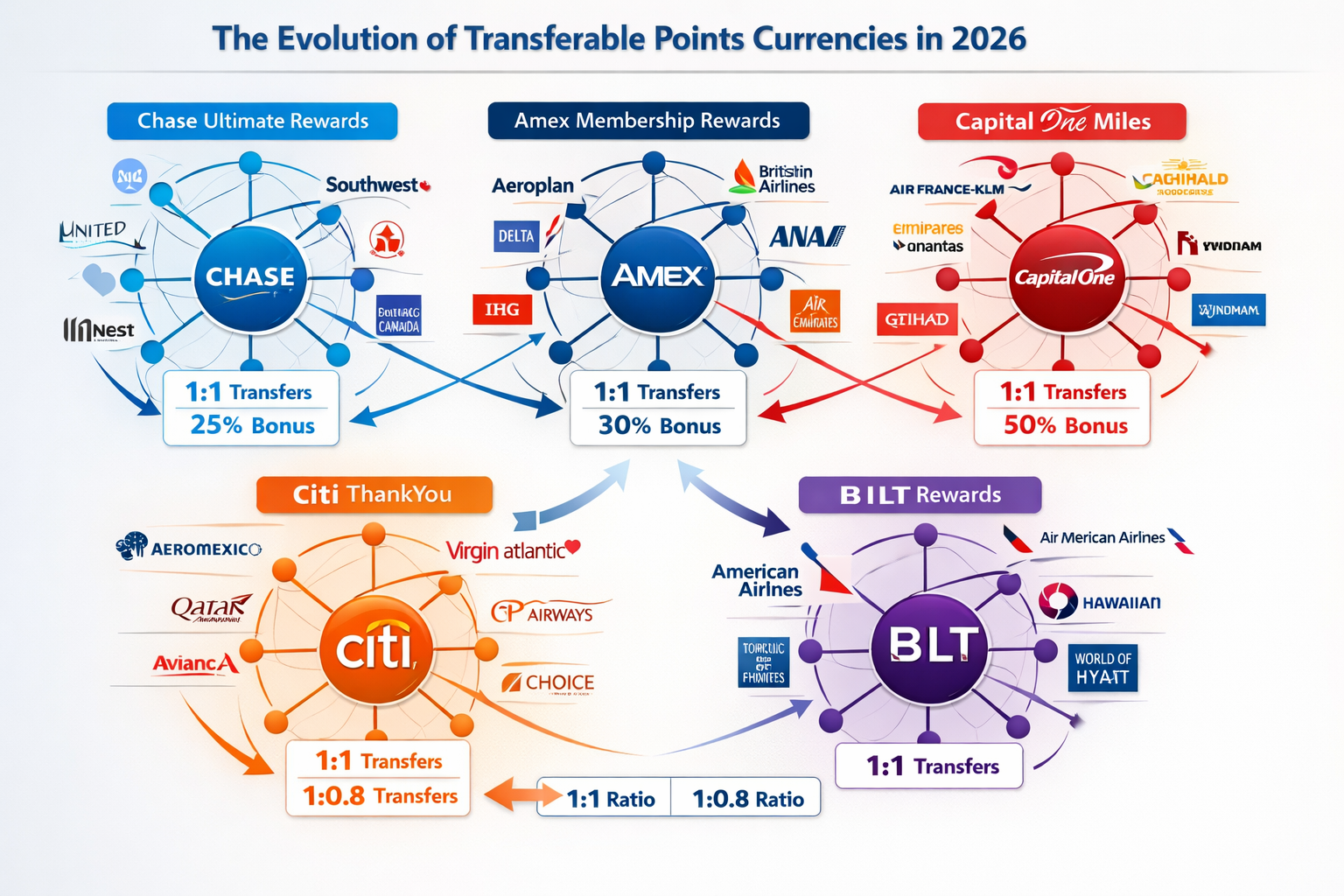
The single most important award travel trend for 2026 is the dominance of flexible transferable points currencies over airline and hotel-specific points. Five ecosystems now define the optimal earning strategy: Chase Ultimate Rewards, American Express Membership Rewards, Capital One Miles, Citi ThankYou Points, and Bilt Rewards.
Why flexible currencies win: Each transferable currency offers 10-20+ transfer partners, creating optionality that airline-specific cards cannot match. When United devalues, Chase points can move to Air Canada Aeroplan or Singapore KrisFlyer instead. When Marriott increases award costs, Amex points can transfer to Hilton Honors or remain flexible for airline transfers. This flexibility provides devaluation insurance—your points retain value even when individual programs decline.
Transfer bonuses have become routine. In 2024-2025, transfer bonuses appeared monthly across all five ecosystems. Amex offered 25-30% bonuses to Virgin Atlantic, British Airways, and Air Canada. Chase promoted 25% bonuses to Virgin Atlantic and Southwest. Capital One ran 50% bonuses to Avianca LifeMiles and Wyndham. These bonuses effectively increase your points value by the bonus percentage—but only if your points are already in a flexible currency when the bonus appears.
Real-world example: A member planning a business class redemption to Europe in summer 2026 faces this scenario:
- United MileagePlus: 80,000-110,000 miles (dynamic pricing, no advance notice of cost)
- Air Canada Aeroplan: 70,000 points (fixed pricing, bookable 11 months out)
- Virgin Atlantic Flying Club: 50,000 points (sweet spot on Delta metal, limited availability)
With flexible points, this member can compare all three options and transfer to whichever offers the best value when ready to book. With United miles only, they’re locked into United’s pricing with no alternatives.
The math on transfer bonuses: A 30% transfer bonus to Virgin Atlantic effectively values Chase points at 1.95 cents per point (CPP) for that redemption (assuming baseline 1.5 CPP). Without the bonus, the same redemption values points at 1.5 CPP. Over time, strategically using transfer bonuses can increase overall portfolio value by 20-30%.
Action items for 2026:
- Shift 70%+ of credit card spend to cards earning flexible currencies (Chase, Amex, Capital One, Citi, Bilt)
- Maintain balances in at least two flexible currencies to maximize transfer bonus opportunities
- Set up transfer bonus alerts to act quickly when favorable bonuses appear
- Avoid transferring points until ready to book—transfers are typically one-way and immediate
For a comprehensive breakdown of transfer partners and their optimal uses, consult a detailed transfer partners comparison guide that maps each currency to its best redemption opportunities.
Trend 2: Tighter Award Space and the Rise of Tools and Alerts
Award availability—particularly in premium cabins—has contracted significantly across most major programs. This trend shows no signs of reversing in 2026, making systematic searching and real-time alerts essential components of any booking strategy.
The availability crunch is data-driven. Analysis of Business Class award space on popular routes (U.S. to Europe, U.S. to Asia) shows 30-40% less availability in 2025 than in 2019. Airlines have reduced the number of seats released to partners, prioritized their own co-brand cardholders, and implemented dynamic inventory management that releases space closer to departure rather than at the standard 330-day window.
Partner space has become especially scarce. Programs like United MileagePlus and American AAdvantage have reduced partner award availability to protect revenue on their own flights. This means sweet spots like booking Lufthansa first class with United miles or Cathay Pacific business class with American miles now require more aggressive searching and flexibility.
Tools have evolved to match the challenge. Three platforms have emerged as essential for serious award travelers in 2026:
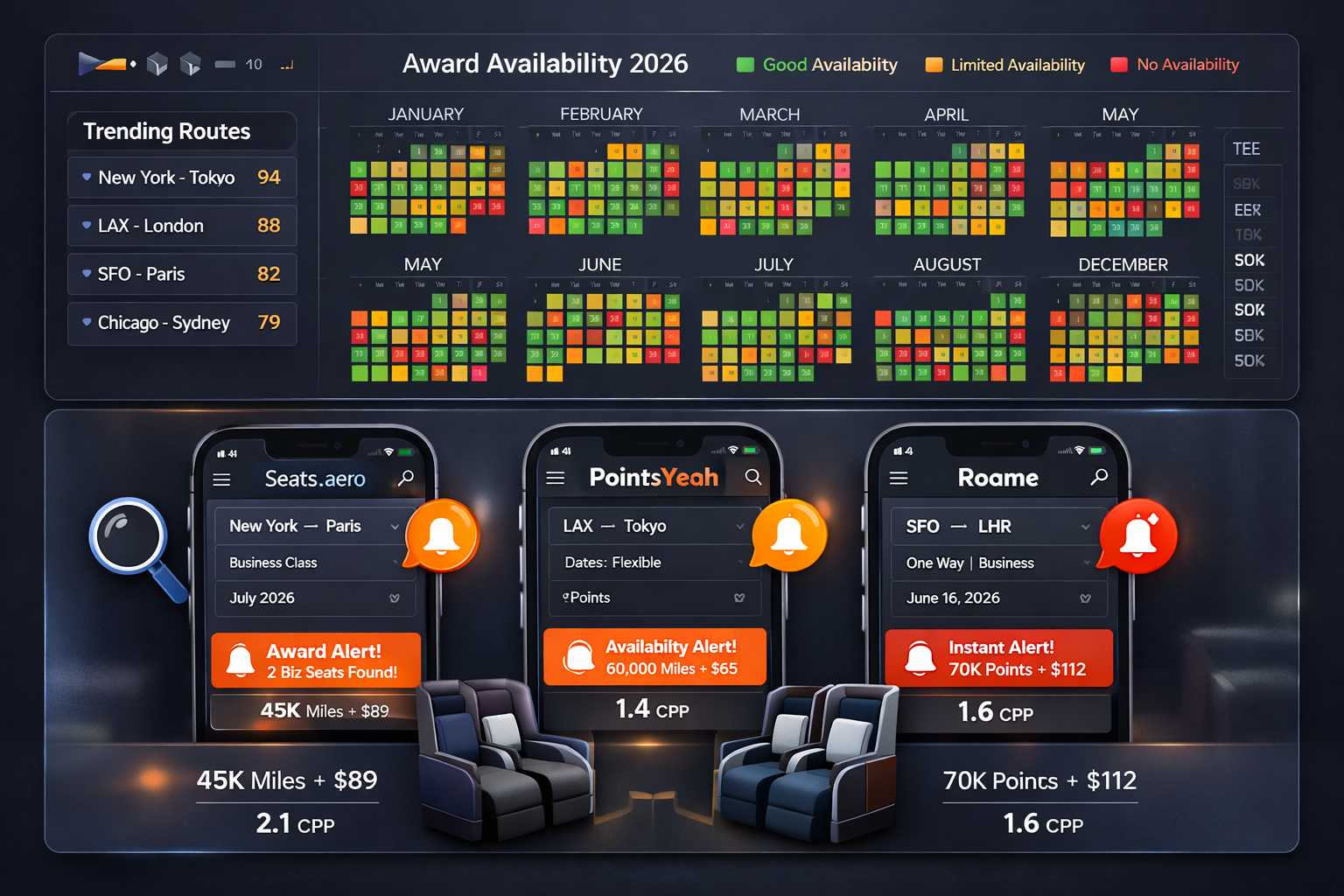
Seats.aero provides real-time award availability searching across multiple programs simultaneously. Instead of checking United, Air Canada, and Avianca separately for the same route, Seats.aero displays all available options in one interface. The platform’s alert system notifies users within minutes when space opens on specified routes.
PointsYeah specializes in complex multi-city searches and identifying hidden availability that doesn’t appear in standard searches. The tool excels at finding positioning flights and creative routings that maximize value.
Roame focuses on hotel award availability and provides alerts when aspirational properties release award space. For hotel programs with limited award inventory, this real-time notification is often the difference between securing a redemption and missing it entirely.
Alert strategy for 2026: Set up alerts 10-11 months before planned travel dates on multiple platforms. For popular routes and dates (summer Europe, holiday Asia travel), award space often fills within 24-48 hours of release. Without alerts, manual checking means missing most opportunities.
Booking windows matter more than ever. Each program releases space on its own schedule:
- Air Canada Aeroplan: 355 days (11.5 months)
- United MileagePlus: 337 days for United metal, 330 days for partners
- American AAdvantage: 331 days
- Alaska Mileage Plan: 330 days
For competitive routes, booking as early as possible – often before most travelers are searching—provides the best chance of securing space.
Real-world booking scenario: A member planning business class travel from the U.S. to Tokyo in August 2026 should:
- Set up alerts on Seats.aero for all Star Alliance and oneworld options 11 months out (September 2025)
- Check ANA, Air Canada, and United availability daily during the 355-330 day window
- Be ready to book immediately when space appears—often within 1-2 hours of release
- Have backup dates and routes prepared if first-choice options aren’t available
This systematic approach increases booking success rates from roughly 30% (manual checking) to 70%+ (automated alerts and immediate action).
Common mistakes to avoid:
- Waiting until 6-8 months before travel to start searching (most premium space is gone by then)
- Checking only one program instead of comparing across all transfer partner options
- Not setting up alerts and relying on periodic manual searches
- Failing to act immediately when alerts trigger (space often disappears within hours)
For members new to award search tools, understanding how award availability patterns work provides the foundation for effective searching and alert configuration.
Trend 3: Airline and Hotel Devaluations and How to Respond
Devaluation risk has escalated from an occasional concern to a constant reality in 2026. Major programs now implement changes with minimal notice, and the trend toward dynamic pricing eliminates the predictability that award charts once provided.
Recent devaluation patterns reveal the scope:
- United MileagePlus eliminated partner award charts in November 2024, moving to dynamic pricing that has increased costs 20-50% on popular routes
- American AAdvantage has implemented multiple “enhancements” that increased award costs to partner airlines, particularly for premium cabins
- Marriott Bonvoy continues annual category changes that move popular properties to higher categories (requiring more points)
- Hilton Honors has reduced the number of standard award nights available at popular properties
Dynamic pricing accelerates devaluation. When programs move from fixed award charts to dynamic pricing, they can adjust costs in real time based on demand, cash prices, and revenue-optimization algorithms. This means award costs can increase without any formal devaluation announcement—the program simply prices each redemption higher over time.
The devaluation response framework:
1. Diversify across multiple transfer partners. Never concentrate points in a single airline or hotel program. Maintain flexible currencies and spread transfers across 3-5 partners based on planned redemptions. This ensures that when one program devalues, alternatives remain available.
2. Book valuable redemptions quickly. When you identify a sweet spot—a route or property that offers exceptional value—book it immediately rather than waiting. Sweet spots rarely improve; they only disappear or devalue. Examples include:
- Air Canada Aeroplan: 70,000 points for business class to Europe (one of the best remaining Star Alliance values)
- Virgin Atlantic Flying Club: 50,000 points for Delta One to Europe (when space is available)
- Avianca LifeMiles: Consistently competitive pricing for Star Alliance partners with frequent transfer bonuses
3. Monitor program announcements and act during notice periods. Most programs provide 30-90 days notice before major changes. This window allows strategic bookings before devaluations take effect. Join program-specific communities and set up news alerts to catch announcements immediately.
4. Calculate cents per point (CPP) for every redemption. Understanding the actual value of each redemption allows comparison across programs and identification of poor values before transferring points. Use the formula:
CPP = (Cash price – Taxes/fees on award) ÷ Points required
Target minimum CPP values:
- Economy: 1.0-1.2 CPP
- Premium economy: 1.3-1.5 CPP
- Business class: 1.5-2.0+ CPP
- First class: 2.0-3.0+ CPP
Redemptions below these thresholds often indicate poor value or devalued programs.
5. Maintain awareness of under-the-radar alternatives. Smaller transfer partners often maintain better value longer because they attract less attention and booking volume. Programs like Turkish Miles&Smiles, Avianca LifeMiles, and Air France-KLM Flying Blue frequently offer better pricing than flagship programs.
Real-world devaluation response: When United eliminated partner award charts in November 2024, savvy members immediately:
- Transferred points to Air Canada Aeroplan for Star Alliance bookings (maintaining fixed pricing)
- Moved future Japan Airlines bookings to Alaska Mileage Plan (better value and fixed pricing)
- Shifted Lufthansa first class bookings to Avianca LifeMiles (lower surcharges)
This diversification maintained redemption value while United’s dynamic pricing increased costs for members who remained loyal to the program.
The role of airline fuel surcharges in devaluation: Some programs have increased surcharges on partner awards as an indirect form of devaluation. Understanding which programs and routes carry high surcharges helps avoid unexpected costs that reduce redemption value.
Trend 4: Shifting Sweet Spots and Under-the-Radar Partner Opportunities
As major programs devalue, identifying and exploiting sweet spots—redemptions that offer exceptional value relative to cash prices—becomes increasingly important. Many of the best sweet spots in 2026 exist with lesser-known transfer partners that most members overlook.
What defines a sweet spot: A redemption that delivers 2.0+ CPP consistently, offers fixed pricing (not dynamic), and provides access to premium cabins on competitive routes. Sweet spots typically exist due to:
- Outdated award charts that haven’t been adjusted for current cash prices
- Strategic partnerships where one program prices another airline’s flights generously
- Regional pricing that favors certain routes or destinations
Top sweet spots heading into 2026:
Air Canada Aeroplan for Star Alliance business class: Fixed pricing at 70,000 points one-way to Europe, 75,000 to the Middle East, and 85,000 to Asia represents some of the best remaining Star Alliance value. Aeroplan also allows free stopovers for just 5,000 additional points, effectively providing two trips for one redemption.
Virgin Atlantic Flying Club for Delta: When Delta releases partner space (limited but available), Virgin Atlantic prices Delta One business class to Europe at 50,000 points one-way—20,000-30,000 points less than Delta’s own pricing. This sweet spot requires patience and availability alerts but delivers exceptional value.
Avianca LifeMiles for Star Alliance: Competitive pricing across Star Alliance partners with frequent 30-50% transfer bonuses from multiple flexible currencies. Avianca prices Lufthansa business class to Europe at 63,000 miles with lower surcharges than United or Aeroplan. The program also allows free stopovers and doesn’t pass on some partner surcharges.
Alaska Mileage Plan for Japan Airlines: 60,000 miles for business class between the U.S. and Japan (one-way) with no fuel surcharges. This represents one of the best transpacific redemptions available and remains a fixed chart while other programs have moved to dynamic pricing.
Air France-KLM Flying Blue for Promo Rewards: Monthly Promo Rewards offer 25-50% discounts on specific routes. While the program uses dynamic pricing, Promo Rewards frequently deliver exceptional value—sometimes 40,000-50,000 points for business class to Europe when standard pricing would be 80,000+.
Turkish Miles&Smiles for Star Alliance: Often overlooked, but it offers some of the lowest redemption rates for Star Alliance business class. The United States to Europe starts at 45,000 miles in business class. The program has quirks (difficult website, limited transfer partners) but delivers value for members willing to navigate them.
How to identify new sweet spots:
- Monitor award chart changes across all transfer partners, not just major programs
- Join specialized communities where members share newly discovered sweet spots
- Test searches on lesser-known programs when planning redemptions—often reveal better pricing
- Track transfer bonus patterns, which often signal programs trying to attract more bookings (indicating available award space and competitive pricing)
Sweet spot longevity and booking urgency: Most sweet spots eventually devalue as programs notice high booking volumes or adjust to market conditions. The strategic approach is to book valuable sweet spots immediately when identified rather than waiting. Examples of sweet spots that have disappeared:
- Citi ThankYou to Singapore KrisFlyer: Once offered exceptional value; program eliminated as a transfer partner
- Chase Ultimate Rewards to Korean Air: Removed as a transfer partner, eliminating access to Korean’s generous award chart
- British Airways off-peak pricing: Eliminated in 2023, increasing costs 30-50% on many routes
Action items for exploiting sweet spots:
- Maintain transfer partner awareness across all five flexible currencies
- Set up searches on under-the-radar programs when planning redemptions
- Book immediately when you identify exceptional value—sweet spots rarely improve
- Share discoveries within trusted communities (while understanding that publicity can accelerate devaluation)
Understanding the full landscape of transfer partner options ensures you’re comparing all alternatives before committing points to any single program.
Trend 5: Dynamic Pricing Expansion Across Programs
The shift from fixed award charts to dynamic pricing represents perhaps the most significant structural change in award travel over the past three years. In 2026, dynamic pricing is no longer limited to Delta and United—it’s becoming the industry standard.
How dynamic pricing works: Instead of publishing a fixed award chart (e.g., 70,000 points for business class to Europe), programs price each flight individually based on:
- Cash ticket price (higher cash prices typically mean higher award costs)
- Demand (popular flights and dates cost more points)
- Inventory management (programs adjust pricing to optimize revenue)
- Competitive factors (sometimes)
This means the same route on the same airline can cost 60,000 points one day and 120,000 points the next, with no advance notice or explanation.
Programs that have implemented dynamic pricing:
- Delta SkyMiles: Fully dynamic since 2023
- United MileagePlus: Dynamic for own flights; eliminated partner charts November 2024
- JetBlue TrueBlue: Dynamic pricing model
- Southwest Rapid Rewards: Always been revenue-based (dynamic)
Programs moving toward dynamic pricing:
- American AAdvantage: Maintains charts but increasingly prices awards dynamically, especially for premium cabins
- British Airways Executive Club: Hybrid model with both fixed and dynamic elements
- Marriott Bonvoy: Peak/off-peak pricing is effectively dynamic pricing with broader windows
The strategic response to dynamic pricing:
1. Book further in advance. Dynamic pricing often starts lower when flights first become bookable (330+ days out) and increases as departure approaches and cash prices rise. This inverts the traditional strategy of booking closer to departure when award space might open up.
2. Compare across multiple programs. When one program uses dynamic pricing, comparing it with programs that use fixed charts often reveals significantly better value. Example: United might price business class to Europe at 120,000 miles dynamically, while Air Canada Aeroplan offers the same route for 70,000 points on a fixed chart.
3. Use flexible currencies exclusively. Dynamic pricing makes airline-specific points even riskier. With flexible points, you can compare dynamic pricing across multiple programs before transferring, ensuring you’re getting the best available value.
4. Monitor pricing trends. Some routes and dates consistently price lower than others, even within dynamic systems. Weekend departures, off-peak seasons, and less popular routes often offer better point values.
5. Calculate CPP religiously. With dynamic pricing, the only way to know whether a redemption offer is good value is to calculate the CPP and compare it with both cash prices and alternative programs.
Real-world dynamic pricing scenario: A member searching for business class from New York to London in July 2026 finds:
- United MileagePlus: 110,000 miles (dynamic pricing, varies by date)
- Air Canada Aeroplan: 70,000 points (fixed chart, same route)
- Virgin Atlantic: 50,000 points (sweet spot, limited availability)
Without comparing across programs, the member might transfer 110,000 points to United and complete the booking, losing 40,000-60,000 points of value compared to alternatives.
The future trajectory: Expect more programs to adopt dynamic pricing over the next 12-24 months. The strategic imperative is maintaining flexibility through transferable currencies and systematic comparison shopping before every redemption.
For members navigating these changes, understanding how to adapt your strategy to dynamic pricing environments is essential for maintaining redemption value.
Trend 6: Credit Card Perks Becoming More Valuable Than Points
An underappreciated trend in 2026 travel rewards strategies is the increasing value of credit card perks relative to points earning. As redemption values decline through devaluations and dynamic pricing, the ancillary benefits of premium travel cards have become more important to overall value propositions.
High-value perks that offset annual fees:
Airport lounge access: Premium cards like the American Express Platinum, Chase Sapphire Reserve, and Capital One Venture X provide Priority Pass, proprietary lounge access, and guest privileges. For frequent travelers, lounge access alone can deliver $500-1,000+ in annual value, effectively covering or exceeding annual fees. Recent lounge access policy changes have tightened some benefits, making it important to understand current access rules.
Annual travel credits: Most premium cards offer $200-300 in annual travel credits that offset specific purchases (airline fees, hotels, general travel). When used strategically, these credits provide guaranteed value regardless of points redemption opportunities.
Elite status benefits: Cards like the American Express Platinum provide automatic elite status with hotel programs (Marriott Gold, Hilton Gold) that deliver room upgrades, late checkout, and bonus points. For members who don’t travel enough to earn status through stays, this benefit provides significant value.
Travel insurance and protections, such as trip cancellation insurance, trip delay reimbursement, lost luggage coverage, and rental car insurance, can save thousands of dollars when needed. These protections are increasingly valuable as travel disruptions have become more common.
Purchase protections: Extended warranty, purchase protection, and return protection provide value on everyday purchases beyond travel.
The perks-first strategy for 2026:
- Calculate total perk value for each card annually, not just points earning potential
- Choose cards where perks alone justify the annual fee, treating points as bonus value
- Maximize credit usage by tracking credit reset dates and planning purchases accordingly
- Stack perks across multiple cards to maximize coverage (e.g., different cards for different trip components)
Example perk value calculation for Amex Platinum:
- Annual fee: $695
- Lounge access value: $600 (assuming 20 visits at $30 each)
- Hotel elite status: $300 (upgrades, late checkout, bonus points)
- Airline credit: $200
- Uber credits: $200 (if used)
- Digital entertainment credits: $240 (if used)
- Total potential value: $1,540
- Net value after fee: $845
Even if points earning is modest, the perks alone deliver positive value—and this calculation doesn’t include points earned on spending.
Best cards for perks-focused strategy in 2026:
- Premium travel cards: Amex Platinum, Chase Sapphire Reserve, Capital One Venture X for lounge access and travel protections
- Airline co-brand cards: For free checked bags, priority boarding, and companion passes
- Hotel co-brand cards: For automatic elite status and annual free night certificates
The strategic shift is viewing cards as comprehensive travel benefit platforms, not just points-earning tools. This perspective becomes more important as points themselves become harder to redeem at high values.
Trend 7: Increased Focus on Positioning and Routing Creativity
As direct award availability tightens and costs increase, creative routing and positioning flights have become essential skills for maximizing redemption value in 2026. The willingness to add complexity to itineraries often unlocks availability and value that direct bookings cannot match.
What positioning means: Flying from your home airport to a major hub on a separate ticket (often paid or low-cost award) to access better award availability or pricing from that hub. Example: Flying from Austin to New York on a paid ticket, then using points for New York to London in business class.
Why positioning works: Major hubs (New York, Los Angeles, San Francisco, Chicago, Houston, Washington DC) have significantly more premium cabin award space than secondary cities. Airlines prioritize award inventory on hub routes where they have more flights and need to fill seats.
Positioning strategy for 2026:
1. Identify your nearest major hubs and monitor award availability from those cities rather than only from your home airport.
2. Calculate the total cost, including positioning flights, when comparing redemptions. Sometimes a 50,000-point redemption from a hub plus a $200 positioning flight beats a 70,000-point redemption from home.
3. Use low-cost carriers for positioning when possible. Southwest, JetBlue, and ultra-low-cost carriers often offer $100-200 positioning flights that make hub departures economical.
4. Build in connection time of at least 3-4 hours when positioning on separate tickets. If the positioning flight is delayed and you miss the award flight, you’re responsible for rebooking.
Creative routing strategies:
Stopover exploitation: Programs like Air Canada Aeroplan and Avianca LifeMiles allow free or low-cost stopovers. This means you can book New York to Paris with a stopover in Reykjavik (Iceland) or London, effectively getting two trips for one redemption. The Aeroplan stopover benefit adds tremendous value when used strategically.
Open-jaw bookings: flying into one city and out of another (e.g., into Rome, out of Paris) often cost the same points as a round-trip but offer more flexibility and eliminate backtracking.
Positioning to sweet spot hubs: Some airports have exceptional award availability due to specific airline hubs or partnerships. Examples:
- San Francisco: United hub with strong Asia award space
- New York JFK: Multiple airline hubs with premium cabin space to Europe
- Los Angeles: Gateway to Asia with multiple carrier options
- Washington Dulles: United hub with good European availability
Mixed-cabin bookings: Booking economy for short segments and business class for long-haul portions often provides 80% of the comfort at 60% of the points cost. Example: Economy from Austin to Houston, business class from Houston to Tokyo.
Real-world routing example: A member in Nashville wants business class to Tokyo in summer 2026:
- Direct search: Nashville to Tokyo shows no business class award space on any dates
- Creative routing: Nashville to San Francisco (economy, 12,500 points), San Francisco to Tokyo (business class, 60,000 points via Alaska Mileage Plan on Japan Airlines)
- Total cost: 72,500 points plus one connection vs. no availability on direct routing
The creative routing adds 3 hours of travel time but makes the redemption possible.
Tools for creative routing: Award search platforms like PointsYeah excel at finding complex routings that standard searches miss. Investing time in learning these tools pays dividends when standard searches show no availability.
Common mistakes in positioning:
- Booking positioning flights on the same ticket as awards without adequate connection time
- Not calculating total cost (points + cash) when comparing positioned vs. direct redemptions
- Overlooking nearby airports that might offer better availability
- Failing to consider positioning to hubs in neighboring countries (e.g., Canadians positioning to U.S. hubs, Americans positioning to Canadian hubs)
Trend 8: Program Consolidation and Partnership Changes
The award travel landscape in 2026 is being reshaped by airline mergers, alliance shifts, and partnership changes, creating both opportunities and risks for points strategies. Staying ahead of these structural changes allows strategic positioning before opportunities disappear.
Recent and upcoming consolidation:
Alaska Airlines and Hawaiian Airlines merger: Completed in 2024, this merger created the Alaska-Hawaiian Atmos Rewards program. Key implications:
- Combined route network improves redemption options
- Potential future devaluations as programs integrate
- New sweet spots may emerge during the transition period
- Mileage Plan remains one of the best programs for Japan Airlines redemptions
Partnership additions and removals: Transfer partner changes significantly impact strategy. Recent examples:
- Bilt Rewards launched as a new flexible currency with unique transfer partners and rent payment earning
- Capital One added new partners, including Avianca LifeMiles and Wyndham
- Chase removed Korean Air as a transfer partner (eliminating access to that program)
Strategic response to consolidation:
1. Monitor merger announcements and book sweet spots immediately before integration changes pricing.
2. Diversify across alliances. Don’t concentrate points in a single alliance or partnership. Maintain options across Star Alliance, oneworld, and SkyTeam through different transfer partners.
3. Act quickly during transition periods. Program integrations often create temporary sweet spots or confusion that savvy members can exploit. The Alaska-Hawaiian merger, for example, created opportunities to book Hawaiian flights at Alaska’s lower pricing before full integration.
4. Track partnership announcements. When programs add new transfer partners or airline partnerships, early adopters often find better availability before booking volumes increase.
The alliance landscape in 2026:
Star Alliance remains the largest alliance with the most comprehensive global coverage. Key programs: United MileagePlus, Air Canada Aeroplan, Avianca LifeMiles, Turkish Miles&Smiles, Singapore KrisFlyer.
oneworld offers strong premium cabin products and some of the best remaining sweet spots. Key programs: American AAdvantage, British Airways Executive Club, Alaska Mileage Plan (partner but not member), Cathay Pacific Asia Miles.
SkyTeam has historically been undervalued but offers good availability and competitive pricing on many routes. Key programs: Air France-KLM Flying Blue, Virgin Atlantic Flying Club (partner with Delta).
Non-alliance partnerships are increasingly important. Airlines like JetBlue, Emirates, and others maintain partnerships outside traditional alliances, creating unique redemption opportunities.
2026 action items for partnership changes:
- Set up news alerts for merger and partnership announcements
- Join program-specific communities where changes are discussed in real-time
- Maintain at least one transfer partner in each major alliance
- Book valuable redemptions quickly when partnerships are announced (before devaluations)
- Review your transfer partner portfolio quarterly to ensure it still aligns with available partnerships
Understanding how airline alliances work provides the foundation for navigating partnership changes and identifying alternative redemption options when programs change.
How to Realign Your 2026 Credit Card and Earning Strategy
Translating these trends into a concrete earning strategy requires evaluating your current card portfolio and making strategic adjustments. The goal is to maximize flexible points earning while capturing high-value perks that offset annual fees.
The optimal 2026 card portfolio structure:
Tier 1: Flexible currency cards (2-3 cards)
Choose cards from different ecosystems to maximize transfer partner access:
- Chase ecosystem: Sapphire Preferred or Sapphire Reserve for Ultimate Rewards
- Amex ecosystem: Gold or Platinum for Membership Rewards
- Capital One ecosystem: Venture X for Miles
- Citi ecosystem: Premier for ThankYou Points
- Bilt ecosystem: Bilt Mastercard for rent payments and unique partners
Tier 2: Category bonus cards (2-3 cards)
Cards that earn high rates in specific categories, ideally within flexible currency ecosystems:
- Dining and grocery: Amex Gold (4x dining, 4x grocery)
- Travel: Chase Sapphire Reserve (3x travel) or Capital One Venture X (2x everything)
- Gas and transit: Amex Gold (3x transit)
- Rotating categories: Chase Freedom Flex or Discover it (5x rotating)
Tier 3: Specialized cards (0-2 cards)
Airline or hotel co-brand cards only if specific perks justify the annual fee:
- Airline cards: Only if you fly that airline enough to benefit from free checked bags, priority boarding, or companion passes
- Hotel cards: Only if annual free night certificates and elite status deliver value
The 2026 earning priority framework:
- 70%+ of spend should go to flexible currency cards
- 20-25% of spend to category bonus cards, where they earn more than flexible cards
- 5-10% of spend to specialized cards only for specific perks
Evaluating your current portfolio:
Step 1: Calculatethe actual value received from each card in 2025:
- Points earned × realistic redemption value (typically 1.5-2.0 CPP for flexible points)
- Perks used (lounge visits, credits, status benefits)
- Annual fee paid
Step 2: Identify underperforming cards:
- Cards where the annual fee exceeds the value received
- Airline/hotel cards that aren’t being used enough to justify keeping
- Cards with high fees but unused perks
Step 3: Make strategic changes:
- Downgrade premium cards to no-fee versions if not using perks (e.g., Sapphire Reserve to Freedom Unlimited)
- Cancel cards that provide no value (after ensuring it won’t significantly impact credit score)
- Apply for cards in flexible currency ecosystems where you have gaps
The application timing strategy:
- Chase cards first: Chase’s 5/24 rule (won’t approve if you’ve opened 5+ cards in 24 months) means Chase cards should be prioritized
- Space applications 2-3 months apart to minimize credit score impact
- Target high sign-up bonuses, which often provide 12-24 months of value in a single bonus
- Consider business cards, which often don’t count toward 5/24 and provide higher bonuses
Common portfolio mistakes in 2026:
- Holding multiple airline-specific cards that aren’t being used enough to justify fees
- Missing flexible currency ecosystems (e.g., only having Chase cards, not Amex)
- Paying annual fees on cards where perks aren’t being utilized
- Not taking advantage of business card opportunities that offer higher bonuses and don’t impact 5/24 status
The annual portfolio review process:
Set a calendar reminder each January to:
- Calculate the value received from each card in the previous year
- Review upcoming annual fees and decide keep/downgrade/cancel for each card
- Identify gaps in flexible currency coverage or category bonuses
- Plan new card applications for the year based on 5/24 status and goals
This systematic approach ensures your portfolio evolves with the changing award travel landscape rather than becoming stagnant with underperforming cards.
A 90-Day Action Plan to Future-Proof Your Points Strategy
Implementing these 2026 award travel trend insights requires a structured action plan. This 90-day framework outlines specific tasks to realign your strategy before the 2026 peak booking season.
Days 1-30: Assessment and Foundation
Week 1: Portfolio audit
- List all current credit cards with annual fees and next fee dates
- Calculate total points/miles balances across all programs
- Review 2025 redemptions and calculate the CPP achieved for each
- Identify which flexible currency ecosystems you’re currently earning in
- Calculate the actual value received from each card’s perks in 2025
Week 2: Tool setup
- Create accounts on Seats.aero, PointsYeah, and Roame
- Set up award alerts for your top 3-5 desired routes/destinations for 2026
- Join 2-3 points and miles communities for real-time information
- Set up Google Alerts for program changes and devaluation announcements
- Bookmark key resources, including transfer partner charts and award charts
Week 3: Transfer partner research
- Review all transfer partners available from your flexible currencies
- Identify 3-5 under-the-radar partners you haven’t used before
- Research sweet spots for your planned 2026 destinations
- Create a comparison spreadsheet of redemption costs across programs
- Subscribe to transfer bonus alert services
Week 4: Strategy documentation
- Document your top 3 travel goals for 2026 (destinations, cabin class, dates)
- Create a decision framework for which programs to use for each goal
- Identify backup options if first-choice programs don’t have availability
- Calculate total points needed for 2026 goals
- Determine the earning gap (points needed minus current balance)
Days 31-60: Optimization and Adjustment
Week 5: Card portfolio optimization
- Make keep/downgrade/cancel decisions for cards with upcoming annual fees
- Identify 1-2 new cards to apply for based on gaps in flexible currency coverage
- Plan application timing based on 5/24 status and bonus opportunities
- Set up category tracking to ensure spending goes to optimal cards
- Review and activate any quarterly bonus categories
Week 6: Earning acceleration
- Identify large purchases coming in the next 6 months that can be strategically timed
- Research shopping portal bonuses for planned purchases
- Set up dining program accounts (Amex Dining, Chase Dining) if not already active
- Review business spending opportunities if you have a side business
- Calculate how to close the earning gap identified in Week 4
Week 7: Advanced booking preparation
- Confirm exact dates you can book 2026 travel (330-355 days out)
- Set calendar reminders for when booking windows open
- Research positioning flight options for your home airport
- Identify which programs have the best availability for your routes
- Prepare backup date options in case first-choice dates aren’t available
Week 8: Risk mitigation
- Diversify points across at least 2 flexible currencies
- Avoid concentrating more than 40% of points in any single program
- Review cancellation and change policies for programs you plan to use
- Understand the risks and protections for your planned redemptions
- Set up account security (2FA) on all points accounts
Days 61-90: Execution and Monitoring
Week 9: First bookings
- Book any 2026 travel that’s already within booking windows
- Act on any award alerts that have triggered
- Transfer points for confirmed bookings (not before)
- Document redemption details and CPP achieved
- Set up monitoring for any waitlisted segments
Week 10: Ongoing optimization
- Review alert results and adjust search parameters if needed
- Monitor for transfer bonuses and act quickly when they appear
- Check for program devaluation announcements
- Adjust strategy based on what you’ve learned in the first 60 days
- Share knowledge and learn from community discoveries
Week 11: System refinement
- Evaluate which tools and alerts are providing the most value
- Adjust spending patterns to optimize category bonuses
- Review progress toward 2026 points goals
- Make any final card application decisions before peak travel season
- Document lessons learned for future reference
Week 12: Long-term planning
- Project points earning through the end of 2026
- Identify potential 2027 redemptions to start monitoring
- Set up quarterly review reminders
- Create a sustainable monitoring routine (15-30 minutes weekly)
- Celebrate progress and successful bookings
Ongoing monthly tasks (after day 90):
- Week 1: Review alert results and program announcements
- Week 2: Check transfer bonus opportunities
- Week 3: Evaluate card spending and category optimization
- Week 4: Plan next month’s strategy and adjustments
This structured approach transforms award travel trends from abstract concepts into concrete actions that protect and grow your points value throughout 2026.
Conclusion
The award travel trends 2026 landscape requires more active management than ever before. Devaluations, dynamic pricing, and tightened availability have eliminated the passive accumulation strategies that worked in previous years. However, members who adapt to these changes—prioritizing flexible currencies, using availability tools, exploiting sweet spots, and maintaining strategic card portfolios—can still extract exceptional value from points and miles.
The key insight is that flexibility has become the most valuable asset in award travel. Flexible points currencies, flexible travel dates, flexible routing, and flexible program choice all contribute to better redemptions and protection against devaluation. The members who thrive in 2026 will be those who maintain optionality at every decision point.
Your immediate next steps:
- Audit your current portfolio and calculate the actual value received from each card
- Set up award availability alerts for your top 2026 destinations
- Shift earnings toward flexible currencies if you’re currently concentrated in airline-specific programs
- Research transfer partners you haven’t used before to identify sweet spots
- Implement the 90-day action plan starting today
The award travel landscape will continue evolving throughout 2026. Programs will devalue, partnerships will change, and new opportunities will emerge. The framework provided here—flexible currencies, systematic searching, sweet-spot exploitation, and strategic card portfolios—provides the foundation for navigating these changes successfully.
For members willing to invest time in understanding the system and actively managing their strategy, 2026 can still deliver extraordinary travel experiences at a fraction of cash prices. The difference between success and frustration lies in adapting to the new reality rather than clinging to strategies that no longer work.
Start with one action today. Set up an alert. Research a transfer partner. Calculate the value of your current cards. Each step builds the knowledge and systems that separate members who consistently book aspirational travel from those who watch their points lose value.
The trends are clear. The action plan is defined. The only remaining variable is execution.


Content on Award Travel Hub is independently created by Award Travel Hub Editorial Desk and, where noted, reviewed by Award Travel Hub Review Desk. Some pages may contain affiliate links, but compensation does not determine our coverage, opinions, or methodology.