
Bank Transfer Partners:
Transferable Points Programs Directory

Last updated: July 30, 2026
Quick Answer
Bank transfer partners are the airline and hotel loyalty programs that accept incoming point or mile transfers from a transferable rewards program. Eligible members of programs such as American Express Membership Rewards, Chase Ultimate Rewards, Capital One Miles, Citi ThankYou Rewards, Wells Fargo Rewards, Bilt Rewards, and Rove can move balances into participating loyalty programs and then redeem for award flights or hotel stays. Eligibility, partner rosters, ratios, minimums, increments, processing times, fees, account requirements, and card requirements vary by program and can change, so verify the current terms in your own account before confirming any transfer.
Key Takeaways
- A transfer moves value in one direction only: transferable program points or miles go into an airline or hotel loyalty account, and completed loyalty-partner transfers should be treated as final.
- The seven programs covered in this directory are not all banks. Five are bank-issued rewards ecosystems, Bilt Rewards is a loyalty and payments platform, and Rove is an independent travel-rewards platform.
- Not every card issued by a bank earns transferable points, and earning methods differ across the seven programs.
- Ratios are not universally 1:1. They can vary by program, partner, card, account, or promotion, and a temporary bonus is not the same as the standard ratio.
- Points cannot be moved between different transferable programs, and name-matching or account-ownership rules limit who can receive a transfer.
- Confirm the exact award, the full point price, and the total taxes and fees with the airline or hotel program before transferring anything.
- Keeping rewards in a transferable program preserves flexibility, but it does not make them immune to change: partners, ratios, and card eligibility can all be revised.
- Use the ATH transfer partners table and the individual program pages for current rosters, ratios, timing estimates, and active bonuses rather than relying on static article text.

What are bank transfer partners in 2026?
Bank transfer partners are participating airline and hotel loyalty programs that a transferable rewards program can send points to on your behalf. In practice, you hold a balance in a flexible currency, find an award you want with the airline or hotel program, then move only the points needed to book that specific award.
Two clarifications matter before going further.
First, “bank transfer partners” is used two different ways online. In award travel, the phrase refers to rewards point transfers into loyalty programs. In consumer banking, the same phrase is often used for money movement between financial institutions (ACH, wires, and instant payment networks). This page covers the rewards meaning in depth and addresses the money movement meaning in a separate section near the end.
Second, a transferable currency is only useful when a redemption exists. Award seats and award-rate hotel rooms are inventory controlled by the loyalty program, not by the transferable program. A large points balance does not guarantee availability on your dates.
Who this page is for: U.S. travelers comparing flexible rewards ecosystems, deciding which program to concentrate spending in, or preparing for a first transfer. Who it is not for: readers looking for a live partner table (use the resource links below) or for one-off award pricing on a specific route.
Choose a transferable points program
Start with the program you already hold, or the one you are considering. Each page below covers eligibility, current partner access, ratios, minimums, timing, and program-specific rules in detail.
- American Express Membership Rewards Transfer Partners is a bank-issued rewards ecosystem tied to eligible American Express cards and accounts. See the program page for current partner access, ratios, and any applicable transfer fees or excise fee treatment.
- Chase Ultimate Rewards Transfer Partners is a bank-issued ecosystem in which transfer access depends on the specific Chase card or account you hold. The program page covers current partners, ratios, and the card-dependent treatment of certain hotel transfers.
- Capital One Miles Transfer Partners is a bank-issued rewards currency earned on eligible Capital One products. Transfer eligibility depends on the rewards product and current terms, which the program page details.
- Citi ThankYou Rewards Transfer Partners is a bank-issued ecosystem where partner access and ratios can differ by card and by partner. Check the program page before assuming your card can transfer.
- Wells Fargo Rewards Transfer Partners is a bank-issued rewards program whose partner lineup has expanded since transfers launched. The program page lists the current roster and eligibility requirements.
- Bilt Rewards Transfer Partners is a loyalty and payments platform rather than a bank rewards program. Bilt Points can be earned through eligible Bilt activities and products, and the program page covers current partners, ratios, and status-dependent transfer minimums.
- Rove Miles Transfer Partners is an independent travel-rewards platform, not a bank-issued credit card currency. Rove Miles are earned through eligible activity on Rove’s platform, and the program page explains current transfer partners and ratios.
This directory does not claim to list every transferable currency available to U.S. travelers. Other issuers and platforms also offer loyalty transfers, and rosters change.
Where to find current partners, ratios, transfer times, and bonuses
Program-level data changes too often to be trusted inside article prose. Use these ATH resources as the live reference layer.
- Credit Card Transfer Partners table: the current partner lineup, transfer ratios, estimated processing times, filters by program, and any active bonuses across all supported programs.
- Current and Historical Transfer Bonuses: which promotions are live now, plus the historical record for context. Never treat an expired offer as current.
- Award Travel Calculators: the Cents Per Point (CPP) Calculator and the Bank Points Transfer & Bonus Calculator for running your own numbers.
- Best Transferable Points Programs: a structured comparison for readers deciding where to concentrate earning.
- Comparing Transfer Partners: Chase vs. Amex vs. Citi vs. Capital One: a head-to-head look at overlap and differences among the four largest bank ecosystems.
- Airline program guides and alliance overviews help on the receiving side, where award charts, routing rules, and surcharges actually live.
Estimated timing in any table is an estimate, not a guarantee. Confirm against official program terms before a time-sensitive transfer.
Bank-issued versus nonbank transferable currencies
Five of the seven programs here are bank-issued rewards ecosystems (American Express Membership Rewards, Chase Ultimate Rewards, Capital One Miles, Citi ThankYou Rewards, and Wells Fargo Rewards). Bilt Rewards is a separate loyalty and payments platform. Rove is an independent travel-rewards platform. Calling all seven “banks” is inaccurate, and the distinction affects how you earn and who sets the rules.
Earning methods differ in ways worth knowing before you chase a balance:
- Bank rewards may be associated with eligible credit cards, but not every card an issuer offers earns transferable points.
- Some cards earn rewards that may only become transferable after being combined with an eligible account in the same ecosystem, subject to current terms.
- Bilt Points may be earned through eligible Bilt activities and products, which currently extend beyond rent to include eligible mortgage-related rewards and a broader card lineup.
- Rove Miles may be earned through eligible activity on Rove’s platform. A Rove credit card is not required for participation.
Decision rule: if your goal is a specific loyalty program, work backward from that program’s accepted sources rather than forward from the card you already carry. If your goal is general flexibility, prioritize the ecosystem whose partner access overlaps most with routes you actually fly.
How do loyalty partner transfers work, step by step?
The mechanics vary by program, so treat the sequence below as a general framework and follow your own program’s rules. The order matters more than any single step: confirm the redemption first, transfer second.
- Confirm that your rewards account is currently eligible for loyalty-partner transfers.
- Find the desired award directly with the airline or hotel loyalty program.
- Verify the complete mileage or point price, including all segments and passengers.
- Check taxes, carrier-imposed surcharges, resort fees, booking fees, change and cancellation rules, and passenger eligibility rules.
- Confirm the current transfer ratio, minimum, increment, and estimated processing time.
- Link or verify the loyalty account according to the transferable program’s rules.
- Review the loyalty account number and the displayed receiving amount on the confirmation screen.
- Transfer only after you have confirmed the redemption exists and is bookable.
- Book promptly once the points post.
Account ownership and name matching rules vary. Some programs restrict transfers to a loyalty account in the account holder’s own name; others allow specific linked or household arrangements. Do not assume a spouse, authorized user, friend, or unrelated third party can receive your points.
What “transfer” does not mean
The word gets used loosely. These are distinct actions with different rules:
- Transferring to a loyalty partner: moving points into an airline or hotel program, generally irreversible.
- Combining rewards within one issuer: consolidating balances between your own eligible accounts in the same ecosystem, where permitted.
- Sharing points with another member: a feature of some loyalty programs, often with fees or limits, and separate from issuer transfers.
- Booking through an issuer travel portal: redeeming at a set rate through the issuer’s booking site, with no loyalty transfer involved.
- Redeeming for cash, statement credit, purchases, or gift cards: a fixed-value exit, usually the floor of what your points are worth.
- Earning directly on a cobranded card: miles or points that land in the airline or hotel program and were never transferable to begin with.
Bank transfer partners comparison 2026: how to evaluate programs
Compare programs on eligibility and partner overlap with your own travel, not on partner counts. A large roster is irrelevant if none of the partners serve your home airport or your preferred hotel brand.
| What to compare | Why it matters | Where to verify |
|---|---|---|
| Account and card eligibility | Some products cannot transfer to partners at all | Program page and issuer terms |
| Partner overlap with your routes | Determines whether awards exist where you fly | ATH table plus airline program |
| Transfer ratios by partner | Changes how many points a booking costs | Confirmation screen in your account |
| Minimums and increments | Can force you to move more than you need | Program page |
| Processing time estimates | Affects exposure to losing award space | Program page and official terms |
| Fees or excise-style charges | Reduces net value of a transfer | Official program terms |
| Bonus eligibility and enrollment | Some promotions are targeted or require opt-in | Transfer bonuses page |
Does my program work with the same partners as another program? Sometimes. Popular partners appear in multiple ecosystems, while others are exclusive to one. Overlap is the reason the comparison page above exists, and it is the single most useful thing to check before opening a new card.
Can points move between two different transferable programs? No. There is no mechanism to convert Chase points into Amex points, or Bilt Points into Capital One Miles. Value moves outward into loyalty programs, not sideways between issuers.
Best program for frequent transfers: whichever ecosystem holds the partners you redeem with most often, at ratios and minimums you can work with, on cards you qualify for and will keep. There is no universally best program, and any ranking that ignores your routes is decoration.
Understanding transfer ratios, minimums, and increments
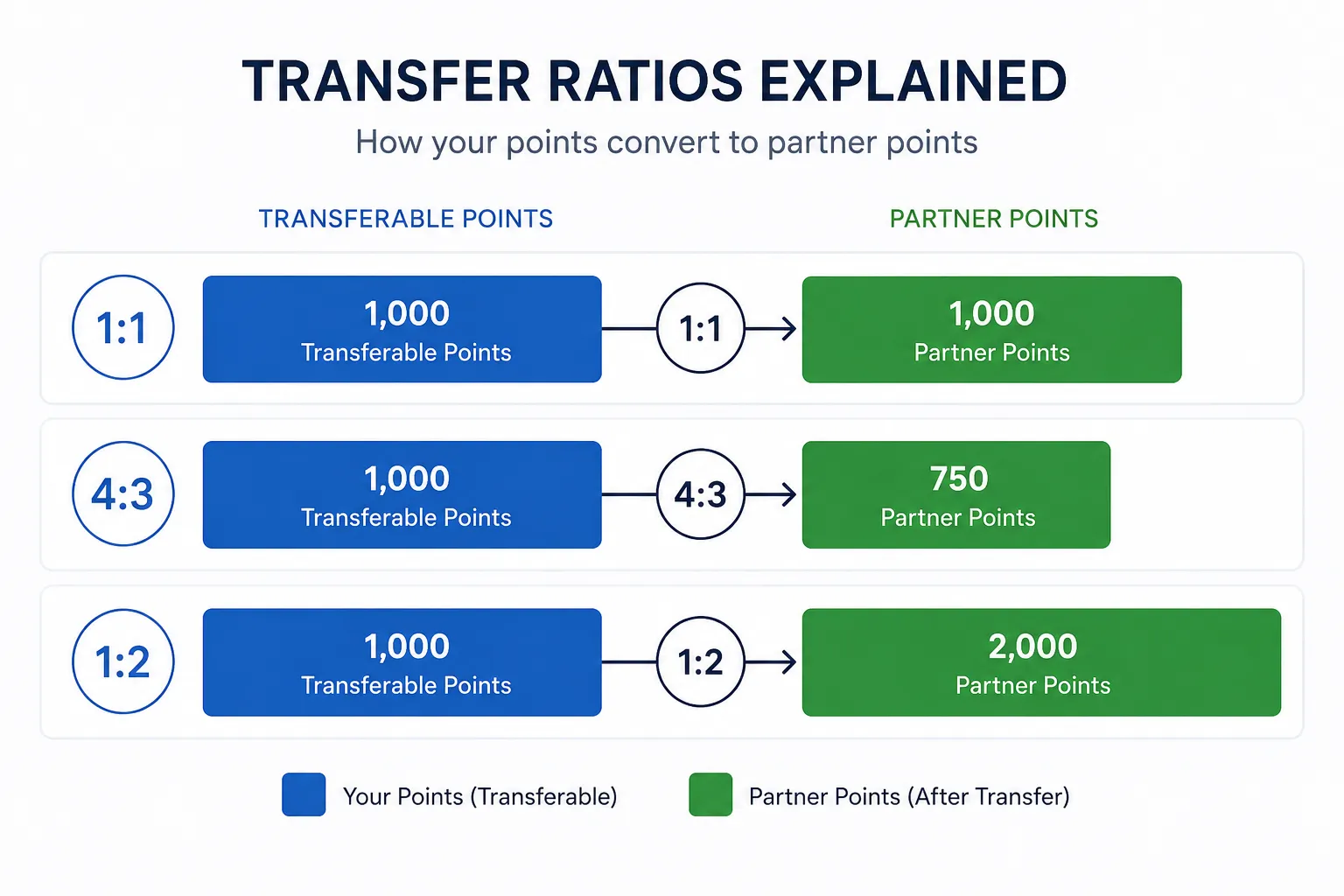
A ratio describes how many partner points you receive for the transferable points you send, always in that direction. Read it as transferable points to partner points.
- At 1:1, 1,000 transferable points become 1,000 partner points.
- At 4:3, 1,000 transferable points become 750 partner points.
- At 1:2, 1,000 transferable points become 2,000 partner points.
Four rules keep this from going wrong:
- Not every transfer uses 1:1. Assume nothing until the confirmation screen shows the receiving amount.
- Ratios may vary by program, partner, card, account, or promotion.
- Receiving more partner points does not automatically mean receiving more value. A 1:2 ratio into a program that charges triple the miles for the same seat is worse, not better.
- A temporary transfer bonus is not the standard ratio. When the promotion ends, the base ratio returns.
Minimums and increments also differ. Some programs transfer in blocks of 1,000, some allow smaller amounts, and some set minimums that vary by status tier. Two current examples worth checking on their own pages: Chase introduced card- and account-date-dependent Hyatt ratios in 2026, and Bilt lists non-1:1 ratios for Accor and I Prefer along with status-dependent minimums. Rove’s official guidance likewise distinguishes airline transfers from its ALL Accor ratio. See the Chase, Bilt, and Rove pages for current treatment.
Common mistake: rounding a transfer up “to be safe.” If you overshoot, the surplus is stuck in the loyalty program under that program’s expiration and redemption rules.
Transfer timing and award availability risk
Processing time is program-specific and partner-specific, so there is no reliable universal range. Some transfers appear almost immediately, some issuers publish a maximum processing window, and some partners routinely take longer than the typical estimate. A normally fast transfer can still be delayed.
Practical implications:
- Verify the applicable program page and current official terms before initiating a time-sensitive transfer.
- Do not transfer speculatively just because a transfer might take several days. If the award is not bookable now, the points may arrive to find nothing available, and they cannot be sent back.
- If the receiving loyalty program permits award holds, place the hold first, then transfer. Holds are program-specific and not universally offered.
- For itineraries with limited award seats, prefer partners where your program’s transfer posts quickly, or accept the risk knowingly.
Transfer taking too long: what to do
If points have not posted within the program’s stated window, work the process in order rather than transferring again.
- Check the loyalty program account directly, including any pending or recent activity view. Posting sometimes shows up there before it shows in the issuer’s transfer history.
- Confirm the loyalty account number and name on the transfer receipt against the account you expected to credit.
- Confirm whether the stated processing window has actually elapsed, counting business days where the program specifies them.
- Contact the sending program with the transfer confirmation details, then the receiving program if the sender shows the transfer as completed.
- Do not initiate a second transfer to “force” the first one through. Duplicate transfers create surplus balances you cannot reverse.
Edge case: transfers can be delayed when a loyalty account is newly created, when the name on the loyalty account does not match, or when either account is under a security or verification review. Resolve the account issue before assuming the points are lost.
How do transfer bonuses work?
A transfer bonus temporarily increases the number of partner points received for the same transferable points. Bonuses are promotional, and their structure varies more than most guides admit.
Bonuses can be:
- Issuer-funded or partner-funded
- Targeted to specific members or broadly available
- Card-dependent or status-dependent
- Conditional on enrollment or registration
- Applied immediately at transfer or posted separately afterward
- Structured differently from the standard ratio, including caps on bonused volume
Use bonuses to lower the cost of a redemption you were already going to make. Do not move points into a loyalty program solely to capture a promotion, because the transfer remains irreversible after the promotion ends. Check Current and Historical Transfer Bonuses for what is live, and confirm terms with the issuer before assuming eligibility.
Transferable points versus cash back and portal bookings
Transfers make sense when a confirmed award costs meaningfully fewer points than the fixed-value alternatives for a trip you would actually pay for. Cash back and portal bookings make sense when no suitable award exists, when flexibility matters more than efficiency, or when the cash fare is already cheap.
Use cents per point to compare, and calculate it honestly:
CPP = (comparable cash price minus unavoidable award taxes and fees) ÷ points used
Hypothetical example, for illustration only: a fare you would genuinely buy costs $900. The award costs 45,000 miles plus $60 in unavoidable taxes and fees. CPP = ($900 − $60) ÷ 45,000 = about 1.87 cents per point. Compare that figure to the fixed value your program pays for cash back or portal redemptions.
The comparison only works if the cash price is one you would realistically pay. Valuing a redemption against a premium cabin retail fare you would never purchase inflates the result and leads to bad decisions.
Two structural factors to include in the math:
- Surcharges and fees. Carrier-imposed surcharges on award tickets vary widely by airline and route, and hotel awards can still carry resort or destination fees. Compare total out-of-pocket costs, not points alone.
- Devaluation exposure. Points held in a transferable program are not tied to a single airline or hotel’s award pricing, which reduces concentration risk. That is not full protection: a transferable program can change partners, ratios, card eligibility, or redemption rules. Flexibility lowers exposure rather than eliminating it.
Pre-transfer checklist
Run this before every transfer, not just the first one.
- The award is confirmed bookable for your exact dates, cabin, and passenger count.
- The full point price and all taxes, surcharges, and fees are documented.
- Change and cancellation rules are understood, including whether points would be refundable.
- The receiving loyalty account is open, in good standing, and in the correct name.
- The loyalty account number on screen matches the account you intend to credit.
- The current ratio, minimum, and increment are confirmed in your account, not from an article.
- The displayed receiving amount matches your expectation.
- You are transferring only what the booking requires.
- You can book promptly once points post.
Skip the “test transfer” advice you may have read elsewhere. Minimums and increments differ by program, a separate test can delay the real transfer, and it can leave a stranded balance. Verifying the account number, name, ratio, minimum, and receiving amount accomplishes the same goal without the residue.
Common transfer mistakes
- Transferring before confirming award availability, then discovering nothing bookable exists.
- Assuming 1:1 and under-transferring or over-transferring as a result.
- Confusing a bonus ratio with the standard ratio and budgeting the wrong point total.
- Sending points to a loyalty account with a name mismatch.
- Assuming an authorized user, spouse, or friend can receive a transfer without checking the program’s rules.
- Ignoring carrier-imposed surcharges until the payment screen.
- Transferring the entire balance out of a flexible program in one move, eliminating future optionality.
- Relying on a table estimate for a same-day booking on a partner with slower processing.
- Expecting to reverse a transfer. Treat completed loyalty-partner transfers as final and irreversible.
Money movement between banks: the other meaning of “bank transfer partners”
Because the phrase is ambiguous, here are short, accurate answers to the banking questions readers often land on. These are general descriptions of U.S. payment infrastructure, not advice about any specific institution, and details vary by bank and credit union.
How do I send money between different banks, and can any two banks transfer?
Most consumer transfers between different U.S. institutions travel over the ACH network (external account transfers, direct deposit, bill pay), a domestic wire, or a person to person service. In practice, almost any two U.S. institutions can exchange funds, because ACH and wires have near universal reach. What varies is speed, cost, and limits.
Which banks support instant transfers, and what is the fastest option?
Instant availability depends on whether both the sending and receiving institution participate in the same real-time rail. The two U.S. real-time rails are the RTP network, launched by The Clearing House in 2017, and the FedNow Service, launched by the Federal Reserve in July 2023. Zelle, operated by Early Warning Services, offers fast person to person transfers among participating institutions. Participation lists change, so check your institution’s disclosures rather than assuming coverage.
Real time payments versus older transfer methods
Real-time payments settle within seconds, operate continuously, and are generally final once sent. Standard ACH settles in batches over one or more business days, with same-day ACH windows available for eligible payments. Domestic wires typically settle the same business day during banking hours and are also difficult to recall. The trade-off is straightforward: faster rails offer less room to undo a mistake, so verify the recipient before sending.
Which institutions are not part of transfer networks, and do credit unions participate?
Credit unions can and do participate in ACH, wires, Zelle, and the real-time rails, and many have joined FedNow and RTP. Participation is a per-institution decision rather than a charter-type rule, so some smaller banks and credit unions support receiving instant payments but not sending them, or support neither. Confirm with the institution directly.
Bank transfer fees in 2026
Fees vary by institution and method. ACH external transfers and person to person services are commonly free to consumers, though banks may charge for expedited delivery. Domestic and international wires typically carry sending fees, and receiving banks or intermediaries may deduct their own. Always read the current fee schedule for both accounts involved.
International bank transfer partners
Cross-border consumer transfers usually move through correspondent banking relationships and messaging standards such as SWIFT, or through licensed money transfer providers. Costs come from three places: the sending fee, intermediary or receiving charges, and the exchange rate margin. Compare the total amount that lands in the recipient’s account rather than the advertised fee alone.
A money transfer is taking too long
Confirm the cutoff time and expected settlement window for the method used, verify the account and routing numbers on the receipt, then contact the sending institution with the trace or confirmation number. For unauthorized electronic transfers from a consumer account, Regulation E provides error resolution rights, generally requiring notice within 60 days of the statement showing the error. Authorized payments sent to the wrong person are much harder to recover, which is why verification before sending matters more than remedies after.
FAQ
What are bank transfer partners?
They are the airline and hotel loyalty programs that accept incoming point or mile transfers from a transferable rewards program such as Amex Membership Rewards, Chase Ultimate Rewards, or Bilt Rewards.
Which transferable points programs does Award Travel Hub cover?
Seven: American Express Membership Rewards, Chase Ultimate Rewards, Capital One Miles, Citi ThankYou Rewards, Wells Fargo Rewards, Bilt Rewards, and Rove Miles. Other transferable currencies exist beyond this directory.
Are all seven programs banks?
No. Five are bank-issued rewards ecosystems. Bilt Rewards is a loyalty and payments platform, and Rove is an independent travel-rewards platform.
Is Rove a bank or credit card program?
Rove Miles is an independent travel-rewards platform. Rove Miles are earned through eligible activity on Rove’s platform, and a Rove credit card is not required to participate.
Can every credit card transfer points to partners?
No. Transfer access depends on the specific card, account, and current program terms. Some cards earn rewards that only become transferable after being combined with an eligible account in the same ecosystem.
Do all transfers use a 1:1 ratio?
No. Ratios vary by program, partner, card, account, and promotion. Confirm the receiving amount displayed in your account before you submit a transfer.
Can points be moved between different transferable programs?
No. There is no mechanism to convert one issuer’s transferable currency into another’s. Points move outward to loyalty partners only.
Can points be transferred to another person?
It depends on the program. Account-ownership and name-matching rules vary, and no program should be assumed to allow transfers to a spouse, authorized user, or third party without checking its current terms.
How long do point transfers take?
Timing is program and partner specific. Some post quickly, some fall under a published maximum processing window, and some take longer than usual estimates. Check the program page and official terms before a time-sensitive transfer.
Can a transfer be reversed?
Treat completed loyalty-partner transfers as final and irreversible. Do not plan around a cancellation window unless the exact program’s current official terms provide one.
Should a small test transfer be made first?
No. Minimums and increments differ, and a test can cause delay or leave a stranded balance. Verify the account number, name, ratio, minimum, and receiving amount instead.
Are transfer bonuses worth using?
They are worth using for a redemption you already intend to book. They are not a reason to move points speculatively, since the transfer stays irreversible after the promotion ends.
Do transferred points expire?
Once transferred, points follow the receiving loyalty program’s expiration and activity rules, which differ by program. Check the specific loyalty program’s current terms.
Is keeping points in a transferable program safer than transferring early?
Generally yes, because flexible balances are not tied to one airline or hotel’s award pricing. That reduces concentration risk without eliminating it, since transferable programs can also change partners, ratios, or eligibility.
Where can current partners, ratios, times, and active bonuses be found?
In the Credit Card Transfer Partners table, the transfer bonuses tracker, and the seven individual program pages linked in the directory above.
Next steps
Pick the program you actually hold and read its page in full:
- Amex Membership Rewards
- Chase Ultimate Rewards
- Capital One Miles
- Citi ThankYou Rewards
- Wells Fargo Rewards
- Bilt Rewards
- Rove Miles
Then check the receiving side in the airline program guides, and run your numbers with the Award Travel Calculators before you move a single point.


Content on Award Travel Hub is independently created by Award Travel Hub Editorial Desk and, where noted, reviewed by Award Travel Hub Review Desk. Some pages may contain affiliate links, but compensation does not determine our coverage, opinions, or methodology.