

Last updated: April 8, 2026
Capital One miles now transfer to Emirates Skywards at a 4:3 ratio instead of 1:1, meaning a business class award that previously cost 90,000 Capital One miles now requires 120,000. That’s a 33% increase in bank points for the exact same seat. The Capital One to Emirates devaluation, effective January 13, 2026, makes Capital One the worst-value transfer path to Emirates among all major U.S. points currencies. But Emirates business class is still bookable at reasonable rates if you use the right points source and, in some cases, skip Skywards entirely.
This guide breaks down the math across every bank, compares alternative booking paths through partners like Aeroplan and Qantas, and gives a clear decision framework for where to send your points in 2026.
Key Takeaways
- Capital One’s 4:3 ratio is the steepest Emirates devaluation among major transferable points programs. Amex and Citi are at 5:4 (20% loss); Capital One is now at a 25% loss.
- Bilt Rewards is the only remaining 1:1 transfer partner to Emirates Skywards from a U.S. bank points program.
- Chase has no Emirates transfer option at all after dropping the partnership in October 2025.
- A JFK–DXB business class award (90,000 Skywards miles) now costs 120,000 Capital One miles, 112,500 Amex points, 112,500 Citi points, or 90,000 Bilt points.
- Transfer bonuses can temporarily restore value, but don’t speculatively transfer—Emirates Skywards miles expire after 3 years with no way to extend them.
- Booking Emirates through Aeroplan or Qantas can sometimes cost fewer miles, but each path has its own trade-offs in surcharges and availability.
- Emirates now restricts First Class awards to Silver-tier Skywards members and above, affecting the calculus for top-cabin redemptions.
Quick Answer
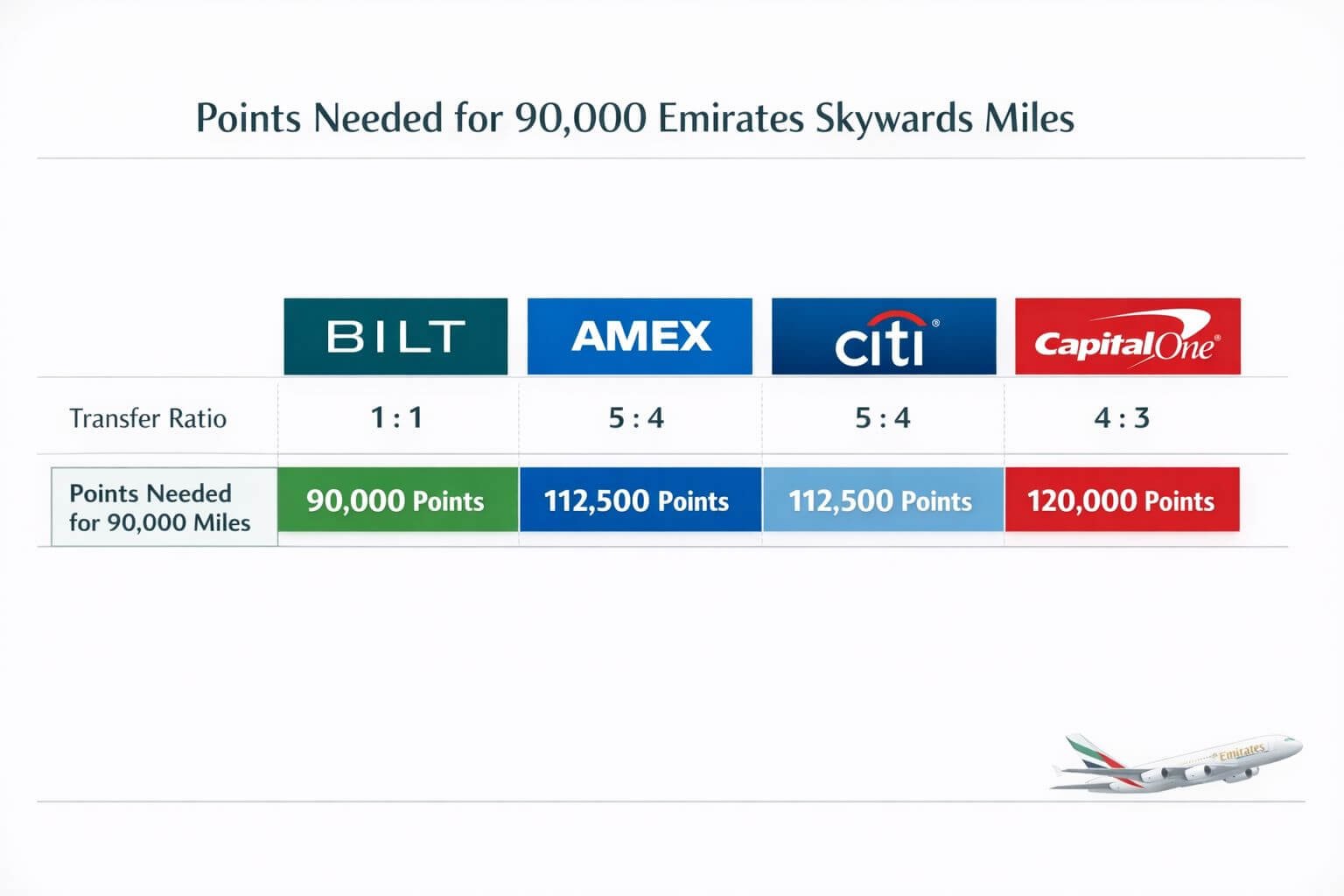
If you hold Capital One miles and want Emirates business class, the 4:3 transfer ratio means you’re paying a 33% premium in bank points compared to the old 1:1 rate. For most travelers, Bilt points are now the best direct path to Emirates Skywards, and booking through Air Canada Aeroplan or Qantas Frequent Flyer may offer better value depending on the route. Capital One miles are better directed toward other transfer partners where they still transfer 1:1.
What Exactly Changed With Capital One to Emirates in 2026
The core change: Starting January 13, 2026, every 1,000 Capital One miles transferred to Emirates Skywards yields only 750 Skywards miles instead of 1,000. That’s a 4:3 ratio, cutting the effective value of Capital One miles for Emirates redemptions by 25%.
This didn’t happen in isolation. Here’s the timeline of Emirates transfer partner erosion:
| Event | Date | Impact |
|---|---|---|
| Citi ThankYou moves to 5:4 ratio | July 2025 | 20% value loss |
| Amex Membership Rewards moves to 5:4 ratio | September 2025 | 20% value loss |
| Chase drops Emirates entirely | October 2025 | No transfer option |
| Capital One moves to 4:3 ratio | January 2026 | 25% value loss |
Why is this happening? Industry reporting from outlets such as One Mile at a Time and The Points Guy indicates that Emirates is demanding higher reimbursement rates from transfer partners. The airline treats Skywards as a profit center, not a loss-leader loyalty program. The result is that every U.S. bank except Bilt now transfers to Emirates at a discount.
For a deeper look at how transfer ratios across all banks compare, see our full comparison of Chase vs. Amex vs. Citi vs. Capital One transfer partners.
How the 4:3 Ratio Impacts Your Emirates Business Class Redemptions
The practical impact is straightforward: every Emirates award costs more Capital One miles than before. Here’s what that looks like across common routes.
Bank Points Needed for Emirates Business Class Awards (Post-Devaluation)
| Route | Skywards Miles Required | Bilt (1:1) | Amex (5:4) | Citi (5:4) | Capital One (4:3) |
|---|---|---|---|---|---|
| JFK–DXB (US to Dubai) | 90,000 | 90,000 | 112,500 | 112,500 | 120,000 |
| EWR–MXP (Fifth Freedom to Milan) | 72,500 | 72,500 | 90,625 | 90,625 | 96,667 |
| JFK–DXB–MLE (US to Maldives) | 127,500 | 127,500 | 159,375 | 159,375 | 170,000 |
| LAX–DXB (US West Coast to Dubai) | 90,000 | 90,000 | 112,500 | 112,500 | 120,000 |
You may be interested



Skywards miles figures are based on Emirates’ published award chart for Business Class. Bank points are calculated by dividing Skywards miles by the transfer ratio.
The JFK–MXP fifth freedom route is a useful benchmark. This was one of the best Emirates sweet spots: a short transatlantic flight on the A380 in business class. At the old 1:1 rate, 72,500 Capital One miles was a strong deal. At 4:3, you need roughly 96,667 Capital One miles—still decent, but the gap between Capital One and Bilt is now over 24,000 points.
What About Transfer Bonuses?
Transfer bonuses can temporarily offset the devaluation. Here’s how a hypothetical 25% Capital One-to-Emirates transfer bonus would change the math:
| Scenario | Capital One Miles for 90,000 Skywards |
|---|---|
| Old 1:1 ratio | 90,000 |
| New 4:3 ratio (no bonus) | 120,000 |
| 4:3 ratio + 25% transfer bonus | ~96,000 |
A 25% bonus on top of the 4:3 ratio effectively brings you close to the old 1:1 rate. But here’s the critical warning: Emirates Skywards miles expire 3 years after your birth month, and additional transfers do not reset the clock. Speculatively transferring Skywards miles during a bonus to “bank” them is risky. Only transfer when you have a specific booking in mind.
For guidance on when transfer bonuses are worth acting on, see our transfer bonus timing strategy guide.
Common mistake: Transferring Capital One miles to Emirates during a bonus promotion without a confirmed award seat in mind. If you can’t book within a reasonable window, those Skywards miles sit idle and eventually expire with no recourse.
Comparing Bilt, Amex, Citi, and Capital One for Emirates Awards
Bilt Rewards is now the clear winner for direct Emirates Skywards transfers. Here’s a side-by-side breakdown of each program’s position.
Bank-by-Bank Emirates Transfer Comparison (2026)
| Factor | Bilt | Amex | Citi | Capital One |
|---|---|---|---|---|
| Transfer ratio | 1:1 | 5:4 (1:0.8) | 5:4 (1:0.8) | 4:3 (1:0.75) |
| Effective CPP for JFK–DXB J* | ~3.3¢ | ~2.7¢ | ~2.7¢ | ~2.5¢ |
| Transfer speed | ~24–48 hrs | Instant–24 hrs | ~24–48 hrs | ~24–48 hrs |
| Bonus frequency | Rare | Occasional | Occasional | Occasional |
| Best alternative use | Hyatt, Turkish | ANA, Virgin Atlantic | Qatar, AA | Avianca, Turkish |
CPP estimate assumes a JFK–DXB business class cash fare of approximately $3,000 one-way. CPP = cash fare ÷ bank points transferred. This is illustrative; actual cash fares fluctuate.
Decision Framework: Which Bank Points to Use
- Use Bilt points if you have them. The 1:1 ratio makes Bilt the most efficient way to redeem for any Emirates Skywards reward. The main limitation is earning velocity—Bilt points accumulate more slowly than other currencies for most people.
- Use Amex or Citi points when Bilt isn’t available, and you need a direct Skywards transfer. The 5:4 ratio is a 20% hit, but still meaningfully better than Capital One’s 25% loss.
- Use Capital One miles only during a transfer bonus that brings the effective ratio close to 1:1, or when you’ve exhausted other options. Otherwise, Capital One miles deliver better value through partners like Avianca LifeMiles or Turkish Miles&Smiles.
- Chase points holders should skip Skywards entirely (no transfer option is available) and consider booking with Emirates through Aeroplan or other partner programs.
For a broader view of how to use each bank’s points most effectively, check our guide to booking Business Class with points.
When to Book Emirates Via Partners Like Aeroplan or Qantas Instead
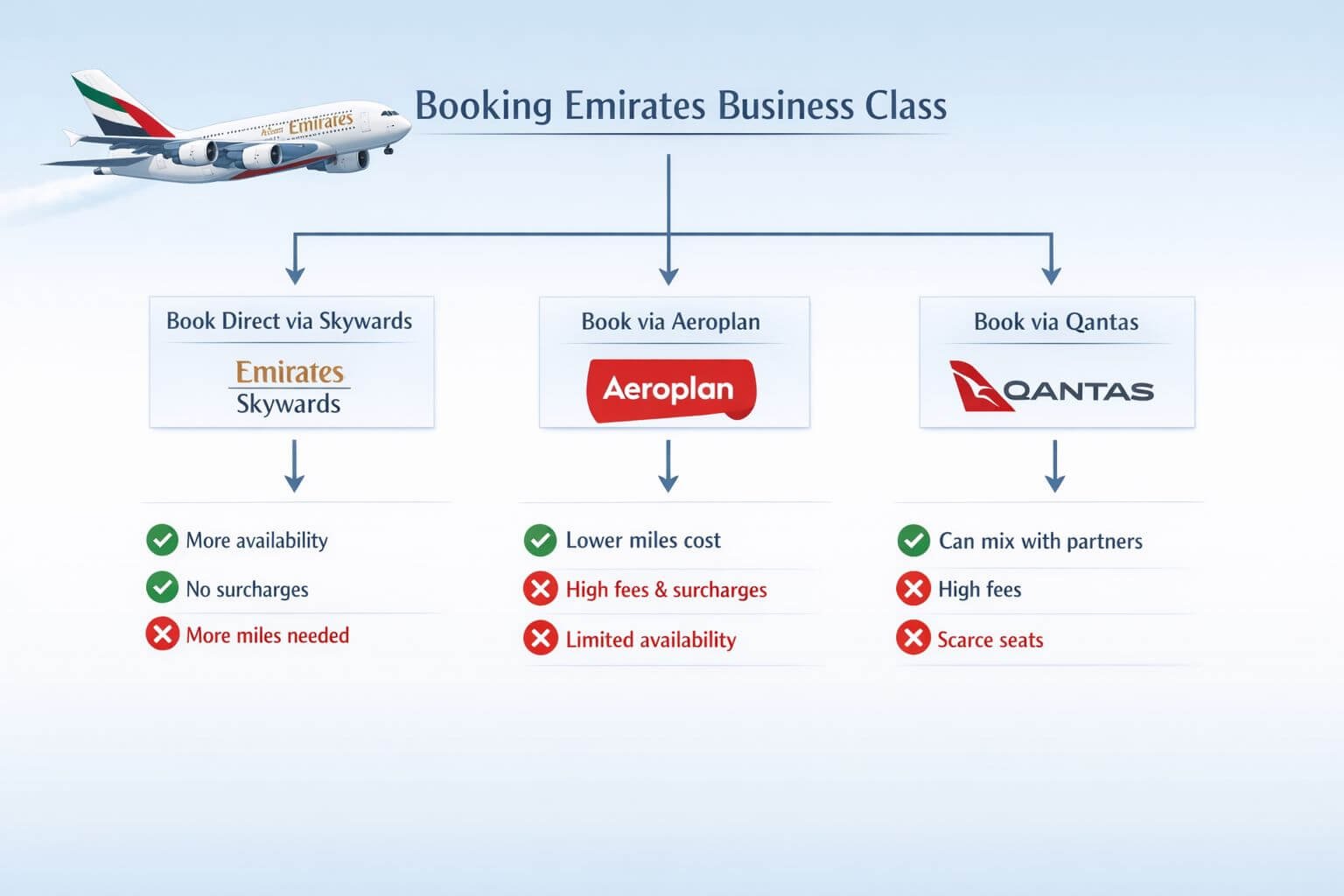
Booking Emirates metal through a partner frequent flyer program can sometimes cost fewer miles or avoid surcharges—but each path has trade-offs that have gotten worse in 2026.
Air Canada Aeroplan
Aeroplan has historically been a popular way to book Emirates flights, especially for Chase points holders who lack a direct transfer to Emirates. However, Aeroplan shifted to dynamic pricing for Emirates awards, which means the once-reliable fixed sweet spots are less reliable. On some dates, Aeroplan prices Emirates business class at 90,000–100,000 miles; on others, it can spike well above that.
Best for: Chase Ultimate Rewards holders who have no other path to Emirates. Also useful when Aeroplan runs transfer bonuses from Amex or Bilt.
Watch out for: Dynamic pricing can make Aeroplan more expensive than booking directly through Skywards. Always compare before transferring. See our Star Alliance award booking guide for tips on searching Aeroplan partner awards.
Qantas Frequent Flyer
Qantas has a dedicated Emirates award chart and is a transfer partner of several U.S. programs. But two recent changes complicate this path:
- Effective March 31, 2026, Qantas increased Emirates business class award costs by approximately 10% across most zones, with First Class up 20%.
- Effective February 18, 2026, only Qantas Silver members and above can book Emirates First Class awards. Bronze members lose access entirely.
Best for: Travelers with Qantas status who want access to Emirates routes not easily available through Skywards. Qantas also charges lower fuel surcharges on some Emirates routes compared to booking directly through Skywards.
Not ideal for: Casual bookers without Qantas status, especially for First Class. The 10% cost increase also narrows the value gap compared to Skywards.
JAL Mileage Bank
Japan Airlines’ program can book Emirates, but availability is extremely limited, and the program isn’t a transfer partner of any major U.S. bank. This is a niche option for people who earn JAL miles through flying or partner credit cards in Asia.
Partner Booking Comparison: JFK–DXB Business Class
| Program | Approximate Miles Required | Fuel Surcharges | Availability |
|---|---|---|---|
| Emirates Skywards | 90,000 | High ($200–$400+) | Best on own flights |
| Aeroplan (dynamic) | 90,000–130,000+ | Low–moderate | Variable |
| Qantas (post-March 2026) | ~99,000 | Moderate | Decent with status |
Edge case: The Emirates EWR–MXP fifth freedom route is often easier to book through Skywards directly than through partner programs, which may not show this route at all. Always check Skywards first for fifth freedom flights.
Action Plan: Where to Move Your Points for Emirates in 2026
Here’s a concrete decision tree based on which bank points you hold and what you’re trying to book.
Step-by-Step: Booking Emirates Business Class After the Capital One to Emirates Devaluation
Search for award availability on Emirates.com first. Log into your Skywards account and check specific dates. Emirates shows its own award inventory most accurately on its website.
Determine how many Skywards miles you need. Note the exact figure for your route and cabin.
Check if Bilt points can cover it. If yes, transfer from Bilt at 1:1. This is the most efficient path.
If Bilt falls short, check Amex or Citi. Both transfer at 5:4. Factor in the 20% premium and decide if the redemption still delivers good cents per point value.
Check for active transfer bonuses. A 20–30% bonus from Capital One, Amex, or Citi can significantly change the math. Our transfer bonus strategy guide tracks current promotions.
Consider Aeroplan for Chase points holders. Search Aeroplan’s site for Emirates availability. If the dynamic price is reasonable (under ~100,000 miles for JFK–DXB), this can work.
Redirect Capital One miles elsewhere. Without a bonus, Capital One miles are better spent on partners like Turkish Miles&Smiles, Avianca LifeMiles, or Virgin Atlantic Flying Club where they still transfer 1:1.
Common Pitfalls to Avoid
- Don’t speculatively transfer to Emirates Skywards. Miles expire after 3 years based on your birth month, and there’s no way to extend them through activity or additional transfers.
- Don’t ignore fuel surcharges. Emirates charges significant surcharges on award tickets ($200–$400+ on long-haul routes). Factor these into your total cost when calculating CPP.
- Don’t assume partner programs are always cheaper. Aeroplan’s dynamic pricing can exceed Skywards’ own chart. Always compare both before transferring.
- Don’t forget First Class restrictions. Emirates now requires Silver-tier Skywards status (or above) to book First Class awards. If you’re a base member, business class is your ceiling through Skywards.
For a broader framework on planning premium cabin trips with points in 2026, see our guide to planning aspirational trips when award space is tight.
Frequently Asked Questions
Is Capital One still worth using for Emirates bookings? Only during transfer bonuses of 25% or more, which effectively restore the ratio close to the old 1:1 rate. Without a bonus, other bank points deliver better value.
Which bank has the best transfer ratio to Emirates in 2026? Bilt Rewards at 1:1. It’s the only remaining U.S. transferable points program with a 1:1 transfer ratio to Emirates Skywards.
Can I book Emirates with Chase Ultimate Rewards? Not directly. Chase dropped Emirates as a transfer partner in October 2025. The workaround is to transfer Chase points to Air Canada Aeroplan and book Emirates as a partner award, though dynamic pricing applies.
Do Emirates Skywards miles expire? Yes. They expire 3 years after your birth month. Additional transfers or account activity do not reset the expiration clock.
How many miles does Emirates business class cost from the U.S. to Dubai? Emirates charges 90,000 Skywards miles one-way for business class from the U.S. to Dubai. The bank points needed vary: 90,000 Bilt, 112,500 Amex or Citi, or 120,000 Capital One.
Are Emirates fuel surcharges high? Yes. Expect $200–$400+ in surcharges and taxes on long-haul business class awards. This is higher than many competitors and should be factored into your total redemption value.
Can I still book Emirates First Class with points? Only if you hold Emirates Skywards Silver status or above. Base-level Skywards members lost access to First Class awards in May 2025.
Is booking Emirates through Aeroplan a good alternative? It depends on the dynamic price. On some dates, Aeroplan prices Emirates business class competitively (around 90,000–100,000 miles). On others, it can spike much higher. Always compare against Skywards directly.
Should I rush to transfer Capital One miles to Emirates before things get worse? No. Speculative transfers are risky because Skywards miles have a hard expiration date. Only transfer when you have confirmed availability and are ready to book.
What are the best alternative uses for Capital One miles in 2026? Turkish Miles&Smiles, Avianca LifeMiles, and Virgin Atlantic Flying Club all still transfer at 1:1 from Capital One and offer strong premium cabin sweet spots. See our Capital One transfer partners guide for details.
Will Emirates devalue Skywards further? No one can predict future devaluations with certainty, but the trend of Emirates demanding higher reimbursement from bank partners suggests further erosion is possible. Earning and burning Skywards miles promptly—rather than hoarding—is the safest approach.
Does a transfer bonus stack with the 4:3 ratio? Yes. A transfer bonus applies on top of the base ratio. For example, a 25% bonus on Capital One’s 4:3 ratio means 1,000 Capital One miles would yield approximately 938 Skywards miles (750 × 1.25), getting close to the old 1:1 effective rate.
Conclusion
The devaluation of Capital One to Emirates is a significant hit, but it doesn’t make Emirates business class unreachable with points. It does mean that, in most cases, Capital One is no longer the right currency for this particular redemption.
Here’s what to do now:
- Prioritize Bilt points for any Emirates Skywards transfer. It’s the last 1:1 option standing.
- Use Amex or Citi as a secondary source at 5:4, accepting the 20% premium when the redemption still delivers strong CPP.
- Redirect Capital One miles to partners where they transfer 1:1—Turkish, Avianca, and Virgin Atlantic all offer excellent premium cabin sweet spots.
- Monitor transfer bonuses closely. A 25%+ Capital One bonus temporarily restores the old economics.
- Compare Skywards against Aeroplan and Qantas for every booking. The best deal varies by route and date.
Emirates is making it more expensive to access its premium cabins with transferable points. The travelers who adapt their booking strategy across multiple programs will continue flying business class without overpaying. Those who default to a single transfer path will pay the price.
For a complete overview of how to match bank points to the right airline programs, start with our 2026 guide to booking Business Class with points.


Content on Award Travel Hub is independently created by Award Travel Hub Editorial Desk and, where noted, reviewed by Award Travel Hub Review Desk. Some pages may contain affiliate links, but compensation does not determine our coverage, opinions, or methodology.